Separate material behavior, manufacturing stage, and feature acceptance before choosing a ceramic machining route.
Why some ceramics are machinable depends on how their microstructure responds to a tool and whether machining occurs before or after final firing. Certain finished grades permit conventional cutting through controlled material removal, while dense structural ceramics commonly need abrasive processes to manage tool wear and damage. An unfired blank presents a different machining problem from the finished ceramic. Choose the route by material grade, processing state, geometry, and acceptance requirements; “not machinable” usually means unsuitable for the proposed cutting conditions, not impossible to shape.
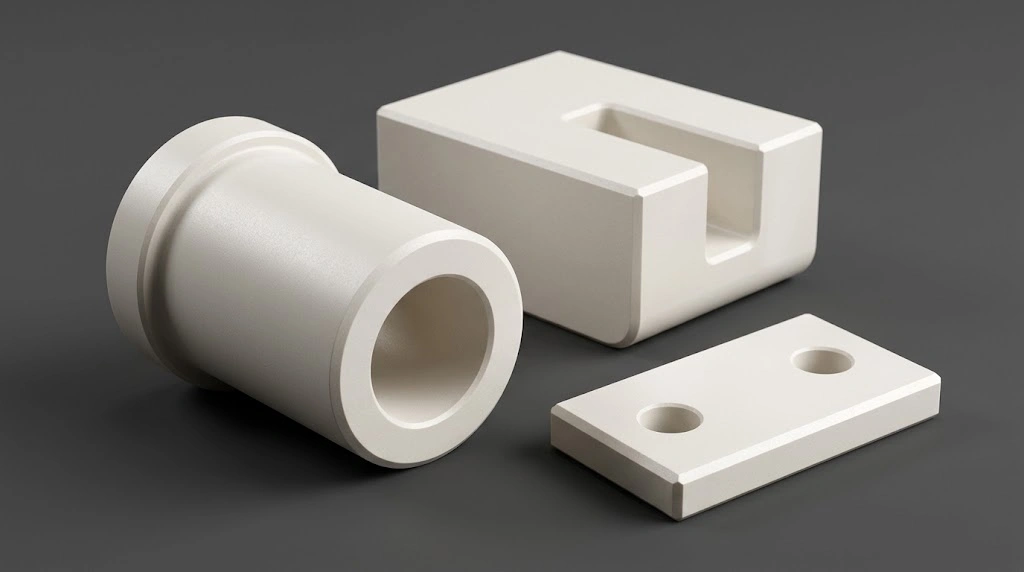
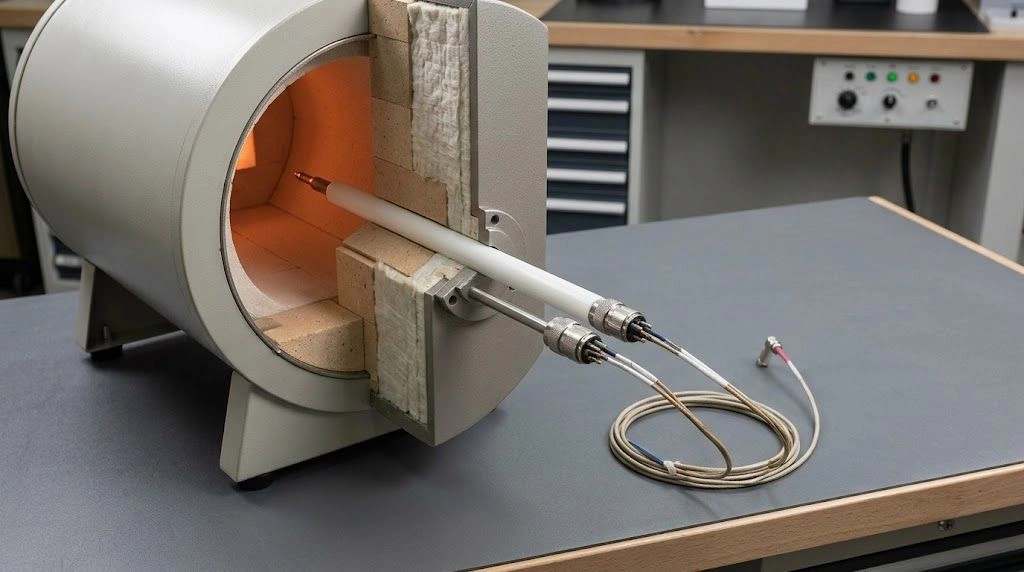
Holes, slots, and shoulders create different tooling and support questions; the component’s appearance does not identify the process that produced them.
What Does “Machinable” Mean for a Ceramic?
A ceramic machinability statement should identify the material, its processing state, the operation, and the required feature quality. In commercial usage, a machinable grade often means a finished material that permits turning, milling, or drilling with conventional cutting tools. Ceramic manufacturing also includes abrasive finishing and machining before final firing. These routes should not be treated as interchangeable. The question is whether a defined operation can produce the required geometry with acceptable edges, surfaces, and application performance.
Conventional Cutting, Abrasive Finishing, and CNC Control
Conventional cutting uses a shaped cutting edge to remove material. Grinding uses abrasive grains; polishing addresses another part of the finishing task. All can contribute to ceramic-part manufacture, but they impose different requirements on tooling, support, and feature access.
“CNC machined” describes computer-controlled motion, not a material-removal mechanism. A CNC machine may carry a milling cutter or an abrasive tool. The label alone does not establish that an ordinary end mill can cut a fully sintered ceramic blank.
Corning’s MACOR® is a commercial mica glass-ceramic example. Corning identifies conventional metalworking tools as suitable and states that subsequent firing is unnecessary after machining. Those characteristics belong to that material example; they are not a general property of every glass-ceramic.
Green, Partially Sintered, and Final-State Materials
Green machining shapes an unfired body. Machining a partially sintered blank occurs after some thermal processing but before the specified final state. Final-state machining acts on material that has already reached its intended ceramic condition.
An operation demonstrated on one state does not establish feasibility in another. A drilled blank that still needs firing may require dimensional allowances and a later inspection stage. A final-state blank may avoid that firing step but require a more demanding removal process.
Before comparing proposals, establish three items:
- The exact material grade and supplied state.
- The proposed cutting or finishing process.
- The acceptance requirements for the finished feature.
Why Do Microstructure and Processing State Change Machinability?
Microstructure changes how cracks initiate and travel around a cutting contact, while processing state changes the body being cut. In mica glass-ceramics, cleavage and crack redirection can support localized removal instead of extensive fracture. Green bodies are easier to shape for a different reason: their particles and processing additives have not developed the final dense structure. Dense alumina, zirconia, and silicon carbide therefore require a separate process assessment rather than assumptions borrowed from an easily machined unfired blank.
Cleavage and Crack Redirection in Mica Glass-Ceramics
Research on fluormica glass-ceramics describes preferential cracking along weakly bonded mica layers. The arrangement of mica crystals redirects cracks through the microstructure, helping limit catastrophic propagation during removal. Crystal morphology and the surrounding structure matter; a hardness value alone does not explain the response.
This behavior is not equivalent to a ductile metal producing a continuous chip. Controlled local fracture can support useful machining when removal remains confined and the resulting feature meets its requirements. The mechanism also does not mean that thin unsupported edges become immune to chipping.
Hexagonal Boron Nitride Needs Grade-Specific Review
Hot-pressed hexagonal boron nitride is another machinable ceramic family. Manufacturer descriptions identify machinable h-BN materials and composites, but those grades do not share one universal property set. Composition and the intended service conditions still need review.
Hexagonal boron nitride should not be confused with cubic boron nitride. The shared chemical formula does not justify transferring machining behavior between the two crystal forms. A quotation that says only “BN” leaves an important material question unresolved.
Green Machining Changes the Manufacturing Sequence
A green ceramic body is held together before final densification, commonly with processing additives contributing to its integrity. Material can be removed at this stage without cutting the final dense ceramic. Public ceramic-manufacturing descriptions distinguish this shaping stage from sintering and subsequent finishing.
Firing can change dimensions and shape, so a route based on green machining needs control of shrinkage, distortion, and finishing allowance. There is no single shrinkage percentage that can be applied to every ceramic formulation and process. Partially sintered blanks also need an identified remaining thermal cycle.
Dense Ceramics Need a Suitable Removal Process
Dense structural ceramics commonly use diamond grinding or other grade-appropriate abrasive processes. Tool access, support, and removal conditions become important when conventional cutting would cause unacceptable wear or damage. Zirconia’s fracture resistance does not automatically make it suitable for ordinary milling cutters.
Nor is ceramic removal always purely brittle: ductile-regime grinding can produce removal dominated by plastic flow under controlled conditions. This is a process-specific possibility, not a universal cutting-depth allowance or a reason to assume conventional machining will work.
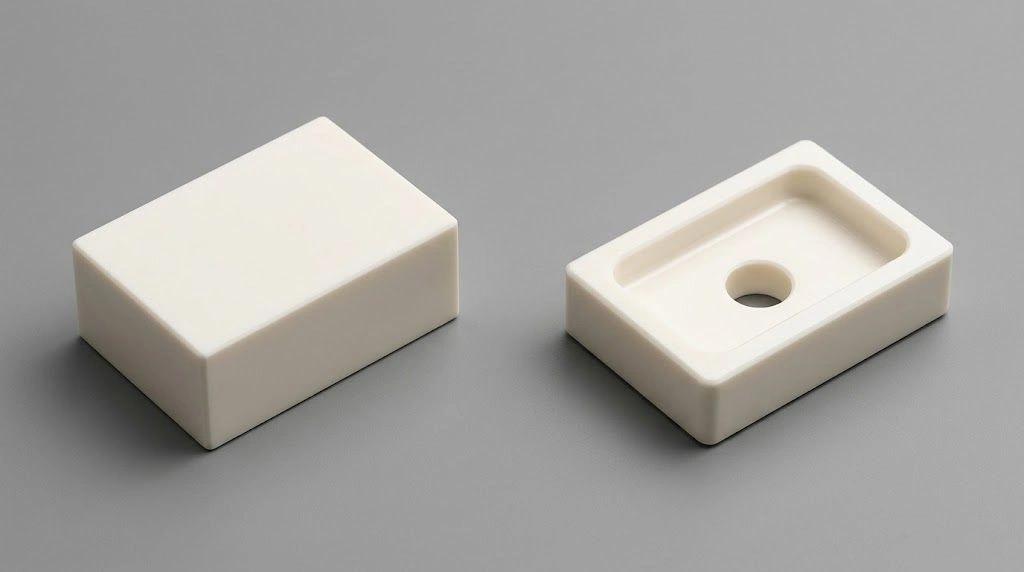
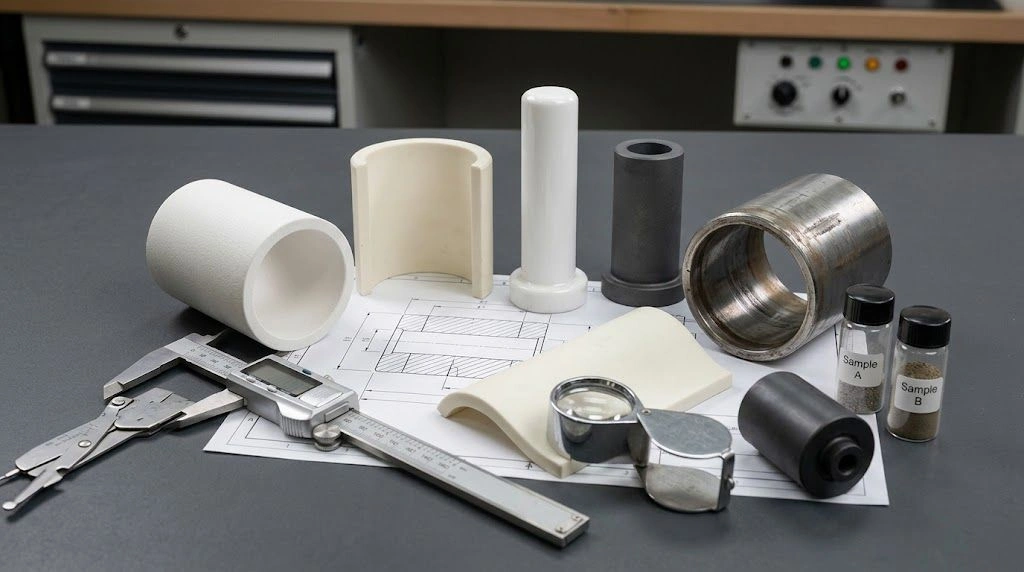
Stock shape and finished geometry define material-removal needs; the image does not establish whether either specimen is green, partially sintered, or fully fired.
Why Can a Smooth, Dimensionally Correct Part Still Need Further Evaluation?
A correct dimension verifies geometry, while surface texture, edge condition, and machining damage describe different attributes. Grinding conditions can affect the strength of finished ceramics, but machining damage is not inevitably the controlling flaw in every well-prepared part. A useful inspection plan identifies which attributes matter to the application and how they will be evaluated. Smooth appearance cannot establish the absence of subsurface cracks, and a roughness result alone cannot determine the residual strength of a component.
Dimensions and Surface Texture Answer Different Questions
A bore can meet its diameter requirement while the entrance edge needs separate acceptance. A flat mating face can satisfy a roughness limit without providing evidence about every flaw beneath the surface. These are different observations, so they should remain separate drawing or inspection fields.
NIST’s Machining Cracks in Finished Ceramics describes both possibilities: grinding damage can control strength, while well-prepared specimens and components may fail from inherent material flaws instead. The appropriate conclusion is to evaluate the relevant uncertainty, not to assume that every ground surface is damaged or that every polished surface is sound.
Edge Chipping and Subsurface Damage Need Different Evidence
In a hypothetical scientific-instrument fixture, a ceramic support block may have a chipped hole entrance after handling or manufacture. The visible chip identifies a location to investigate. Tool exit, local support, handling, and later processing are candidate questions, not proven causes from the photograph.
An image cannot rule out subsurface cracking. NIST’s silicon-nitride grinding study connects machining conditions with flaw characteristics in the specimens examined; it does not provide a universal damage size or acceptance limit for other grades and geometries.
A smooth surface and an acceptable dimension do not together constitute a complete surface-integrity assessment.
Match Verification to the Function
ASTM C1495-16(2023) evaluates how surface grinding affects flexure strength in its applicable context. Its planar-surface approach is not directly applicable to cylindrical or centerless grinding. It should not be copied into an RFQ as a universal finished-part inspection requirement.
ASTM C1322-25 addresses fractography and fracture-origin characterization. A visual inspection photograph is not equivalent to that investigation. Dimensional acceptance and machining-damage evaluation answer different questions, but not every component needs destructive strength testing: additional verification should address the function and the specific unresolved risk.
Should You Change the Ceramic or Change the Machining Route?
Choose the ceramic from the service requirements, then evaluate a route that can deliver the final drawing. A machinable final-state grade may be appropriate when its documented properties satisfy the application. If a dense structural ceramic is needed, shaping before sintering or finishing a suitable sintered blank may preserve that material choice. Substitution to an easier-cutting grade reopens material suitability; changing tooling or sequence reopens process feasibility. Neither change should remain hidden inside a quotation.
Start with the Operating Requirements
For an instrument insulator or positioning fixture, relevant requirements may include electrical behavior, temperature, contact loading, chemical exposure, and dimensional stability. Machinability helps determine how the part can be produced; it does not establish those service properties.
If a proposed machinable grade meets the service requirements, conventional cutting may be worth evaluating. If the selected alumina, zirconia, or silicon carbide grade is necessary for the application, machining difficulty is a reason to review the route before replacing the material.
| Starting condition | Candidate route | Proceed when | Resolve before quotation |
|---|---|---|---|
| A finished machinable grade meets service needs | Conventional cutting of the final-state blank | The grade and required features are supported | Blank availability and feature acceptance |
| A dense ceramic is required and the route is flexible | Forming or machining before sintering, followed by selected finishing | Final geometry can be controlled through the full process | Shrinkage, distortion, datums, finishing allowance |
| A suitable sintered blank is available | Abrasive machining and finishing | Access and material removal are feasible | Support, edge condition, inspection |
| Thin walls, deep features, or difficult internal geometry dominate | Joint design and process review | A workable geometry and sequence are agreed | Radii, access, support, alternative feature layouts |
| Existing parts show damage | Investigate process and handling history | Evidence supports a targeted corrective action | Damage location, inspection findings, acceptance criteria |
The routes are conditional manufacturing options, not guarantees that every grade or feature can be produced by the listed process.
Reserve Finishing for Features That Need It
When much of a shape can be formed or machined before firing, selected final features may still need post-sintering finishing. Datum surfaces, fits, and critical contact regions should be identified so the supplier can assess the sequence and allowance.
Avoid assigning the tightest tolerance or finest finish to every surface unless the function requires it. A supplier cannot judge a shallow clearance pocket and a precision locating bore from the same generic instruction to “finish all surfaces.”
Compare the Same Final Drawing
No route is automatically the lowest-cost choice. Blank availability, removal volume, tooling, inspection, quantity, and the consequences of rejection all affect the proposal. A meaningful comparison uses the same final supplied condition and acceptance requirements.
If one proposal ends before final firing and another includes grinding and final inspection, their prices cover different deliverables. Ask each supplier to identify the proposed sequence, exclusions, and any drawing changes needing agreement.
What Should You Include in a Ceramic Machining RFQ?
A ceramic machining RFQ should combine the controlled drawing with material, service, quantity, and acceptance information. The supplier needs to know which dimensions apply after all firing and finishing, which features are critical, and what inspection evidence is required. A process proposal should identify its material state, sequence, and assumptions. The resulting review can then distinguish material selection from manufacturing feasibility and prevent an intermediate blank or an easier-cutting substitute from being mistaken for the specified finished component.
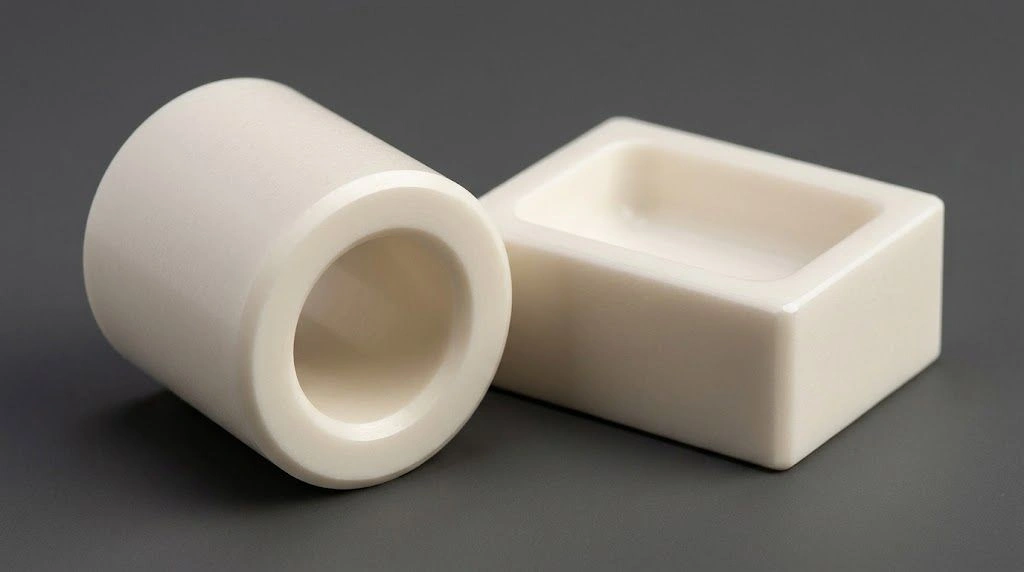
Bore entrances, internal radii, and mating faces need explicit drawing requirements; visible finish cannot prove dimensional compliance or subsurface integrity.
Material, Final State, and Quantity
- Drawing number and revision.
- Exact material grade, or operating conditions for material selection.
- Required final supplied condition.
- Prototype and production quantities.
- Relevant thermal, mechanical, electrical, or chemical conditions.
Feature and Inspection Requirements
- Critical dimensions and datum references.
- Hole, slot, thread, and internal-radius details.
- Edge and chamfer requirements.
- Surface texture requirements identified by surface.
- Required inspection records and application-specific verification.
- Final inspection stage after applicable firing and finishing.
Supplier-Proposed Route
- Material state at each machining stage.
- Proposed machining and finishing sequence.
- Shrinkage or finishing assumptions where applicable.
- Feature limitations, exclusions, and proposed drawing changes.
A supplier should distinguish confirmed feasibility from items that need a sample, a revised feature, or further application information. There is no cross-material minimum wall thickness, smallest hole, or universal machining tolerance that can replace this review.
For custom ceramic parts, the completed package gives engineering and procurement a common basis for comparing material and process proposals.
The following note can accompany the drawing:
All dimensions and tolerances apply to the final supplied condition. Identify the proposed material grade and manufacturing route. Confirm critical-feature feasibility, edge requirements, and inspection methods during drawing review. Document proposed deviations and obtain agreement before manufacture.
Share the drawing, intended material or operating conditions, quantities, and final acceptance requirements with ADCERAX at info@adcerax.com for a ceramic-part review. Include any proposed material substitution or unfinished blank so the review can address the complete manufacturing sequence.
FAQ
Can fully sintered ceramics be machined?
Yes. Fully sintered ceramics can be shaped or finished using suitable processes, commonly including abrasive machining. Some specially formulated grades also permit conventional cutting. Feasibility depends on the exact material, feature geometry, tooling, and acceptance requirements; the word “sintered” alone does not determine the route.
Why is MACOR machinable with conventional tools?
MACOR is Corning’s mica glass-ceramic designed for conventional machining. Mica cleavage and crack redirection help explain the machinability of this material family. Corning identifies MACOR as requiring no subsequent firing after machining, but that capability should not be generalized to every glass-ceramic or every feature geometry.
Is green machining the same as machining a finished ceramic?
No. Green machining shapes an unfired body before it develops its final ceramic structure. Later processing can change its dimensions and properties. Machining a finished ceramic acts on the final material state, so the tooling, allowances, and inspection plan may be different.
Should I choose the easiest ceramic to machine?
Choose a material that meets the operating requirements, then evaluate a practical manufacturing route. An easier-cutting grade may be suitable, but substitution requires checking its relevant properties. A more demanding machining process may be justified when the original material is needed for the application.