Geometry, end type, and wall trade-offs that decide furnace instrumentation RFQs
Furnace instrumentation RFQs fail most often when grade talk starts before geometry is locked. Lab tube furnaces, process furnaces, and sensor wells need alumina protection tubes that shield thermocouples, isolate atmospheres, or route heater leads without contaminating the sample or cracking under cycling. Metal sheaths oxidize or creep in oxidizing and reducing atmospheres; glass softens once soak enters the ceramic range. The variables that control first-article fit are end type, bore layout, wall thickness versus response time, and as-fired versus ground OD—not a purity nickname alone. This article resolves those gates in RFQ-ready language and routes grade confirmation to the live grade table and supplier [TDS: grade/temp] after the drawing is clear.
Alumina protection tubes for lab furnace instrumentation justify closed-end, multi-bore, or open-end geometries when sensor immersion, lead separation, or gas-path duty—not grade purity alone—defines the first selection gate. Closed-end single-bore wells fit immersion thermocouples; open-end tubes fit atmosphere or process flow paths; multi-bore tubes separate sensor or heater leads in one sheath. Wall thickness trades response speed against mechanical robustness. Confirm peak temperature and atmosphere against the supplier grade table and [TDS: grade/temp] only after OD, ID, length, and end style are fixed on the drawing.

Geometry First: End Type and Bore Layout Gate Selection
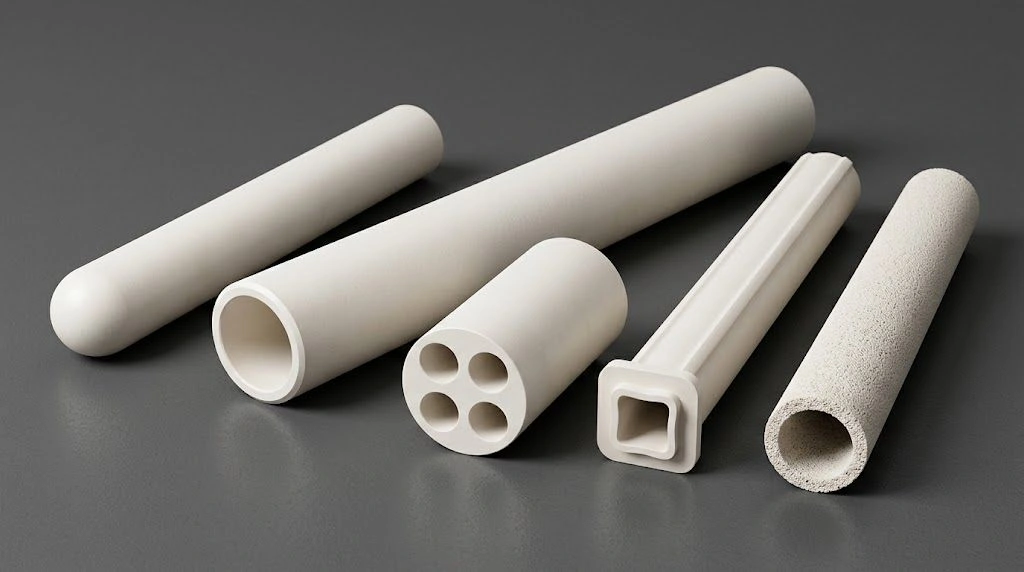
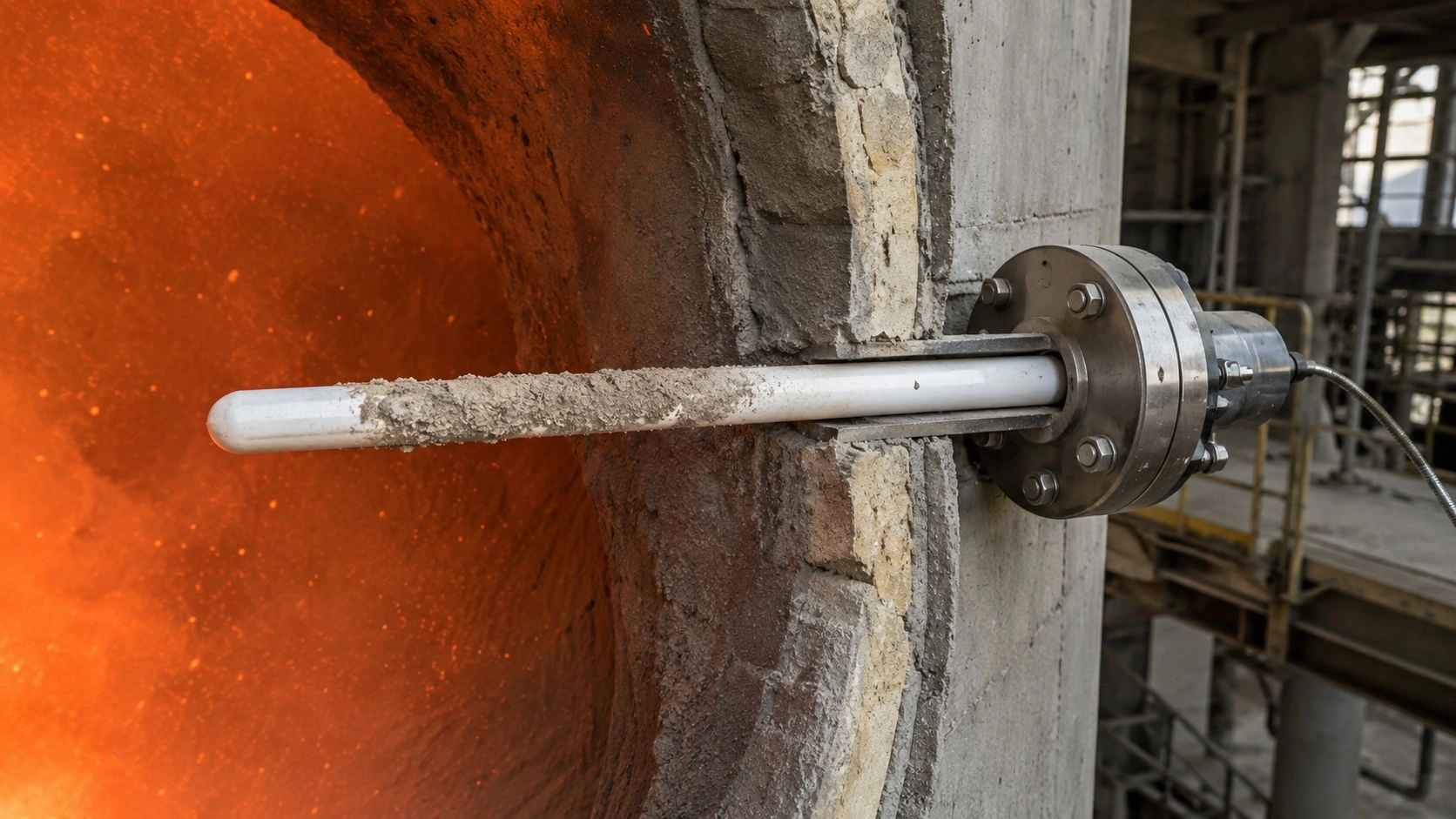
End type and bore layout gate alumina protection tube selection for furnace instrumentation before purity grade is discussed. Closed-end (one-end closed) single-bore tubes serve immersion thermocouple and sensor wells. Open-end tubes serve atmosphere isolation, gas sampling, and process flow paths that need seals at both ends or ports. Multi-bore alumina tubes carry separated sensor or heater leads when electrical isolation and packing density matter more than a single large bore. Quoting a high-purity grade before end style and bore count are fixed is the usual source of flange, bung, and probe rework.
For a scannable OD and end-geometry path before grade lock, use the alumina tube decision matrix as a parallel check—then return to the drawing fields below.
| Need | Typical tube form | Decision direction |
|---|---|---|
| Immersion thermocouple / sensor well | Closed-end, single bore | Prefer one-end closed; call tip radius / flat on drawing |
| Atmosphere or gas sampling path | Open-end, sized for flow and seal | Prefer open ends; state seal land and leak-check need |
| Separated sensor or heater leads | Multi-bore sheath | Prefer multi-bore; state bore count, bore diameter, and pitch |
| Insulation / lead routing only | Single-bore open or closed as fit requires | Choose end style from fit, not from grade nickname |
Put exact OD, ID, length, and wall on the drawing. Thin-wall long tubes still need engineering review for straightness and firing risk. A typical scenario engineers in lab tube-furnace thermocouple-well specification review encounter is a probe that fits the ID on paper but binds at a closed tip radius that was never drawn.
Closed-end geometry is a thermal and mechanical design choice—not a grade upgrade. Naming a purity grade does not fix a missing tip radius or an open end used as a well.
In practice: if your duty is immersion sensing with a single thermocouple, lock closed-end single-bore before any purity discussion. Default to a closed-end, single-bore tube for immersion thermocouple protection; use multi-bore only when leads must be separated, and use open-end when a gas path or through-tube is required—do not choose multi-bore for a simple single-thermocouple immersion.


Closed-end, open-end, and multi-bore layouts make the form-factor gate visible before any purity nickname enters the RFQ.
Selection Criteria: Wall, Tolerance, and Atmosphere Before Grade
Selection criteria for alumina thermocouple protection tubes should rank wall thickness, tolerance class, and atmosphere envelope ahead of grade nickname. Wall thickness controls thermocouple response versus mechanical robustness. As-fired versus ground OD/ID controls seal and slip-fit cost. Atmosphere and qualitative peak-temperature band control which grade family the supplier may propose—confirmed later on alumina tube grade properties and supplier [TDS: grade/temp], not invented in the RFQ narrative.
The table below is the decision core for pre-RFQ specification. Hard ceilings stay on the live grade table and Rev13 TDS; this article keeps selection logic.
| Criterion | Threshold / range | Decision direction |
|---|---|---|
| End type | Closed vs open vs multi-bore | Fix form factor before grade shortlist |
| Wall thickness | Thin-wall vs thick-wall trade-off (drawing value) | Thin favors response; thick favors robustness and path length |
| OD / ID / length | Exact values on drawing or old-part photo | Long/thin combinations need engineering review |
| OD/ID tolerance class | As-fired vs ground | Ground when seal lands or probe slip fits demand it |
| Atmosphere + peak band | Oxidizing / inert / mildly reducing + qualitative peak | Map to live grade table / [TDS: grade/temp] after geometry lock |
| Thermal cycling | Soak-only vs frequent door cycles | Cycling raises thermal-shock risk; soak stresses creep/chemistry differently |
| Cleanliness / porosity intent | Gas-tight well vs sampling path vs insulation-only | State intent on RFQ; density confirmation waits for grade pick |

The decision path starts at end type and bore layout, then wall and tolerance class, then grade mapping via the page grade table and [TDS: grade/temp].
Grade is over-prioritized relative to end geometry on most furnace-instrumentation RFQs. After geometry is locked, map atmosphere and peak-temperature band to the live alumina tube grade properties table and confirm service limits on supplier [TDS: grade/temp]—do not paste legacy purity lists or display temperature bands into the RFQ body. Higher-purity, denser stock suits clean atmospheres and tight contamination budgets; standard grades remain acceptable when contamination risk is low and availability dominates. Do not default every instrumentation order to the highest purity nickname.
The most common diagnostic error in furnace instrumentation RFQs is reading a purity nickname as a complete specification while omitting atmosphere, end type, and as-fired versus ground callouts. Quotes then diverge because vendors fill different assumptions.
In a process-furnace gas-sampling tube pre-RFQ specification check, the practical check is whether the open-end seal land and leak-test expectation are written before any grade shortlist is circulated.
Thermocouple Response vs Mechanical Robustness Trade-offs
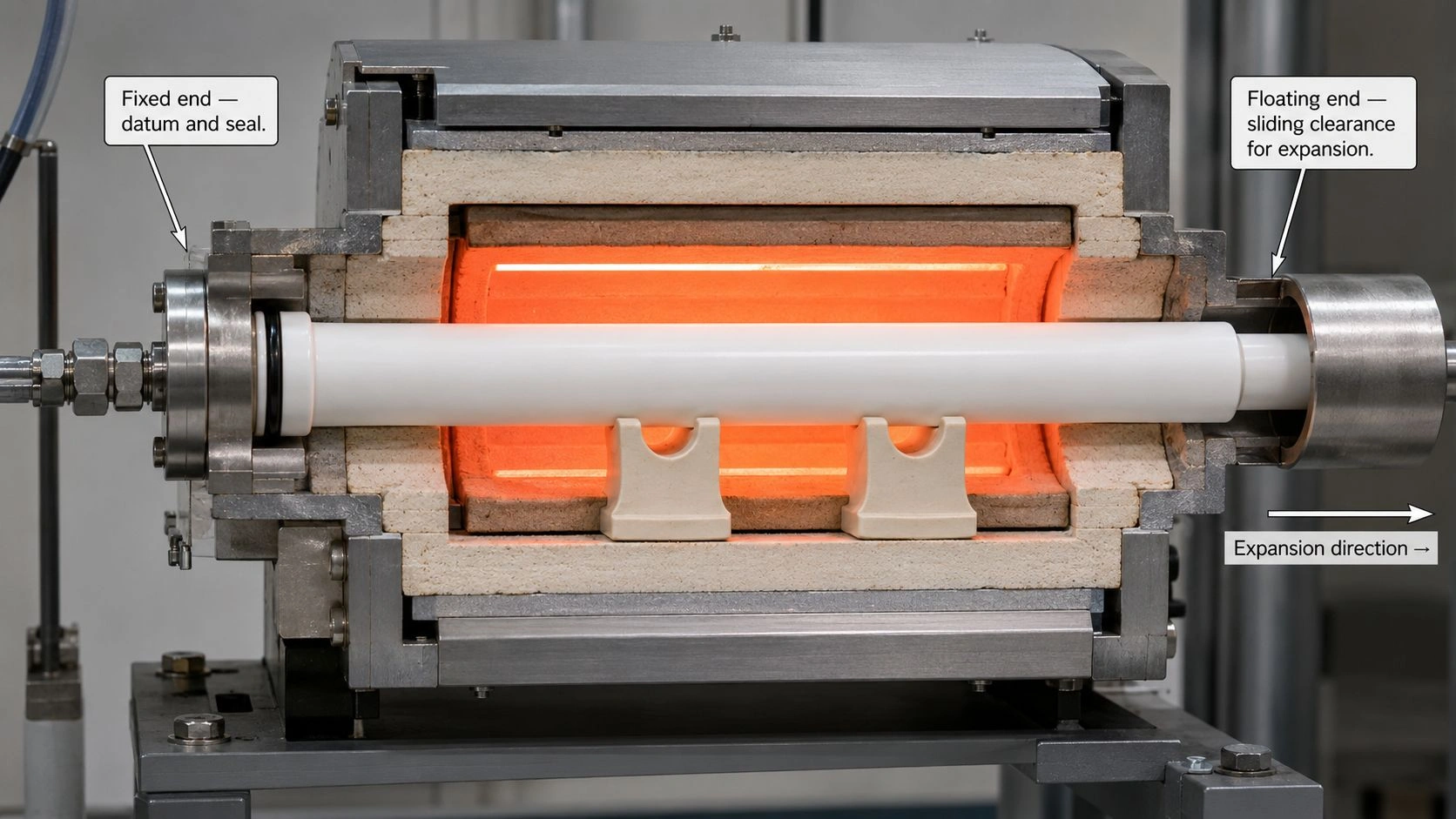
Wall thickness on alumina protection tubes trades thermocouple response time against mechanical robustness and gas-path length under furnace duty. Thinner walls reduce thermal mass between the process and the junction, which shortens lag on temperature steps. Thicker walls raise fracture resistance at ports, improve handling survival, and lengthen the diffusion path for aggressive atmospheres. Neither extreme is universally better; the correct wall follows the sensor lag budget and the mechanical envelope of the flange or bung.
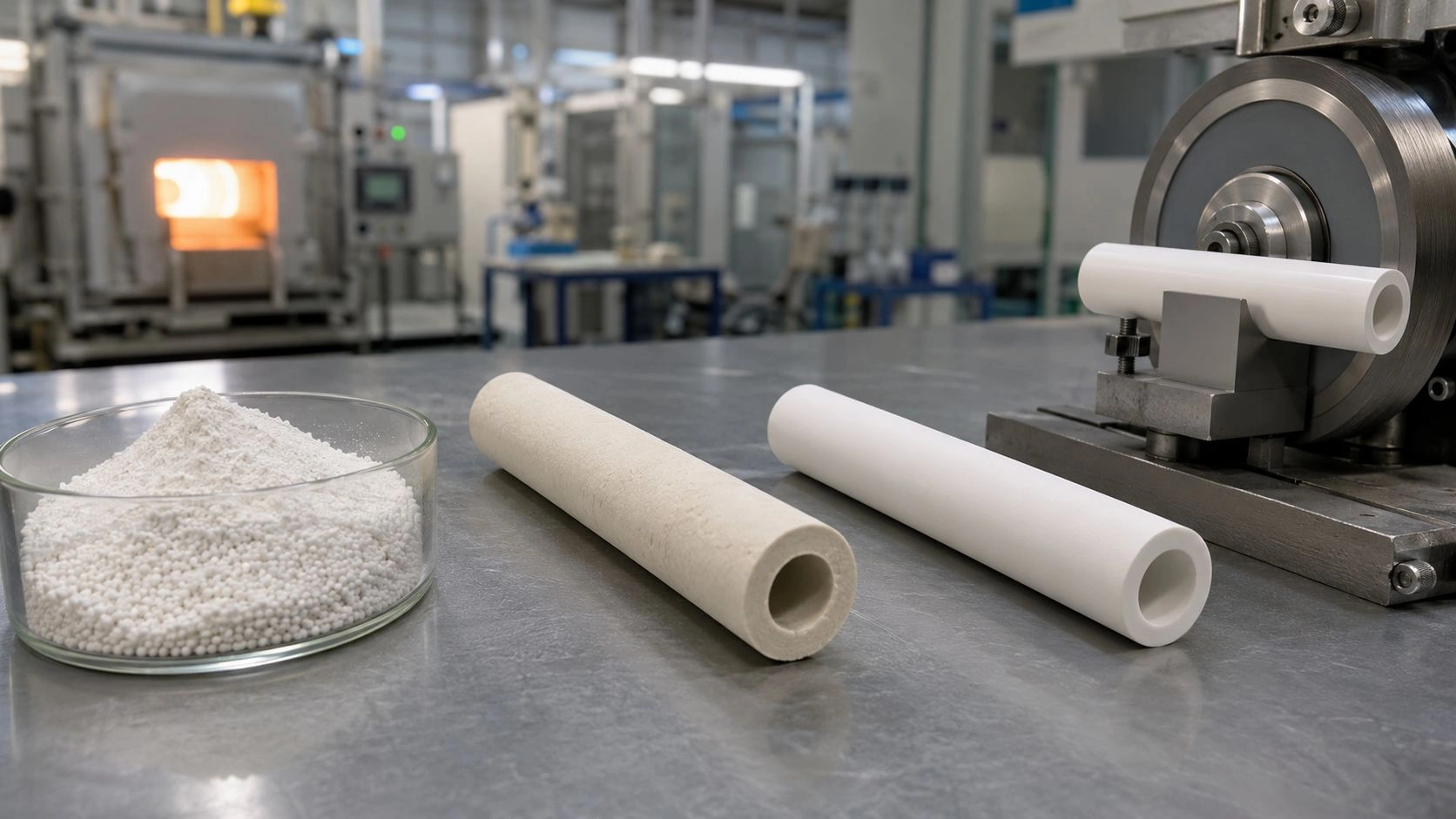
As-fired surfaces suit many insulation and routing duties. Ground OD or ID is justified when seal lands or probe slip fits need controlled diameter. Call out the drawing tolerance class explicitly; over-specifying polish without a seal need adds lead time. Put straightness and concentricity inspection expectations on the RFQ for long tubes in tight ports.
Electrical insulation remains a primary reason alumina is chosen for heater-lead and thermocouple sheaths; high-temperature insulation still needs engineering review against atmosphere and soak. State porosity intent on the RFQ—gas-tight well, sampling path, or insulation-only—and confirm density on [TDS: grade/temp]. If lag budget is tight and the port supports the tube, favor thinner walls; if door cycling and side loads dominate, favor thicker walls.
Common Spec Errors That Cancel Grade Advantage
Common specification errors cancel the advantage of a premium alumina grade when geometry and finish callouts are incomplete. A closed-end tube still fails first article if tip radius or bung OD was never drawn; an open-end tube still leaks if the seal land is as-fired when the gland expects ground diameter; multi-bore tubes still bind leads if bore count, diameter, and pitch were assumed.
Trigger conditions include wrong end geometry, wall thickness that kills response time, grade selected without atmosphere notes, and tolerances that miss the flange stack. The mechanism is dimensional and thermal mismatch; the visible result is probe binding, seal leak, slow sensor lag, or early crack at a port under cycling. An RFQ that omits end type and as-fired versus ground callouts is the usual fit failure. Related alumina crucibles may share a PO for sample prep but do not substitute for protection-tube geometry—and crucible long-term temperature rows must not be copied onto tube RFQs.
Alumina Protection Tube RFQ Checklist
An alumina protection tube RFQ should include drawing geometry, end type, bore layout, atmosphere band, tolerance class, and inspection expectations before grade confirmation. When those fields are clear, supplier grade proposals and [TDS: grade/temp] review become a mapping exercise rather than a guess. Product ranges that support that review start from alumina ceramic tubes. For the sensor-specific range, compare ceramic thermocouple protection tubes before finalizing the bore and tip. For a quote-package template, see custom ceramic tube RFQ information. Send the completed package to ADCERAX for an engineering RFQ review.
This checklist supports engineering and purchasing speaking the same language on furnace instrumentation tubes:
- Drawing or old-part photos: OD, ID, length, wall, closed/open end, tip radius/flat, flats, grooves, chamfers
- Bore layout: single-bore vs multi-bore; bore count, bore diameter, and pitch if multi-bore
- Wall thickness class: thin-wall response priority vs thick-wall robustness priority
- Quantity and delivery window (prototype vs series / annual demand if known)
- Atmosphere and qualitative or numeric peak-temperature band; request grade mapping via live grade table and [TDS: grade/temp]
- Tolerance class: as-fired vs ground OD/ID; any critical seal land
- Thermal cycling description (soak-only vs frequent door cycles)
- Inspection: straightness, concentricity, gas-leak check if required
- Packaging / cleanliness (lab-grade wipe-down, no organic residue)
- Related parts on the same PO? (matching alumina crucibles for sample prep, if any—separate RFQ lines)
Spec Logic Recap
Furnace instrumentation alumina protection tubes are selected by end type, bore layout, wall trade-off, and finish class first; grade follows as a mapped confirmation against atmosphere and soak band on the live grade table and supplier [TDS: grade/temp]. When the drawing carries tip geometry, as-fired versus ground callouts, and cycling notes, quote divergence shrinks and first-article fit improves. The next step is a complete RFQ package—not another round of grade nicknames without dimensions.
Ready to lock geometry before grade on your alumina protection-tube RFQ? Send OD/ID/length, end type, atmosphere band, wall priority, and as-fired vs ground callouts. ADCERAX engineers return a form-factor and grade-fit memo with [TDS: grade/temp] confirmation points; turnaround depends on inquiry complexity—no purchase commitment required at the memo stage.
FAQ
When should engineers use closed-end vs open-end alumina tubes?
Closed-end alumina tubes fit immersion thermocouple and sensor wells that need a sealed tip in the hot zone. Open-end tubes fit atmosphere isolation, gas sampling, and process flow paths that require seals, ports, or flow-through. Choose end type from sensor immersion and gas-path duty before selecting purity grade or finish class.
How does wall thickness affect thermocouple response in alumina protection tubes?
Thinner walls reduce thermal mass between the process and the thermocouple junction, which shortens lag on temperature steps. Thicker walls improve mechanical robustness at ports and lengthen diffusion paths in aggressive atmospheres, at the cost of slower response. Match wall class to the lag budget and the mechanical envelope of the flange or bung.
What should an alumina tube RFQ include beyond OD and length?
Beyond OD and length, the RFQ should state end type, tip geometry, bore layout (including bore count and pitch for multi-bore), wall priority, as-fired versus ground tolerance class, atmosphere and peak-temperature band, cycling description, inspection expectations, and a request for grade mapping plus supplier [TDS: grade/temp] confirmation. Missing end type and finish class are the usual drivers of first-article fit failures.
Can multi-bore alumina tubes replace multiple single-bore tubes?
Multi-bore alumina tubes can replace several single-bore sheaths when leads must stay electrically separated inside one outer envelope and packing density at the port matters. They are not automatic substitutes when each sensor needs an independent immersion tip or a different wall/response class. Specify bore count, bore diameter, and pitch explicitly.
How should grade be chosen relative to geometry for furnace instrumentation?
Grade should be chosen after geometry is locked: end type, OD/ID/length, wall class, and finish. Then map atmosphere and peak-temperature band to the live alumina tube grade-properties table and verify service limits on [TDS: grade/temp]. Do not invent tube long-term temperatures in the RFQ narrative, do not copy crucible long-term temperature rows onto tube claims, and do not default every instrumentation RFQ to the highest purity nickname.