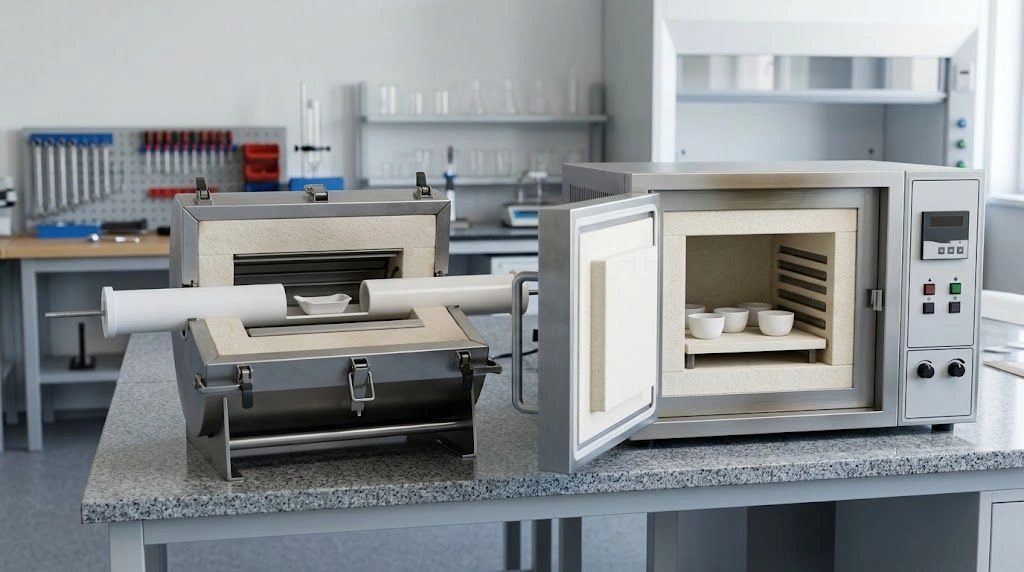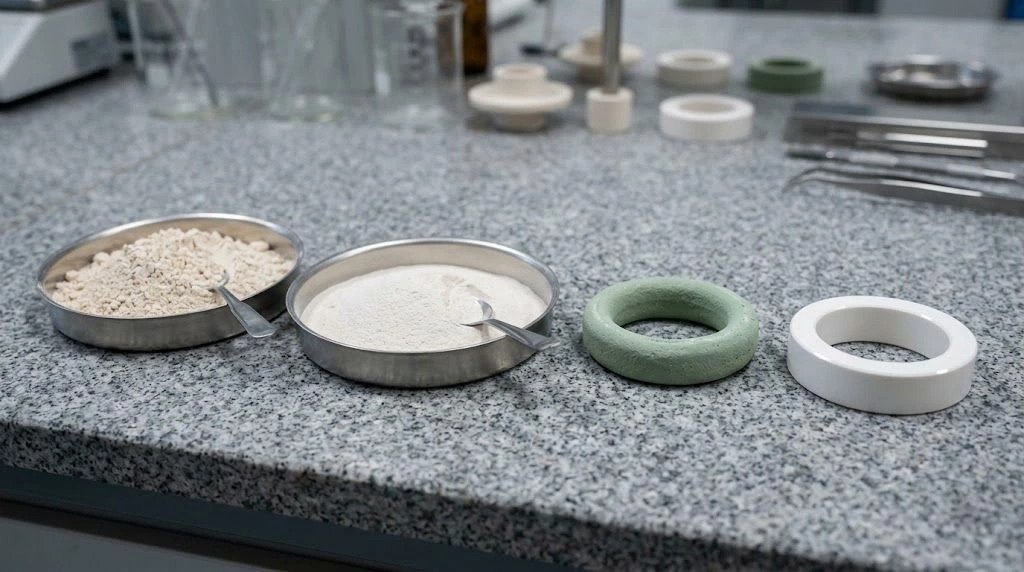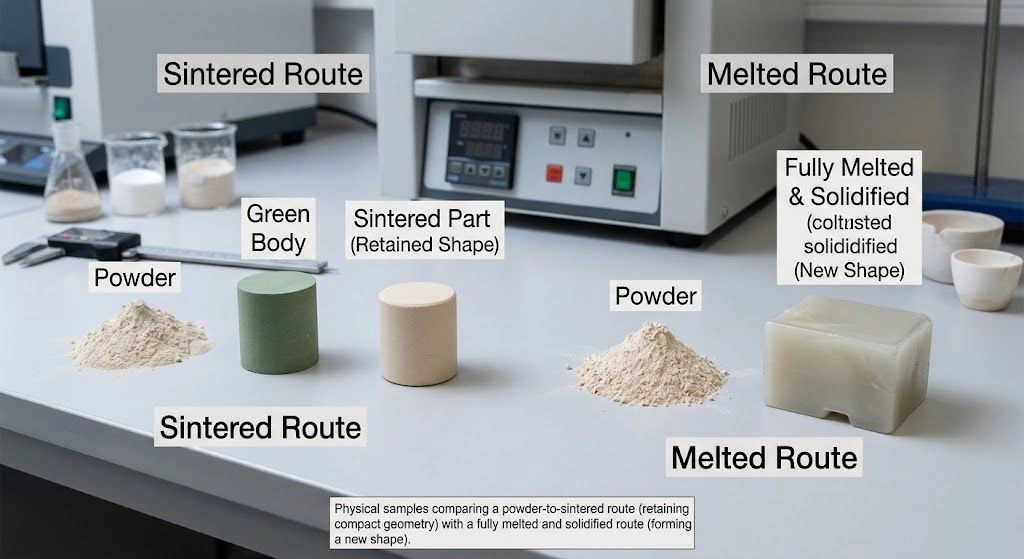
Zirconium is the metallic element Zr, while zirconia is zirconium dioxide, ZrO₂, an oxide ceramic. Zirconium behaves like a metal: it conducts electricity, can be formed and joined, and can plastically deform under appropriate conditions. Zirconia is commonly an electrical insulator at room temperature, is hard and wear resistant, and is produced by powder forming and sintering. Their similar names do not make them interchangeable; an engineering specification must state the exact zirconium alloy or stabilized zirconia grade.
What Is the Difference Between Zirconium and Zirconia?
Zirconium and zirconia are chemically related but belong to different material classes. Zirconium is element 40, symbol Zr, and is processed as a reactive metal or alloy. Zirconia is the compound ZrO₂, created when zirconium is chemically bonded with oxygen. That change produces different bonding, crystal structures, electrical behavior, deformation mechanisms, manufacturing routes, and failure modes.
Zirconium metal can yield and plastically deform under suitable conditions. Dense zirconia normally follows brittle-ceramic fracture behavior without metal-like yielding. A drawing that says only “zirconium” when a ceramic component is intended is therefore not shorthand—it is a material-identity error.
| Term | Formula or Symbol | Material Class | What It Means |
|---|---|---|---|
| Zirconium | Zr | Metal element | Metallic zirconium or a zirconium-based alloy |
| Zirconia | ZrO₂ | Oxide ceramic | Zirconium dioxide used as powder, coating, electrolyte, refractory, or structural ceramic |
| Zircon | ZrSiO₄ | Zirconium silicate mineral | Principal economic mineral source of zirconium; not zirconia |
| Cubic zirconia | Stabilized cubic ZrO₂ | Synthetic crystalline zirconia | Cubic-phase material widely known as a gemstone; not a synonym for every zirconia ceramic |
| YSZ | Y₂O₃-stabilized ZrO₂ | Stabilized ceramic | Broad family of zirconias containing yttria to control phase stability |
| Y-TZP | Yttria-stabilized tetragonal zirconia polycrystal | Structural ceramic | Fine-grained zirconia designed to retain a large tetragonal-phase fraction |
| Mg-PSZ | Magnesia partially stabilized zirconia | Structural ceramic | Zirconia partially stabilized with magnesia; properties depend on formulation and microstructure |
Zirconium Is a Metal
The Royal Society of Chemistry’s zirconium reference identifies Zr as atomic number 40 and a silvery metallic element. Commercial zirconium is supplied in specific grades and alloys. It can be melted, alloyed, formed, machined, and joined using suitable metal-processing routes. Its electronic conductivity and ability to plastically deform distinguish it from zirconia ceramic.
Zirconia Is an Oxide Ceramic
The NIST Chemistry WebBook identifies zirconium dioxide as ZrO₂. Engineering zirconia parts are normally made through powder preparation, forming, binder removal, sintering, and—when necessary—diamond grinding, lapping, or polishing. Dense structural grades are hard and wear resistant but do not provide metal-like ductility.
Zircon Is Neither Zirconium Metal nor Zirconia Ceramic
Zircon is zirconium silicate, ZrSiO₄. The U.S. Geological Survey identifies it as the principal economic source of zirconium and describes uses in refractories, foundry sands, and ceramic opacification. Zircon can also be a gemstone, but it is not a substitute name for ZrO₂.
Likewise, cubic zirconia is a stabilized cubic form of zirconium oxide, not every kind of zirconia. Industrial structural zirconia is frequently tetragonal-rich or partially stabilized rather than gemstone-type cubic material.
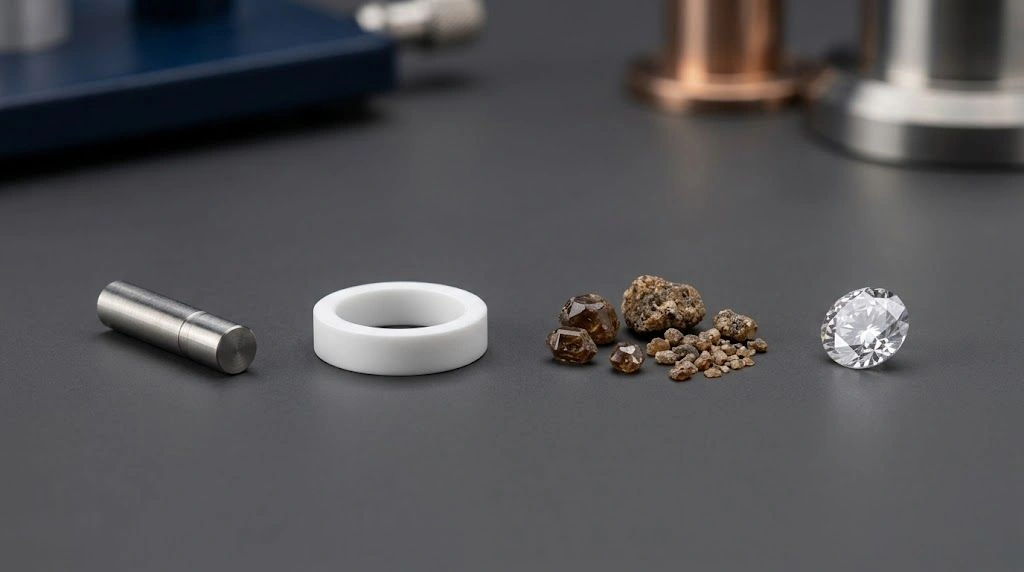
Zirconium is metal Zr, zirconia is ceramic ZrO₂, zircon is mineral ZrSiO₄, and cubic zirconia is one stabilized crystalline form of ZrO₂.
How Do Stabilizers and Crystal Phases Change Zirconia?
Zirconia is not one fixed ceramic grade. Pure ZrO₂ changes crystal structure with temperature, and cooling through these transformations can produce dimensional changes and cracking. Stabilizers such as yttria, magnesia, calcia, or ceria are added to retain useful tetragonal or cubic phase fractions at lower temperatures.
The resulting phase balance influences strength, toughness, ionic conductivity, thermal behavior, translucency, and aging sensitivity. A specification that says only “zirconia” therefore leaves major engineering variables unresolved. NIST’s zirconium and zirconia phase-diagram reference reinforces the need to consider composition and phase equilibrium together.
Monoclinic, Tetragonal, and Cubic Zirconia
Monoclinic zirconia is the stable room-temperature phase of unstabilized bulk ZrO₂ under ordinary conditions. Tetragonal and cubic structures are stable at higher temperatures in pure zirconia. Stabilizers and controlled grain size can retain tetragonal or cubic fractions at lower temperatures.
Exact boundaries depend on composition, grain size, processing route, thermal history, stress, and reference conditions. Published transition temperatures should not be copied into a manufacturing acceptance limit without a grade-specific phase diagram and test basis.
Transformation Toughening
Transformation toughening uses a controlled metastable tetragonal phase:
- Tensile stress concentrates near a crack tip.
- Suitable tetragonal grains may transform toward the monoclinic phase.
- The local transformation produces strain and volume expansion.
- The transformed zone creates a crack-closing or shielding effect.
- Additional energy is then required for the crack to advance.
This mechanism helps explain why some structural zirconias resist crack extension better than many conventional oxide ceramics. More transformability is not automatically better, however. Uncontrolled or spontaneous transformation can create microcracking, roughening, dimensional change, or degradation. Stabilizer content, grain size, porosity, temperature, moisture, stress state, and time all matter.
Stabilized Zirconia Grades Are Not Interchangeable
| Zirconia Family | Intended Engineering Character | Important Qualification |
|---|---|---|
| Y-TZP | High strength and transformation-toughening potential | Confirm yttria content, phase balance, grain size, aging condition, and test method |
| YSZ with higher cubic fraction | Phase stability or ionic-conduction functions, depending on composition | Do not assume the same mechanical behavior as structural Y-TZP |
| Mg-PSZ | Transformation-toughened structural ceramic with a different microstructure | Confirm magnesia content, heat treatment, and supplier grade |
| Ce-TZP | Ceria-stabilized tetragonal zirconia | Confirm strength, toughness, aging, and application-specific data |
| Unstabilized zirconia | Limited structural use where transformation creates risk | Do not substitute it for a stabilized structural grade |
Ionic Conductivity Does Not Mean Metal-Like Conductivity
Zirconium metal transports electrons. Some stabilized zirconias transport oxygen ions at elevated temperature, which is useful in oxygen sensors and solid-electrolyte systems. Ionic conductivity depends strongly on stabilizer chemistry and temperature, while electronic conductivity can remain low. The specification must identify the required charge carrier, temperature, atmosphere, and target property.
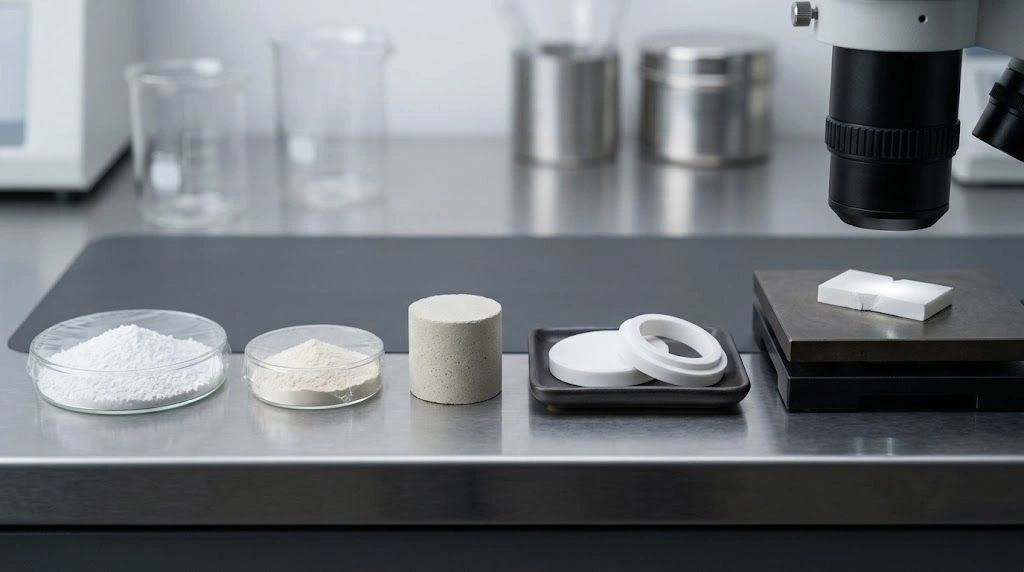
Zirconia phase balance and transformation behavior depend on stabilizer chemistry, microstructure, processing, temperature, and environment.
How Do Zirconium Metal and Zirconia Ceramic Compare?
Oxidation changes zirconium into a different material platform. Zirconium metal offers electronic conduction, metal-forming options, joining routes, and some plastic deformation. Zirconia ceramic offers high hardness, room-temperature electrical insulation in many grades, wear resistance, and transformation-toughening potential, but remains sensitive to tensile flaws and stress concentrations.
Neither material is universally superior. Selection depends on whether the part requires metal-like fabrication and yielding or ceramic hardness, insulation, wear performance, and stabilized-phase functions.
| Selection Factor | Zirconium Metal | Zirconia Ceramic | Specification Warning |
|---|---|---|---|
| Chemical identity | Zr or zirconium alloy | ZrO₂ plus stabilizer/additives | Do not use the names interchangeably |
| Material class | Metal | Oxide ceramic | Manufacturing routes are fundamentally different |
| Electrical behavior | Electronic conductor | Commonly an electronic insulator; some grades conduct oxygen ions when hot | State temperature and conductivity type |
| Deformation | Can plastically deform under suitable conditions | Limited plastic deformation; brittle-fracture design applies | Do not use metal allowable-strain assumptions |
| Hardness and wear | Grade- and condition-dependent metal behavior | Typically harder and more wear resistant | Counterface and wear mode still matter |
| Fracture behavior | Alloy toughness and ductility must be specified | Flaw-sensitive; structural grades may use transformation toughening | Compare grade- and method-qualified data |
| Corrosion mechanism | Passive oxide film can provide protection | Already an oxide, but compatibility remains condition-dependent | Specify medium, concentration, temperature, and impurities |
| Manufacturing | Melting, alloying, forming, machining, joining | Powder preparation, forming, sintering, diamond machining | Metal drawings may require redesign |
| Joining | Welding, brazing, or mechanical fastening by grade | Designed mechanical retention, adhesive, brazing, or metallization | Joint design requires separate review |
| Geometry response | Can permit thinner or more compliant sections | Avoid sharp corners, unsupported edges, and point loading | Changing material class can require new geometry |
| Service temperature | Usually limited far below melting in loaded or reactive service | Usually limited far below melting where creep, phase, or environment controls | Melting point is not a working-temperature rating |
Hardness Does Not Make Zirconia a Drop-In Metal Replacement
Higher hardness may reduce abrasive wear, but it does not supply ductility. Threads, snap fits, press fits, thin walls, sharp corners, and point contacts can introduce severe local tensile stresses. A metal component converted to zirconia needs a ceramic design review covering radii, wall transitions, support, fits, assembly sequence, and acceptable surface damage.
Corrosion Resistance Must Be Medium-Specific
Zirconium metal’s passive-film performance depends on alloy, medium, concentration, impurities, temperature, fabrication, and weld condition. “Resistant to all chemicals” is not a defensible claim.
Zirconia is already an oxide, but it is not universally inert. Stabilizer loss, hydrothermal aging, molten salts, strong acids or alkalis, and high-temperature reactions can require grade-specific review. Hardness is not evidence of chemical compatibility.
Melting Point Is Not Maximum Working Temperature
An unloaded melting point says little about safe continuous service. Strength loss, creep, oxidation, corrosion, phase transformation, thermal shock, grain growth, stabilizer redistribution, atmosphere, joint materials, and assembly stress may control at much lower temperatures. Working limits belong to a grade, geometry, load case, and environment—not merely a chemical formula.
When Should You Choose Zirconium or Zirconia?
Choose by the function that controls failure. Zirconium belongs in a metal-design route when the part requires electrical conduction, welding or metal joining, plastic deformation, metallic sealing, or a verified zirconium-alloy corrosion envelope. Zirconia belongs in a ceramic-design route when hardness, wear resistance, electrical insulation, low thermal conductivity, precision sliding surfaces, or stabilized-phase functions dominate.
If both sets of requirements appear in one assembly, a hybrid design may be more practical than forcing either material to act as a universal substitute.
If–Then Selection Logic
- If electrical conduction or welded metal construction is required, evaluate zirconium metal or another appropriate alloy.
- If room-temperature electrical insulation and high surface hardness are primary, evaluate zirconia ceramic.
- If the part must yield, bend, flare, or absorb substantial deformation, do not treat zirconia as a direct metal replacement.
- If abrasive wear and dimensional stability dominate, evaluate zirconia after checking counterface, load, speed, lubrication, and edges.
- If corrosion resistance controls, compare both candidates against the exact chemical medium and temperature.
- If high-temperature oxygen-ion conduction is required, specify a composition-qualified stabilized zirconia—not generic structural zirconia.
- If rapid thermal cycling dominates, review expansion, conductivity, modulus, strength, geometry, support, and thermal gradients.
- If converting a zirconium-metal drawing to zirconia, repeat the geometry, tolerance, joining, and assembly review.
| Engineering Requirement | More Natural Starting Point | Required Verification |
|---|---|---|
| Welded chemical-process equipment | Zirconium metal | Alloy grade, medium, temperature, impurities, weld condition |
| Electrically conductive structural part | Zirconium metal | Resistivity, connection design, oxidation, allowable temperature |
| Precision wear sleeve or guide | Zirconia ceramic | Grade, load, counterface, finish, lubrication, edge geometry |
| Electrical-insulating wear component | Zirconia ceramic | Dielectric requirement, temperature, contamination, finish |
| Oxygen sensor or solid electrolyte | Stabilized zirconia | Stabilizer, ionic conductivity, electrodes, operating temperature |
| Deformable clamp or spring feature | Zirconium or another metal | Yield strength, fatigue, corrosion, joining |
| High-contact-stress valve or pump part | Structural zirconia grade | Toughness, strength, contact stress, fluid chemistry, finish |
| Generic “high-temperature part” | No automatic winner | Load, atmosphere, gradients, dwell, cycling, geometry |
ADCERAX’s relevant commercial scope is zirconia ceramic components, not zirconium metal. Requirements for zirconium alloy plate, tube, weldments, or chemical-process equipment should go to a qualified zirconium-metal supplier. Requirements for sintered and precision-machined ZrO₂ parts can proceed to a zirconia-specific drawing and RFQ review.
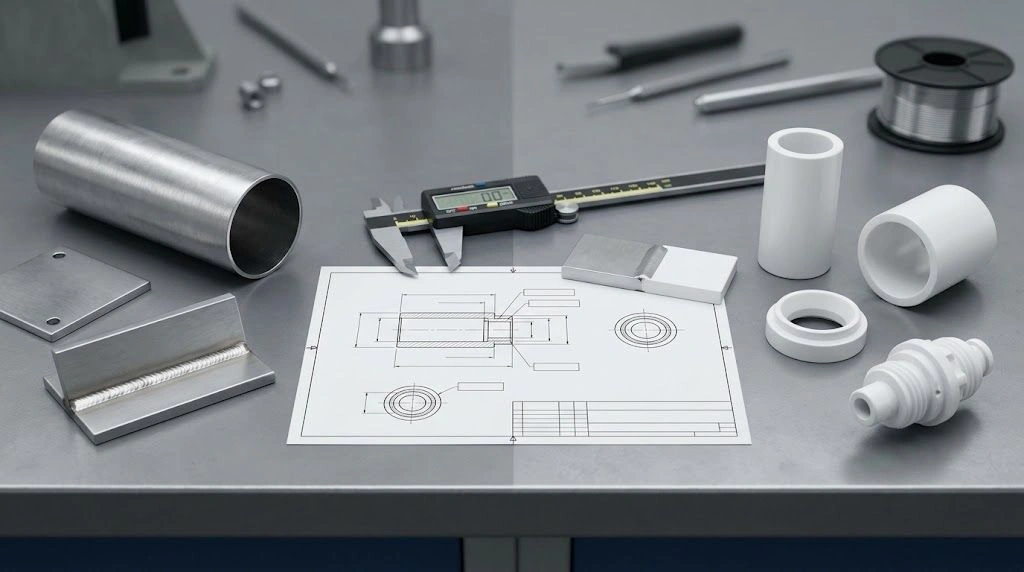
Select zirconium for metal-specific fabrication and deformation; select zirconia when ceramic hardness, insulation, wear resistance, or stabilized-phase functions control.
How Should Zirconia Be Specified on a Drawing or RFQ?
A usable specification defines more than ZrO₂. It should identify the zirconia family or stabilizer, required properties, environment, geometry, tolerances, surface condition, inspection plan, and quantity. If the exact grade is unknown, describe the duty and failure risk instead of guessing a stabilizer percentage. The supplier can then assess Y-TZP, Mg-PSZ, another stabilized zirconia, or a different ceramic.
Copyable Drawing Material Callouts
Avoid:
Material: ZirconiumAlso avoid:
Material: Zirconia, best qualityPreferred structure when the exact grade is not yet qualified:
Material: Stabilized zirconia ceramic (ZrO₂), not zirconium metal. Proposed grade and stabilizer system shall be stated by the supplier and approved before production.When a grade has already been qualified:
Material: [specified Y-TZP / Mg-PSZ / other stabilized zirconia grade]. Composition and property certificate required per the approved material specification.Zirconia RFQ Checklist
Material identity
- Confirm ceramic ZrO₂, not zirconium metal.
- State the requested family or qualified grade.
- Define stabilizer type and concentration if controlled.
- State phase, microstructure, color, or contamination limits if functional.
- Define density, open porosity, certification, and traceability requirements.
Geometry and surface
- Provide a revision-controlled drawing with units and datums.
- Define OD, ID, length, thickness, holes, slots, radii, and tolerances.
- State flatness, roundness, cylindricity, concentricity, and surface finish where critical.
- Define edge breaks, chamfers, allowable chips, mating parts, and assembly method.
- Identify regions exposed to tensile, contact, or impact loading.
Service conditions
- State continuous and peak temperature, ramp rate, atmosphere, and cycling.
- Identify chemical medium, concentration, impurities, pressure, and exposure time.
- State mechanical load, contact type, sliding speed, counterface, and lubrication.
- Define electrical-insulation or oxygen-ion-conductivity requirements.
- Describe expected life and the current part’s known failure mode.
Quality and supply
- Define strength or toughness test methods if required.
- State dimensional and surface inspection methods and acceptance criteria.
- Require lot traceability and identify prototype and production quantities.
- Specify packaging, shipping protection, destination, and documents.
Copyable RFQ Language
Please quote this part as a stabilized zirconia ceramic component, not zirconium metal. State the proposed ZrO₂ grade, stabilizer system, typical density, strength and fracture-toughness test methods, recommended service limits, manufacturing route, achievable tolerances, surface finish, inspection plan, and any geometry changes required for ceramic processing.
When the application requires a dense ZrO₂ wear, insulating, valve, pump, guide, sleeve, ring, or other structural part, send the drawing and operating conditions for review as custom zirconia ceramic components. If the design requires a conductive, weldable, or plastically deformable zirconium alloy, route it to a qualified metal supplier.
Frequently Asked Questions
Is zirconia a metal?
No. Zirconia is zirconium dioxide, ZrO₂, an oxide ceramic. Zirconium is the metal element Zr. Oxygen bonding and the ceramic crystal structure give zirconia different electrical, mechanical, thermal, and manufacturing behavior.
Is all zirconia cubic zirconia?
No. Zirconia can contain monoclinic, tetragonal, and cubic phases. Structural zirconia commonly uses tetragonal-rich or partially stabilized microstructures rather than gemstone-type cubic zirconia.
What is yttria-stabilized zirconia?
YSZ is ZrO₂ containing yttria to control phase stability. Different yttria contents and processing routes can produce tetragonal-rich structural grades or higher-cubic-fraction grades for ionic-conduction functions. The term alone is not a complete grade specification.
Is zirconia electrically conductive?
It is generally a poor electronic conductor and commonly serves as an insulator at room temperature. Some stabilized grades conduct oxygen ions when hot. Ionic and electronic conductivity must not be confused.
Can zirconium metal be replaced directly with zirconia?
Usually not. Zirconia lacks metal-like ductility, welding, yielding, and tolerance for point loading. Geometry, joining, fits, edges, tolerances, and assembly loads require ceramic-specific review.
Decision rule: Treat zirconium metal and zirconia ceramic as different engineering platforms. Specify the exact material class first, then qualify the grade, processing route, geometry, environment, and test data.