Define the measured volume and specimen condition before comparing ceramic density or setting an inspection requirement.
Bulk, apparent and true density in ceramics should be compared only after the volume definition is clear. For a sintered body, bulk density includes open and closed pores; apparent solid density excludes accessible open pores but retains closed pores; true density excludes all pore volume. Gas pycnometry often reports skeletal density rather than a completely pore-free value. Because “apparent density” can also describe a powder-bed measurement, a useful supplier comparison must identify the complete density term, sample condition, and test method before comparing numbers.
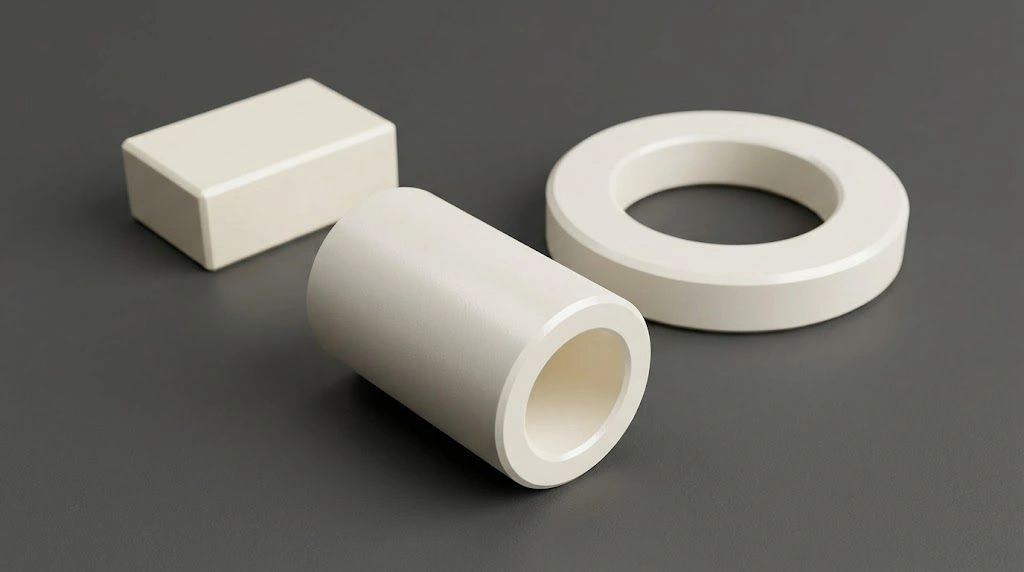
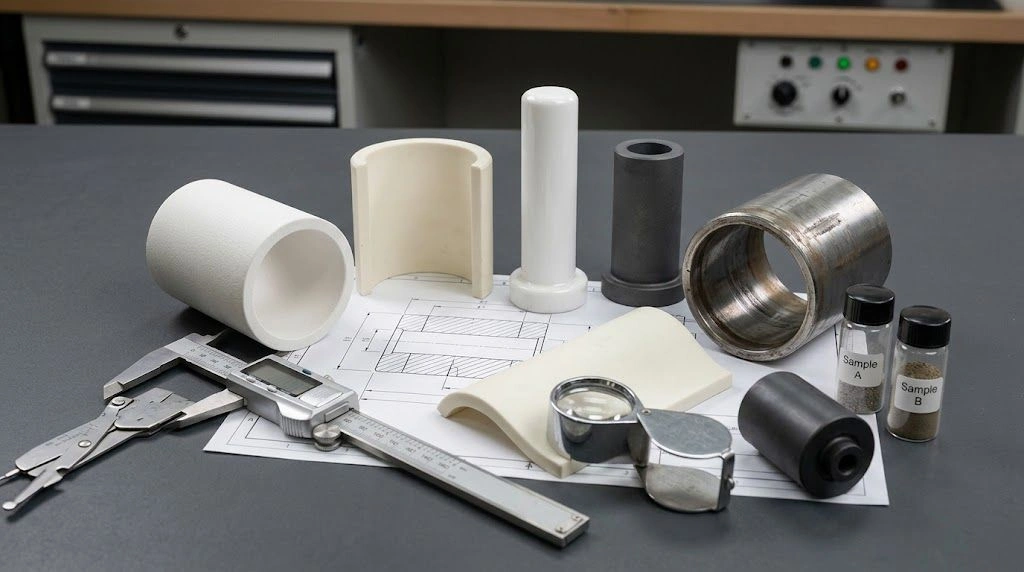
Finished parts and representative coupons establish the specimen context; their appearance alone cannot verify density, purity, or internal porosity.
Which Pores Are Included in Bulk, Apparent Solid, and True Density?
The density definition determines whether the denominator includes only solid material or also includes pore volume. A sintered ceramic may contain open pores connected to the exterior and closed pores isolated inside the body. Bulk density includes both; apparent solid density excludes the open volume accessible under the stated method; true density excludes every pore. Liquid and gas access need not be identical, so a reported density must retain its method context even when the terminology appears familiar.
Start with a Defined Volume Model
For one dry, chemically unchanged ceramic body, let m be dry mass, Vs solid-material volume, Vo open-pore volume, and Vc closed-pore volume. The ideal relationships are:
- Bulk density: ρbulk = m / (Vs + Vo + Vc)
- Apparent solid density: ρapparent-solid = m / (Vs + Vc)
- True density: ρtrue = m / Vs
These expressions assume that the open pores are fully accessible to the method being discussed. For compatible definitions and the same material state, ρbulk ≤ ρapparent-solid ≤ ρtrue. The ordering is not a rule for reconciling unrelated specimens or incompatible liquid and gas measurements.
| Term | Volume represented | Open pores | Closed pores | Main boundary |
|---|---|---|---|---|
| Sintered-body bulk density | Solid plus pores within the body | Included | Included | Not powder packing density |
| Apparent solid density | Solid plus pores inaccessible to the stated method | Accessible pores excluded | Included | Pore access must be defined |
| Skeletal density | Volume inaccessible to the displacement gas | Gas-accessible pores excluded | Included | Not automatically pore-free |
| True density | Solid-material volume only | Excluded | Excluded | Requires a defensible pore-free basis |
| Powder bulk density | Filled powder-bed volume | Included within particles | Included within particles | Interparticle voids also included |
| Theoretical density | Composition- and phase-based ideal reference | Excluded in the reference | Excluded in the reference | A reference, not a specimen measurement |
Density commonly uses g/cm³ or kg/m³. The table defines volume conventions; it does not provide material acceptance values.
Why “Apparent Density” Needs Context
In fine-ceramic testing, the complete term apparent solid density distinguishes the intended result. In powder handling, apparent density can instead describe mass per freely filled powder-bed volume, including spaces between particles. A supplier’s shortened label therefore needs a definition before it becomes comparable data.
A sleeve’s designed bore is also not a microscopic pore. For geometric material-volume calculations, intentional through-holes and machined recesses must be treated according to their geometry. Using the entire enclosing cylinder or bounding box would include empty design space in the ceramic volume.
When Can Ceramic Density Values Be Compared Directly?
Two ceramic density values can support a direct comparison when the material, sample state, volume definition, and measurement method are compatible. An intact fired part, a cut coupon, crushed material, and a powder bed do not necessarily represent the same volume. Composition and phase differences also matter. A higher absolute density in zirconia than in alumina cannot establish better densification, and a gas-pycnometer value cannot satisfy a bulk-density requirement simply because the units match.
Check the Grade and Specimen History
An alumina sleeve, zirconia ring, and silicon carbide part require their own material basis. Even within one family, stabilizers, second phases, or formulation differences can change the relevant solid-density reference. A value resembling a familiar catalog number does not identify the composition or prove purity.
Cutting, crushing, or grinding can expose pores that were inaccessible in the original body. The resulting measurement may be useful, but the report must state the preparation. A green-body result or powder bulk density should not be presented as acceptance evidence for a finished sintered component.
Use a Report Comparison Checklist
- Identify the material grade and relevant phase composition.
- Identify the specimen: powder, green body, fired part, coupon, or crushed material.
- Record the complete density name and units.
- Confirm the method, drying, conditioning, and preparation.
- Identify the pore volume included or excluded.
- Check the reference density whenever a percentage is reported.
- Decide whether the results answer the same purchasing question.
Specific gravity is a dimensionless ratio to a stated reference density. Density carries mass-per-volume units. Relative density is another ratio, usually comparing bulk density with an appropriate solid or theoretical reference; its denominator must also be identified.
For custom ceramic parts, match the density requirement to the represented material, specimen condition, and agreed inspection method.
Why Do Low Water Absorption and High Skeletal Density Not Prove Full Density?
Low water absorption does not establish that a ceramic has no closed pores, because uptake concerns liquid access under a particular preparation and test procedure. A high skeletal-density result also does not automatically establish complete densification. Pores inaccessible to the displacement gas remain within its measured volume, while gas-accessible pores are excluded. Any conclusion about total porosity therefore needs a compatible bulk-density result and a defensible pore-free solid reference, rather than an instrument name or favorable reading alone.
Open Porosity Is Only Part of the Question
Apparent porosity describes the open volume accessible under the stated measurement conditions. Total porosity includes closed pores as well. Water absorption expresses liquid uptake relative to dry mass; apparent porosity expresses accessible pore volume relative to body volume. These percentages should not be treated as identical results.
Inadequate access or saturation can also limit interpretation. A result reported as no measurable uptake needs the method’s capability and preparation context; it should not become an unqualified statement that no pores exist.
Gas Access Does Not Remove Every Pore
Penn State’s helium-pycnometry explanation identifies the measurement as skeletal volume and notes that helium cannot enter closed pores. Closed pores can remain inaccessible during gas pycnometry, so a reported gas-displacement density does not automatically represent the pore-free solid.
ASTM C604-18(2023), despite using “true specific gravity” in its title, explicitly recognizes that residual closed pores may remain after the prescribed sample preparation. The result can therefore approximate, rather than exactly represent, the true value. Preparation and applicability remain necessary parts of the interpretation.
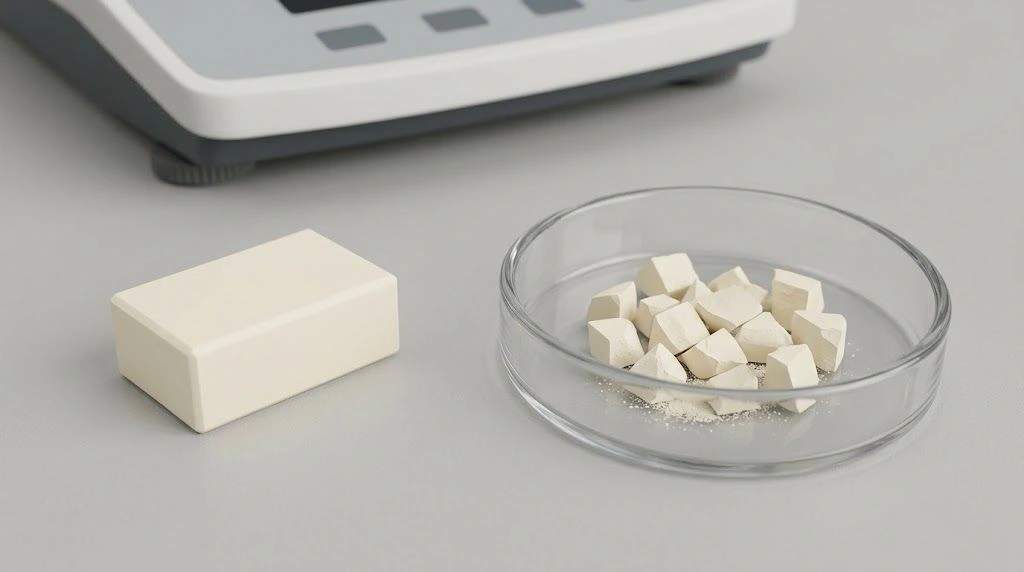
Preparation can change pore accessibility; showing an intact coupon and fragments does not demonstrate that every closed pore has opened.
Calculate Porosity Only with Compatible Inputs
Under the ideal volume model, the porosity fractions are:
- Total porosity: Ptotal = 1 − ρbulk / ρtrue
- Open porosity: Popen = 1 − ρbulk / ρapparent-solid
- Closed porosity: Pclosed = Ptotal − Popen
Multiply a fraction by 100 to express a percentage. These relationships follow from the volume definitions; they do not remove the need for compatible specimens and measurement conditions.
Replacing ρtrue with a skeletal density that retains inaccessible pores does not establish complete total porosity. Difference calculations also combine measurement uncertainty, which becomes especially important when the porosity being estimated is small.
Relative density is ρbulk / ρreference, expressed as a fraction or percentage. The reference should match the composition and phases, with its source documented. A relative-density percentage is not a chemical-purity percentage.
Density can support a defined material comparison; it cannot independently certify purity, strength, or leak tightness.
In a hypothetical pump-sleeve review, equal bulk density could coexist with different pore connectivity or flaw locations. A leakage requirement needs evidence directed at the actual part and leakage path. Likewise, density acceptance does not replace mechanical qualification when fracture is the concern.
Which Density Measurement Fits the Ceramic and the Decision?
The appropriate density method depends on the specimen geometry, pore access, and decision being made. A regular shape may support geometric bulk density; suitable liquid displacement can provide bulk density and accessible porosity; gas pycnometry answers a skeletal-volume question. The method should identify what remains unmeasured as well as what it reports. Standards must also fit the product scope, because a fine-ceramic component, refractory shape, and ceramic tile do not automatically share the same qualification route.
Geometric and Liquid-Displacement Routes
Geometric density combines mass with a defined volume calculated from measured dimensions. For a simple sleeve, the bore must be excluded and relevant end features accounted for. Complex recesses, rough surfaces, and dimensional uncertainty can make this route less suitable for the required precision.
ISO 18754:2020 covers fine-ceramic density and apparent porosity. Method A uses liquid displacement; Method B determines geometric bulk density from mass and dimensions. The published abstract flags Method A limitations above 10% apparent porosity, possible unsatisfactory open-porosity results below 0.5%, and unsuitability for average pore sizes above 600 µm. These are method-applicability boundaries, not product acceptance limits.
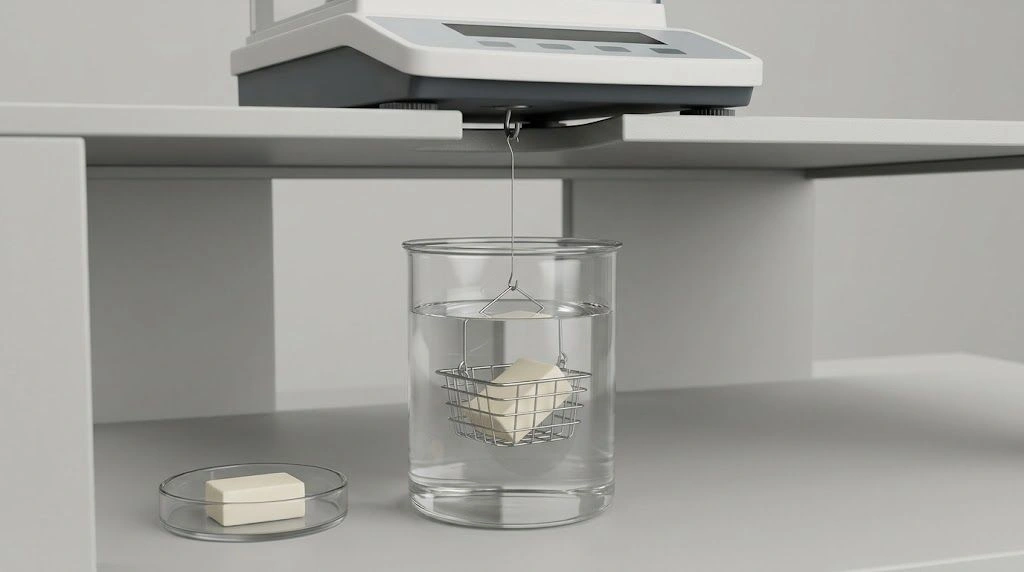
An immersion arrangement needs a defined specimen, preparation, and support geometry; the photograph illustrates equipment context rather than a measured result.
Gas Pycnometry and Product-Scope Checks
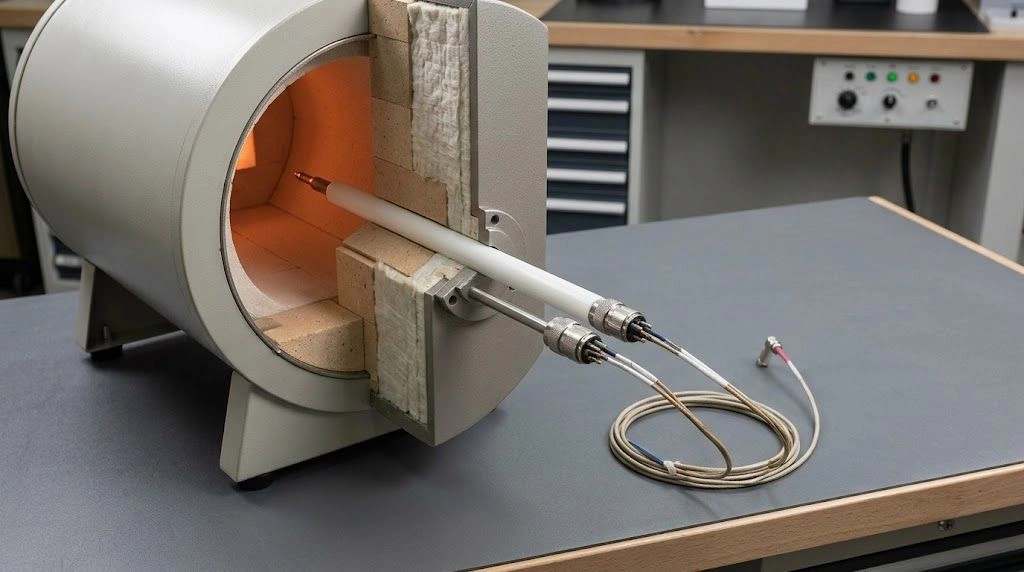
A gas pycnometer uses gas displacement to determine an inaccessible volume. Sample state, conditioning, gas access, and equilibration belong in the report. Describing the instrument alone does not establish whether its output represents the volume needed for purchasing acceptance.
ASTM C20-00(2022) addresses burned refractory brick and shapes. ASTM C373-18(2023) addresses tiles and specified fired whiteware products. Neither should be selected as the automatic default for every precision technical-ceramic part merely because its title contains familiar density or absorption terminology.
| Decision need | Candidate route | Essential check | What remains unproven |
|---|---|---|---|
| Mass per ceramic body volume | Geometric or suitable displacement bulk density | Shape and volume convention | Pore distribution |
| Accessible porosity | Suitable saturation/displacement method | Access, saturation, applicability | Closed porosity |
| Gas-inaccessible volume | Gas pycnometry | Sample state and equilibration | Fully pore-free volume |
| Total-porosity estimate | Bulk density plus defensible solid density | Matching composition and specimens | Pore size and connectivity |
| Batch comparison | Consistent definition and method | Grade, sampling, preparation | Every functional property |
| Leak-tightness acceptance | Application-relevant leakage evidence | Actual part and requirement | Cannot be replaced by density |
This matrix is an engineering review framework, not a universal selection procedure prescribed by a standard.
What Should a Ceramic Density Specification and Report Include?
A ceramic density specification should identify the accepted property, represented material, sample condition, and method before stating a numerical limit. Porosity and relative-density calculations need separate fields so their reference values and assumptions remain visible. The supplier response should distinguish routine inspection from additional characterization and identify the sampled population. Functional requirements such as leakage or strength should remain independent acceptance items whenever density alone cannot demonstrate the performance needed from the finished component.
Material and Sampling
- Part number, drawing revision, material grade, and relevant composition or phases.
- Batch identification, specimen source, and agreed sampling plan.
- Intact, cut, crushed, powdered, green, or fired sample state.
- Relationship between a representative test coupon and the supplied parts.
Measurement and Calculation
- Complete density term, units, standard edition, and method variant.
- Drying, conditioning, and sample-preparation details.
- Immersion liquid or displacement gas, with saturation or equilibration details.
- Geometric-volume definition, including designed holes and recesses where applicable.
- Open/apparent porosity reported separately from density and water absorption.
- True or reference density source for total-porosity and relative-density calculations.
Reporting and Acceptance
- Individual results, summary statistics, and relevant measurement uncertainty.
- Agreed acceptance range and treatment of inconclusive results.
- Routine-inspection versus additional-qualification scope.
- Separate functional requirements for leakage, strength, or contamination where needed.
The drawing and inspection review should also record whether specimen preparation is destructive. A crushed-sample result may characterize material, but it cannot preserve the original part for subsequent dimensional or functional acceptance. The sampling agreement should make that distinction explicit.
The following wording can accompany a supplier review:
Density shall be reported with its complete definition, units, specimen condition, and test method. Bulk-density acceptance shall not be satisfied by an unspecified apparent-density or gas-pycnometer result. Any calculated relative density or total porosity shall identify the reference density and its applicability to the represented material.
Share the drawing, material grade, available reports, and density or porosity requirement with ADCERAX at info@adcerax.com for a custom ceramic part and inspection review. Include the intended acceptance purpose so the review can distinguish material characterization from finished-part requirements.
FAQ
Is apparent density the same as bulk density in ceramics?
Not always. In powder handling, apparent density may refer to a powder-bed measurement that includes spaces between particles. In fine-ceramic testing, apparent solid density uses a different volume basis. The report should define the term and method before its value is compared with a sintered-body bulk density.
Does helium pycnometry always measure true density?
No. Gas pycnometry measures the volume inaccessible to the gas under the test conditions. Closed or otherwise inaccessible pores can remain in that volume. The result is therefore often described as skeletal density, and a pore-free interpretation needs an appropriate basis rather than the instrument name alone.
Can a ceramic have low water absorption and still contain pores?
Yes. Low water absorption does not rule out closed pores or establish that every relevant open pore was measured adequately. The result must be interpreted with the preparation and method limitations. Total porosity requires additional information, including a suitable solid-density reference when it is calculated from density.
What should a supplier include in a ceramic density report?
The report should identify the grade, batch, specimen source and condition, complete density term, units, and test method. Preparation details and any porosity calculations should be stated separately. Relative-density results also need a documented reference, so the buyer can distinguish material characterization from agreed finished-part acceptance.