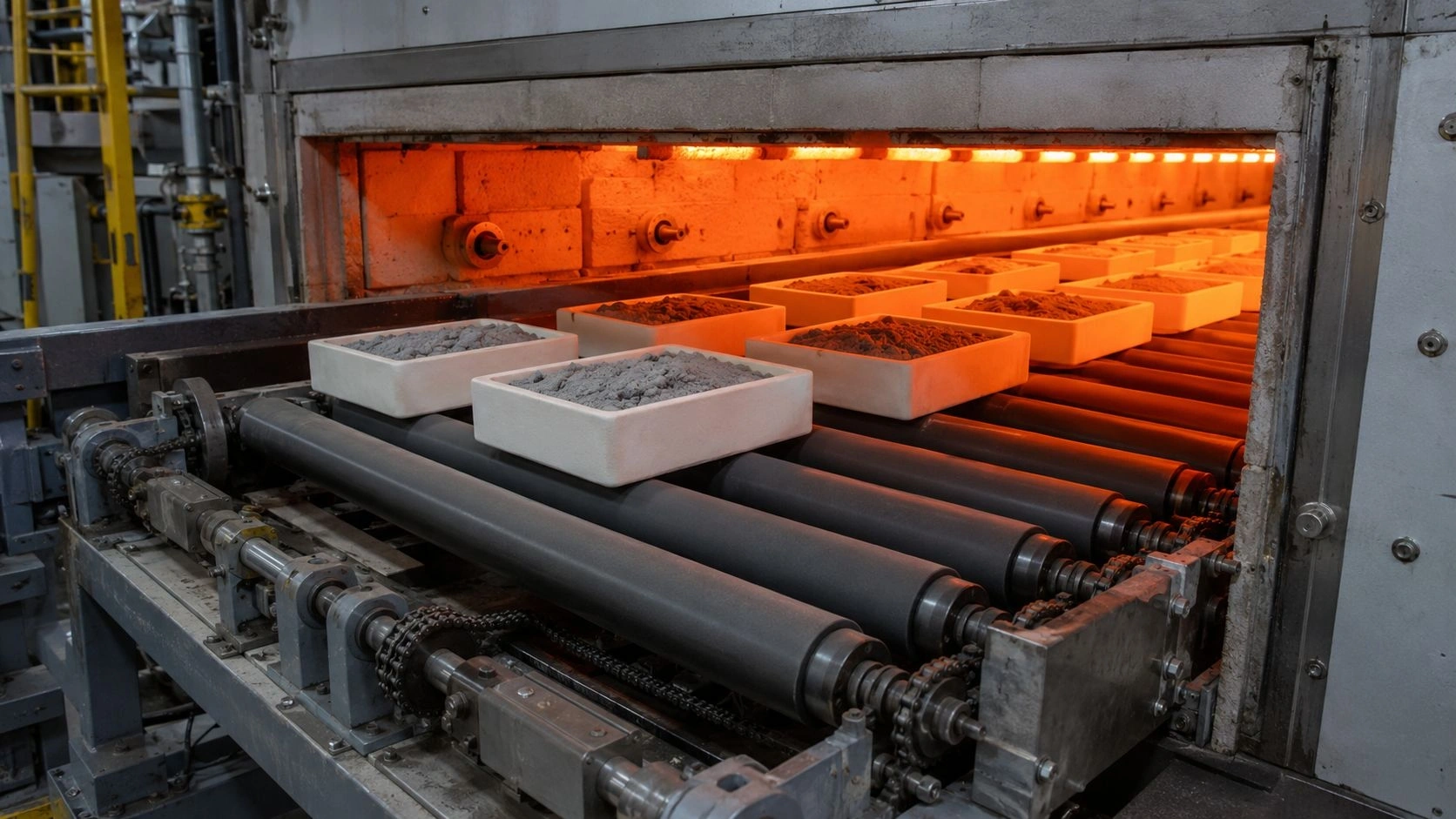
Select ceramic rod material for high-temperature service by matching the rod's operating temperature, thermal cycling frequency, load type, atmosphere, electrical insulation requirement, and contact condition — not by maximum service temperature alone. Alumina is usually the first material to evaluate for high-temperature insulation and furnace support. Silicon carbide fits hot, corrosive, abrasive, or thermally conductive environments. Silicon nitride fits rapid thermal cycling and mechanical stress. Zirconia fits wear and toughness-focused positions where its temperature limits are acceptable. Boron nitride serves selected vacuum, inert, and non-wetting applications. Aluminum nitride serves roles where thermal conductivity and electrical insulation must coexist. The practical decision begins with the dominant risk to avoid, not the highest number on a datasheet.
The ceramic rods at ADCERAX — covering alumina, zirconia, SiC, silicon nitride, boron nitride, and aluminum nitride rod forms in round, square, and threaded configurations for high-temperature support, guide, insulation, wear, and thermal-conduction service — provide the product context for the material selection decisions described in this guide.
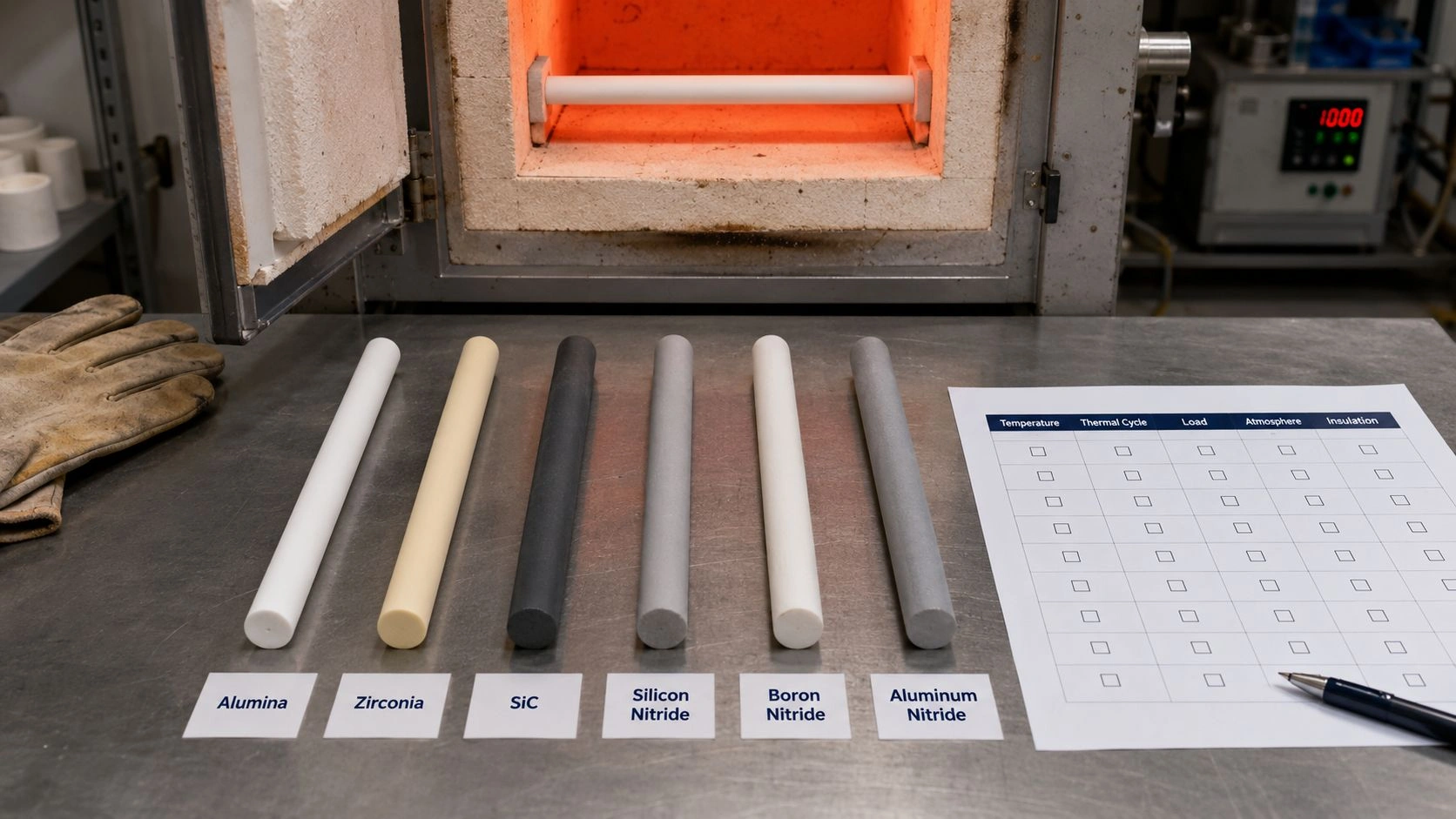
High-temperature ceramic rod material selection requires matching the dominant service requirement — insulation, thermal shock, wear, hot strength, corrosion, or thermal conductivity — to the right ceramic material; selecting only by maximum temperature rating leads to common specification failures.
Do not select ceramic rod material by maximum temperature alone
The most frequent mistake in high-temperature ceramic rod selection is using the maximum service temperature as the primary or only selection criterion. Maximum temperature matters, but it tells the engineer only one thing: whether the material's melting point, sintering limit, or phase-change temperature is safely above the operating condition. It says nothing about how the material behaves under load at that temperature, how it responds to thermal cycling, how it reacts with the kiln or furnace atmosphere, or whether it maintains its electrical or dimensional properties over long service.
Alumina may be the practical first choice for many high-temperature insulation and support applications because it combines heat resistance, electrical insulation, and mechanical strength. External material references consistently describe alumina as providing electrical isolation, wear resistance, high-temperature resistance, and mechanical strength in rod and structural form — confirming that its value is the combination of properties, not the temperature number alone. Silicon carbide is often preferred where high-temperature strength, wear resistance, corrosion resistance, and thermal shock behavior are more important than electrical insulation. Morgan Technical Ceramics confirms that sintered and reaction-bonded SiC are highly wear resistant and have good high-temperature strength and thermal shock resistance. Silicon nitride is often considered when thermal shock and mechanical stress dominate, because major technical ceramic references emphasize its excellent thermal shock resistance and high-temperature strength retention.
Continuous temperature vs short peak temperature. A ceramic rod that operates continuously at 1200°C and a rod that spikes to 1400°C for short cycles face different material risks. A brief thermal excursion may be survived by a material that cannot sustain that temperature continuously. Thermal fatigue from repeated peak cycles can damage materials that perform well at steady-state. The specification should define both the continuous operating temperature and the peak-cycle temperature and duration separately.
Static furnace support vs moving or contact rod. A rod that sits stationary in a furnace recess accumulates load through creep and thermal deformation over long campaigns. A rod that slides against a counterpart accumulates wear at the contact surface and may require better tribological properties than static supports. A rod that is inserted, removed, and reinserted repeatedly accumulates handling stress at the ends. These differences in mechanical use pattern change which material property matters most for life prediction.
Why thermal cycling can matter more than peak temperature. Ceramic materials fail in thermal cycling from the tensile stress that develops when the surface cools faster than the interior — or heats faster — creating a temperature gradient that generates thermal-expansion-mismatch stress. Materials with lower thermal expansion and higher fracture toughness survive more cycles before propagating a crack. This is why silicon nitride, which is described by Kyocera as showing high heat shock resistance, is preferred in rapid-cycle applications over alumina despite alumina's higher nominal use temperature in static conditions.
Match the ceramic rod material to the dominant high-temperature requirement
After rejecting single-variable selection by maximum temperature, the next step is identifying which operating risk dominates the ceramic rod's service environment and selecting the material that handles that risk best.
For insulation and furnace support: alumina. When the rod must provide electrical insulation and stable mechanical support at high temperature in air or moderately oxidizing atmosphere, alumina is usually the correct starting point. AZoM's reference documentation on alumina confirms that it combines hardness, high-temperature operation capability, and electrical insulation — precisely the combination needed for furnace standoffs, insulation supports, thermocouple fixture rods, and kiln support bars.
For corrosion, abrasion, and hot structural stability: silicon carbide. When the rod must survive abrasive particles, corrosive atmosphere, or demanding hot-strength requirements in industrial environments, silicon carbide becomes the dominant candidate. CoorsTek's technical ceramics documentation confirms that silicon carbide exhibits high hardness, wear resistance, corrosion resistance, and strength at high temperatures — which is why it appears in sliding guides, abrasive-process support bars, and hot chemical-exposure structural rods.
For thermal shock and mechanical stress: silicon nitride. When the rod will experience rapid heating and cooling cycles, thermal shock events, or mechanical bending and contact stress under temperature, silicon nitride should be evaluated. Kyocera's silicon nitride material documentation describes excellent thermal shock resistance, wear resistance, and high strength at high temperatures. Precision Ceramics similarly lists high strength over a large temperature range, fracture toughness, flexural strength, creep resistance, low thermal expansion, and thermal shock resistance as the defining silicon nitride properties.
For wear and toughness at moderate high temperature: zirconia. When the rod's primary job is precision wear guidance, alignment, or high-stress contact in a temperature range where zirconia's limits are acceptable, zirconia provides higher fracture toughness than alumina and good hardness. Kyocera's material-property comparison characterizes zirconia as high in strength and fracture toughness, making it useful for demanding contact and wear positions.
For vacuum, inert service, or non-wetting requirements: boron nitride. When the rod must operate in vacuum, inert gas, or non-oxidizing atmospheres where wetting by molten metals or reactive materials is a concern, boron nitride offers machinability, good thermal shock behavior, and non-wetting properties that other ceramic rod materials do not combine as effectively.
For thermal conductivity plus electrical insulation: aluminum nitride. When the rod must spread heat while remaining electrically insulating — for example, in electronic power device fixtures, heat-spreading structural components, or substrate-support rods — aluminum nitride provides substantially higher thermal conductivity than alumina while maintaining electrical insulation.
The numbered selection rule for quick reference:
- Choose alumina when insulation, cost-effective high-temperature support, and chemical stability are the main needs.
- Choose silicon carbide when corrosion, abrasion, thermal conductivity, and hot strength dominate.
- Choose silicon nitride when thermal shock and mechanical stress are the main risks.
- Choose zirconia when toughness, wear resistance, and precision contact matter more than the highest thermal shock resistance.
- Choose boron nitride for selected vacuum/inert, non-wetting, or machinability-focused high-temperature uses.
- Choose aluminum nitride when thermal conductivity and electrical insulation must coexist in the same rod.
Compare alumina, zirconia, SiC, silicon nitride, BN, and AlN rods by high-temperature role
After the first-pass material decision, the detailed comparison by material window confirms the selection and identifies the watch-out conditions.
The High-Temperature Ceramic Rod Material Selection Matrix maps the key decisions:
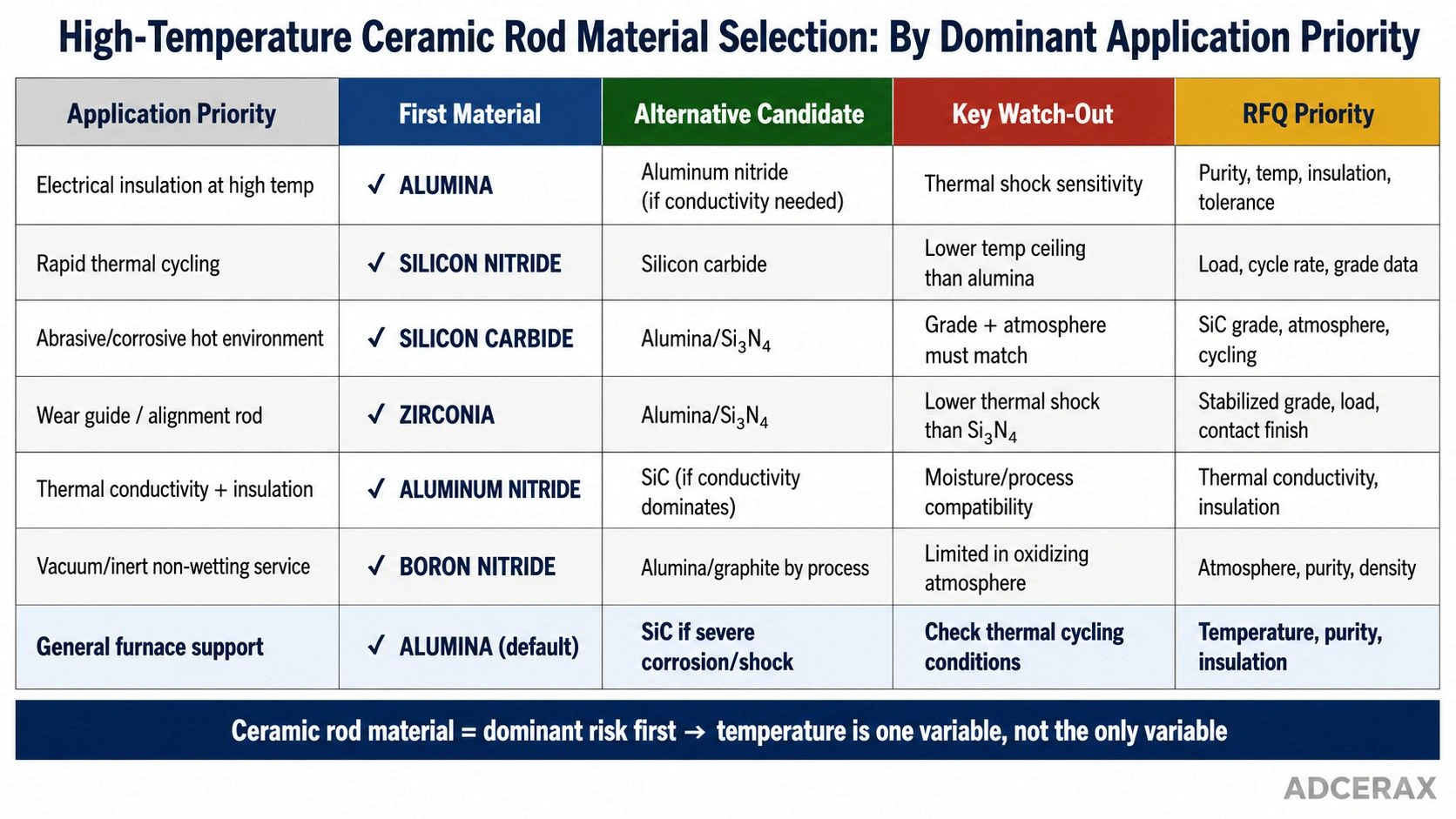
High-temperature ceramic rod material selection should begin with the dominant application priority — insulation, thermal cycling, corrosion, wear, thermal conductivity, vacuum/inert non-wetting service, or general furnace support — then confirm temperature, atmosphere, load, and RFQ requirements.
| Application priority | First material to evaluate | Alternative candidate | Why | RFQ priority |
|---|---|---|---|---|
| Electrical insulation at high temperature | Alumina | Aluminum nitride | Alumina is widely used for insulation and furnace support; AlN adds thermal conductivity | Purity, temperature, insulation, tolerance |
| Rapid thermal cycling | Silicon nitride | Silicon carbide | Silicon nitride is widely recognized for thermal shock resistance | Load, cycle rate, grade data |
| Abrasive or corrosive hot environment | Silicon carbide | Alumina/silicon nitride | SiC offers hardness, wear resistance, and hot strength | SiC grade, atmosphere, thermal cycling |
| Wear guide or alignment rod | Zirconia | Alumina/silicon nitride | Zirconia provides toughness and wear resistance in suitable temperature windows | Stabilized grade, load, contact finish |
| High thermal conductivity plus insulation | Aluminum nitride | SiC if conductivity dominates over insulation | AlN supports heat transfer while remaining electrically insulating | Thermal conductivity, insulation, surface protection |
| Vacuum/inert non-wetting service | Boron nitride | Alumina/graphite alternative | BN fits special atmosphere and non-wetting requirements | Atmosphere, purity, density |
| General furnace support | Alumina | SiC if corrosion/thermal shock is severe | Alumina is common, stable, and electrically insulating | Temperature, purity, insulation |
Values indicative; verify with supplier-specific grade, geometry, atmosphere, and test data.
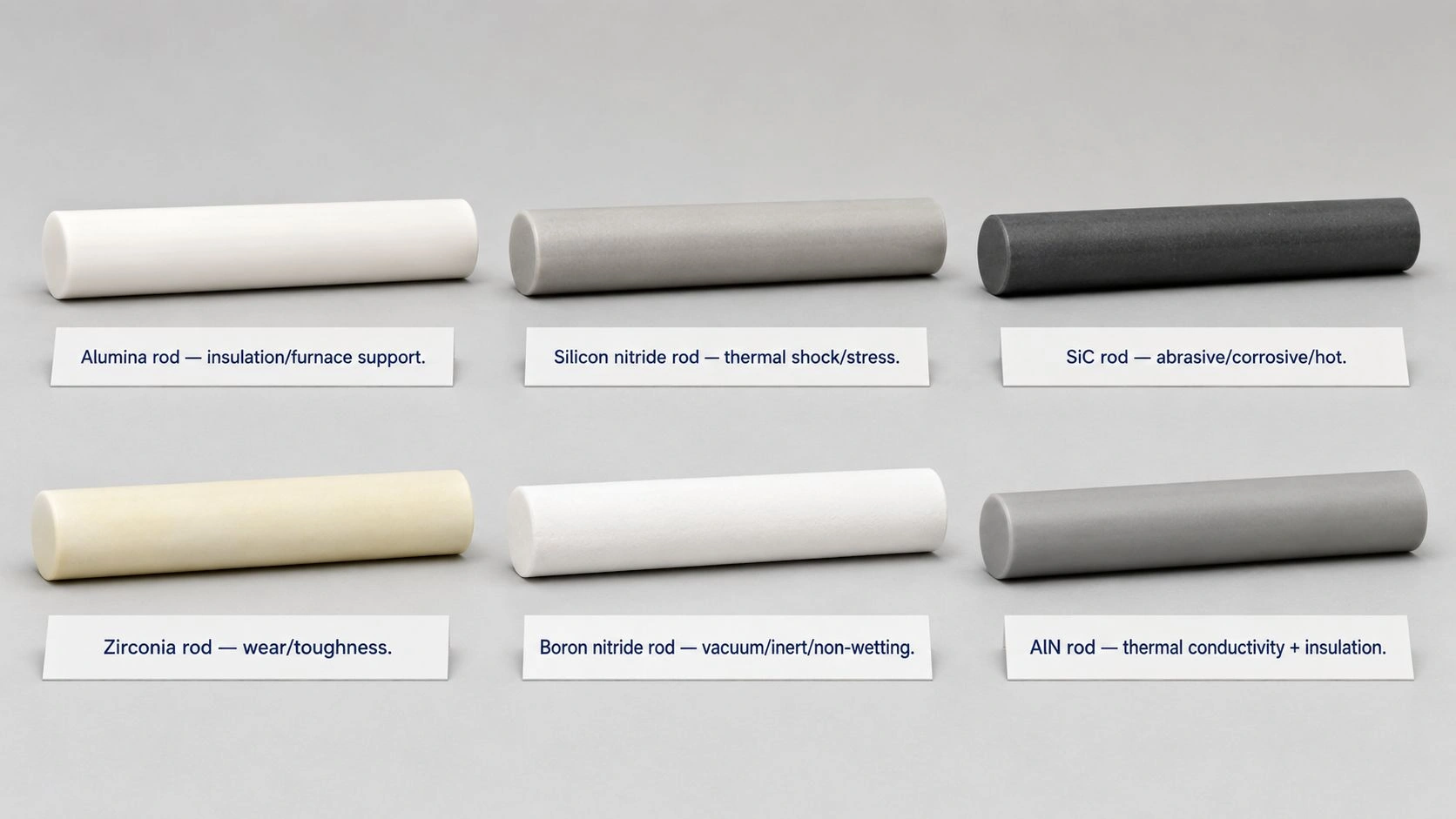
Alumina, silicon nitride, SiC, zirconia, boron nitride, and aluminum nitride rods serve different high-temperature priorities; material choice should be tied to insulation, thermal shock, abrasive or corrosive exposure, wear toughness, vacuum or inert compatibility, and thermal conductivity needs.
ADCERAX's ceramic rod reference data positions alumina rods around 1600–1800°C for general furnace supports and insulation standoffs, zirconia around 1500°C for high-load guides and alignment pins, SiC around 1380–1600°C for abrasive and chemical environments, and silicon nitride around 1100–1200°C for rapid heating/cooling and mechanical stress conditions — confirming that the material windows are overlapping but not equivalent.
Alumina rods: the high-temperature insulation default. For the majority of industrial high-temperature rod applications — furnace support bars, kiln shelf supports, insulation standoffs, thermocouple mounting fixtures, and electrical isolation rods — alumina provides the practical combination of adequate hot strength, electrical insulation, chemical stability in air, and availability in precision ground forms. The watch-out condition is thermal shock: alumina is relatively sensitive to rapid temperature change compared with silicon nitride or SiC, which is why it is most appropriate for stable furnace environments rather than fast-cycling ones.
Zirconia rods: toughness and wear in precision contact roles. Zirconia's fracture toughness advantage over alumina makes it useful for precision wear guides, alignment pins, and contact rods where the ceramic must survive impact, insertion, or sliding contact that would chip alumina. The watch-out condition is that zirconia has a lower continuous use temperature than alumina in many commercial forms, and it should not be used in applications where alumina's temperature headroom is needed.
Silicon carbide rods: hot, abrasive, and thermally demanding service. Silicon carbide rod applications include hot-zone structural rods in corrosive atmospheres, abrasive-fluid contact guides, high-temperature furnace conveyor support bars, and thermally conductive structural rods where heat must flow efficiently through the rod body. The watch-out condition is grade and atmosphere: different SiC grades — reaction-bonded, sintered, nitride-bonded — have different free silicon content, porosity, and atmosphere compatibility. A SiC grade suitable for air atmosphere may not be appropriate for reducing or steam atmospheres.
The silicon carbide ceramic rod at ADCERAX covers the grade and application routing for abrasive, corrosive, and high-temperature SiC rod service. The alumina rods page covers the alumina rod product range for insulation, furnace support, and standard high-temperature rod applications. The aluminum nitride rod covers the thermal-conductivity-plus-insulation rod application.
Silicon nitride rods: rapid cycling and mechanical stress. Silicon nitride's combination of low thermal expansion, high fracture toughness, and high strength retention makes it the preferred rod material when the application involves repeated thermal cycling, significant bending or contact stress under temperature, or conditions where crack propagation must be slowed. The watch-out condition is the operating temperature window: silicon nitride's practical use temperature ceiling in many commercial grades is lower than alumina's, so applications that require both high thermal shock resistance and very high continuous temperature may need engineering review.
Avoid common selection mistakes in high-temperature ceramic rods
Many ceramic rod failures in high-temperature service are not material quality failures — they are material-selection failures. Knowing what to avoid is as important as knowing what to choose.
Mistake 1: selecting by maximum temperature number only. A material rated to a high temperature in a datasheet was tested under specific conditions — typically a short-term hot-strength or firing-temperature test — that may not reflect the actual combination of load, cycling, atmosphere, and time in the application. The maximum temperature number is a necessary but not sufficient specification.
Mistake 2: ignoring thermal cycling. A rod that survives indefinitely at a steady 1200°C may crack after a few dozen cycles to 1200°C and back to room temperature if its thermal shock resistance is insufficient. If the application involves any start-stop cycling, shock-loading events, or rapid temperature transitions, thermal shock resistance becomes a primary selection criterion, not a secondary one.
Mistake 3: treating all SiC rods as identical. Reaction-bonded SiC, pressureless-sintered SiC, nitride-bonded SiC, and SiSiC have different microstructures, porosity, free silicon content, and atmosphere compatibility. A SiC rod specified as ""SiC"" without grade confirmation may be acceptable in one environment and fail in another. Morgan Technical Ceramics' confirmation that both sintered and reaction-bonded SiC types are available, with material form still affecting performance, reinforces that grade confirmation is part of the specification.
Mistake 4: using zirconia where thermal shock is the main risk. Zirconia is tough and wear-resistant, but its thermal shock resistance in standard commercial grades is lower than silicon nitride. If the rod faces repeated rapid thermal change and wear simultaneously, silicon nitride may be the better candidate despite zirconia's toughness advantage.
Mistake 5: ignoring atmosphere compatibility. Ceramic rod materials react differently with different atmospheres. Boron nitride is vulnerable to oxidizing atmospheres at high temperature. Some SiC grades are sensitive to reducing or steam atmospheres. Alumina is generally stable in air but may have issues in specific chemical environments. The atmosphere in which the rod operates must be confirmed with the supplier before finalizing material grade.
Mistake 6: blaming the material when geometry or mounting caused failure. A ceramic rod that cracks at the clamping point, the end support, or the contact zone may have been loaded to failure by a mounting design that created localized stress concentrations. Before changing material grade on a failed rod, verify that the load path, support geometry, and contact stress were within the material's mechanical limits.
What to include in an RFQ for high-temperature ceramic rod material
A well-structured RFQ for high-temperature ceramic rods begins with the application function and the dominant service risk, not the material name.
The RFQ Checklist for Ceramic Rod Material Selection maps the required information:
| RFQ item | Why it matters | Example input |
|---|---|---|
| Rod function | Material choice depends on role | Support rod / guide rod / insulation standoff |
| Continuous temperature | Defines base material window | 1200°C continuous |
| Peak temperature | Checks safety margin | 1500°C peak for 30 minutes |
| Atmosphere | Changes oxidation/corrosion behavior | Air/inert/vacuum/steam/reducing gas |
| Thermal cycle | Controls thermal shock risk | Room temp to 1100°C, 3 cycles/day |
| Load condition | Rods fail differently in bending, compression, or sliding | Cantilever support/compression/contact wear |
| Electrical requirement | Determines need for insulation | High-voltage insulation standoff |
| Thermal conductivity | Determines heat transfer role | Heat-spreading support rod |
| Dimensions | Affects stiffness, handling, manufacturability | Diameter, length, straightness |
| Surface finish | Critical for sliding/wear/contact | Polished guide surface |
| Inspection data | Prevents unclear acceptance | Dimensional report, material certificate, test data |
For furnace support rods, note whether the rod is cantilevered, simply supported between two bearing points, or clamped — each support geometry creates different bending stress. For sliding or wear rods, define the counterpart material and contact pressure. For atmosphere-sensitive applications, state the specific gas composition rather than a generic category. The supplier should confirm material grade, applicable manufacturing route, dimensional achievability for the critical tolerances, and whether test data from comparable service conditions are available.
The ceramic parts and components page at ADCERAX covers drawing-based review and custom rod specification for non-standard dimensions, end geometries, and specialty applications.
Selecting ceramic rod material for a high-temperature application? Share your rod function, operating temperature range, thermal cycling, atmosphere, load condition, electrical or thermal conductivity requirement, critical tolerances, surface finish, and drawing. ADCERAX can review the material options, confirm grade suitability, and provide an engineering specification recommendation.
Frequently Asked Questions
What is the best ceramic rod material for high temperature?
There is no single best material for every high-temperature ceramic rod application. Alumina is usually the first choice for insulation and furnace support; SiC for hot abrasive or corrosive service; silicon nitride for thermal shock and mechanical stress; zirconia for wear and toughness roles; boron nitride for selected vacuum or inert applications; and aluminum nitride for thermal conductivity combined with electrical insulation.
Is alumina good for high-temperature ceramic rods?
Yes. Alumina is widely used for high-temperature support and electrical insulation. External material documentation consistently describes it as combining electrical isolation, wear resistance, high-temperature resistance, and mechanical strength — making it the default first evaluation for most furnace standoff, support, and insulation rod applications.
When should I choose silicon carbide ceramic rods?
Choose SiC rods when the application involves hot abrasive conditions, corrosive environments, high thermal conductivity needs, or high-temperature strength requirements where alumina's corrosion or wear limits are insufficient. The specific SiC grade and atmosphere compatibility should be verified before finalizing the specification. Morgan Technical Ceramics confirms that SiC is highly wear resistant with good high-temperature strength and thermal shock resistance.
When should I choose silicon nitride ceramic rods?
Choose silicon nitride rods when thermal shock, mechanical stress, and strength retention under temperature are the dominant requirements. Kyocera's documentation describes silicon nitride as offering excellent thermal shock resistance and high strength at high temperatures, and Precision Ceramics confirms its fracture toughness, low thermal expansion, and creep resistance as defining properties. Silicon nitride is especially appropriate for rapid thermal cycling applications where alumina would be at risk of thermal shock cracking.
"