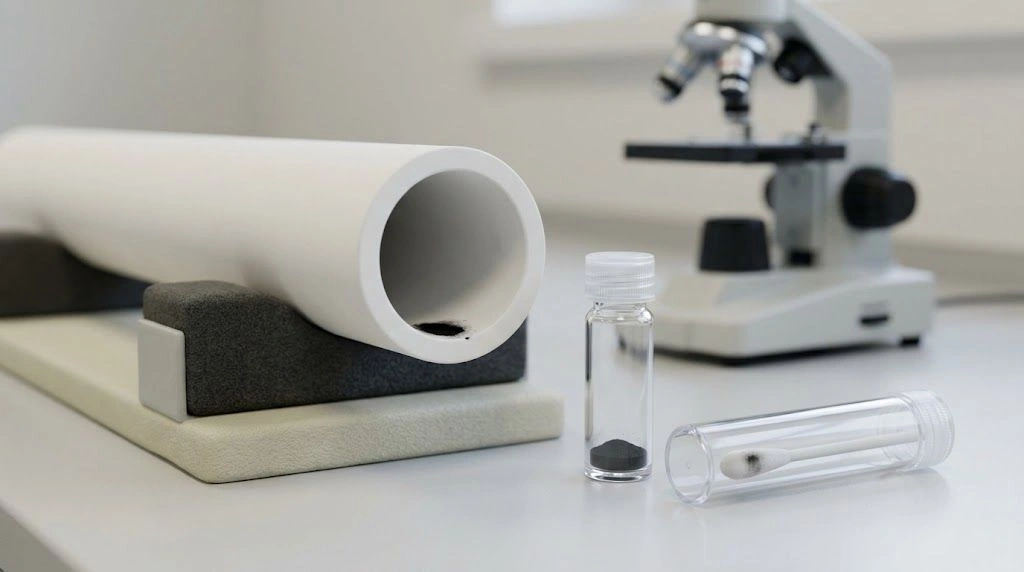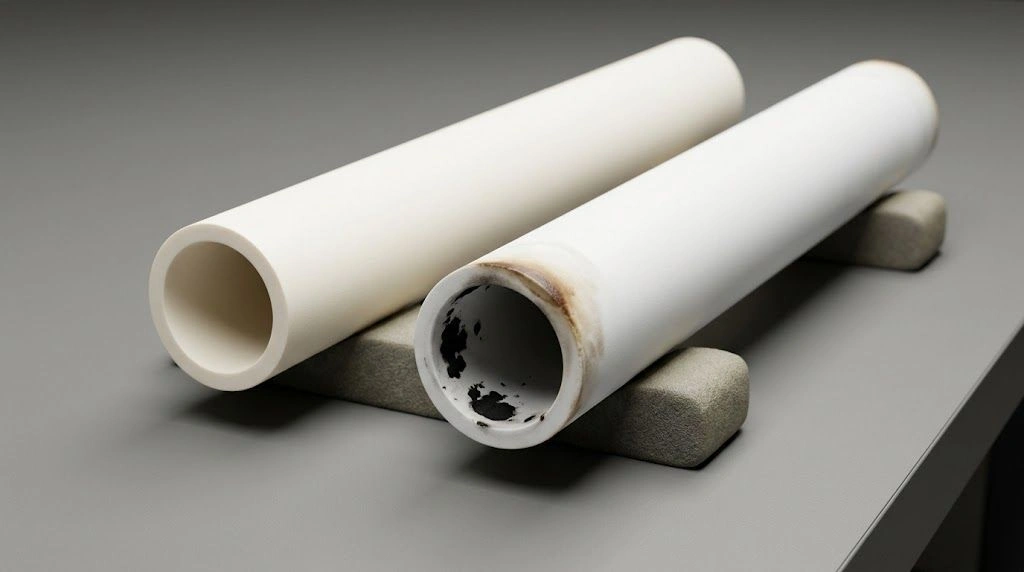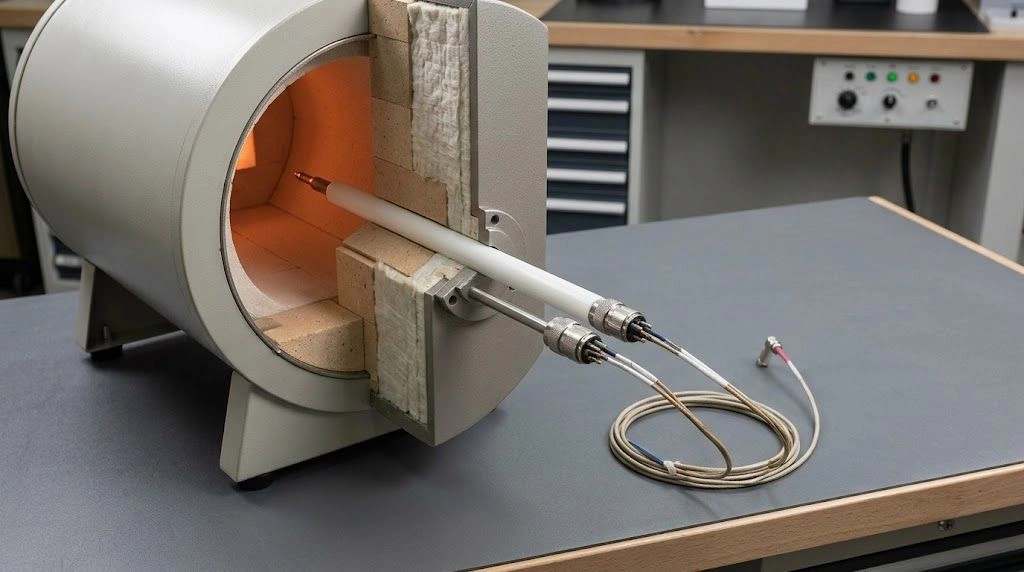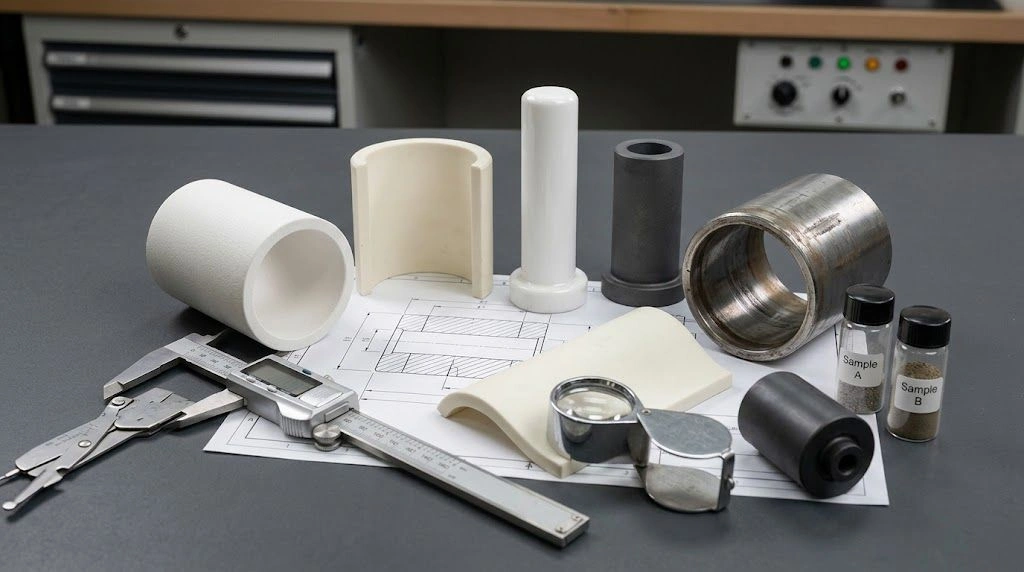
Sintering turns powder into a solid part by bonding neighboring particles. Heating increases atomic or ionic mobility, particle contacts grow into necks, and densifying mechanisms reduce pore volume. The entire component does not need to become liquid.
Full melting follows a different route: the solid framework becomes a freely flowing liquid, the original particle arrangement disappears, and a mold or container controls the shape before solidification.
Some sintering processes deliberately form a limited liquid phase. They are still sintering processes when a substantial solid framework remains instead of the complete part becoming a free-flowing melt.
What Is the Difference Between Sintering and Melting?
Sintering preserves a compact framework
Sintering begins with particles that have already been arranged into an approximate part shape. In conventional solid-state sintering, the particles remain solid while their contacts grow and the pore structure evolves.
The part normally retains the recognizable geometry of the green body, although its dimensions change. It may become stronger before it reaches high density, and it may finish with intentional or residual porosity.
Full melting destroys the particle framework
During full melting, the charge loses its solid-particle network and flows. Original particle contacts no longer define the structure. On cooling, nucleation and solidification create a new solid microstructure.
Multicomponent materials can have separate solidus and liquidus conditions, so partial and complete melting must be distinguished.
| Question | Sintering | Full melting |
|---|---|---|
| Does the entire part become liquid? | Normally no | Yes |
| What creates the final bond? | Diffusion, deformation, viscous flow, reaction or limited liquid | Solidification from a liquid |
| Is the green geometry recognizable? | Usually | Not without containment |
| Can the part shrink? | Yes, as pores and the framework evolve | Yes, during solidification and cooling |
| Can pores remain? | Yes | Yes, through different formation mechanisms |
| Do original particle contacts survive? | They evolve into grains and boundaries | They disappear in the liquid |
| Is a mold needed at peak temperature? | Usually not once the compact is self-supporting | Normally yes |
| Can a limited liquid exist? | Yes | The complete charge is liquid |
Liquid-phase sintering is not full melting
Liquid-phase sintering contains solid grains and a wetting liquid at the processing temperature. The liquid can draw particles together, accelerate transport and help eliminate pores while the solid phase continues to carry a framework.
An open-access review describes liquid-phase sintering as the coexistence of solid grains and a wetting liquid, with rearrangement, solution and reprecipitation contributing to densification and microstructure evolution. The same review also notes that liquid content and wetting influence distortion risk. Journal of Materials Science review
Transient liquid-phase sintering forms a liquid that later reacts, dissolves or changes into another phase. Viscous-flow sintering uses the flow of a softened glassy phase. Neither term means that every part has behaved like a fully molten casting.
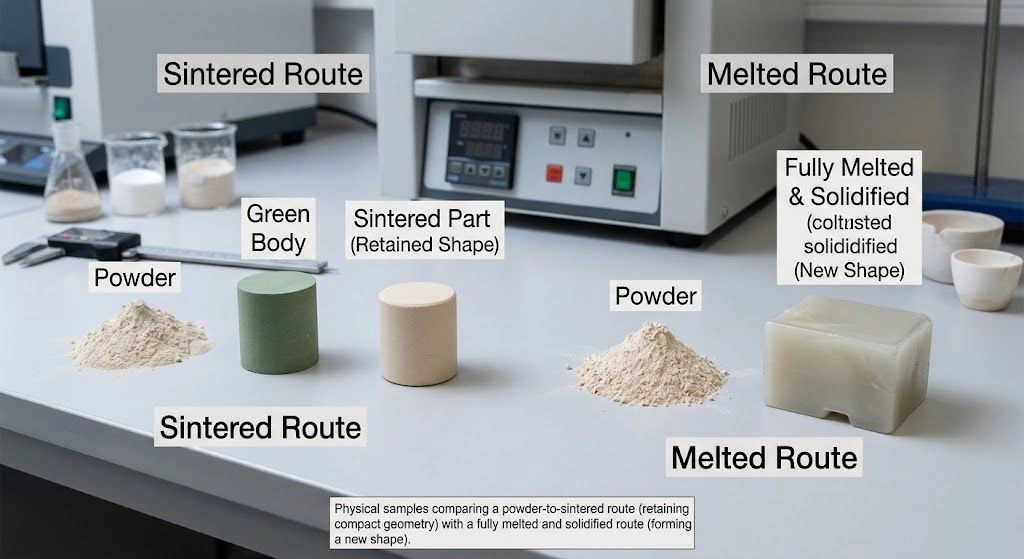
The sintered route retains the compact’s basic geometry, while the fully melted material must take shape again during solidification.
How Does Sintering Turn Powder Into One Solid Part?
Powder and forming establish the starting structure
Particle size, distribution, surface area, agglomeration, purity and additives affect how a powder packs and responds to heat. Finer particles often shorten diffusion distances and increase surface area, but strong agglomerates can create persistent large pores.
The powder is shaped by dry pressing, cold isostatic pressing, extrusion, injection molding, slip casting, tape casting or additive manufacturing. The unfired object is the green body.
A green body can be handled because compaction, binders and particle interactions provide green strength. It remains weaker and more porous than the fired ceramic.
Debinding prepares the compact for sintering
Organic binders and processing aids must leave through a controlled thermal stage. If gas evolves faster than it can escape, the part can blister, delaminate, crack, distort or retain carbon.
Debinding is not the same mechanism as sintering. A part can complete binder removal while particle bonding remains limited. Conversely, premature sintering can restrict escape paths and trap decomposition products.
Surface and interfacial energy provide a driving force
A powder compact contains extensive free surface area. The system can lower its energy by enlarging contacts, replacing free surface with grain boundaries, rounding interfaces and changing pores.
Heating does not supply a simple “glue.” It increases mobility so atoms or ions can move through paths that depend on the material and process.
Necks grow at particle contacts
The first contacts between particles are small. Material transport enlarges them into necks, increasing bonded area and rigidity.
As necks grow:
- Strength increases.
- Particle shapes evolve.
- Grain boundaries begin to develop.
- Pore channels change shape.
- Stress concentration at point contacts decreases.
Neck growth explains why a compact can become mechanically coherent before it is fully dense.
Different transport paths give different results
Possible paths include surface diffusion, grain-boundary diffusion, lattice diffusion, vapor transport, viscous flow, solution through a liquid and pressure-assisted deformation.
In simplified sintering models, surface diffusion and vapor transport can enlarge necks with little direct movement of particle centers. They can strengthen or coarsen the compact without equivalent shrinkage.
Densification requires transport or deformation that reduces pore volume and brings the particle framework closer together. The European Ceramic Society’s technical sintering material treats densification and grain growth as competing microstructural processes governed by different transport paths; this supports evaluating them separately rather than using neck size as a density measurement. European Ceramic Society sintering reference
| Mechanism | Can grow bonds or necks? | Direct densification in common idealized models |
|---|---|---|
| Surface diffusion | Yes | Little or none |
| Vapor transport | Yes | Little or none |
| Grain-boundary diffusion to pores | Yes | Yes |
| Lattice diffusion to pores | Yes | Yes |
| Viscous flow | Yes | Yes |
| Pressure-assisted deformation | Yes | Yes |
| Solution and reprecipitation | Yes | Often |
Real systems can combine paths, reactions and evolving phases; the table is only a conceptual guide.
Pore-volume reduction creates shrinkage
When densification dominates, particle centers approach, connected pore channels narrow and bulk volume decreases. The solid mass has not vanished; matter has been redistributed into a body containing less empty volume.
Linear shrinkage is an outcome of this evolving three-dimensional structure. It is not a universal material constant. Packing, forming direction, geometry, furnace position and phase changes can make shrinkage anisotropic or nonuniform.
Grain growth changes the final microstructure
Grain boundaries move as firing continues, and larger grains may grow at the expense of smaller ones. Some growth accompanies normal microstructure development.
Excessive growth can isolate pores from effective removal paths or reduce the benefit of additional holding time. Density, grain size, pore population and phase distribution therefore need to be evaluated together.
What Are the Main Stages and Types of Sintering?
Initial, intermediate and final stages
Initial stage: Particle contacts develop into necks. The pore network remains largely interconnected, particles remain recognizable and strength begins to rise.
Intermediate stage: Necks enlarge, grain boundaries develop and open pore channels narrow. A large share of densification and dimensional shrinkage commonly occurs during this stage.
Final stage: Many remaining pores are isolated. Densification slows, trapped gas can resist further shrinkage, and grain growth can become increasingly significant.
The boundaries are gradual; a nonuniform compact can contain regions at different stages during one cycle.
Solid-state sintering
Solid-state sintering proceeds without an intentionally persistent bulk liquid phase. Diffusion, interface migration and sometimes external pressure consolidate the part.
It can provide controlled phase composition and good shape retention, but may require high temperature and careful control of powder packing, additives and grain growth.
“Solid-state” does not guarantee that impurities or boundary phases never soften. The grade and atmosphere still matter.
Liquid-phase and transient-liquid routes
In liquid-phase sintering, a limited liquid can wet grains, rearrange them and accelerate mass transport. Benefits may include faster densification or a lower processing temperature.
Risks include slumping, segregation, reactions with setters and retained glassy boundary phases. Too much liquid or inadequate hot strength can compromise geometry.
A transient liquid later reacts, dissolves into the solid or changes during the hold. The phase present at peak temperature may therefore differ from what is found in the cooled component.
Viscous-flow and reactive sintering
Glasses and glass-containing ceramics can densify through viscous flow as a phase softens. The body may deform readily without becoming an unconstrained, fully liquid casting.
Reactive sintering forms new phases while consolidation occurs. Reactions can enhance bonding, but may also introduce volume change, gas, porosity or dimensional instability.
Pressure-assisted routes
Hot pressing and hot isostatic pressing combine heat with external pressure. Field- or current-assisted methods are also used; “spark plasma sintering” is a common industry name, but it should not be interpreted as proof that plasma is the universal densification mechanism.
Pressure can change the required temperature, time, density and grain-growth balance. Tooling, shape, size and cost limitations also change, so the route cannot be selected from density alone.
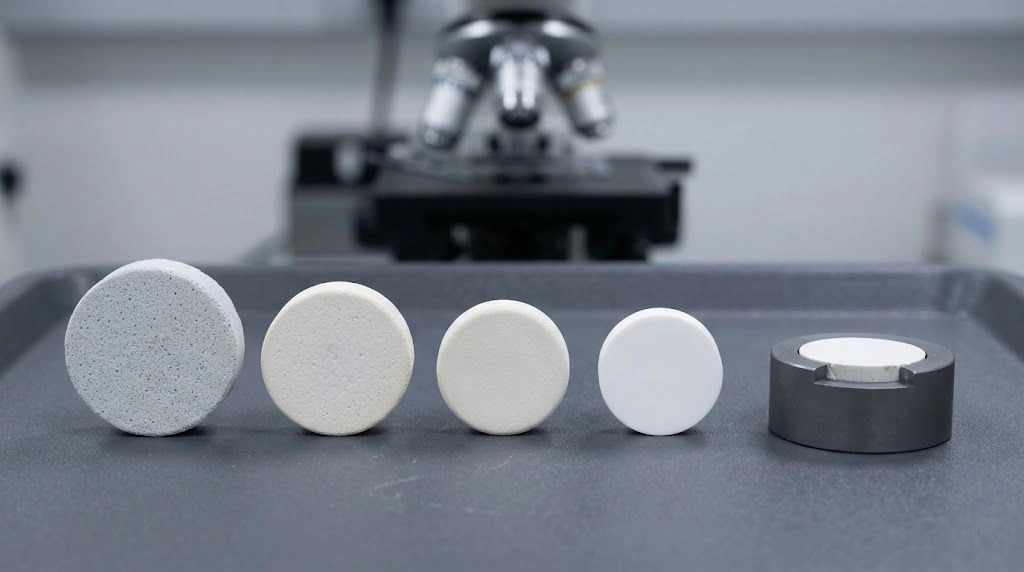
Controlled test specimens can document progressive shrinkage and surface development, while microscopy is needed to confirm internal pores and grains.
What Controls Shrinkage, Density and Sintering Defects?
Powder packing and green density
Average green density matters, but local density distribution matters more for distortion. Pressing gradients, agglomerates, layer boundaries and thickness transitions can cause different regions to shrink differently.
A nominal description such as “99.5% alumina” does not define powder morphology, additives, binder distribution or forming history. Two grades with the same headline purity can require different compensation.
Temperature and holding time
Higher temperature generally accelerates transport, but it does not guarantee a better component. Insufficient firing may leave weak bonds, open porosity or low density.
Excessive firing can promote grain coarsening, slumping, reaction, volatilization, phase change and distortion. Once densification becomes limited, extra hold time may mainly increase grain size or setter interaction.
The optimum window is material-, geometry- and equipment-specific. A cycle validated for a small pellet cannot automatically be transferred to a thick tube or large plate.
Heating rate, debinding and atmosphere
Heating rate controls the time available for binder escape, phase reactions and temperature equalization. Thick sections and enclosed features often respond differently from thin test pieces.
Atmosphere affects oxidation state, defect chemistry, carbon removal, volatilization and additive behavior. Specify gas composition, purity, flow, dew point or oxygen partial pressure where they influence the grade.
Vacuum is also a process condition, not an absence of chemistry. Volatile species and furnace materials still need consideration.
Additives and liquid formation
Sintering additives can increase diffusion, inhibit grain growth, stabilize a phase or create a liquid. They may also leave secondary phases, alter electrical behavior or reduce high-temperature capability.
Additive selection is part of the ceramic grade. Substituting a “similar purity” without reviewing the additive system can change shrinkage, color, microstructure and performance.
Geometry, setters and restraint
Abrupt thickness changes, sharp internal corners, large flats, long unsupported spans and asymmetric features can amplify differential shrinkage.
Setters support the part but also introduce friction, contact reactions and heat-transfer differences. Powder beds and coatings must be compatible with the ceramic, atmosphere and contamination limits.
| Observed defect | Possible process source | Evidence to review |
|---|---|---|
| Low density | Insufficient transport, poor packing or trapped pore network | Density and pore analysis |
| Warpage | Green-density gradient, thermal gradient or setter restraint | Green dimensions and furnace position |
| Firing crack | Debinding damage or differential shrinkage | Crack origin and burnout history |
| Large isolated pores | Agglomerates or trapped gas | Polished cross-section |
| Coarse grains | Excessive thermal exposure or abnormal growth | Grain-size measurement |
| Slumping | Excess liquid or inadequate hot strength | Phase and dimensional analysis |
| Surface reaction | Setter, crucible or furnace contamination | Elemental and phase analysis |
| Correct size but low strength | Porosity, flaws or unsuitable microstructure | Microscopy and mechanical testing |
A defect table identifies hypotheses, not root causes. For example, a firing crack may have originated during forming or debinding and only opened visibly during sintering.
What Should Buyers Specify for Sintered Ceramic Parts?
Buyers normally specify the finished component and service requirements. The manufacturer determines the powder route, green dimensions, firing compensation and machining sequence needed to meet them.
Do not apply one universal shrinkage factor
Shrinkage depends on the material grade, powder lot, forming route, pressing direction, local green density, part geometry, sintering cycle and furnace loading.
A catalog value can support early planning but cannot replace process validation. Scaling every green dimension by one percentage can fail when axial and radial shrinkage differ or when features have different density distributions.
Define the finished material and geometry
Provide the ceramic family and required grade or purity, plus any stabilizer, additive, prohibited-element, density or porosity requirements that are functionally justified.
The finished drawing should establish datums and identify critical-to-quality dimensions. Include wall thickness, flatness, straightness, parallelism, concentricity, radii, chamfers and edge requirements where relevant.
State which surfaces may remain as-fired and which require grinding, lapping or polishing. Final machining can correct selected dimensions, but it cannot repair internal porosity, an unsuitable phase or firing cracks.
Describe service and acceptance conditions
Provide operating temperature, atmosphere, cycling, mechanical load, pressure or vacuum, contact media, insulation needs and cleanliness requirements.
Define the inspection basis: dimensional report, density method, sampling plan, material certification, lot traceability, functional test and first-article approval.
If grain size, open porosity or surface finish is specified, identify the test method and acceptance location. A requirement without a measurement basis can be interpreted differently by buyer and supplier.
Ask how the route controls risk
Useful supplier questions include:
- Which forming route is proposed?
- Which features are formed, green-machined or fired-machined?
- How is lot shrinkage compensated?
- How are green-density gradients and warpage controlled?
- Which dimensions are CTQs?
- How are density and porosity verified?
- What first-article evidence will be provided?
- Which parameters are frozen for repeat production?
- How are drawing revisions controlled?
A technically complete inquiry for custom sintered ceramic components should define finished geometry, ceramic grade, service environment and inspection requirements. The supplier can then review green allowance, sintering compensation and final machining.
Frequently asked questions
Does sintering melt the powder?
Not necessarily. Solid-state sintering bonds solid particles. Other routes use a limited liquid without melting the whole part.
Why does the part shrink?
Densifying mechanisms reduce pore volume and bring the particle framework closer together.
Does neck growth prove increasing density?
No. Some transport mechanisms enlarge necks with little direct densification.
Can a sintered ceramic have zero porosity?
Very high density is possible, but complete pore elimination is not automatic. Closed pores, trapped gas and grain growth may limit densification.
Why not simply increase temperature?
Additional heat can accelerate densification, grain growth, reaction and distortion. The useful balance is process-specific.
Is sintering limited to ceramics?
No. It is also used for metals, carbides, cermets, composites and selected polymers.
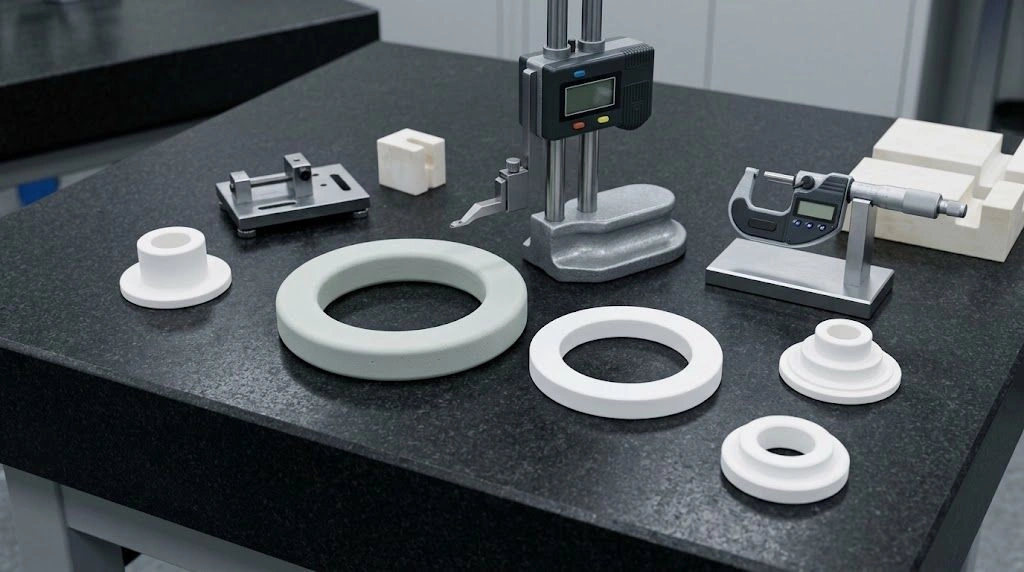
Finished-part requirements should drive green allowance, firing compensation and machining decisions.
From powder to a controlled finished part
Powder becomes solid through particle bonding, pore evolution and microstructure development—not because every particle simply melts together. Sintering retains a compact framework; full melting replaces it with a liquid that must solidify again.
This distinction explains why density, shrinkage, grain size and final tolerances depend on the complete route from powder preparation through forming, debinding, firing and machining.