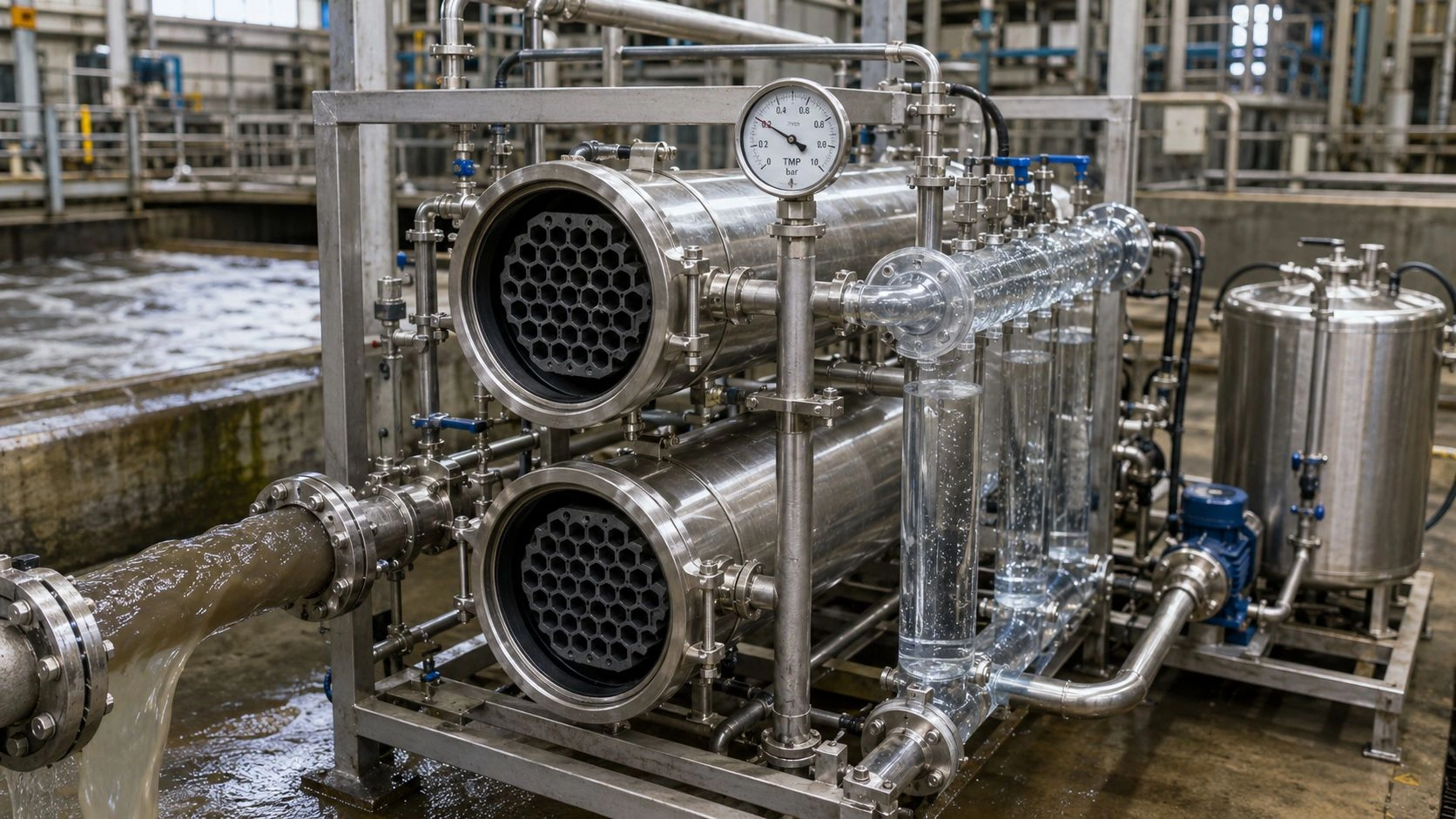
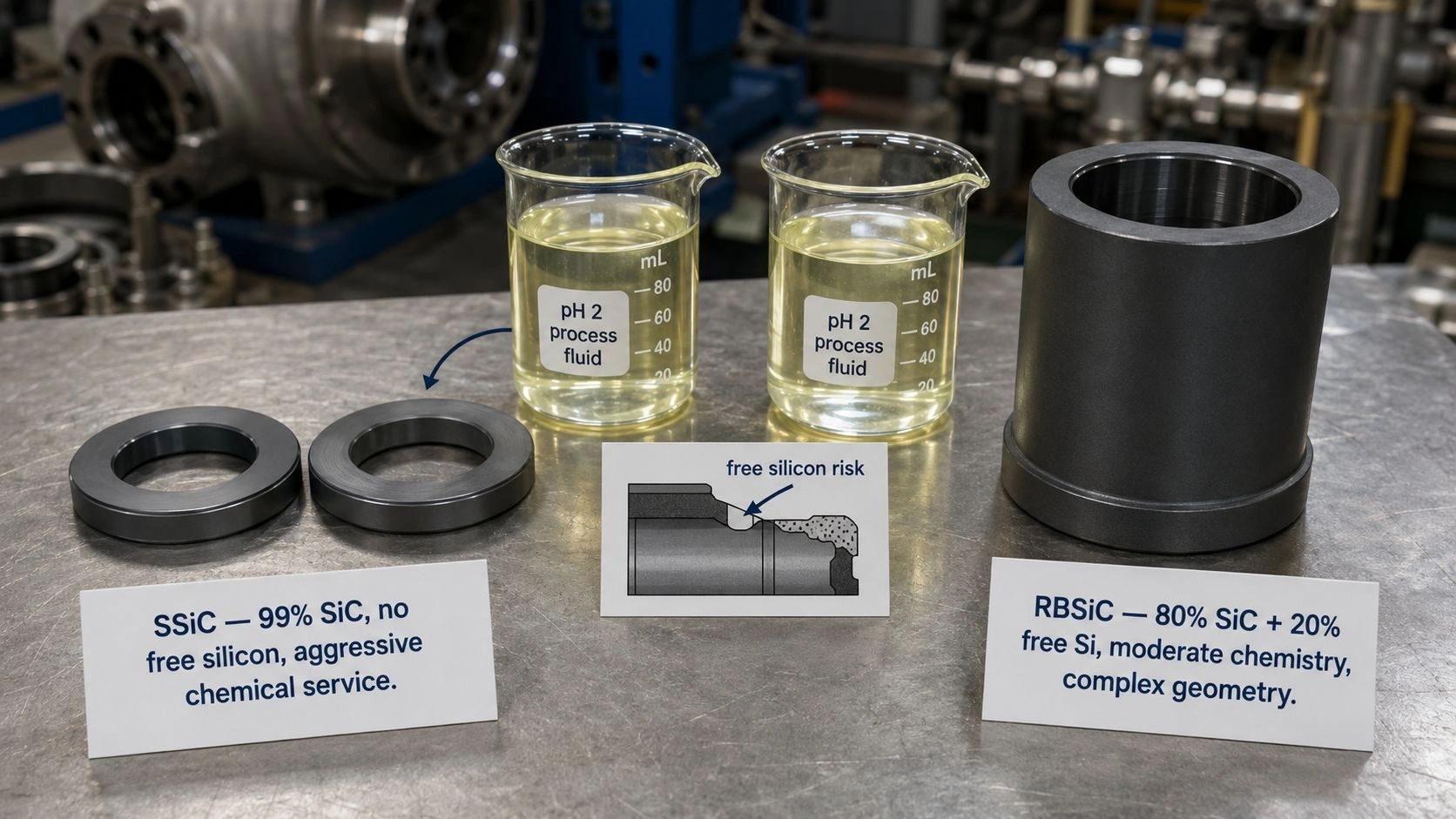
SSiC is usually the safer choice for chemical pump service when the fluid contains strong acids, strong alkalis, oxidizers, high-purity chemicals, or when seal faces and bearings require maximum corrosion resistance, density, and dimensional stability. RBSC — also called reaction-bonded SiC, RBSiC, or SiSiC — can be a practical choice when the duty is mainly abrasive wear, moderate chemical exposure, complex shape requirement, larger component geometry, or cost-sensitive replacement. The key difference is residual silicon: SSiC is essentially free silicon-free sintered SiC, while RBSC contains residual free silicon from the reaction-bonding process. That free silicon improves near-net shape manufacturability but limits chemical resistance in aggressive media.
That residual-silicon framing — not a general quality comparison — is the engineering basis for the SSiC/RBSC decision in chemical pump service.
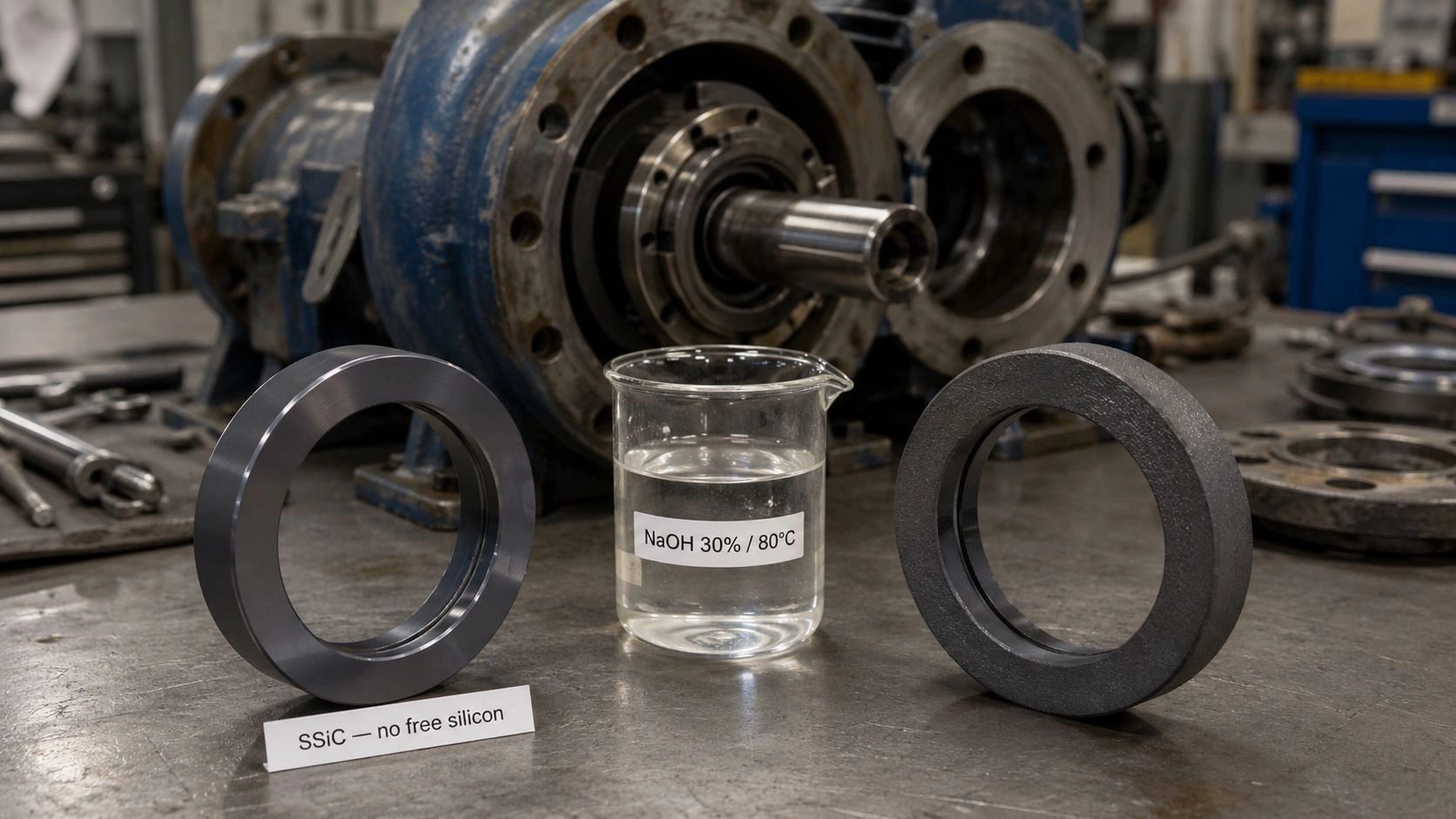
SSiC and RBSC are both silicon carbide pump materials, but residual free silicon in RBSC limits chemical resistance in strong acids and alkalis — component role, fluid chemistry, and failure mode determine which grade is correct.
The silicon carbide mechanical components at ADCERAX — covering SSiC seal rings, bearings, bushings, shaft sleeves, and custom pump wear parts alongside RBSiC components for chemical processing and fluid-handling applications — are the starting point for the grade selection decisions described in this guide.
What SSiC and RBSC mean in pump components
Before comparing the two grades, the manufacturing difference that creates their performance difference must be understood — because both carry the name ""silicon carbide"" but are produced by fundamentally different routes.
SSiC — dense, high-purity, no free silicon. Sintered silicon carbide is produced by pressing and sintering fine SiC powder, typically with sintering aids, at very high temperature. The result is a dense, essentially single-phase ceramic body with very low open porosity, no free silicon, and a high SiC content. Published SiC material descriptions confirm SSiC as the highest-purity SiC route with no residual free silicon, recommended for mechanical seals, pump components, and demanding chemical applications.
RBSC — SiC body with residual silicon phase. Reaction-bonded silicon carbide is made by infiltrating a porous SiC and carbon preform with molten silicon. The silicon reacts with the carbon to form new SiC, while excess silicon fills the remaining pore space. This creates a dense SiC–Si composite with good strength and near-net-shape manufacturability, but the residual silicon — typically 8–12% by volume — remains as a continuous or near-continuous phase in the material.
In pump service, that residual silicon is the dividing line. The SSiC vs RBSC Decision Matrix below maps the key decision variables:
| Decision variable | SSiC direction | RBSC/SiSiC direction | What to verify |
|---|---|---|---|
| Strong acid | Usually preferred | Risk if free silicon is attacked | Acid type, concentration, temperature |
| Strong alkali | Usually preferred | Often higher risk | NaOH/KOH %, temperature |
| Oxidizing chemical | Safer starting point | Validate carefully | Oxidizer type and pH |
| Neutral abrasive slurry | Strong but higher cost | Often practical | Particle size and impact severity |
| Complex shape | Harder/costlier | Strong advantage | Geometry, wall thickness, tolerances |
| High-purity fluid | Usually preferred | Residual silicon may be unacceptable | Contamination limit |
| Precision seal face | Preferred | Possible in less aggressive service | Flatness, lapping, mating face |
| Large sleeve/liner | Possible but costly | Often cost-effective | Chemistry and residual silicon risk |
| Dry-running upset | Grade alone does not solve | Grade alone does not solve | Heat generation, lubrication, cooling |
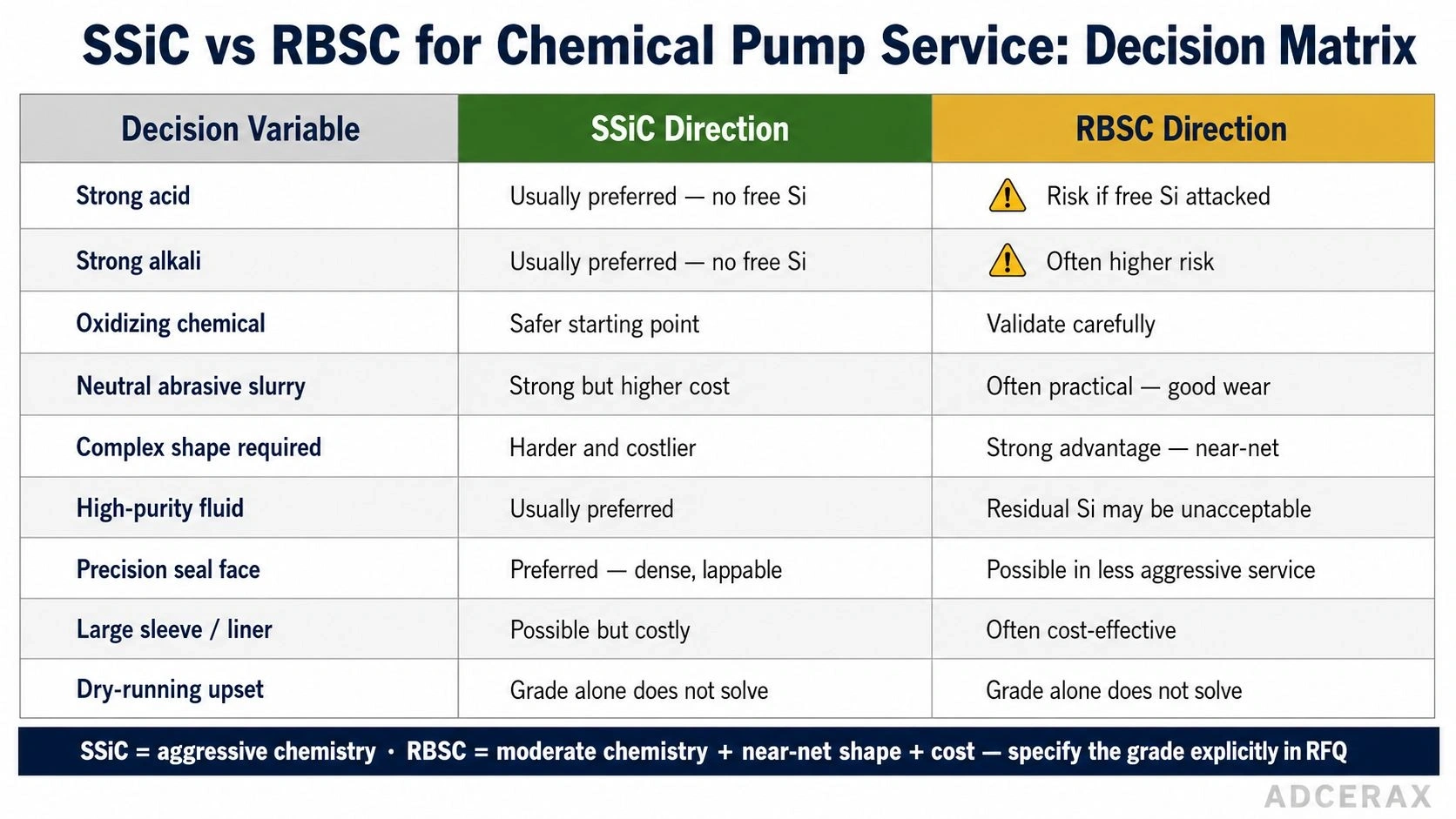
SSiC is usually the safer starting point for aggressive chemistry and precision seal faces, while RBSC remains practical for moderate chemistry, near-net complex shapes, and cost-sensitive larger components when residual free silicon is acceptable.
Why both are called ""SiC"" but behave differently. The difference is invisible in the product name and often under-specified in RFQs that request only ""SiC seal ring"" or ""SiC sleeve."" A supplier who ships RBSC in response to an SSiC requirement has supplied a formally different material with potentially meaningfully lower corrosion resistance in the intended fluid. The RFQ must specify which SiC route is required and confirm chemical compatibility.
Where SSiC wins in chemical pump service
After establishing the material-route difference, the application conditions that favor SSiC over RBSC can be mapped to specific pump fluids and component duties.
[CITE: Published mechanical seal material guidance confirms that reaction-bonded silicon carbide contains approximately 8–12% free silicon and should be avoided in strong acids and strong bases because the free silicon phase is attacked by those media — and published seal material comparison references recommend alpha-sintered silicon carbide for chemical applications as the more chemically resistant SiC route — confirming that for aggressive chemical pump service the residual silicon in RBSC creates a corrosion risk that SSiC avoids, and that the grade selection should be driven by the specific fluid chemistry's ability to attack free silicon rather than by general SiC material category.]
Strong acids and strong alkalis. The free silicon phase in RBSC can be attacked by both strong acids and strong caustic solutions. In a pump handling concentrated sulfuric acid, concentrated hydrochloric acid, concentrated nitric acid, 50% sodium hydroxide, or concentrated potassium hydroxide, the residual silicon in an RBSC seal ring or bushing can be selectively dissolved — degrading the mechanical integrity of the component even while the SiC phase remains intact. SSiC, with no free silicon, avoids this selective attack mechanism.
Oxidizers and high-purity chemical fluids. Oxidizing acids such as concentrated nitric acid, mixtures with hydrogen peroxide, or bleaching agents can attack silicon selectively in oxidizing conditions. For high-purity chemical production, pharmaceutical intermediates, and electronic-grade chemical transfer, contamination from dissolving silicon is an additional concern alongside surface corrosion. SSiC's absence of a separate reactive silicon phase makes it the more defensible specification in these services.
Precision seal faces and lapped surfaces. SSiC's density and hardness support fine lapping of seal faces to the flatness required for liquid-film mechanical seal operation. Published SiC bearing and seal guidance confirms that sintered SiC is suited for thrust and journal bearing components in magnetically driven pumps due to corrosion resistance, thermal conductivity, and strength at high speed in chemical service. A precision-lapped SSiC seal face provides a consistent, stable tribological surface over the service life of the seal.
Magnetic-drive pump bearings and thrust washers. In canned motor and magnetic-drive pumps where the bearings run in the process fluid without external lubrication, the bearing material must resist both the process chemistry and the low-lubricity condition. SSiC bearings — providing low porosity, chemical resistance, and thermal conductivity for heat dissipation from the bearing interface — are the standard specification for demanding chemical magnetic-drive pump service.
The silicon carbide seal rings and silicon carbide sleeves at ADCERAX are available in SSiC for corrosion-critical chemical pump applications where residual-silicon-free material is required.
Where RBSC/SiSiC still makes sense
After establishing where SSiC is preferred, RBSC's valid use cases in pump service should be understood rather than dismissed — because treating RBSC as a uniformly inferior material leads to over-specifying SSiC where it adds cost without solving the actual failure mode.
The Material Route Comparison table maps the main SiC and alternative options:
| SiC route | Best-fit pump use | Main advantage | Main boundary |
|---|---|---|---|
| SSiC | Chemical pump seals, bearings, sleeves, high-purity wet-end parts | Highest chemical resistance, dense body, no free silicon | Higher cost and machining difficulty |
| RBSC/RBSiC | Larger wear parts, sleeves, liners, moderately corrosive slurry service | Near-net shape, cost-effective, good wear resistance | Residual free silicon limits chemical resistance |
| SiSiC | Often used interchangeably with RBSC terminology | Dense SiC–Si composite and shape flexibility | Same free silicon review needed |
| Tungsten carbide | Shock, vibration, impact-heavy seal duty | Higher toughness than SiC in some duties | Corrosion limits in some chemicals |
| Zirconia | Impact or edge-load-sensitive ceramic parts | Higher toughness | Lower thermal conductivity and different chemical limits |
| Metal alloy | Structural and pressure-bearing pump parts | Toughness, machinability, repairability | Corrosion, galling, and wear |
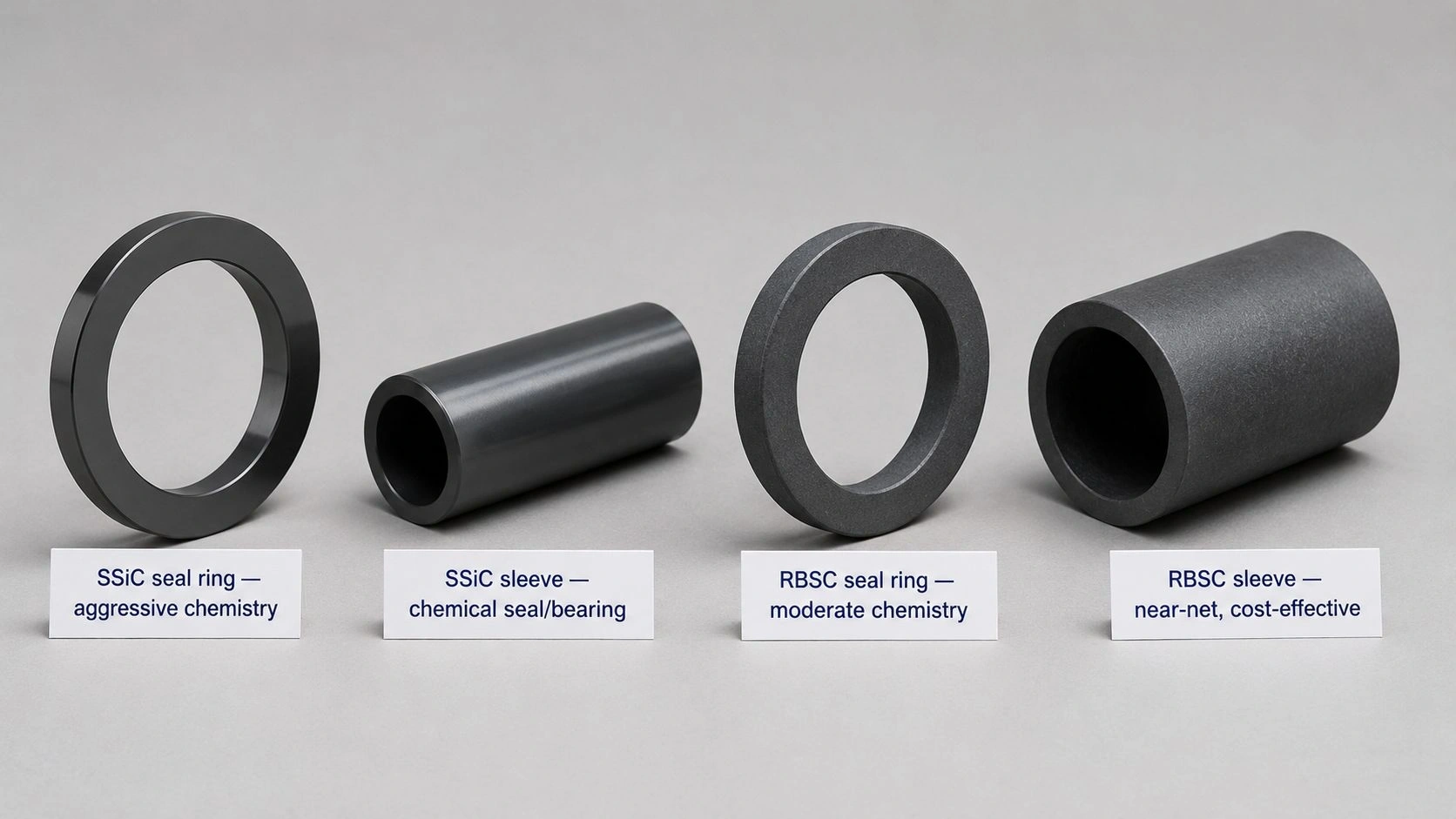
SSiC seal rings and sleeves are typically specified for aggressive chemistry and precision sealing duties, while RBSC seal rings and sleeves can fit moderate chemistry or larger near-net pump parts where cost and geometry matter.
Cost-sensitive replacement parts. For pump components that are regularly replaced — wear sleeves, bushings, liners — where the fluid does not aggressively attack free silicon, RBSC can provide adequate service at lower material and machining cost than SSiC. If the process fluid is a neutral abrasive slurry, cooling water with suspended solids, or a mildly corrosive solution that does not specifically attack silicon, RBSC is a practical economic choice.
Near-net shape for complex or larger geometries. RBSC's near-net-shape manufacturing process can produce larger and more geometrically complex SiC components with lower machining allowance and lower manufacturing risk than SSiC, which requires significant material removal after sintering to reach final dimensions. For large sleeves, pump liners, and custom-geometry components, RBSC's manufacturing advantage can be meaningful.
Abrasive wear where chemistry is moderate. In slurry pump applications handling abrasive particles in neutral or mildly aggressive media, the dominant failure mode is abrasive wear rather than chemical attack. Both SSiC and RBSC provide good hardness and abrasion resistance, and the choice between them may be driven by cost and geometry rather than corrosion performance — provided the fluid chemistry has been confirmed not to attack free silicon.
The silicon carbide ceramic material overview at ADCERAX distinguishes SSiC, RBSiC, and NBSiC routes by manufacturing process, density, and application fit, and the custom ceramic shaft and pump component range covers hybrid ceramic-metal pump assemblies where the SiC grade selection follows the specific component's corrosion and wear exposure.
Do not misdiagnose pump failure as SSiC or RBSC grade error alone
When a SiC pump component — whether SSiC or RBSC — fails prematurely, the grade selection is one of several possible causes. Attributing every failure to the wrong grade without investigating the failure mechanism leads to expensive material upgrades that do not fix the underlying problem.
Dry running vs chemical corrosion. SiC seal faces that crack or heat-check from dry running look similar to chemically corroded surfaces when inspected casually. A dry-running event — caused by loss of prime, operation against a closed valve, or insufficient flush — generates frictional heat that exceeds SiC's thermal shock resistance at the seal face contact, producing surface fracture. This failure mode is not solved by switching from RBSC to SSiC — it requires lubrication, flow protection, or flush system correction.
Cavitation and slurry impact vs material wear. Pitting, surface crater formation, and localized material removal in pump wet-end components can come from cavitation energy rather than chemical attack or tribological wear. If the component shows a distinctive crater pattern concentrated on the suction-side or pressure-side face rather than distributed surface degradation, cavitation is the probable cause, and NPSH correction or impeller redesign addresses the problem rather than grade change.
Press-fit and assembly stress vs ceramic brittleness. SiC pump bushings and seal ring carriers that crack at installation are showing assembly-induced mechanical failure, not material quality failure. If the press-fit interference is too high, the edge chamfer is insufficient, or the housing bore is not aligned, the resulting hoop stress during press-in can fracture the ceramic regardless of whether it is SSiC or RBSC. Design review of the fit, chamfer, and installation method resolves this failure mode.
The Failure Diagnosis Matrix maps observed chemical pump SiC failures to better diagnostic questions:
| Observed problem | Common assumption | Better diagnostic question |
|---|---|---|
| RBSC part corrodes in caustic | Supplier quality issue | Is free silicon being attacked by strong alkali? |
| SSiC seal face cracks | SSiC wrong grade | Was there dry running, thermal shock, or face overload? |
| RBSC sleeve wears quickly | RBSC not hard enough | Are particles too large or impact-heavy rather than sliding wear? |
| Seal leaks after upgrade | SSiC failed | Was mating face, flatness, spring load, or elastomer compatibility checked? |
| Bushing cracks during assembly | Bad ceramic | Was press-fit too high or chamfer insufficient? |
| Pump seizes | SiC material issue | Was lubrication, solids load, or shaft runout controlled? |
| Metal contamination appears | SiC contamination | Were metal holders, springs, shaft, and casing also checked? |
Diagnosis should be based on failure location, surface analysis, fluid chemistry records, and operating history before any grade change is specified.
RFQ checklist for SSiC vs RBSC chemical pump parts
A complete RFQ for SSiC or RBSC chemical pump components must provide the fluid chemistry and the failure mode context — without both, the supplier cannot confirm whether SSiC or RBSC is appropriate and cannot confirm chemical compatibility for the specific pump duty.
[CITE: Engineering and mechanical seal material guidance on SSiC vs RBSC specification for chemical pump service confirms the complete RFQ sequence: component role with load and surface requirement, fluid chemistry including acid/base type/pH/concentration/oxidizers/chlorides/HF risk, operating and upset temperature, solids content with particle size and hardness, pump speed and face load, dry-running risk, current failure mode with photographs, mating material for tribological pair, surface finish and flatness requirement, grade specification (SSiC or RBSC stated explicitly with chemical limits), and inspection method — because fluid chemistry, failure mode, and grade route together determine the correct SiC specification, and a supplier who receives only ""SiC seal ring"" cannot confirm residual silicon risk, chemical compatibility, or appropriate surface specification without the remaining pump duty context.]
| RFQ field | Why it matters | Recommended wording |
|---|---|---|
| Component role | Defines load and surface requirement | ""Seal ring/sleeve/bearing/bushing/thrust washer/liner"" |
| Fluid chemistry | Main corrosion driver | ""Acid/base type, pH, concentration, oxidizers, chlorides, HF risk"" |
| Temperature | Controls corrosion and thermal stress | ""Normal, peak, upset temperature"" |
| Solids content | Controls wear and impact | ""Solids %, particle size, hardness, concentration"" |
| Pump speed/load | Controls friction and stress | ""RPM, face load, shaft diameter, pressure"" |
| Dry-running risk | Controls thermal shock | ""Expected dry-run duration or upset condition"" |
| Current failure mode | Guides grade choice | ""Corrosion, scoring, cracking, leakage, seizure, wear"" |
| Mating material | Controls tribology | ""SiC/SiC, SiC/carbon, SiC/TC, SiC/metal"" |
| Surface finish | Controls leakage and wear | ""Ra, flatness, lapping, sealing face requirement"" |
| Grade request | Prevents generic SiC substitution | ""Quote SSiC or RBSC separately with chemical limits"" |
| Inspection | Prevents acceptance disputes | ""Density, porosity, flatness, CMM, visual, leak or fit test"" |
RFQ fields are the minimum for a chemical pump SiC component grade selection; add mating pair seal geometry, spring rate, and cleaning or sterilization cycle as needed.
For new pump applications, new process chemicals, or first-time SiC upgrades from metal components, running one service period with monitoring — seal temperature, flush flow, leakage rate, and impurity content — provides the most reliable qualification data before specifying SSiC or RBSC for fleet-wide replacement.
Evaluating SSiC or RBSC for chemical pump service? Share your pump type, fluid chemistry, pH, concentration, temperature, solids content, dry-running risk, current failure mode, component drawing, mating material, and surface-finish requirement. ADCERAX can review whether SSiC, RBSC/SiSiC, tungsten carbide, zirconia, metal alloy, or a hybrid design fits the duty; turnaround depends on inquiry complexity — no commitment required at this stage.
Frequently Asked Questions
Which is better for chemical pumps: SSiC or RBSC?
SSiC is usually better for aggressive chemical pump service because it has no free silicon phase and offers stronger resistance to strong acids, strong alkalis, and oxidizing media. RBSC can be suitable for moderate chemical service, abrasive wear-dominated duty, larger component geometries, and cost-sensitive replacement parts where the fluid does not specifically attack free silicon.
Why does residual silicon matter in RBSC pump parts?
RBSC contains residual free silicon from the reaction-bonding manufacturing process — typically around 8–12% by volume. That silicon phase can be attacked by strong acids and strong bases even when the surrounding SiC matrix remains intact, potentially degrading the mechanical integrity and chemical resistance of the component in aggressive chemical pump service. Published mechanical seal material guidance explicitly states that RBSC should be avoided in strong acids and strong bases for this reason.
Is RBSC still used in mechanical seals?
Yes, widely. Reaction-bonded SiC is common in mechanical seal faces and pump wear parts, especially for applications where the fluid is not strongly attacking free silicon and where near-net shape, component size, and cost are important. Published seal material references confirm that alpha-sintered SiC is recommended for more demanding chemical applications, while RBSC remains practical for a broad range of pump duties.
When should I specify SSiC for pump components?
Specify SSiC for strong acids, strong alkalis, oxidizing fluids, high-purity chemical service, precision seal faces requiring fine lapping, magnetic-drive pump bearings and thrust washers, and any application where the fluid chemistry could selectively attack free silicon in RBSC.
When is RBSC a reasonable pump component choice?
RBSC can be appropriate for abrasive but chemically moderate slurry service, larger or geometrically complex components where near-net shape reduces manufacturing cost, cost-sensitive pump sleeves, liners, and bushings, and applications where fluid chemistry has been confirmed not to attack free silicon at the operating temperature.
What should I send to a supplier to specify SSiC vs RBSC?
Send pump type, component drawing with all geometry and tolerances, fluid chemistry including acid/base type, pH, concentration, oxidizers, chlorides, and any HF risk, operating and upset temperature, solids content and particle size, pump speed and face load, dry-running risk, current failure mode and photographs, required mating material, surface finish and flatness requirement, explicit grade specification (SSiC or RBSC), and inspection criteria including density, porosity, flatness, and leak or fit test as applicable.
"