Ceramics for metal melting should be selected by melt chemistry, operating temperature, wetting behavior, flux or slag exposure, thermal cycling, furnace type, and contamination tolerance — not by maximum temperature rating alone. Alumina fits many clean laboratory and high-purity industrial melts; silicon carbide is often considered for thermal-shock-prone non-ferrous melting where heat transfer matters; boron nitride is useful where non-wetting behavior and clean release are governing requirements; zirconia or specialized oxides may be needed for reactive alloys after compatibility testing. No single ceramic material is correct for all metals or all furnace conditions.
That selection discipline — starting with the metal and the operating environment before shortlisting materials — is the engineering framework this guide is built around.
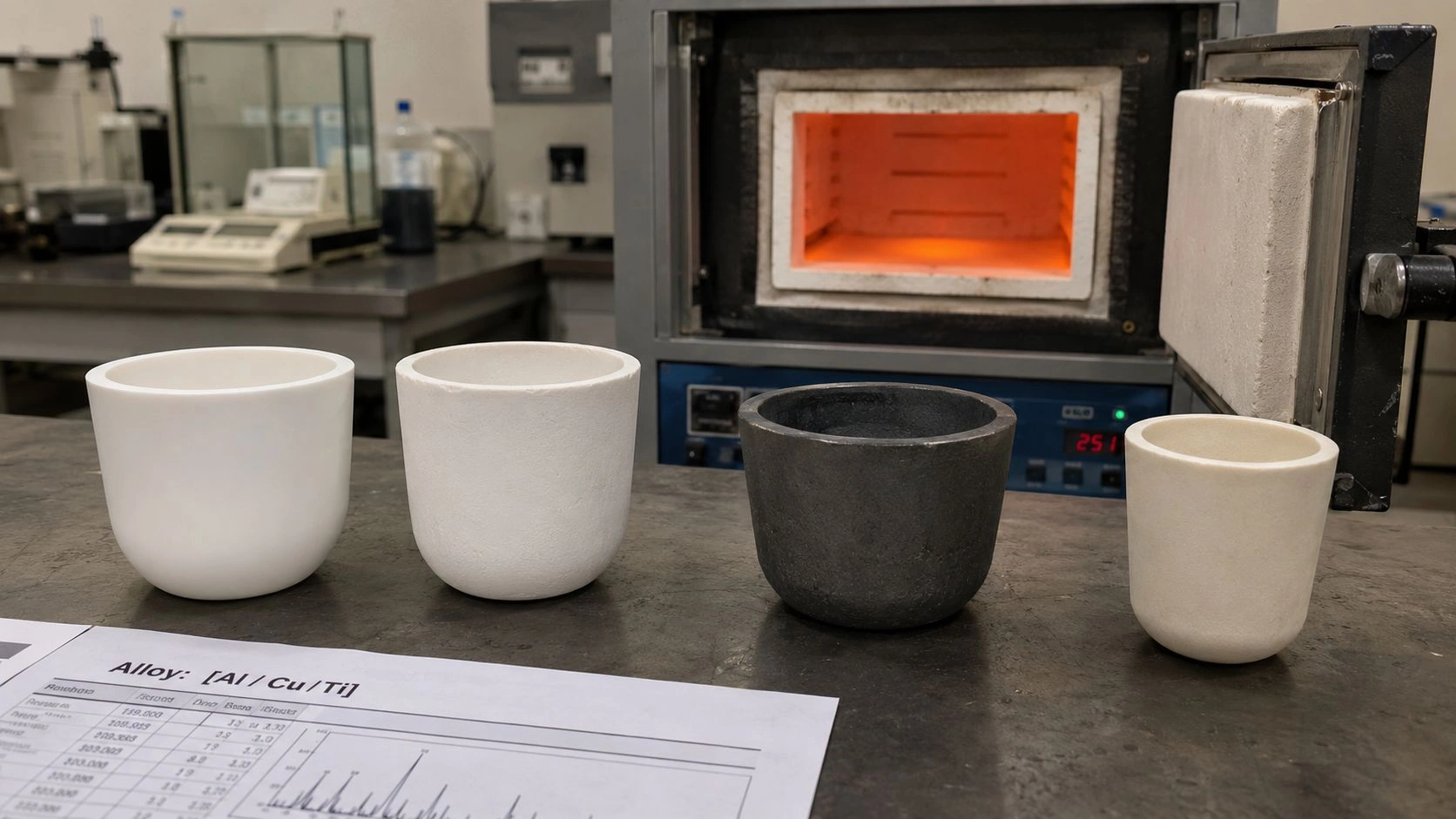
Ceramic selection for metal melting starts with the metal and the furnace environment — alumina, zirconia, SiC, and BN each serve different metal families and failure-mode profiles.
What operating conditions control ceramic selection for metal melting?
Before shortlisting ceramic candidates, the service environment must be defined. A ceramic that performs excellently in one melting condition can fail in a closely related application if any one of the key variables differs. In practice, the metals and alloys being melted define the temperature window and the chemical/physical interaction between melt and crucible — so the metal is the starting point, not a ceramic catalog.
The Ceramic Selection Criteria table below maps each operating variable to its engineering significance:
| Selection variable | What to check | Why it matters | RFQ input |
|---|---|---|---|
| Metal/alloy chemistry | Aluminum, magnesium, copper alloy, precious metal, steel, titanium, nickel alloy | Determines wetting, corrosion, contamination, and reaction risk | Exact alloy grade or composition range |
| Melt temperature | Melting + holding + superheat | Maximum temperature alone does not capture exposure time or gradient | Melt temp, hold temp, cycle duration |
| Flux/slag/salt | Borax, chloride salts, oxide slag, reducing flux, refining agent | Flux can attack ceramics differently from clean metal | Flux type and concentration |
| Atmosphere | Air, vacuum, inert gas, reducing gas | Oxidation and decomposition risk vary by ceramic | Furnace atmosphere and oxygen level |
| Thermal cycling | Heating/cooling rate and cycle count | Thermal shock may dominate over steady-state heat resistance | Ramp rate and expected cycles |
| Purity requirement | Metal contamination tolerance | Some ceramics can introduce trace elements or react at the interface | Maximum impurity limits |
| Geometry/load | Wall thickness, unsupported span, tong/handling | Brittle fracture risk depends on design and handling | Drawing, load, handling method |
Values indicative; verify with supplier-specific test data and application trials.
Metal chemistry and melt interaction. The chemistry of the alloy being melted is the first and most important selection variable. Aluminum alloys, copper-base alloys, precious metals, steel, nickel-base superalloys, and reactive metals such as titanium all interact differently with ceramic surfaces. Some alloys wet oxide ceramics readily; others form chemical reaction products at the interface. The same ceramic that is inert toward one alloy may dissolve, contaminate, or be penetrated by another under similar temperature and time conditions. Identifying the metal chemistry first prevents the most common selection error — choosing a ceramic by temperature rating before checking chemical compatibility.
Temperature, holding time, flux, slag, and furnace atmosphere. Temperature sets the lower bound for ceramic qualification, but it is far from the only thermal variable. Holding time at peak temperature increases the opportunity for diffusion-driven reactions between melt and ceramic. Superheat — the temperature above the liquidus at which the alloy is processed — accelerates chemical reactions exponentially in some systems. Flux or slag chemistry must be evaluated separately from the clean metal, because fluxes used in aluminum drossing, copper refining, or precious metal recovery often attack ceramics more aggressively than the base metal alone. Furnace atmosphere — air, vacuum, inert gas, or reducing gas — changes the surface chemistry of the ceramic and can shift the stability boundary of the surface protective phases that make a ceramic chemically resistant.
Metal chemistry and melt interaction
The single most useful practice when starting a new ceramic selection is to describe the melt in writing before looking at any ceramic data sheet. The description should include the alloy designation, the major and minor alloying elements with their concentration ranges, any flux or refining agents added during processing, the expected holding time at peak temperature, and the allowable contamination in the finished metal. With that description, a supplier can immediately identify which ceramic grades are disqualified by chemical compatibility before any other properties are evaluated.
Temperature, holding time, flux, slag, and furnace atmosphere
A practical rule is to treat maximum temperature as a necessary but not sufficient condition. After confirming that a ceramic survives the temperature, the next checks are: does the melt wet the ceramic surface or penetrate it under the combination of temperature and hold time? Does the flux react with the ceramic body? Is the protective surface phase of the ceramic stable in the furnace atmosphere? Does the thermal cycling impose shock conditions that exceed the ceramic's quench-crack resistance? These four checks eliminate more candidates than temperature alone.
Which ceramic materials fit aluminum, copper alloys, precious metals, steel, and reactive alloys?
After defining the operating conditions, the material shortlist follows a metal-family logic — not a ceramic-popularity logic. The right ceramic for a given metal family emerges from the combination of the most common failure modes for that metal group and the properties that address those failure modes.
The Metal Family to Ceramic Shortlist table maps common metal families to their primary failure risks and ceramic candidates:
| Metal family | Primary risk | Ceramic candidates to evaluate | Main caution |
|---|---|---|---|
| Aluminum/magnesium alloys | Wetting, melt penetration, oxide/flux attack | BN, SiC, selected alumina | Confirm non-wetting behavior and flux compatibility |
| Copper/brass/bronze | Thermal shock, heat transfer, erosion | SiC, alumina, selected zirconia | Furnace type and cycling rate strongly affect choice |
| Precious metals | Purity, contamination, clean release | Alumina, zirconia, BN | Avoid contamination from crucible additives or binders |
| Steel/cast iron | High temperature, slag attack, erosion | High-alumina systems, SiC-based systems, specialized refractories | Large-scale melting may require refractory-system design |
| Titanium/reactive alloys | Thermodynamic stability and interface reaction | Yttria/zirconia/specialized oxides after testing | Require melt-specific compatibility testing |
Values indicative — candidates to evaluate; melt-contact trial / supplier grade sheet required. Not an ADCERAX exclusive recommendation. Verify per supplier data, ASTM-referenced tests, and pilot melt results.
Non-ferrous metals: aluminum, magnesium, copper, brass, and bronze. For aluminum and magnesium alloys, wetting behavior and melt penetration into the ceramic are often more important than raw refractoriness. BN's non-wetting surface toward many molten metals makes it a frequent candidate for clean laboratory aluminum melting, while selected SiC crucible grades are often evaluated for fuel-fired copper-alloy melting where thermal shock from repeated charge cycles is the primary durability challenge (industry-typical screening — not an ADCERAX life guarantee). Alumina is a candidate for both families in lower-cycling or cleaner-atmosphere applications, but non-wetting testing and flux compatibility must be confirmed for each specific alloy.
Precious metals and laboratory melts. Gold, silver, platinum, palladium, and their alloys are primarily selected by contamination control rather than temperature — the melting points are achievable by many ceramic grades. High-purity alumina and zirconia are the most common candidates because they have well-characterized purity, low binder or additive content, and minimal chemical interaction with most precious metal systems under clean-atmosphere conditions. BN is a candidate where non-wetting and clean release are required alongside purity, particularly for alloys that tend to adhere to oxide surfaces during cooling. The critical specification discipline for precious metals is to confirm that the ceramic grade's purity certificate covers the specific elements that are contaminants in the target alloy.
Steel, cast iron, and nickel-base alloys. High-temperature melting of steel and cast iron typically involves slag chemistry, erosion from stirring and pouring, and operating temperatures that push most oxide ceramics toward their practical limits. For small-scale laboratory steel or nickel alloy melting, high-alumina crucibles with appropriate wall thickness can be practical with controlled chemistry and atmosphere. For production-scale steel melting, the selection shifts away from discrete ceramic crucibles toward refractory system design — the alumina, magnesia, or alumina-zirconia-carbon lining systems used in induction coreless and channel furnaces are engineered composites designed for the specific slag chemistry and stirring conditions of that process.
Titanium and reactive alloys. Reactive metals — titanium, zirconium, niobium, vanadium, and their alloys — impose the most demanding ceramic selection criteria because their chemical affinity for oxygen, nitrogen, and carbon at elevated temperature disqualifies many conventional refractory options. Crucible–melt interaction, thermodynamic stability under process conditions, and thermal shock resistance are the three central criteria. Yttria-stabilized zirconia and calcia-stabilized zirconia are frequently evaluated as a literature-typical route because their thermodynamic stability toward titanium melt is often better than many oxide ceramics — melt-specific testing is still required. BN is also used in some reactive metal applications, particularly in vacuum configurations where graphite contact and oxide contamination must both be avoided. For all reactive alloy applications, melt-specific compatibility testing should precede production specification.
What selection mistakes cause wetting, cracking, contamination, or short service life?
The most common ceramic crucible selection mistake is confirming that maximum temperature exceeds the melt temperature and stopping there. Temperature is a necessary condition, but four other failure mechanisms routinely cause ceramic crucible failures in metal melting service that had adequate temperature margins.
Wetting and melt penetration. When a molten alloy wets the ceramic surface — when the contact angle between the liquid metal and the ceramic is low — the melt can spread across and penetrate into surface pores, grain boundary spaces, or microcracks. Penetration leads to thermal stress on cooling as the frozen metal contracts against the ceramic, to mechanical difficulty in releasing the solidified charge, and to progressive degradation of the ceramic surface that accelerates in subsequent cycles. Wetting is an alloy-specific and ceramic-grade-specific phenomenon that cannot be predicted reliably from temperature rating alone.
Chemical attack from flux and slag. Fluxes and slags that are added to the melt during processing — drossing salts for aluminum, borax for gold, reducing agents for nickel — often attack ceramics more aggressively than the base metal itself. Flux chemistry can dissolve grain boundaries, reduce alumina to aluminum metal at the interface, or introduce low-melting phases that weaken the ceramic body at temperature. ASTM C621 provides a standard framework for evaluating isothermal corrosion resistance of refractories to molten glass, and ASTM itself notes that static isothermal test results do not directly predict furnace service with gradients, moving melt, erosion, or cooling effects — confirming that even standardized corrosion testing must be interpreted with caution when the process conditions differ from the test configuration.
Thermal shock. Ceramic materials that survive steady-state high temperature can still fail when temperature changes rapidly. Quenching a hot ceramic crucible with a cold charge, opening a furnace door and exposing a hot crucible to cold air, or ramping the furnace too fast during startup all impose thermal gradients that generate tensile stress. ASTM C1171 evaluates the effect of thermal shock and thermal cycling on refractories, measuring strength loss and discontinuity after defined heating and cooling cycles — reflecting the industry recognition that thermal shock testing is a separate and necessary qualification step, not a consequence of temperature rating.
Contamination from ceramic body or additives. Not all ceramic crucibles of the same nominal material type have the same purity. Hot-pressed alumina crucibles made with sintering aids, binders, or flux additives can introduce elements — magnesium, silicon, calcium, sodium, iron — that are contaminants in high-purity precious metal or semiconductor-adjacent melts. The ceramic's analysis certificate should be reviewed for the specific elements that are contaminants in the target alloy, not only for the majority component purity.
How should engineers choose between alumina, zirconia, silicon carbide, and boron nitride?
After identifying the failure modes that are most relevant to the specific metal family and furnace condition, the if-then selection logic follows from which property addresses the dominant failure mode.
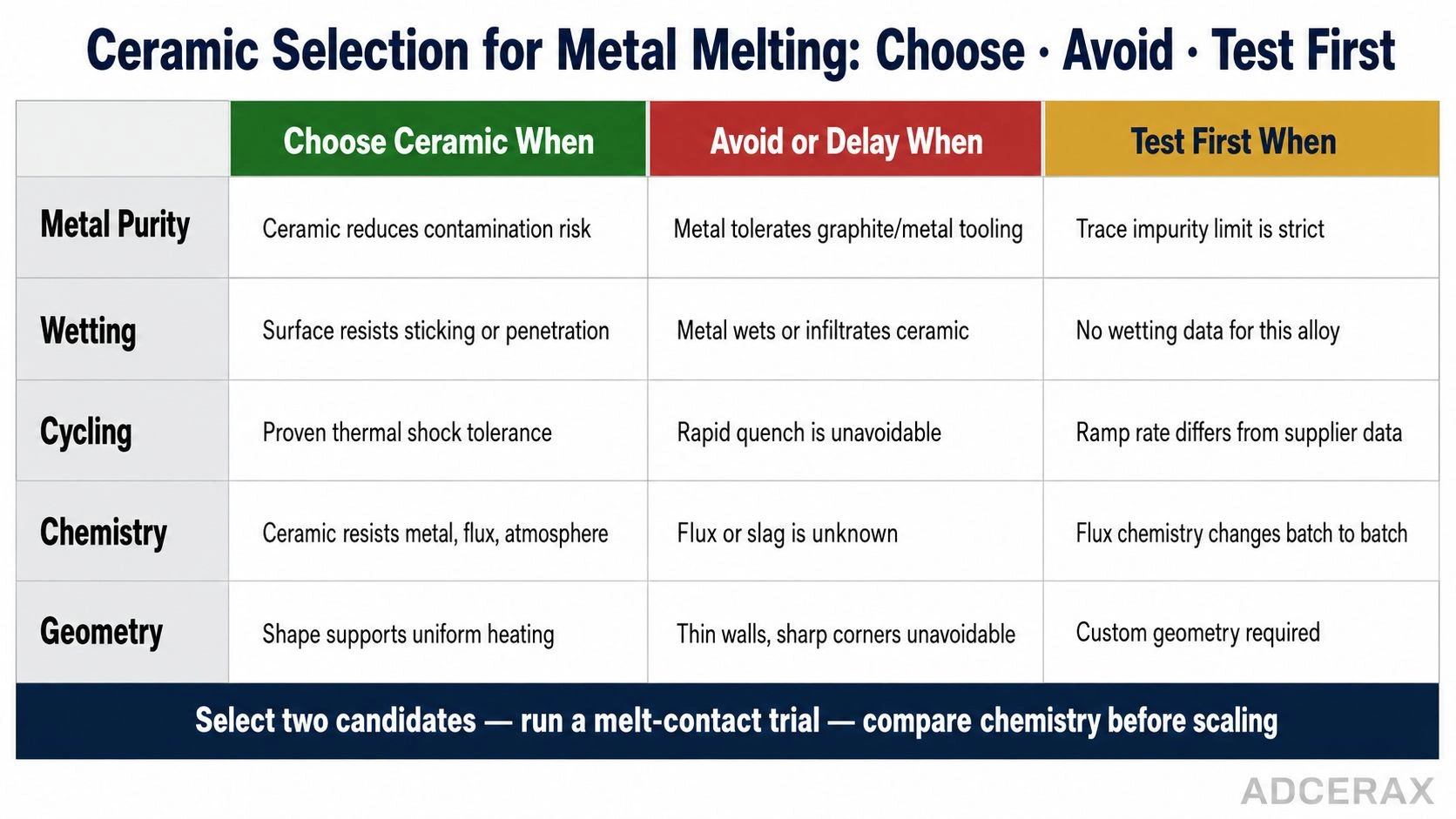
The ceramic selection decision for metal melting follows a choose/avoid/test sequence based on the dominant failure mode — wetting, chemistry, cycling, purity, or geometry — rather than maximum temperature rating.
The Choose/Avoid/Test First Matrix maps the dominant service condition to the appropriate decision:
| Condition | Choose ceramic when | Avoid or delay ceramic when | Test first when |
|---|---|---|---|
| Metal purity | Ceramic reduces contamination risk | Melt can tolerate graphite or metal tooling contamination | Trace impurity limit is strict |
| Wetting | Ceramic surface resists sticking or penetration | Metal wets or infiltrates the ceramic | No wetting data exists for this alloy |
| Cycling | Ceramic has proven thermal shock tolerance | Rapid quench or mechanical shock is unavoidable | Ramp rate differs from supplier data |
| Chemistry | Ceramic resists metal, flux, and atmosphere | Flux or slag is unknown | Flux chemistry changes batch to batch |
| Geometry | Shape supports uniform heating and stress control | Thin walls, sharp corners, or poor handling are unavoidable | Custom geometry is required |
The if-then decision logic by dominant failure mode:
If wetting or clean release is dominant. Route toward BN first. BN's non-wetting behavior toward many molten metals is its most distinctive advantage — it reduces melt adhesion, simplifies charge removal, and limits the thermal stress imposed on cooling when the frozen charge contracts away from the ceramic. Boron nitride crucibles are commonly evaluated for this role with aluminum, magnesium, copper, precious metals, and silicon under vacuum or inert gas. The constraints are oxidizing atmosphere boundary (BN should not be used for extended high-temperature service in air without grade-specific validation) and mechanical load (BN is softer than alumina or SiC and should not carry structural loads without support).
If thermal shock and heat transfer are dominant. Route toward SiC. SiC's high thermal conductivity and strong thermal shock resistance make it the practical choice for fuel-fired non-ferrous melting, radiant tube applications, and repeated charge-cycle duty where oxide ceramics crack from thermal fatigue. The furnace type matters: SiC performs its heat-transfer advantage best when the temperature gradient between furnace environment and crucible wall is large and cycling is frequent. The constraints are atmosphere and slag compatibility — SiC's protective oxide layer can be attacked by certain slag chemistries, and reducing atmospheres at high temperature require grade-specific review.
If oxide stability in air and electrical insulation dominate. Route toward alumina. Alumina is the most broadly available and chemically stable option for clean, high-temperature laboratory and industrial melting in air or mildly oxidizing environments. Its limitations appear under severe thermal shock, in applications where melt wetting is significant, and where the alloy chemistry reacts with alumina at the operating temperature and time combination.
If corrosion resistance or reactive alloy compatibility dominate. Route toward zirconia or specialized oxides, and require melt-specific testing. Stabilized zirconia provides better chemical resistance toward certain slag and aggressive melt chemistries than alumina. For reactive metals, yttria-stabilized or calcia-stabilized zirconia are more frequently evaluated than standard commercial zirconia grades, and no grade should be specified for reactive alloy contact without at least a small melt-contact trial.
Before excluding any ceramic. Run a controlled small-scale melt-contact test: same alloy batch, same thermal cycle, same furnace atmosphere, different ceramic candidate. Inspect the interface, measure the post-melt metal chemistry, and compare against the alloy specification limits. Two candidate ceramics evaluated in parallel, with post-run chemical analysis and surface inspection, will confirm which is compatible before any production-scale commitment.
What should a metal-melting ceramic RFQ require?
A complete RFQ for ceramic metal-melting components must provide the melt conditions and geometry that allow a supplier to confirm compatibility — not only the target temperature and a part description.
The RFQ for any ceramic metal-melting component should include:
From the buyer: the exact metal or alloy, melt temperature, holding temperature, superheat, furnace type, atmosphere, flux or slag chemistry (if used), expected cycle count, heating and cooling rate, contact time, geometry drawing, wall thickness, load condition, contamination limits, and cleaning method.
From the supplier: material grade, purity or composition range, density or porosity where relevant, recommended maximum service temperature, thermal shock guidance, chemical compatibility notes, dimensional tolerance, surface finish, manufacturing method, and sample inspection documents.
For high-risk applications: whether the supplier recommends coupon testing, trial crucibles, or post-run inspection before production-scale use. For reactive alloys, request thermodynamic compatibility data or literature references alongside the material data sheet.
Selecting a ceramic for metal melting? Share your alloy, melt temperature, holding time, furnace type, atmosphere, flux or slag chemistry, cycle rate, purity requirement, and component drawing. Use those RFQ fields to request a ceramic grade shortlist with compatibility review, contamination-pathway assessment, and a melt-contact trial recommendation for the confirmed application — no RFQ commitment required.
For catalog and melt-contact crucible options, start from ceramic crucibles and metallurgical ceramics; for application-specific melting crucible geometry see ceramic metal melting crucibles. When wall thickness, unsupported span, handling, or trial geometry is non-standard, use custom ceramic services.
Frequently Asked Questions
Can ceramic crucibles be used for metal melting?
Yes. Ceramic crucibles are used across aluminum, copper alloy, precious metal, steel, nickel alloy, and reactive metal melting in laboratory, foundry, and vacuum applications. The correct ceramic for each application depends on the metal chemistry, furnace temperature, atmosphere, flux or slag exposure, thermal cycling, and contamination tolerance — not on a single material name.
What ceramic is best for aluminum melting?
There is no universal best ceramic for aluminum melting. BN, SiC, and selected alumina systems may each be appropriate depending on wetting behavior, flux chemistry, purity requirement, furnace type, thermal cycling, and geometry. BN is often evaluated for non-wetting and clean release. SiC is considered for fuel-fired or cycling duty. Alumina is practical for clean, low-cycling laboratory melts.
Is alumina good for melting metals?
Alumina is useful for many clean, high-temperature laboratory and industrial applications where dimensional stability and contamination control matter. It needs compatibility testing with the specific melt and flux — alumina can be wetted or chemically attacked by some alloy and flux combinations, and it is susceptible to thermal shock cracking in rapidly cycling applications.
When should silicon carbide be considered?
SiC should be considered when thermal shock resistance, heat transfer, and non-ferrous melting productivity are important — particularly in fuel-fired aluminum, copper, or brass applications where repeated charge cycles impose significant thermal fatigue. SiC grade, binder system, atmosphere compatibility, and slag resistance must still be confirmed for the specific application.
Why use boron nitride for molten metals?
BN is used when non-wetting behavior and clean release are the governing requirements — particularly for aluminum, magnesium, copper, precious metals, and silicon in vacuum or inert-gas melting. BN's oxidizing-air temperature boundary must be confirmed before specifying it in air-furnace applications, and it should not be used as a load-bearing structural crucible without appropriate support.
Why do ceramic crucibles crack during metal melting?
Cracking can result from thermal shock when the heating or cooling rate exceeds the ceramic's tolerance, from wetting and penetration that freezes the metal against the ceramic wall and generates tensile stress on cooling, from chemical attack that weakens the ceramic body at the melt-contact interface, or from mechanical handling — dropping cold charge pieces into a hot crucible or mishandling a hot crucible with tongs.
What should I send to a supplier before requesting a ceramic recommendation?
Send the alloy composition, melt and holding temperature, furnace type and atmosphere, flux or slag chemistry if applicable, expected thermal cycle count and ramp rate, required purity with contamination limits, crucible geometry drawing with wall thickness, and expected handling method. A supplier who receives this information can confirm material compatibility — a supplier who receives only "ceramic crucible for [metal]" cannot.
Related reading
- Crucible material selection by metal — When you already know the metal family and need a deeper crucible-material matrix by alloy — not the multi-ceramic selection framework on this page.
- Which ceramic for furnace decision tree — When the decision is which ceramic for furnace furniture or tubes, not which ceramic contacts the melt in a crucible.
- Zirconia crucibles for melting and casting stability — When the shortlist has already narrowed to zirconia and the risk is melting/casting stability under heat cycles.