Choose furnace ceramics by function first, not by maximum temperature alone. Use alumina when electrical insulation, oxide stability, and general high-temperature service dominate; silicon carbide when thermal shock, heat transfer, and structural hot-zone duty dominate (grade- and atmosphere-dependent); boron nitride when non-wetting behavior, machinability, and vacuum or inert service dominate — in air or oxidizing atmospheres BN use is limited and should stay inert or protective duty, confirm grade; zirconia when corrosion resistance or low thermal conductivity matters most (stabilizer and thermal-shock trade-off); silicon nitride when thermal shock and mechanical toughness are critical under demanding cycling. The final decision always depends on temperature, atmosphere, load, cycling, chemistry, and component geometry — no single ceramic fits every furnace role.
That function-first principle is the starting point of the decision tree this guide builds.
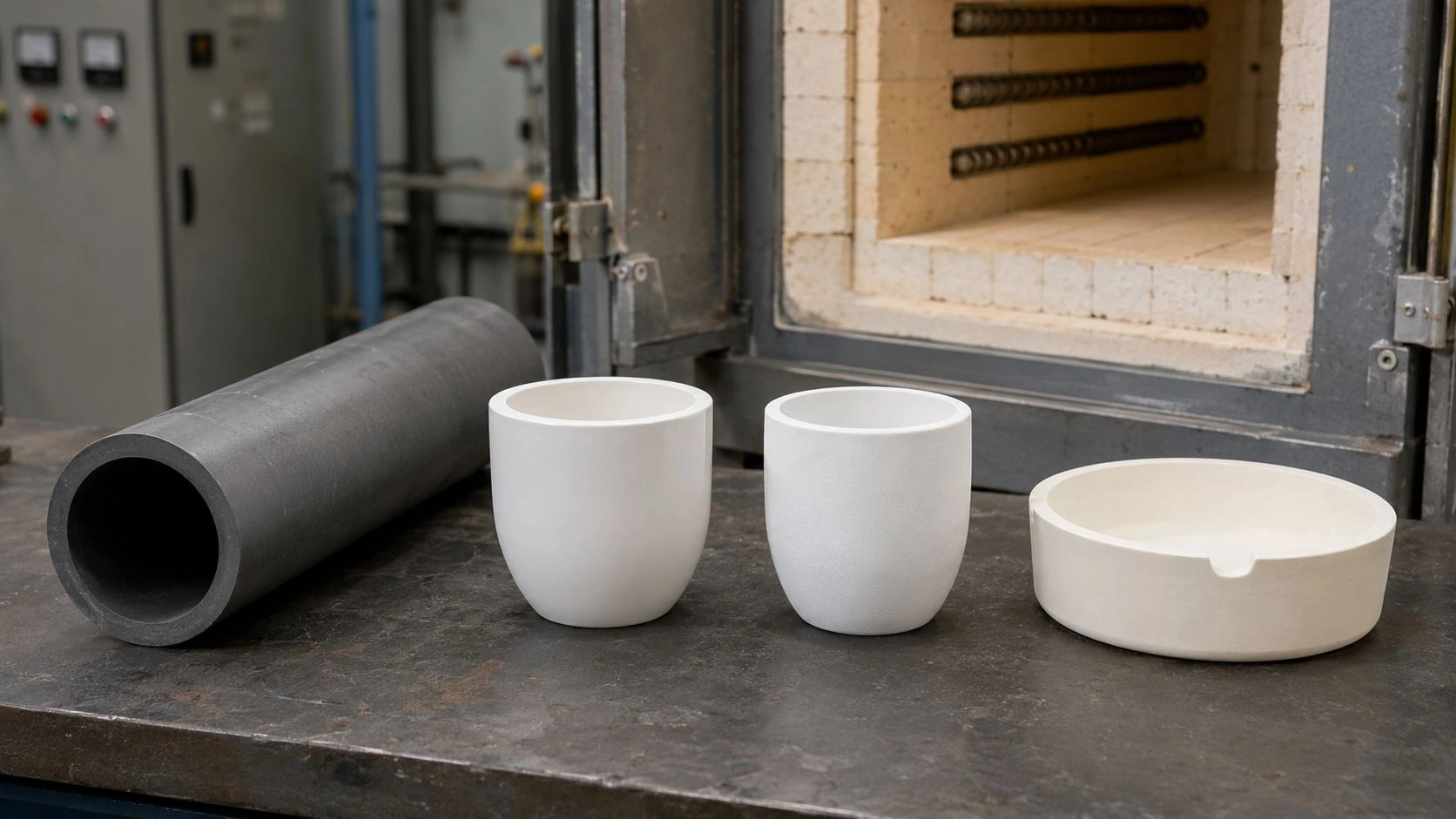
Furnace ceramics span tubes, crucibles, kiln furniture, radiant tubes, spacers, and insulation — the correct material for each component depends on function before temperature.
Tube, crucible, and related furnace ceramic material families span alumina, SiC, zirconia, BN, and ZTA for high-temperature, atmosphere-specific, and load-bearing service — use them as screening starting points for the selection decisions in this guide. For non-catalog geometry or multi-zone duty, open a custom furnace ceramic RFQ with function, atmosphere, and load fields filled in. Family hubs such as ceramic tubes remain useful after the decision tree shortlists a route.
Start with furnace component function, not material name
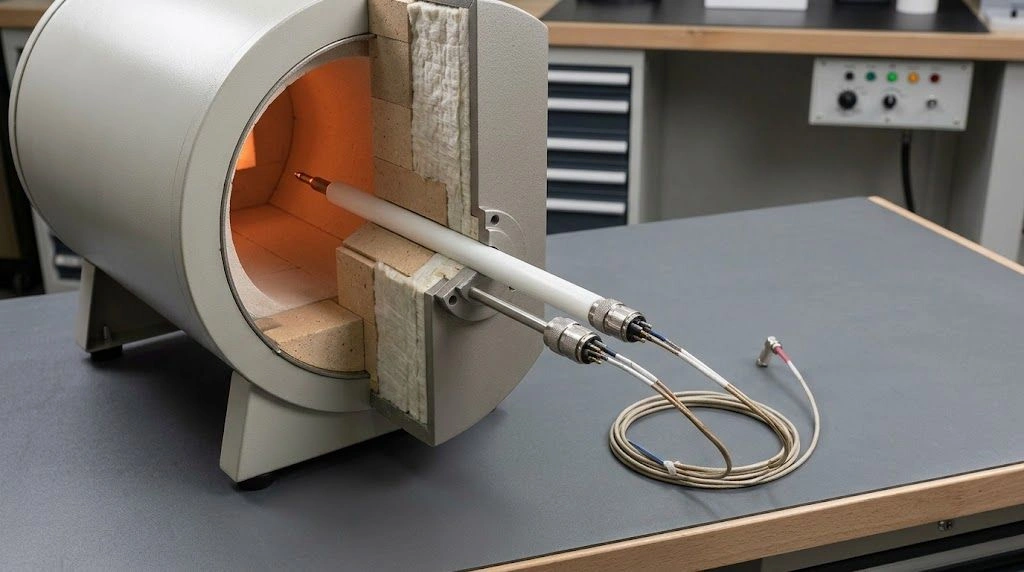
The most common furnace ceramic selection mistake is looking up a material's maximum temperature rating before defining what the component must actually do. A ceramic tube protecting a thermocouple, a crucible holding molten metal, a kiln roller carrying load, a radiant tube transferring combustion heat, and an insulation plate reducing heat loss operate under entirely different failure mechanisms. The same temperature can demand different materials in different roles.
NIST's Structural Ceramics Database covers oxide, carbide, nitride, boride, and oxynitride ceramic families with property and processing data specifically because no single material family solves every structural, thermal, and chemical problem across furnace applications. Published ceramic property databases and grade TDS data likewise frame furnace ceramics around actual operating temperature ranges and service conditions rather than nominal limits — which is why function must precede temperature in the selection sequence.
Furnace tubes, crucibles, rollers, supports, boats, and radiant tubes
Each component type imposes its own governing failure mode. A long horizontal kiln roller fails primarily by creep and sag under sustained load. A thermocouple protection tube fails primarily by thermal shock from rapid insertion and withdrawal. A crucible fails by melt reaction, sticking, or thermal expansion mismatch. A radiant tube fails by oxidation, creep, or burner hot spot. A spacer or setter fails by chemical attack from sintered powder. Identifying the failure mode before selecting the material is the only way to match material properties to actual service requirements.
Why maximum temperature is only the second filter
Once component function is defined, maximum temperature becomes a filter that eliminates disqualified candidates — but it is not the selector. Several ceramics can withstand the same temperature while differing dramatically in thermal shock resistance, thermal conductivity, electrical insulation, chemical resistance, and non-wetting behavior. The furnace temperature narrows the field; the function-based properties determine the winner within that field.
How component function changes material priorities
A vacuum furnace spacer that must not contaminate the processed material prioritizes purity and non-wetting behavior — not maximum temperature. An air-fired kiln support that carries load through hundreds of thermal cycles prioritizes thermal shock resistance and creep strength — not highest theoretical temperature capability. Two components in the same furnace at the same temperature can require different ceramic families because their governing failure modes differ.
The furnace ceramic decision tree
The decision tree below gives the six-step branching sequence engineers should use before shortlisting materials. The tree is not a ranking — it is a routing system.
Thermal shock resistance must be evaluated under defined test conditions rather than inferred from material name alone. ASTM C1525 is a quench-based thermal-shock screening method for advanced ceramics (quench medium, ΔT, cycles, and retained strength defined by the test protocol) — it is a method name for comparing grades under stated criteria, not a furnace-wide contract test required for every component. NIST's Structural Ceramics Database and other published ceramic property databases cover multiple families because selection needs property evidence across oxide, carbide, nitride, and boride systems.
The Furnace Ceramic Decision Tree table below maps each branch to its leading question, likely material route, and disqualification conditions:
| Decision branch | Ask this first | Likely material route (screening) | What can disqualify it |
|---|---|---|---|
| Electrical insulation | Must the part remain insulating at temperature? | Alumina, mullite, BN, AlN | Conductive deposits, humidity, chemical attack |
| Heat transfer/radiant output | Must the part move heat efficiently? | SiC, AlN, selected Si₃N₄ | Electrical insulation need, corrosion, geometry |
| Thermal shock | Is rapid cycling or flame exposure present? | SiC, BN, Si₃N₄, mullite | Air oxidation for BN, chemistry for SiC |
| Oxidizing air stability | Is the furnace air-fired or oxygen-rich? | Alumina, zirconia, mullite, SiC | Thermal shock, chemical corrosion |
| Vacuum/inert non-wetting | Is melt release or clean separation needed? | BN, PBN, alumina, zirconia | Oxygen leak, load, size/cost boundary |
| Load bearing/creep | Does the part carry weight at high temperature? | SiC, Si₃N₄, alumina, mullite | Span too long, point load, thermal gradient |
| Corrosion/melt contact | Does powder, salt, slag, glass, or metal contact the part? | Alumina, zirconia, BN, SiC, special grades | Reaction, wetting, contamination |
| Low thermal conductivity | Must heat loss or heat transfer be reduced? | Zirconia, mullite, insulation ceramics | Thermal shock, strength, cost |
Routes above are screening shortlists — not exclusive. Confirm chemistry, atmosphere, geometry, and grade on RFQ; verify with supplier TDS/COA, furnace trials, and applicable ASTM/ISO methods before production selection. Do not treat any cell as a must-use / only / always specification.
The six-step practical sequence is:
Step 1 — Function. What must the component do? Insulate, contain, support, transfer heat, separate atmospheres, provide melt release, or resist chemical attack?
Step 2 — Temperature and time. What is the continuous operating temperature, peak temperature, dwell time, and ramp/cooling profile? These set the first temperature filter and determine which grades within a material family are relevant.
Step 3 — Atmosphere. Is the environment air, vacuum, inert gas, reducing gas, hydrogen, wet gas, or corrosive vapor? Atmosphere is often the variable that most sharply distinguishes material candidates — BN's behavior in vacuum versus air, SiC's behavior in reducing versus oxidizing atmospheres, and alumina's behavior in reducing hydrogen all differ significantly.
Step 4 — Thermal shock and cycling. How fast is the ramp? How frequently does the furnace cycle? Is there direct flame exposure, a furnace door opening while hot, or a quench event? ASTM C1525 provides a defined quench / ΔT / cycle / retained-strength framework for thermal-shock screening — use it as a method name when comparing grades, not as a blanket furnace-wide SLA.
Step 5 — Load, span, and creep. Does the component carry structural load? Over what span? Are there point contact or distributed contact conditions? At what temperature must it maintain dimensional stability? These questions route toward SiC, silicon nitride, or dense alumina — and away from materials with lower high-temperature creep resistance.
Step 6 — Chemistry and contamination. What substances contact the ceramic? Molten metal, sintered powder, glass melt, salt bath, alkali vapor, flux, slag, or process gas? This step can reverse a tentative selection from the earlier branches if chemical compatibility fails.
Material matrix: alumina, SiC, zirconia, BN, silicon nitride, mullite, ZTA, and AlN
After running through the decision tree, the following material matrix maps common furnace conditions to screening ceramic families — fits are grade- and atmosphere-dependent, not exclusive:
| Ceramic material | Best-fit furnace role | Main strength | Main boundary | Typical components |
|---|---|---|---|---|
| Alumina | General insulation, tubes, crucibles, spacers | Oxide stability, insulation, broad availability | Thermal shock and some melt reactions | Tubes, crucibles, plates, rods |
| Silicon carbide | Radiant tubes, kiln furniture, heat-transfer parts | Thermal shock, conductivity, hot-zone structure | Atmosphere/vapor compatibility and grade choice | Radiant tubes, rollers, beams, burner tubes |
| Zirconia | Corrosion-resistant or low-conductivity furnace parts | Low thermal conductivity, corrosion resistance | Thermal shock, stabilizer/phase choice | Crucibles, trays, liners, thermal barriers |
| Boron nitride | Vacuum/inert, non-wetting, machinable parts | Non-wetting, thermal shock, machinability | Oxidizing-air temperature boundary | Crucibles, liners, nozzles, spacers |
| Silicon nitride | Tough thermal-shock components | Fracture toughness and thermal shock | Oxidation/cost/forming constraints | Rollers, supports, fixtures |
| Mullite/alumina-mullite | Kiln furniture and cycling furnace supports | Thermal shock and cost-performance balance | Lower high-end capability than premium ceramics | Setters, supports, plates |
| ZTA | Wear/impact with ceramic stability | Toughness above alumina | Less common for extreme furnace chemistry | Guides, wear fixtures, supports |
| Aluminum nitride | Heat spreading plus insulation | High thermal conductivity and insulation | Hydrolysis/moisture and cost constraints | Heat spreaders, fixtures, plates |
The notes below for each material family provide the engineering context the matrix alone cannot capture:
Alumina is the default candidate when the furnace component needs electrical insulation, oxide stability in air, and broad availability across temperatures up to approximately 1700°C and beyond for high-purity grades. Its limitations appear under severe thermal shock conditions, when molten metals or reactive melts contact the wall, and when non-wetting behavior is required.
Silicon carbide earns its place when thermal shock resistance, high thermal conductivity, and structural load-bearing at high temperature all matter simultaneously. Published analysis of SiC and silicon nitride for high-temperature applications identifies SiC's high thermal conductivity and thermal shock resistance as key properties for furnace use. The grade distinction — SSiC, RBSiC, SiSiC, ReSiC — affects maximum temperature, porosity, and atmosphere compatibility and must be specified after confirming the furnace zone.
Zirconia is most relevant when low thermal conductivity is needed for thermal barrier or insulation function, when corrosion resistance against specific melts or chemicals is the driver, and when operating temperatures exceed alumina's practical boundary for some applications. Stabilizer selection — yttria, magnesia, ceria — and thermal cycling profile must be confirmed to avoid phase transformation cracking.
Boron nitride serves vacuum and inert-gas furnace applications where non-wetting melt release, machinability into complex shapes, and thermal shock resistance all matter. Common process labels include hot-pressed BN (HPBN) and pyrolytic BN (PBN) — HPBN is not the same as CVD-PBN; treat both as screening labels and confirm TDS/COA for the grade and geometry on RFQ. See also the boron nitride ceramic family hub for grade orientation. In air or oxidizing atmospheres BN use is limited; prefer inert or protective duty and confirm the oxidizing-air boundary before specifying BN in air-fired or mixed-atmosphere furnaces.
Silicon nitride offers fracture toughness and thermal shock resistance that oxide ceramics cannot match, making it relevant for components that must survive mechanical impact, rapid cycling, and structural load simultaneously. Its use is more constrained by forming and cost than by material properties.
Mullite and alumina-mullite are the practical workhorses for kiln furniture — setters, supports, and plates used in repeated firing cycles — where cost-performance balance matters and temperature demands are in the moderate-to-high range.
AlN addresses the specific case where a furnace component must both conduct heat efficiently and maintain electrical insulation — a combination that SiC cannot provide. Its moisture sensitivity limits storage and handling conditions.
Do not misdiagnose furnace ceramic failure as "wrong material" too early
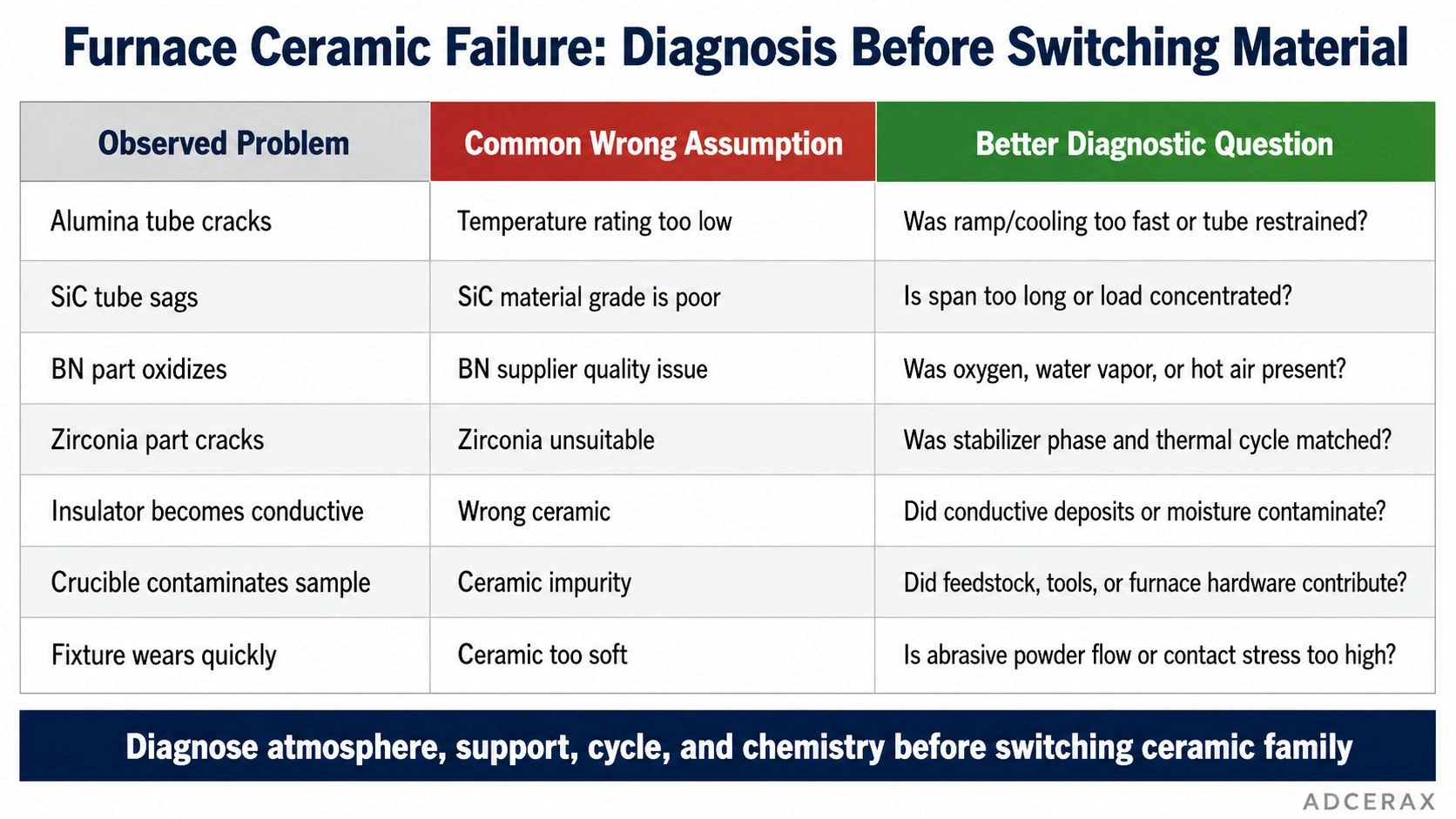
Most furnace ceramic failures are misdiagnosed as material selection errors when the root cause is atmosphere mismatch, support geometry, thermal cycle rate, or chemical contact — diagnosis before material switch is the correct sequence.
A cracked, sagged, or corroded furnace ceramic component does not automatically mean the material family was wrong. Before specifying a replacement from a different ceramic family, the failure mechanism should be documented — because switching material without fixing the root cause will reproduce the failure.
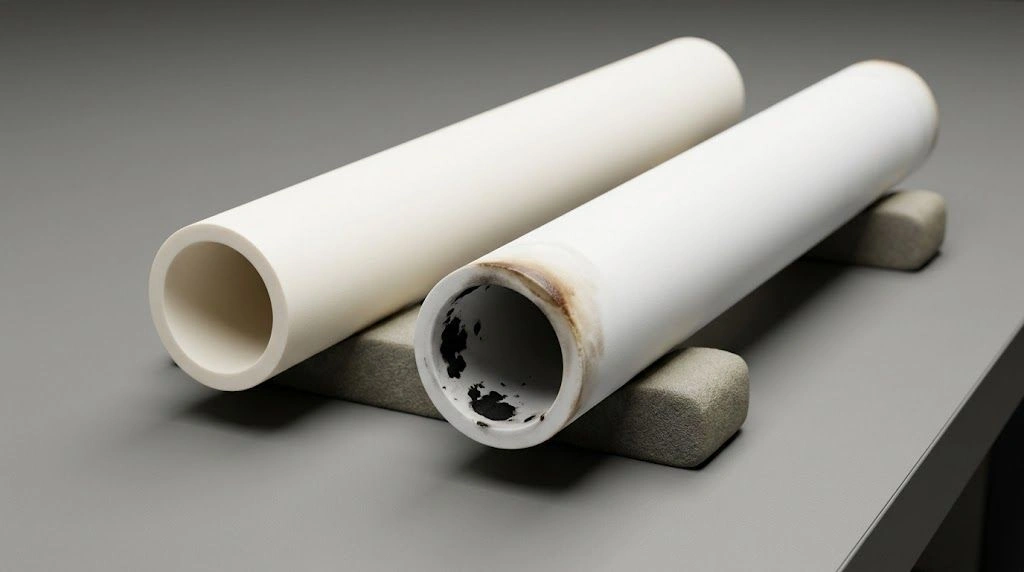
Crack: thermal shock vs poor material choice. Alumina tube cracking that occurs during rapid insertion into a hot furnace, or during fast cooling, is a thermal-shock event — not evidence that alumina's temperature rating is insufficient. The corrective action is controlled ramp rate or preheating, not material substitution. ASTM C1525 (or an equivalent defined thermal-shock protocol) distinguishes grades under stated quench/ΔT/cycle criteria — assuming shock resistance from maximum temperature rating alone is the wrong diagnostic path, and the method is not a universal contract test for every furnace part.
Sag: creep/support span vs wrong ceramic. A SiC tube that sags progressively during service is most likely exposed to a span or load that exceeds its design bending stress, not to a temperature above its capability. The corrective action is shorter support spacing, distributed contact, or reduced load — not necessarily a different ceramic material.
Surface attack: atmosphere/chemistry vs grade defect. BN that shows surface oxidation and material loss in service was almost certainly exposed to oxygen or water vapor that the specification assumed would not be present. An "inert" gas system with a small oxygen leak, or a furnace door opened hot, can expose BN to a damaging atmosphere that a different supplier's BN would also fail in.
Contamination: material body vs tools, powder, or furnace hardware. When a crucible or sample container shows unexpected elemental contamination, the first diagnostic step is to check feedstock purity, furnace hardware, setter plates, and atmosphere — not to assume the ceramic body is the only contamination source.
Insulation failure: temperature, humidity, or conductive deposits. An alumina component that appears to be conducting electricity at temperature may have developed a surface layer of conductive oxide, salt, or carbon deposit from process vapors, rather than having degraded internally. Cleaning, atmosphere control, or geometry change may resolve the problem without changing the ceramic material.
The Misdiagnosis Matrix below maps observed problems to better diagnostic questions:
| Observed furnace problem | Common assumption | Better diagnostic question |
|---|---|---|
| Alumina tube cracks | Alumina temperature rating too low | Was the ramp/cooling too fast or the tube end-restrained? |
| SiC tube sags | SiC material grade is poor | Is the span too long or load concentrated at a point? |
| BN part oxidizes | BN supplier quality issue | Was there oxygen, water vapor, or hot air exposure? |
| Zirconia part cracks | Zirconia unsuitable | Was the stabilizer phase and thermal cycle matched? |
| Insulator becomes conductive | Wrong ceramic | Did conductive deposits or moisture contaminate the surface? |
| Crucible contaminates sample | Ceramic impurity | Did feedstock, tools, atmosphere, or furnace hardware contribute? |
| Furnace fixture wears quickly | Ceramic too soft | Is abrasive powder flow or contact stress too high? |
Diagnosis should be based on failure location, temperature history, atmosphere records, and contact chemistry before any material change is specified.
How to prioritize conflicting furnace requirements
Most real furnace ceramic decisions involve two or more requirements that pull toward different materials. The priority-routing rules below give engineers a way to resolve those conflicts without needing to arbitrate between materials in isolation.
If electrical insulation dominates. Alumina, mullite, BN, and AlN all provide insulation. Among these, alumina is the most broadly available and chemically stable in oxidizing air. BN is preferred when non-wetting and machinability also matter under vacuum or inert gas. AlN is preferred when heat spreading and insulation must coexist. Mullite is preferred for cost-performance balance in kiln furniture.
If heat transfer dominates. SiC routes to the top when radiant output, thermal conductivity, and furnace-zone heat transfer matter. This means accepting lower electrical insulation than alumina provides and confirming that the atmosphere and chemistry are compatible with the SiC grade. AlN is the alternative when insulation must be preserved while still spreading heat.
If thermal shock dominates. SiC, BN, and silicon nitride all have strong thermal shock resistance. SiC is preferred for structural hot-zone components under load. BN is preferred for melt-contact components under vacuum or inert gas. Silicon nitride is preferred when mechanical toughness after thermal shock events matters.
If long oxidizing-air service dominates. Alumina and zirconia are the primary candidates. SiC can also be considered in air with appropriate grade selection, but vapor chemistry and surface reactions must be checked. BN should not be specified for continuous high-temperature air service without grade-specific oxidation data.
If vacuum or inert non-wetting dominates. Hot-pressed BN (HPBN) and pyrolytic BN (PBN) process routes often serve this role as screening labels (confirm TDS; HPBN ≠ PBN). Alumina and zirconia are alternatives when contamination from boron is a concern. Multi-material ceramic crucible families spanning alumina, zirconia, BN, and SiC illustrate the same function-first routing across melt-contact geometries.
If load-bearing and creep dominate. SiC and silicon nitride provide the strongest combination of high-temperature stiffness and creep resistance for structural components. Dense alumina can serve load-bearing roles at moderate temperature and span. Support spacing and load distribution should be resolved before upgrading material grade.
If chemical corrosion dominates. The answer depends entirely on what the specific chemical is. Molten aluminum routes toward BN or coated metal systems. Precious metals route toward alumina, zirconia, or platinum labware. Reactive rare earth metals route toward BN, yttria, or tantalum-based systems. Molten glass and alkali slag route toward specific fused-cast or high-purity oxide grades. Saint-Gobain's furnace ceramics range confirms that furnace applications use a spectrum of SiC, high-purity alumina, alumina-mullite, mullite, and zirconia products because chemical environments differ by furnace type and process.
RFQ checklist for furnace ceramic material selection
After running through the decision tree and resolving priority conflicts, the RFQ must provide the service conditions that allow a supplier to confirm material suitability — not just a temperature and a component type.
| RFQ field | Why it matters | Recommended wording |
|---|---|---|
| Component function | First decision branch | "Tube/crucible/support/radiant tube/spacer/insulation plate" |
| Furnace zone | Defines local environment | "Heating/soaking/cooling/hot face/exhaust/vacuum zone" |
| Continuous and peak temperature | Prevents over-reliance on max rating | "State continuous, peak, dwell, and thermal cycle" |
| Atmosphere | Controls oxidation/corrosion | "Air, vacuum, argon, N₂, H₂, wet gas, process vapor" |
| Thermal cycling | Controls thermal shock | "Ramp, cooling rate, opening events, direct flame exposure" |
| Load and support | Controls sag and cracking | "Load mass, contact area, support spacing, orientation" |
| Chemistry contact | Controls reaction and contamination | "Powder, molten metal, salt, glass, vapor, flux, slag" |
| Electrical/thermal function | Distinguishes insulation vs heat transfer | "Insulating, conductive heat spreader, or radiant emitter" |
| Geometry and tolerance | Controls stress and fit | "OD, ID, length, wall, flatness, holes, chamfers" |
| Oxygen / dew point | Controls BN oxidation and SiC vapor chemistry | "State pO₂ or O₂ ppm, dew point, and leak risk" |
| Support span vs specimen | Separates coupon data from finished-part risk | "Span, orientation; note coupon vs finished part" |
| COA / trace (if process-critical) | Contamination and grade confirmation | "Request TDS/COA and any required elemental exclusions" |
| Validation data | Converts recommendation into evidence | "Request grade data, test method, and prototype trial" |
RFQ fields are the minimum for a furnace ceramic material recommendation; add drawing, peak vs continuous temperature detail, pO₂/dew point, support span, specimen vs finished part, and COA/trace notes when the process is critical.
A supplier who receives the full set of inputs above can route to a screening ceramic family, confirm grade suitability against TDS/COA, and propose prototype validation. A supplier who receives only "ceramic tube, 1400°C, air" cannot confirm thermal shock adequacy, load-bearing performance, chemical compatibility, or contamination pathway without the remaining context. Treat 1400°C as one selection filter (for example, it can align with lower alumina long-term ceilings in some TDS screens) — still specify function, atmosphere, load, and ramp; it is not a universal rating or contract limit by itself.
Selecting a ceramic for a furnace component? Share the component function, furnace zone, temperature profile, atmosphere (including pO₂/dew point if known), thermal cycling, load and support span, chemical contact, and geometry drawing via a custom services RFQ or the relevant materials family page. A useful inquiry enables a screening material-route recommendation with grade confirmation against TDS/COA and validation guidance — turnaround depends on inquiry complexity; no RFQ commitment is required at this stage.
Frequently Asked Questions
Which ceramic material is best for a furnace?
There is no universal best ceramic for all furnace applications. The correct material depends on component function (insulation, heat transfer, load bearing, chemical containment, melt release), operating temperature and atmosphere, thermal cycling frequency, load and support geometry, and chemical contact. The decision tree in this guide provides a structured branching sequence: function → temperature → atmosphere → thermal shock → load → chemistry.
Which ceramic can withstand the highest temperature?
Several advanced ceramics — including certain grades of silicon carbide, silicon nitride, alumina, zirconia, and hafnium oxide — can operate at very high temperatures. But maximum temperature is only one selection criterion. A material's behavior in oxidizing vs inert atmospheres, under repeated thermal cycling, under sustained mechanical load, and in contact with specific chemicals often distinguishes candidates more sharply than absolute temperature limit.
Should I use alumina, silicon carbide, zirconia, or boron nitride in a furnace?
That depends on what the furnace component must do. Alumina is the general candidate for electrical insulation and oxide-stable service. SiC is strongest for heat transfer, thermal shock, and structural hot-zone duty (grade- and atmosphere-dependent). Zirconia is used for corrosion resistance or low thermal conductivity. BN is preferred for vacuum or inert-gas service with non-wetting melt release requirements; in air or oxidizing atmospheres BN is limited — confirm grade before air-fired duty. The decision tree in this guide maps each of these candidates to screening conditions where they are most likely to succeed — not exclusive must-use assignments.
Which ceramic has the best thermal shock resistance?
Silicon carbide, silicon nitride, and boron nitride are often cited for strong thermal shock resistance. Among oxide ceramics, mullite and some alumina grades have better thermal shock resistance than high-purity dense alumina. ASTM C1525 provides a standardized quench-based screening method (defined quench medium, ΔT, cycles, retained strength) for comparing thermal shock resistance — useful when the RFQ asks for test conditions, but not a furnace-wide mandatory SLA. Grade selection based on defined test data is more reliable than selection based on nominal temperature ratings alone.
How do I choose a ceramic for high-temperature furnace fixtures?
Start with the fixture's function: is it a setter carrying load, a spacer providing clearance, a boat holding powder, a support resisting deflection, or an insulating plate reducing heat loss? Each function prioritizes different properties. Then confirm temperature, atmosphere, thermal cycling, load, and chemical contact. The material matrix in this guide provides a starting shortlist for each condition combination.
What information should I send to a supplier when requesting a furnace ceramic recommendation?
Provide the component function, furnace zone, continuous and peak temperature with hold time, atmosphere type and oxygen level, ramp and cooling rate, load mass and support spacing, chemical contact (molten metal, powder, salt, flux, gas), whether insulation or heat transfer is required, component geometry drawing, tolerance requirement, and current failure description if replacing an existing ceramic. A supplier who receives this full context can confirm material suitability — one who receives only temperature and component type cannot.
Related reading
- Ceramic material selection matrix (Al₂O₃ / ZrO₂ / SiC / BN) — four-family matrix deep-dive that complements this furnace-component decision tree.
- Alumina protection tubes in cement kiln preheaters — function-to-duty case for protection tubes under kiln preheater conditions.
- Alumina tubes in diffusion furnaces for solar cells — furnace-zone alumina tube case that shows how zone function drives grade choice.