Engineers are moving some advanced ceramic sourcing to China when projects need custom geometry, low MOQ for prototype and pilot runs, fast drawing-based iteration, and broad material options — not only catalog parts or unit price. China-sourced ceramics fit when the supplier can support alumina, zirconia, silicon carbide, boron nitride, silicon nitride, and related engineered ceramics with drawing review, machining, inspection, and repeatable batch control. The shift is not risk-free: material certificates, tolerance confirmation, first-article inspection, application testing, and supplier qualification still come before production. Price matters, but engineering responsiveness, custom MOQ flexibility, and qualification discipline are the real drivers.
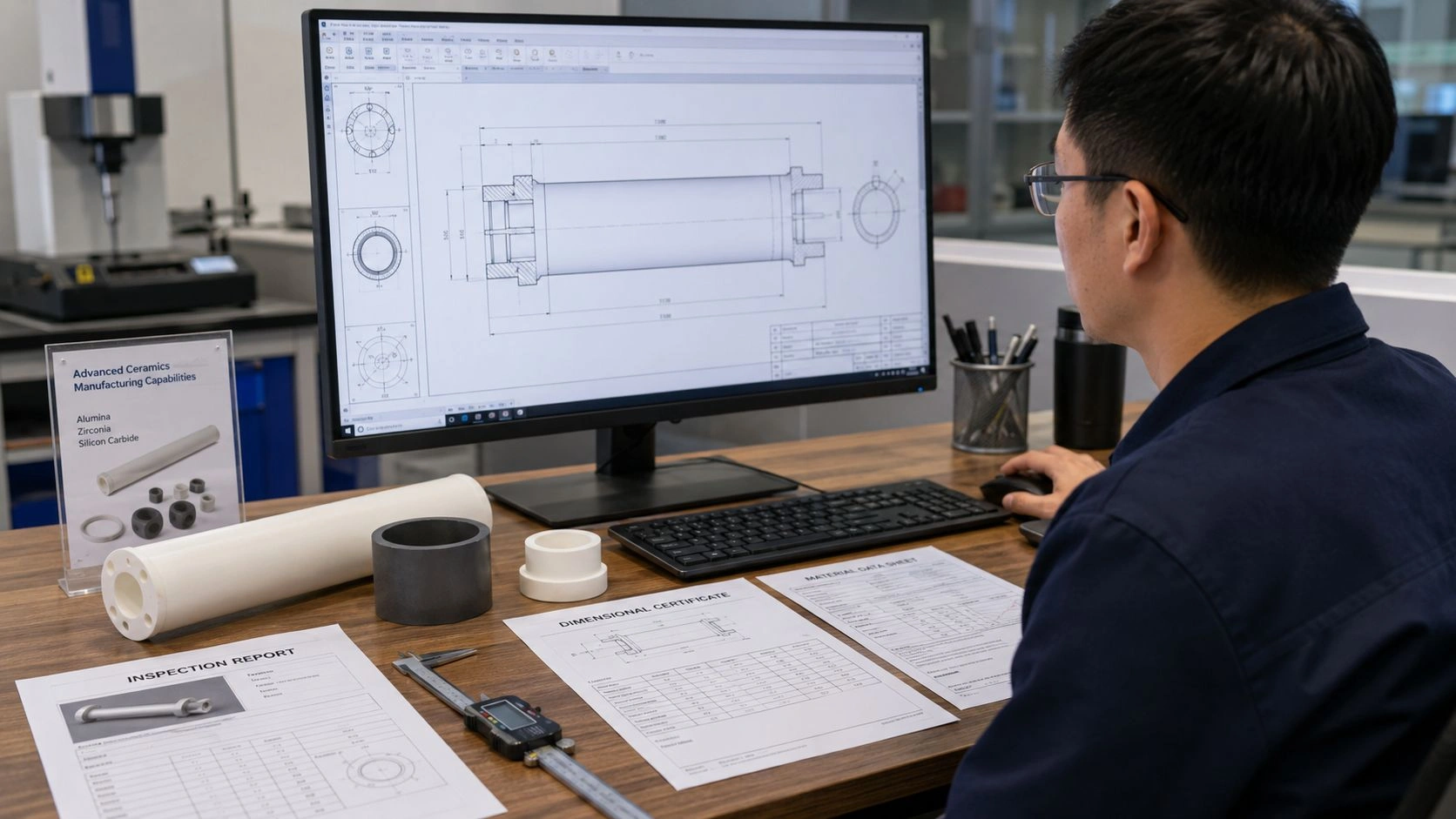
Engineers are moving to China-sourced ceramics when projects require custom dimensions, small batches, fast samples, and broad material options — the shift is driven by engineering responsiveness alongside cost, and qualified suppliers must provide drawing review, inspection reports, and application testing.
The manufacturing capabilities route supports drawing-based production for alumina, zirconia, silicon carbide, boron nitride, silicon nitride, aluminum nitride, and related engineered ceramics; confirm process fit and QC requirements during RFQ.
The shift is not just about price
The primary reason engineers are reconsidering China-sourced ceramics is not that China is always the lowest price. It is that many ceramic procurement projects have shifted from standard catalog purchases to custom engineered components — and China-based manufacturers have developed the capability to serve that engineering workflow.
Third-party market research (Spherical Insights, China Advanced Ceramics Market) estimates China's advanced ceramics market at approximately USD 28.8 billion in 2024 with projected growth through 2035 — a major global production base for technical ceramics. That figure is a market estimate, not ADCERAX capacity or share proof. On the engineering side, a large share of output at drawing-based custom shops is custom/MOQ-flexible work — confirm current mix, piece-count starts, and schedule windows on RFQ. Prototype and pilot programs may support low piece-count starts; MOQ varies by geometry, material, and process. Typical engineering-review / manufacturing windows for simple modifications versus new geometries depend on material, queue, and inspection — they are not contractual SLAs.
The Why Engineers Consider China Ceramics table maps the main sourcing drivers:
| Driver | What engineers need | Why China can fit | What still must be verified |
|---|---|---|---|
| Custom geometry | Holes, slots, sleeves, liners, non-standard tubes | Drawing-based manufacturing and machining | Manufacturability review |
| Small batch | R&D, pilot, replacement parts | Low MOQ can support trial orders | Batch consistency |
| Material coverage | Alumina, zirconia, SiC, BN, Si₃N₄, AlN | Broad supplier portfolios | Correct grade selection |
| Faster samples | Design iteration | Shorter sample loops for simple modifications | Inspection report |
| Cost pressure | Lower total project cost | Drawing-based production with QC gates | Not at expense of QC |
| Complex machining | Tight fit, polished zones, custom interfaces | CNC grinding and lapping support | Tolerance capability |
| Replacement parts | Obsolete or non-standard ceramics | Reverse engineering from samples/drawings | Datum and fit validation |
| Export supply | International B2B sourcing | Established global shipping workflows | Packaging and lead-time buffer |
Custom geometry is replacing catalog-only sourcing. Modern engineering projects increasingly need ceramic parts that cannot be bought from a distributor's shelf — non-standard OD/ID combinations, multi-bore tube configurations, custom slot or hole patterns, polishing on specific zones only, or material-grade combinations that are not common stock. A China-based custom ceramic factory can receive a drawing and convert it into a manufactured part through forming, sintering, and CNC finishing, often at smaller minimum quantities than equivalent Western suppliers can accommodate.
Small-batch ceramic parts are becoming normal engineering items. R&D teams, equipment builders, and process engineering groups frequently need five, ten, or twenty ceramic parts for prototype testing before committing to production volumes. Western ceramic manufacturers typically have economic minimum orders that make small-batch prototyping expensive. China-based suppliers — particularly those oriented toward engineering customers — can serve these small-batch requirements because their cost structures and manufacturing flexibility are designed for custom production rather than standardized output.
Engineers need faster sample loops, not only cheaper parts. A ceramic design that fails its first test needs a revised OD, an added chamfer, a different alumina grade, or a switch to zirconia. The time from revised drawing to revised sample determines how quickly the engineering team can iterate. For many projects, the time savings from a China-based supplier who can return prototype revisions quickly is often worth more than a marginal cost difference from a local supplier with a long lead that stalls qualification. Typical windows depend on material, queue, and inspection — not a contractual SLA.
Material coverage matters: alumina, zirconia, SiC, BN, Si₃N₄, AlN. A China-based manufacturer that covers the full range of engineered ceramic materials — alumina, zirconia, silicon carbide, boron nitride, silicon nitride, aluminum nitride, ZTA, and related composites — enables a single-supplier workflow for projects that need to evaluate multiple material options. The advanced ceramic materials portfolio covers these material families for comparison, grade selection, and application-specific guidance during RFQ.
Where China-sourced ceramics fit best
After establishing the sourcing drivers, the practical question is which ceramic procurement projects are a good fit for China sourcing — and which require more caution.
The Ceramic Parts That Commonly Fit China Sourcing table maps the main ceramic categories:
| Ceramic category | Good-fit applications | Main buyer concern | Qualification focus |
|---|---|---|---|
| Alumina | Tubes, insulators, crucibles, rods, sleeves | Purity, tolerance, thermal shock | Grade, density, straightness |
| Zirconia | Wear parts, plungers, guides, sleeves | Chipping, fit, toughness | Tolerance, surface finish |
| SiC | Tubes, seals, pump parts, heat exchangers | Grade route and corrosion | SSiC/RBSiC/NBSiC selection |
| BN | Liners, crucibles, insulation, nozzles | Moisture, oxidation, purity | Grade, atmosphere, packaging |
| Si₃N₄ | Bearings, rollers, mechanical parts | Cost and toughness | Density, strength, finish |
| AlN | Thermal management, insulating heat spreaders | Thermal conductivity and purity | Material data and surface quality |
| ZTA | Wear and impact-resistant parts | Balance of toughness and cost | Composition and mechanical data |
| Custom assemblies | Multi-material or interface parts | Stack-up and fit | Assembly trial and inspection |
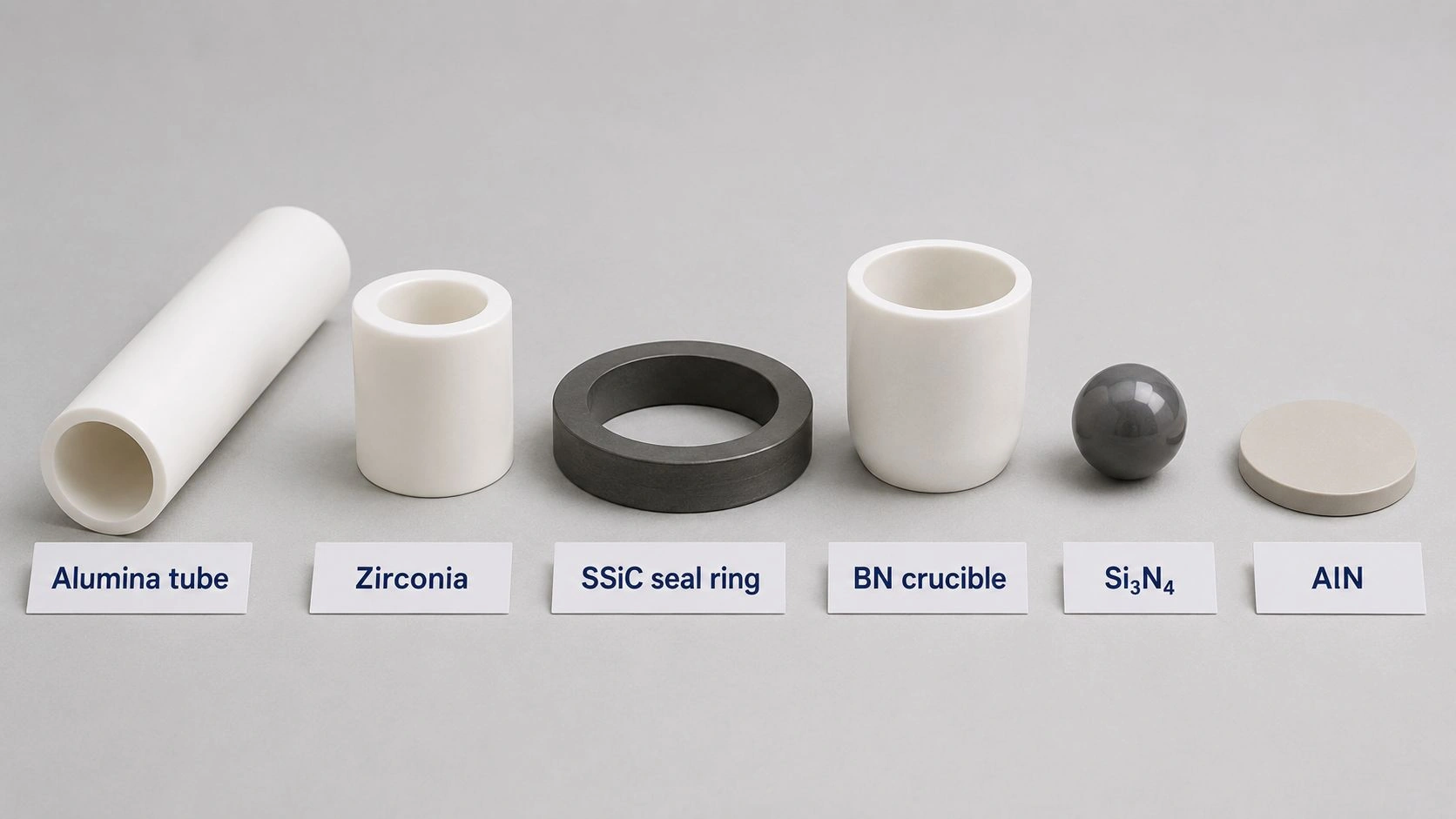
China-sourced ceramics fit best when the supplier can cover multiple engineered ceramic families — alumina, zirconia, SSiC, BN, silicon nitride, and AlN — while supporting drawing review, material selection, machining, inspection, and batch control.
Good fit: custom industrial parts with clear drawings. The strongest application for China-sourced ceramics is a part where the engineer has a drawing, knows the material grade requirement, has defined the functional tolerances, and can specify an inspection method. With those inputs, a capable China supplier can produce a first-article sample that either confirms the design or reveals a manufacturability issue — which is the beginning of a productive engineering relationship.
Good fit: R&D samples, pilot batches, and non-standard dimensions. Research and development programs often need five pieces of an unusual geometry in a specific alumina purity grade, or three test samples in two different zirconia compositions. This use case maps to a custom parts RFQ for drawing-based production, quantity review, and application-specific material selection.
Higher-risk fit: wafer-facing semiconductor or ultra-high-purity parts. Semiconductor-grade ceramic components — wafer boats, process tubes, wafer-facing fixtures — require trace metal qualification, coating integrity, particle testing, and thermal cycling validation that exceed standard industrial ceramic procurement. These applications can still be sourced from China-based manufacturers, but they require deeper qualification, multi-batch validation, and audit of the specific production lot.
Poor fit: projects with vague specs and no inspection plan. China sourcing fails — not as a reflection of China manufacturing quality but as a reflection of buyer preparation — when the buyer sends a rough sketch and asks for ""ceramic tubing, strong, and heat-resistant."" Without material grade, dimensional tolerance, inspection method, and application condition, no supplier anywhere can reliably produce the correct part.
What engineers actually value: speed, MOQ, machining, and flexibility
After mapping the fit and misfit zones, the practical sourcing value from China-based ceramic manufacturers can be summarized around four engineering-relevant dimensions.
Fast prototype loops reduce engineering delay. A ceramic sleeve that needs a 0.1 mm wall reduction, a chamfer added, or a through-hole relocated can be re-machined and re-sampled in a few days at a China-based supplier with CNC grinding capability. The same change at a specialty Western ceramic shop may require re-scheduling, tooling review, and a multi-week wait. For active engineering development programs, this iteration speed is a real project-management advantage.
Low MOQ supports R&D and pilot equipment. Standard ceramic fabrication economics typically favor high volumes. A supplier willing to support low piece-count starts on a custom zirconia guide — MOQ varies by geometry, material, and process — allows an engineering team to test and validate without committing to a full production run. Confirm piece-count starts per drawing on RFQ. This lowers the financial and schedule risk of specification changes, which are common early in product development.
CNC finishing makes custom ceramics practical. Many custom ceramic geometries that appear to require specialized sintering actually require post-sinter CNC grinding, lapping, or polishing to reach final dimensions. China-based ceramic manufacturers with integrated CNC capability — including 5-axis grinding, ID/OD grinding, lapping tables, and surface-finish inspection — can produce precision ceramic parts from standard sintered blanks without the buyer needing to source the sintering and finishing separately.
Supplier feedback prevents impossible ceramic drawings. A capable supplier is more valuable than a compliant one. When an engineering team submits a drawing with a wall thickness below the minimum achievable by sintering, a tolerance requiring 50% of the material's hardness variation to be cut away by machining, or a surface finish specification that conflicts with the required edge chamfer, a knowledgeable supplier should flag these issues before production rather than producing a part that fails. This engineering-partner relationship is what distinguishes a qualified China ceramic supplier from a catalog price source.
The risks engineers still need to control
Recognizing the fit and the value of China-sourced ceramics does not mean the risks are ignorable. The qualified engineering buyer must understand and actively manage several risk categories.
Risk 1: Material grade ambiguity. A quotation for ""alumina tubes"" without specifying 95%, 99%, 99.5%, or 99.7% purity — and without density, open-porosity, and SiO₂-impurity data — means the supplied material may not match the application requirement. For SiC, a quotation that does not distinguish SSiC, RBSiC, and NBSiC routes is similarly ambiguous. Specifying grade, purity, and key material properties in the RFQ is the buyer's responsibility.
Risk 2: Tolerance promises without inspection method. A supplier who accepts all specified tolerances without requesting manufacturability feedback, and without confirming which tolerances will be measured and how, may be planning to deliver whatever emerges from the process rather than a part verified to the drawing. Requiring an inspection report — CMM, bore gauge, flatness, straightness, roundness — as a delivery condition converts the specification from aspirational to measurable.
Risk 3: Batch-to-batch consistency. A first-article sample that meets specification does not guarantee that production batches will. Ceramic sintering, powder batch variation, kiln loading, and machining setup all contribute to part-to-part variation. A pilot batch — smaller than the first production order but larger than the sample — tested at application conditions before production commitment is the most reliable consistency screen.
Risk 4: Trade policy and supply-chain dependency. China has recently applied export controls to precision manufacturing inputs relevant to high-technology industries. Published reporting confirms that China announced export controls on artificial diamond powders, single crystals, wire saws, and grinding wheels — items directly relevant to precision ceramic grinding supply chains. Engineers with single-source ceramic dependency should maintain visibility into supply-chain risk and develop alternative qualification paths where the part is critical.
The China Ceramic Supplier Risk Matrix maps each risk to its prevention:
| Risk | What it looks like | Prevention |
|---|---|---|
| Wrong material grade | ""Alumina"" quoted without purity | Specify 95%, 99%, 99.5%, 99.7%, etc. |
| Generic SiC quote | No SSiC/RBSiC/NBSiC distinction | Ask for route and property data |
| Over-tight tolerance | Supplier accepts impossible drawing | Request manufacturability feedback |
| Poor repeatability | Sample works, production varies | Run pilot batch before production |
| Surface finish mismatch | Part fits but wears or leaks | Specify Ra, lapping, polish zones |
| Packaging damage | Chips after long transport | Require protective packaging photos |
| Communication gap | Supplier misses application risk | Provide use environment and failure mode |
| No inspection method | Disputes after delivery | Define CMM, caliper, gauge, flatness method |
How to qualify a China ceramic supplier
After the sourcing evaluation is complete and the risks are understood, the qualification workflow converts the supplier selection from a price decision to an engineering decision.
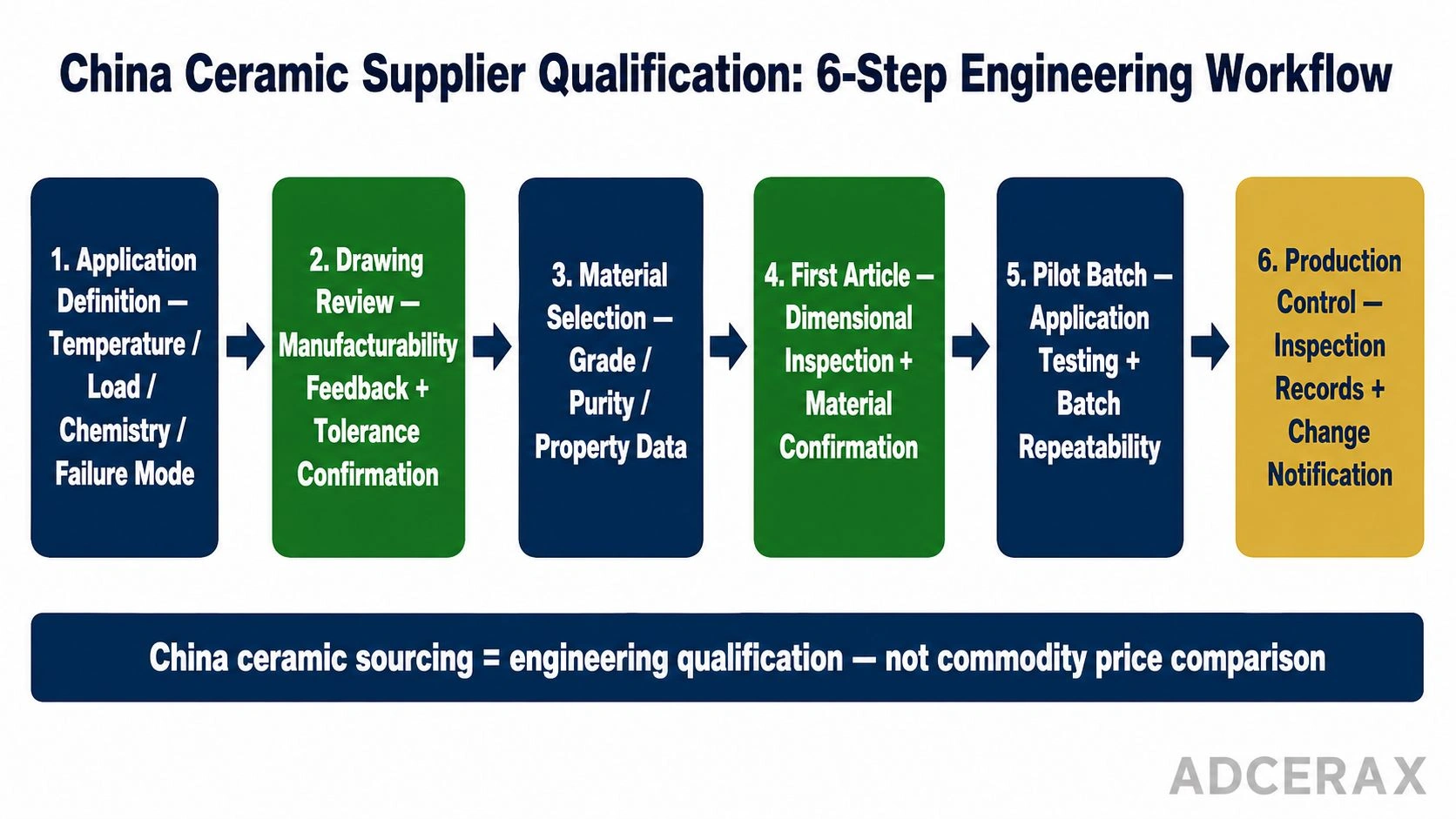
Qualifying a China-based advanced ceramic supplier for custom components follows a complete sequence: application definition (temperature, atmosphere, load, chemical exposure, wear mode, purity target); drawing review (OD/ID/wall, flatness, straightness, tolerance, surface finish, chamfer, inspection datum); material grade selection matched to the failure mode; first article with dimensional inspection and material confirmation; pilot-batch testing for repeatability; and production control (batch documentation, inspection records, packaging standard, change notification). Each step reduces a different risk category — skipping any step transfers that risk to production parts.
China ceramic sourcing should follow a qualification workflow rather than a price-only comparison — application definition, drawing review, material selection, first-article inspection, pilot-batch testing, and production control reduce different sourcing risks.
The practical qualification sequence is:
Step 1 — Application definition. Before sending any drawing, define the temperature, atmosphere, load, chemical exposure, wear mode, insulation requirement, purity target, and failure history of the application. This information determines which ceramic material route is correct and which specifications matter most.
Step 2 — Drawing review. Submit a complete 2D or 3D drawing with datum, tolerance zones, surface finish designations, and all functional dimensions called out. A capable supplier will provide manufacturability feedback — which tolerances are achievable, which wall thicknesses are minimum, which features create sintering or machining difficulty.
Step 3 — Material grade selection. Confirm with the supplier that the proposed ceramic route — alumina purity, SiC grade, BN type, zirconia stabilizer — matches the application requirement. Request material data: density, strength, thermal expansion, porosity, and for some applications, trace metal content.
Step 4 — First article. Order a sample quantity — typically one to five pieces — and inspect against the drawing. Dimensional report, material confirmation, and application fit-check are the minimum first-article deliverables.
Step 5 — Pilot batch. Order a small production run — ten to thirty pieces — before the full production quantity. Test in the real application environment, or run the qualification cycle that the production parts will face.
Step 6 — Production control. Establish batch documentation requirements: inspection records per lot, material certificate per lot, packaging photos, and change-notification protocol for any process change that might affect the part.
The custom ceramic parts manufacturing route, ceramic tubes and pipes, and custom precision ceramic parts can be evaluated against the drawing, material, quantity, and inspection requirements in an RFQ.
Evaluating China-sourced ceramics for your next project? Share your drawing, material requirement, quantity, operating temperature, chemical exposure, wear mode, surface finish, and inspection requirements. The RFQ can confirm whether alumina, zirconia, SiC, BN, Si₃N₄, AlN, or another engineered ceramic route fits the application and can request a sample quotation, manufacturability feedback, and material data.
Related reading
- How to qualify a Chinese advanced ceramic supplier — When you need the full China-supplier qualification sequence — application, drawing review, FAI, pilot, and production control.
- New ceramic supplier procurement checklist — When you need a general procurement checklist for any new ceramic supplier — not the China-sourcing motivation framework.
- Advanced ceramics manufacturer selection — When you are comparing manufacturer selection criteria across regions and capability gates.
Frequently Asked Questions
Why are engineers sourcing ceramics from China?
Engineers are sourcing ceramics from China when they need custom dimensions, small batch quantities, fast prototype iterations, broad material options, and manufacturing flexibility that is difficult to find in a single Western supplier. The strongest drivers are custom engineering capability and material breadth, alongside cost. Third-party estimates (e.g. Spherical Insights) place China's advanced ceramics market near USD 28.8 billion in 2024 — a major global production base, not ADCERAX capacity or share proof.
Are China-sourced ceramics reliable?
They can be reliable with proper qualification. The key is treating ceramic procurement as an engineering process rather than a commodity purchase. Buyers should request material grade confirmation, first-article dimensional inspection, application-specific sample testing, pilot batch runs, and batch-level documentation before committing to production. Reliability correlates more strongly with specification quality and supplier qualification than with supplier geography.
What ceramic materials are commonly sourced from China?
Common materials include alumina, zirconia, silicon carbide, boron nitride, silicon nitride, aluminum nitride, ZTA, boron carbide, and magnesia-based ceramics. A China-based supplier with broad material portfolio coverage — across SSiC, RBSiC, high-purity alumina grades, stabilized zirconia, and BN/PBN — enables material comparison and application-specific selection within one supplier relationship.
What is the biggest risk when sourcing ceramic parts from China?
The biggest risk is insufficient specification from the buyer side. A buyer who sends a description rather than a drawing, or requests ""SiC"" without specifying SSiC, RBSiC, or NBSiC, or does not define which tolerances require measurement, creates a gap that no supplier — Chinese or otherwise — can reliably fill. On the supplier side, the main risks are material grade substitution, tolerance over-promising, and inconsistent batch density. Both risks are controlled through detailed specifications and structured qualification.
Is China sourcing only about lower price?
No. Price is part of the evaluation, but engineers consistently report that prototype speed, MOQ flexibility, CNC machining capability, material breadth, and supplier engineering feedback matter equally or more. A China-based supplier who can return a revised prototype on a typical engineering-review window and identify a drawing error before production often provides more engineering value than one offering a modest unit-price cut on a long lead that stalls qualification. Schedule windows depend on material, queue, and inspection — not a contractual SLA.
How should I qualify a China ceramic supplier?
The qualification process should follow these steps: define the application (temperature, load, chemistry, failure mode); submit a complete drawing with tolerances and inspection datum; confirm material grade and request material data; order and inspect a first article; run a pilot batch in the real application environment; and then establish batch-level documentation and change-notification requirements for production. Skipping any step transfers the corresponding risk category directly to the production parts.