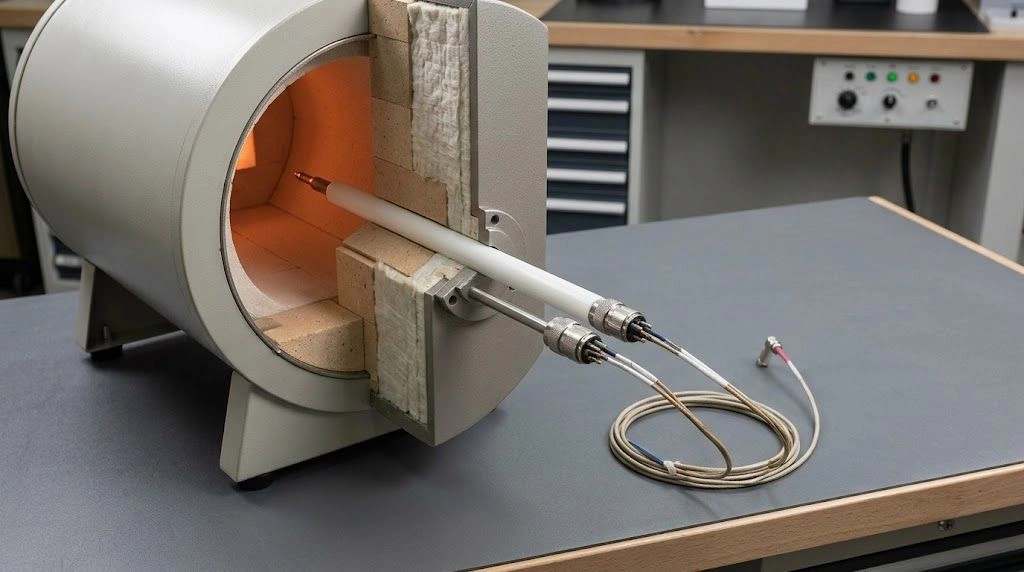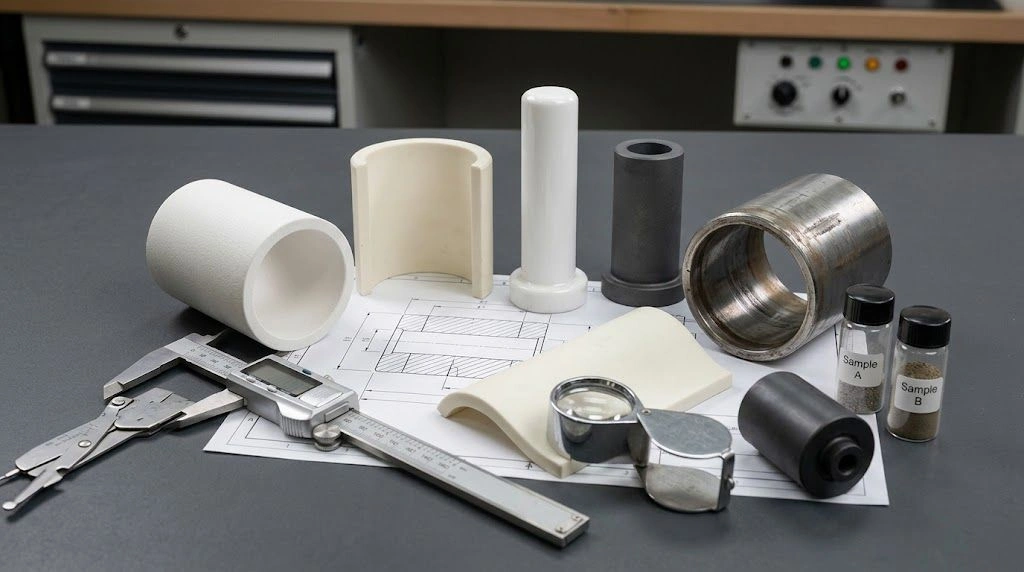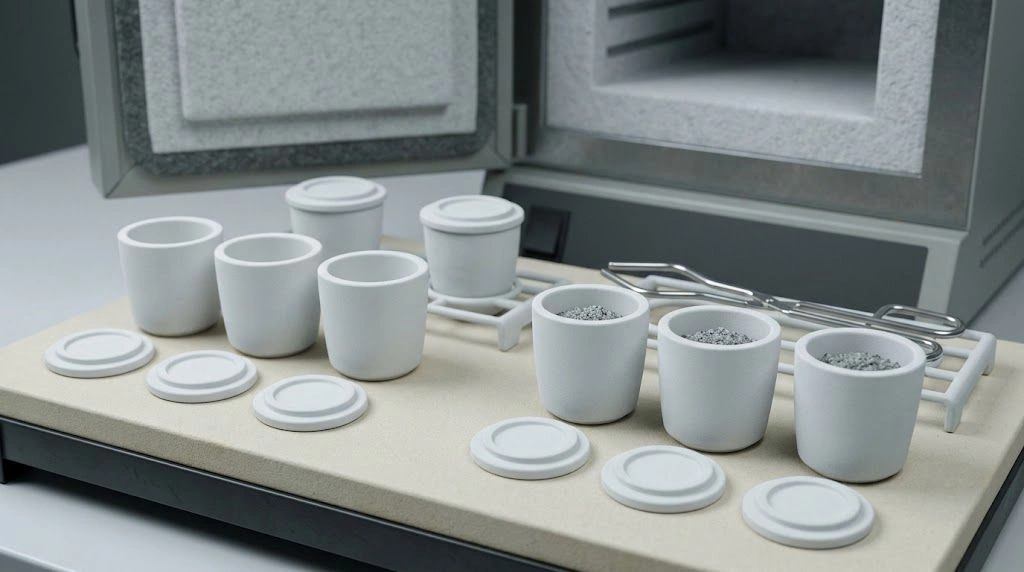
A white ceramic furnace tube usually turns black because carbon, condensed process vapor or another contaminant accumulates on its surface. Organic binders, oils, polymers and carbon-containing loads are common starting points for investigation, particularly in low-oxygen processes.
However, blackening can also involve metal-bearing contamination, fixture contact, chemical attack or changes within the ceramic. Color identifies a symptom; it does not establish composition, damage or suitability for reuse.
Before choosing a cleaning method, identify the original material, map the deposit and review the process history. Separate naturally dark ceramics, removable deposits, persistent contamination and structural damage.
Is the Furnace Tube Supposed to Be White?
Dense high-purity alumina tubes are normally white or ivory. Mullite is commonly off-white, cream or pale gray, depending on composition and manufacturing. A new dark patch on either material deserves investigation, but does not automatically mean strength or insulation has been lost.
Quartz work tubes are transparent or translucent. An internal black coating usually comes from the process; cloudiness or devitrification is a different observation and should not automatically be classified as carbon buildup.
Many silicon carbide tubes are naturally dark gray or black. Silicon nitride can also be gray. On these materials, look for a new coating, changed texture, flaking, glazing or dimensional change instead of judging the original color.
Compare the used tube with an unused component of the same grade, its original photograph or a protected cold-end surface. A cold end is a useful reference, although it may itself collect condensate.
Do not infer composition from appearance alone. A black alumina tube has not necessarily been reduced to aluminum, become electrically conductive or become contaminated through its full wall thickness.
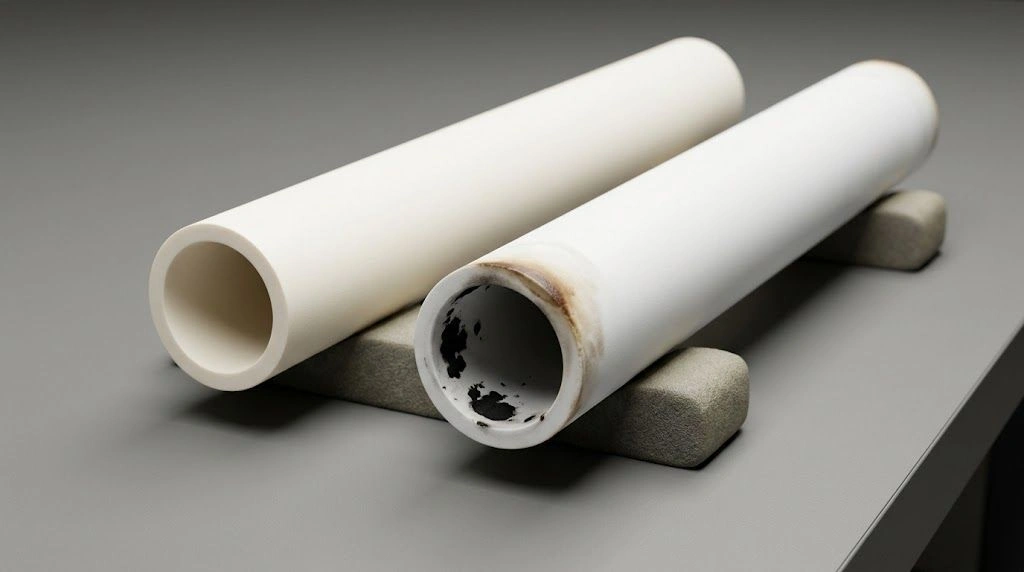
Compare the original ceramic appearance with localized deposits on the used tube.
Why Does a White Ceramic Furnace Tube Turn Black?
Carbon or soot deposition
Carbon is a leading suspect when blackening follows the processing of binders, wax, resin, oils, adhesives, biomass or hydrocarbon gases. Heating can release vapors that decompose or react to leave soot or coke on the tube wall.
An inert atmosphere does not prevent this mechanism. It can suppress combustion while organic material decomposes. The outcome depends on feed chemistry, temperature, residence time and atmosphere.
Loose black powder, increasing deposits with larger loads, and a clear relationship to an organic-containing sample support this explanation. They do not prove it: graphite and dark inorganic powders can also transfer to a wipe.
Condensed organic vapors
Brown or black deposits near a cooler outlet may begin as condensed organic vapor. Repeated heating can turn a sticky film into a harder coating.
Look for a brown-to-black transition, a glossy surface and residue in outlet fittings. This pattern directs attention toward vapor transport and exhaust handling as well as the ceramic. A clean hot zone does not rule out substantial downstream contamination.
Graphite and fixture contact
Graphite boats, carbon felt, powders or contaminated tools can leave contact-shaped marks. Bands at support positions or patches beneath a boat suggest a local source.
Compare the mark with the contacting fixture. Embedded particles may be difficult to remove from a rough or porous surface. Scraping harder is not a reliable way to distinguish contamination from ceramic damage.
Metal-bearing contamination
Metal powders, alloy scale, fixtures and deteriorating furnace components can introduce dark particles or vapors. Their appearance depends on composition and chemical state.
Inspect sample boats, exposed hardware and thermocouple protection components for corresponding damage or deposits. Black color alone cannot distinguish metal-bearing contamination from carbon; elemental analysis may change the appropriate cleaning decision.
Sample reaction or volatilization
A sample can spatter, volatilize or react with the tube. A persistent dark patch accompanied by glazing, pitting or altered surface texture deserves particular attention.
A smooth-looking glaze may conceal a reaction layer. Record whether the problem began with a new sample formulation, higher temperature, longer hold or different boat. Surface appearance after wiping cannot establish the remaining sound wall thickness.
Atmosphere-dependent discoloration
Reducing conditions may affect impurity chemistry, defect populations or secondary phases in some oxide ceramics. The response is grade- and process-dependent; ordinary hydrogen operation does not universally blacken alumina.
A UC Davis–industry investigation examined discoloration in high-calcia alumina during metallization firing, including subsurface changes and possible minority-phase involvement. That is evidence for composition-specific discoloration, not proof that a black furnace tube has the same mechanism. Its experimental heat treatments are not a general tube-cleaning procedure. UC Davis investigation
Gas leakage, poor purge or flow problems
Leaks, restricted outlets, reversed connections and inadequate purging can change the intended atmosphere. Check actual conditions rather than relying only on the programmed gas setting.
A leak does not always directly create soot. In controlled carburizing equipment, for example, atmosphere-measurement problems and compensating enrichment can contribute to excessive carbon deposition. This mechanism is specific to that control system and should not be assumed for every laboratory furnace. Surface Combustion maintenance guidance
External furnace contamination
When the outside is black but the bore is clean, investigate heating components, insulation, maintenance residues and debris from earlier failures. A pattern following heater or support positions points toward a different source from a deposit centered on the sample.
| Observation | Possible explanation | Next check |
|---|---|---|
| Loose black powder | Soot, graphite or process powder | Load, fixtures and deposit composition |
| Sticky brown-black outlet film | Condensed organic vapor | Exhaust condition and thermal profile |
| Contact-shaped dark patch | Fixture transfer or local reaction | Boat and support materials |
| Persistent glazed or pitted patch | Reaction product or chemical attack | Compatibility and wall condition |
| Black outside, clean inside | External furnace contamination | Elements, insulation and maintenance |
| Uniform original dark color | Normal appearance of some ceramics | Material certificate and baseline photo |
What Does the Blackening Pattern Reveal?
Map location before disturbing the deposit
Photograph the cooled tube and record inlet, outlet, heated length, sample position and supports. Keep these references consistent across cycles.
Internal deposits prioritize the load, gas supply, boats and exhaust. External deposits prioritize surrounding furnace components. Blackening on both sides does not prove through-wall penetration: separate sources, handling contamination or furnace-wide deposition are also possible.
| Location | Useful diagnostic question |
|---|---|
| Heated center | Did the sample react, spatter or release vapor here? |
| Hot-to-cold transition | Did transported vapor condense as it cooled? |
| Gas inlet | Is the supply line contaminated, or was flow reversed? |
| Gas outlet | Is residue accumulating in a cooler or restricted connection? |
| End seal | Are lubricant, seal material or condensate involved? |
| Along a crack | Has an existing fracture collected contamination? |
Classify texture without assuming chemistry
Loose powder, sticky film, hard matte coating, glassy glaze and subsurface color are different observations. Record flaking and roughness separately.
Only perform a small white-wipe test after the tube is cooled, isolated and the residue is assessed as safe to sample under the site's procedure. An unknown deposit may need specialist handling before it is disturbed. Do not deliberately smell residue or use compressed air to disperse powder.
Material transferred to a wipe confirms that some deposit is removable. It does not identify the material or establish that the remaining surface is clean.
Follow a controlled diagnostic sequence
- Confirm tube grade, service history and original appearance.
- Photograph the deposit before cleaning.
- Compare inside, outside, sample zone and cold ends.
- Review the last load, binder, boat and gas changes.
- Inspect seals, plugs, supply connections and exhaust restrictions.
- Collect representative residue only under an approved sampling procedure.
- Select analysis or a controlled blank test to resolve the remaining uncertainty.
Do not run an unknown contaminated tube merely to see whether it clears. A blank cycle is appropriate only after its chemistry, atmosphere and exhaust implications have been reviewed.
Select analysis for the actual question
| Method | Useful information | Main limitation |
|---|---|---|
| Optical microscopy | Texture, particles, glazing and visible cracks | Does not identify most chemistry |
| SEM-EDS | Morphology and elemental distribution | Carbon signals need preparation controls; structure is not established |
| Raman spectroscopy | Carbonaceous structures and selected phases | Fluorescence and mixed deposits can complicate interpretation |
| XRD | Crystalline reaction products | Thin, amorphous or minor deposits may be difficult to detect |
| XRF | Selected inorganic contaminants | Sensitivity depends on elements and sample geometry |
| FTIR | Selected organic residues | Complex mixtures may need complementary methods |
| TGA/DSC | Mass change and thermal events | Unknown residues require laboratory risk assessment |
| Cross-section examination | Penetration and reaction-layer depth | Destructive; use a retired tube or approved specimen |
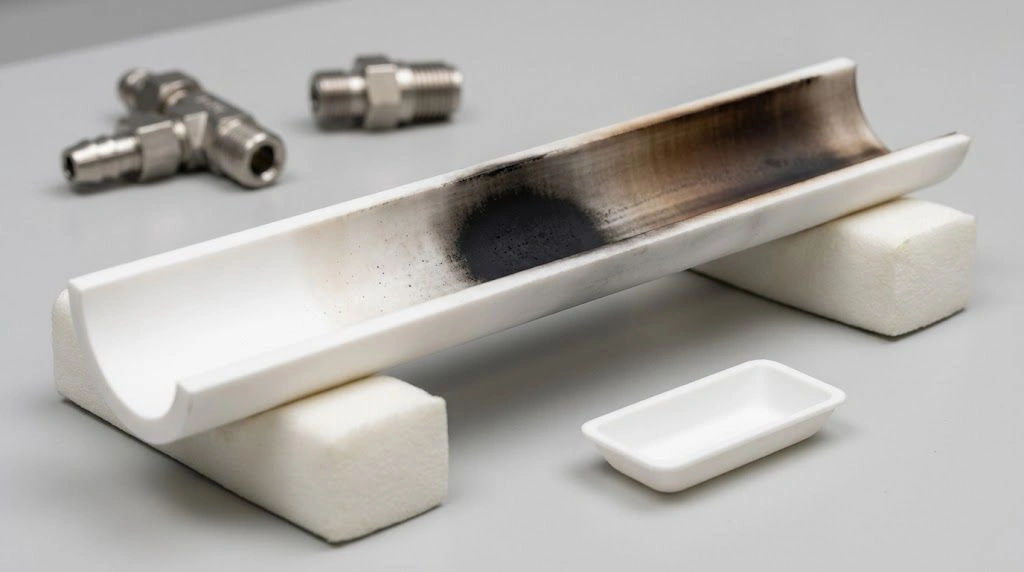
An opened specimen from a retired tube can reveal deposit distribution; sectioning is destructive.
Can a Blackened Ceramic Tube Be Cleaned and Reused?
Reuse requires three separate judgments: whether the residue can be removed safely, whether the tube remains fit for service, and whether cleanliness meets the next process's requirements.
A tube with no visible cracks can still retain contamination, have subsurface damage or fail a required leakage test. Returning to a white appearance is not proof of restored performance.
Evaluate the cleaning method
Dry cleaning: A soft wipe or suitable non-metallic brush may remove known loose residue. Use controlled collection. Steel-wire brushes, metal scrapers, impact and unapproved abrasive blasting can introduce contamination or damage.
Solvent cleaning: Consider it only for identified residues with a compatible, approved procedure. Review ventilation, ignition control, waste handling, penetration into porosity and complete drying before reheating. Do not mix chemicals or guess a solvent from the deposit's color.
Oxidative burnout: Some known carbonaceous deposits can be oxidized under a manufacturer-approved cycle. Suitability depends on deposit quantity, reaction heat, tube grade, furnace construction and exhaust capacity. Graphite components and other oxidation-sensitive parts require specific consideration.
Debinding equipment uses engineered provisions for volatile release and exhaust management. Nabertherm describes dedicated safety concepts for these processes; a general-purpose tube furnace should not be assumed to provide equivalent capability. No universal burnout temperature, oxygen flow or heating rate applies here. Nabertherm debinding safety concepts
Acid or alkaline cleaning: Alumina's identity alone does not establish compatibility. Cleaning agents may affect secondary phases, react with deposits, penetrate pores or leave ionic residues. Obtain material- and contaminant-specific approval.
Decide whether to clean, quarantine or replace
| Tube condition | Appropriate direction |
|---|---|
| Known loose deposit, no identified damage | Evaluate controlled cleaning and inspection |
| Known organic film | Assess an approved solvent or thermal method |
| Unknown deposit | Quarantine pending identification and handling review |
| Glazing, pitting or a persistent reaction layer | Engineering assessment; replacement may be necessary |
| Through-wall crack, severe wall loss, deformation or damaged sealing face | Remove from service and replace |
| Residue incompatible with required purity | Validate cleanliness or replace |
| Repeated blackening after cleaning | Correct the source before returning to routine operation |
Unknown contamination does not automatically make disposal necessary. It does mean routine cleaning and reuse should wait. Conversely, removing loose soot does not repair a crack or restore a damaged sealing face.
After approved cleaning, inspect the bore, ends and supports, check relevant dimensions, and verify required atmosphere integrity. Where electrical insulation is part of the tube's function, evaluate it under the applicable service requirements rather than inferring it from color.
For contamination-sensitive work, an approved blank and appropriate analysis may be needed. Set acceptance criteria before cleaning so “looks better” does not become the release standard.
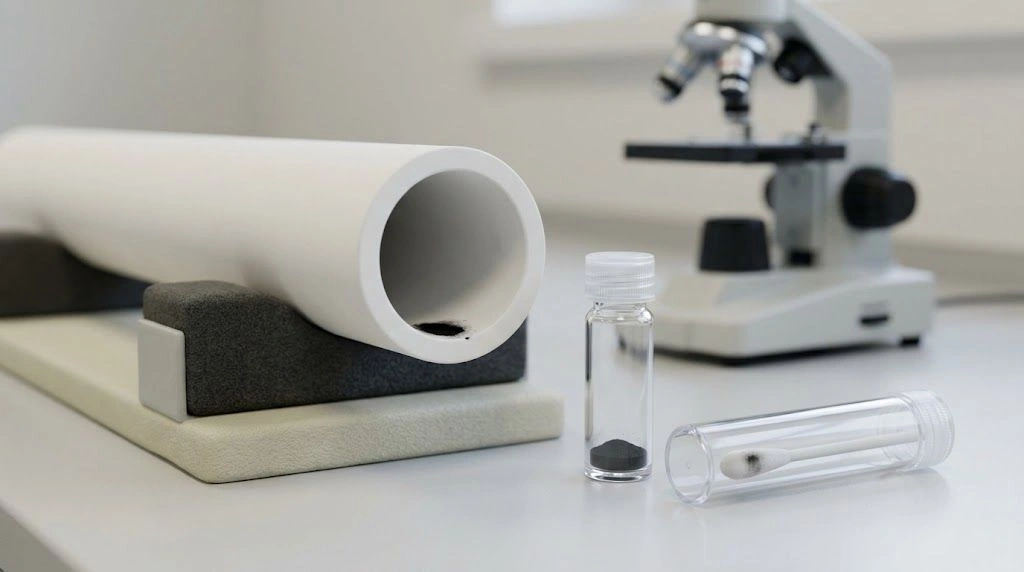
Document residue and tube condition before selecting a cleaning method or releasing the tube for reuse.
How Can Furnace-Tube Blackening Be Prevented?
Control the source and vapor release
Record sample composition, organic content, load mass, binder type and heating profile. Faster heating can release vapor faster than a particular system can manage.
Where organic loading is substantial, evaluate separate debinding equipment or a qualified preliminary stage. Do not add oxygen to an inert or reducing process simply to make the tube look cleaner; that changes process chemistry and may introduce combustion hazards.
Review boats, supports and handling tools alongside the tube. A compatible work tube can still receive contamination from an incompatible fixture or a boat carrying residue from an earlier process.
Verify atmosphere and exhaust performance
Check gas identity, purity, flowmeter performance, connections, seals and approved purge sequence. Include exhaust restriction, pressure balance and any required moisture or oxygen monitoring.
Increasing gas flow is not a universal cure. It can affect residence time, transport deposits downstream or exceed the system's intended operating conditions. Correct the demonstrated cause within the furnace's operating limits.
Use blanks and repeatable records
When operationally approved, compare a clean empty assembly, a clean boat, and the complete load. A binder-free sample can provide another comparison where scientifically meaningful.
Change one factor at a time and document exceptions. A clean blank narrows the likely source but does not prove that every loaded process is compatible.
Use repeatable photographs and record deposit length, texture, cycle count, recipe and cleaning history. Define an inspection trigger before narrowing of the bore, flaking or exhaust restriction becomes substantial.
Replacement-tube RFQ checklist
Provide the following information when discussing a replacement:
| Information group | Details to supply |
|---|---|
| Tube | Material, grade, purity where applicable, OD, ID, length, wall thickness and quantity |
| Geometry | Open or closed end, straightness, end faces, flange interface and surface requirements |
| Furnace | Orientation, heated length, supports, seals, operating temperature and thermal ramps |
| Process | Sample, binder, boat, atmosphere, gas flow, vacuum or pressure differential and exhaust arrangement |
| Evidence | Before-cleaning photographs, deposit locations, cycles to blackening, previous cleaning and analysis |
| Acceptance | Required cleanliness, dimensional checks, leak criteria and relevant electrical requirements |
When replacement is needed, custom ceramic furnace tubes should be reviewed against the complete drawing and operating conditions. Changing from alumina to mullite or silicon carbide also requires reassessing chemical compatibility, oxidation behavior, electrical properties and sealing requirements.
Frequently asked questions
Does black color mean an alumina furnace tube has failed?
No. It can represent a deposit or a material change. Damage, leakage, contamination limits and required functional checks determine serviceability.
Can hydrogen turn alumina black?
Some grades can discolor under particular reducing and firing conditions. Check impurities, secondary phases and contamination before assigning hydrogen as the cause.
Can black carbon be burned off in air?
Sometimes, under an approved procedure for the complete assembly and known residue. An unknown deposit should not receive a trial burnout.
Why is the outlet darker?
Vapor can travel downstream and condense in cooler regions. Verify flow direction and exhaust condition before drawing a conclusion.
Can a blackened tube contaminate later samples?
Yes. Residue can shed particles or release material during later heating. Validate cleanliness against the next process's requirements.
Is a black silicon carbide tube contaminated?
Not necessarily. Many grades are naturally dark. Compare coatings, texture and dimensions with the original condition.
Diagnose before cleaning
Start with the material, deposit location and process history. Distinguish removable contamination from reaction damage and persistent discoloration. Clean only through an approved method, verify the result against service requirements, and address the source before installing another tube.