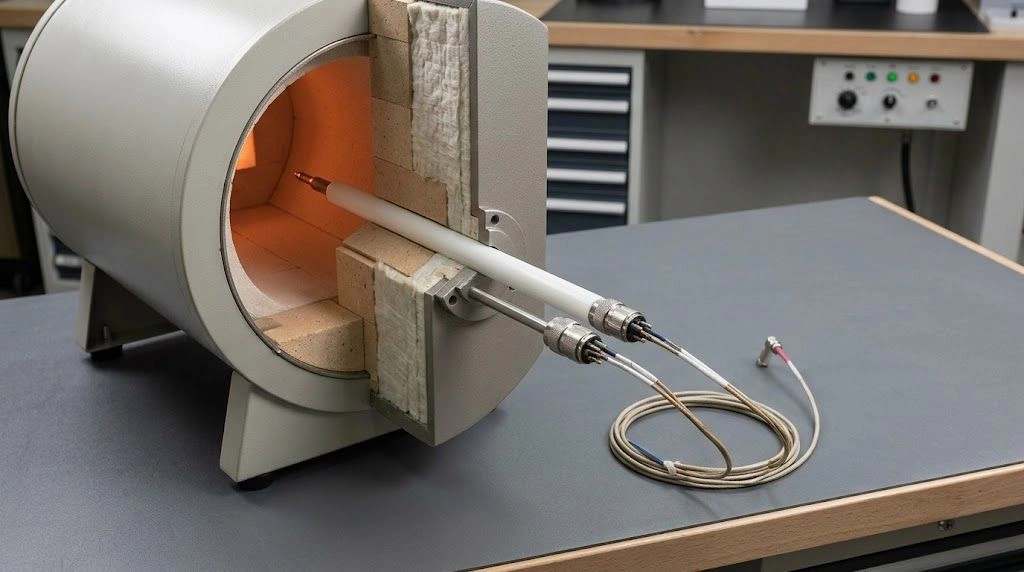
A ceramic’s melting point is not its maximum service temperature. Melting—or decomposition, dissociation, sublimation, or softening for some ceramics—is a phase-behavior reference under defined conditions. A component reaches an application limit earlier because strength loss, creep, oxidation, phase transformation, chemical attack, thermal gradients, electrical-property drift, or joint failure becomes unacceptable. Select a grade using continuous and peak temperature, atmosphere, time, load, cycling, contacting chemistry, geometry, and required retained properties—not the highest number in a chart.
Which Temperature Does the Data Sheet Actually Report?
“Temperature resistance” can describe different events. Melting identifies transition to a liquid under stated composition and pressure. Some non-oxide ceramics decompose, dissociate, or sublime before an atmospheric melting point becomes useful. Glass-containing grades may soften progressively.
Sintering temperature densifies a ceramic; it is not an operating rating. A maximum-use value may apply only to one grade, specimen, atmosphere, duration, and load. Continuous service, peaks, thermal-shock tests, and over-temperature events remain separate.
Use this hierarchy when reading a data sheet:
- Phase-behavior reference: Melting, decomposition, dissociation, sublimation, or softening.
- Property limit: The point where strength, creep, dimensions, phase, chemistry, or electrical behavior becomes unacceptable.
- Grade maximum-use value: Supplier guidance under stated test conditions.
- Component design limit: The grade value adjusted for geometry, load, gradients, finish, and joints.
- Application operating limit: The qualified boundary after duty cycle, process variation, safety margin, and failure consequence are included.
| Published term | What it may indicate | What it does not prove |
|---|---|---|
| Melting point | Approximate intrinsic phase behavior | Structural strength or dimensional stability |
| Decomposition or sublimation temperature | High-temperature phase or chemical behavior | Safe service in air, vacuum, or process gas |
| Sintering temperature | Manufacturing densification condition | Reusable operating temperature |
| Maximum-use temperature | Grade-specific supplier guidance | Performance under every load, duration, or atmosphere |
| Thermal-shock value | Outcome of a defined heating and cooling test | Universal allowable temperature difference |
| Peak temperature | Short-exposure target | Continuous-life capability |
| Continuous temperature | Intended steady exposure boundary | Survival during rapid cycles or abnormal excursions |
Alumina illustrates the gap: its phase-change reference is near 2,050°C, while maximum-use values are lower and may assume no load. Precision Ceramics’ alumina data separate grades and conditions rather than offering one universal rating. Ask which property must remain acceptable, and for how long.
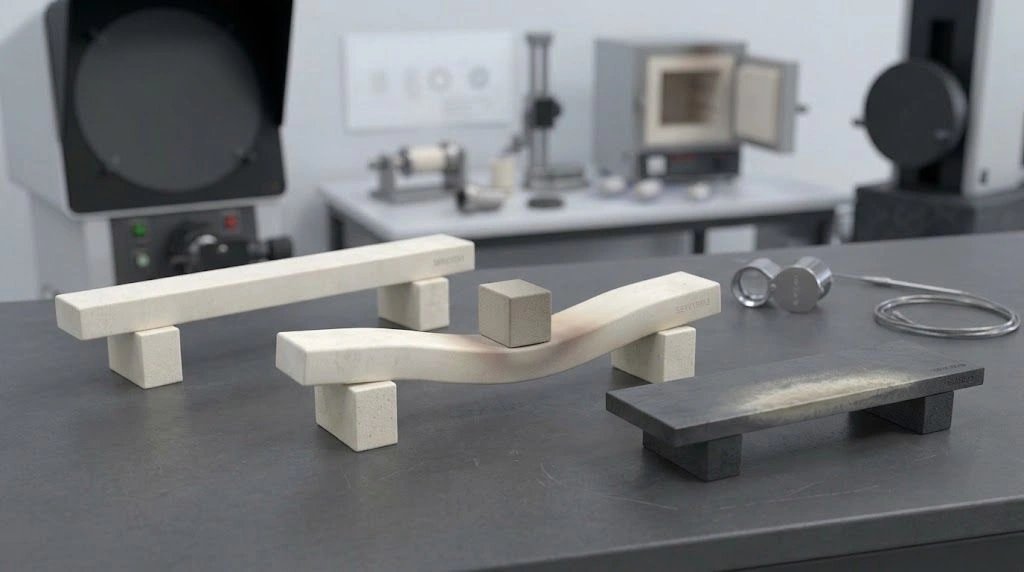
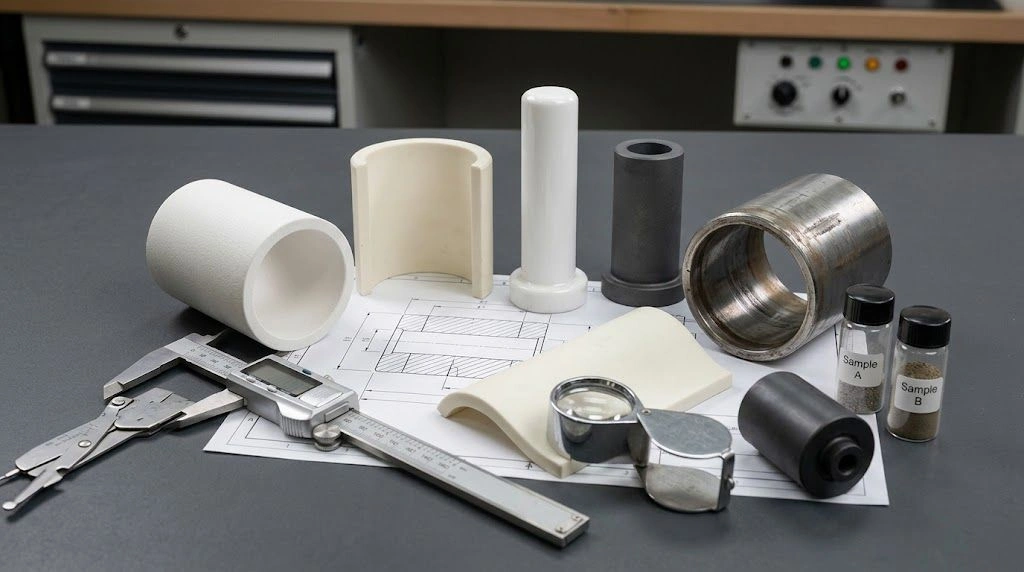
The physical samples show that deformation, oxidation, and surface degradation can establish service limits while the ceramic remains solid.
What Usually Sets the Practical Service Limit?
The usable limit is the first unacceptable property change. A loaded setter or tube can creep while solid. Strength may decline as intergranular phases soften. Oxidation or volatilization can change dimensions and surfaces. Grain growth or phase transformation changes mechanical behavior. Electrical or thermal properties may drift before visible damage.
Chemical contact may be more restrictive than furnace temperature. Metals, salts, slags, fluxes, vapors, steam, carbon, vacuum, or reducing gas can react with the ceramic or secondary phases. An intact crucible may still contaminate or bond to the charge. “No fracture” is not always success.
Eight mechanisms should be reviewed:
- High-temperature strength loss
- Time-dependent creep, sagging, or stress relaxation
- Oxidation, dissociation, sublimation, or volatilization
- Phase transformation, grain growth, or grain-boundary softening
- Chemical reaction, corrosion, wetting, penetration, or contamination
- Thermal-gradient, thermal-fatigue, or thermal-shock fracture
- Electrical resistivity, dielectric, or thermal-conductivity drift
- Seal, joint, coating, fixture, or metal-housing failure
| Duty condition | Likely controlling mechanism | Evidence required |
|---|---|---|
| Loaded furnace support | Creep or bending | Stress, span, orientation, dwell time, elevated-temperature data |
| Rapid insertion or cooling | Thermal stress | Ramp rate, gradients, geometry, finish, representative cycling test |
| Molten-material contact | Wetting, dissolution, penetration, contamination | Exact chemistry, hold time, atmosphere, coupon or trial test |
| Oxidizing atmosphere | Scale formation or oxidation of non-oxide grades | Grade-specific oxidation and mass-change evidence |
| Vacuum or reducing gas | Changed decomposition or volatilization equilibrium | Pressure, gas purity, and partial-pressure conditions |
| Electrical insulation | Loss of resistivity or dielectric performance | Electrical data at temperature and atmosphere |
| Precision fixture | Creep or thermal expansion beyond alignment allowance | Hot dimensional-stability and support requirements |
Thermal shock needs separate qualification. Kyocera publishes different results for specific Si₃N₄, SiC, zirconia, and alumina grades. Its heat-shock comparison supports relative screening, not universal component ΔT ratings. Wall thickness, flaws, finish, constraint, heat transfer, rate, and method change the result.
How Should Common Ceramic Families Be Compared?
There is no ranking independent of function. Alumina suits many furnace insulators, tubes, crucibles, and supports, but gradients, chemistry, and creep need review. Zirconia has a high melting point and useful toughness, yet stabilizer, phase stability, expansion, time, and load can impose a lower limit.
SiC combines high-temperature strength, conductivity, and low expansion, but route, density, free silicon, porosity, oxidation, atmosphere, and joints matter. Silicon nitride offers strength and thermal-shock resistance while additives and intergranular phases affect creep and oxidation.
AlN combines electrical insulation with thermal conductivity, making retention of conductivity part of its service definition. One supplier’s AlN grade table lists 1,200°C no-load maxima for several grades while separately noting development of a surface alumina layer around 700°C in oxidizing conditions. The material may remain intact while the surface change affects the property that justified selecting it.
BN is similarly grade- and atmosphere-dependent. Precision Ceramics’ BN guidance reports that some grades withstand more than 2,000°C in inert or reducing atmospheres. Binder system, density, strength, permeability, oxidation, and contact chemistry prevent that example from becoming a general air-service rating.
| Material family | Phase-behavior reference | Useful selection direction | Frequent service-limit question |
|---|---|---|---|
| Alumina, Al₂O₃ | Melts near 2,050°C | Electrical insulation, furnace tubes, crucibles, setters | Purity, creep, gradients, melt or vapor compatibility |
| Zirconia, ZrO₂ | High melting point near 2,700°C | Tough precision parts at qualified temperatures | Stabilizer, phase stability, aging, creep, expansion |
| Silicon carbide, SiC | Decomposition or sublimation is often more relevant than atmospheric melting | Heat transfer, thermal gradients, wear, high-temperature structures | SiC route, free silicon, oxidation, porosity, joints |
| Silicon nitride, Si₃N₄ | Decomposes at extreme temperature | Thermal cycling and loaded mechanical parts | Additives, grain-boundary phase, atmosphere, creep |
| Aluminum nitride, AlN | Decomposition and oxidation boundaries matter | Thermally conductive electrical insulation | Surface oxidation and retained conductivity |
| Hexagonal boron nitride, h-BN | Sublimation or decomposition and atmosphere dependence | Inert-atmosphere insulation and non-wetting contact | Oxidation, binder, density, strength, permeability |
These are screening directions, not guaranteed ratings. Confirm the exact grade, process route, atmosphere, load, duration, geometry, and supplier evidence.
Specific data demonstrate why grade names matter. One silicon-nitride supplier table lists no-load maximum temperatures of 1,100–1,200°C in air and up to 1,400°C in inert conditions across several grades. That is evidence for those materials under those stated conditions, not a general rating for every Si₃N₄ tube, bearing, or fixture.
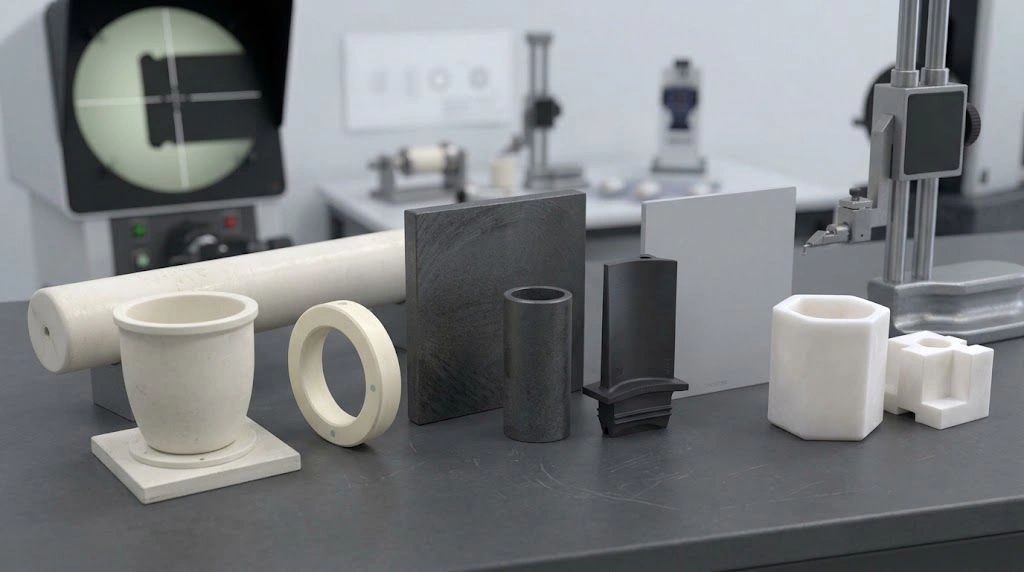
The six product families require grade- and duty-specific review rather than selection by a single headline temperature.
How Do Geometry and Assembly Lower the Temperature Limit?
Material data usually come from simplified specimens. A long tube, thin crucible, wide setter, cantilevered hook, multi-bore protection tube, and compact insulator experience different stresses and temperature fields.
Section changes and sharp corners concentrate thermal stress. Unsupported spans can sag. A closed-end tube may develop axial and radial gradients during insertion. Grinding damage and chips reduce fracture margin. A glaze, braze, gasket, coating, or metal collar may fail first.
| Component variable | Temperature consequence | Review action |
|---|---|---|
| Wall thickness | Changes heating time and through-wall gradient | Model or test the actual section |
| Unsupported length | Increases bending and creep exposure | Add supports or reduce span |
| Sharp transition | Concentrates thermal stress | Add radii and smooth section changes |
| Closed end | Heats differently from an open tube | Define insertion and heating method |
| Surface damage | Can reduce retained strength | Control grinding direction, finish, and edges |
| Ceramic-to-metal joint | Adds CTE mismatch and lower-temperature materials | Map the joint temperature and compliance |
| Furnace support contact | Creates local constraint and hot or cold spots | Define contact area and movement allowance |
| Orientation | Changes gravitational creep and contact load | Specify installed position |
| Nonuniform temperature | Generates stress below the headline maximum | Provide axial and radial temperature maps |
Furnace setpoint is not necessarily part temperature. A thermocouple may measure gas, heater, wall, or fixture temperature at a different location. Short exposure does not prove continuous life, and a surviving coupon does not qualify a final geometry. The system limit is the lowest qualified limit among ceramic body, surface condition, seal, joint, coating, support, fixture, and surrounding metalwork.
Safety margin cannot come from melting point alone. It depends on temperature uncertainty, variation, gradients, property scatter, failure consequence, excursions, and evidence quality.
What Temperature Information Belongs in the RFQ?
Replace “maximum temperature” with a thermal-duty envelope. Separate normal operating temperature, continuous maximum, intermittent peak, dwell time, ramp and cooling rates, cycle frequency, and abnormal excursions. State atmosphere, pressure, humidity or steam, process chemicals, molten materials, load, support points, and properties that must be retained.
Use this RFQ sequence:
- Define the exact material or acceptable material families.
- State normal, maximum continuous, and intermittent peak temperatures.
- Add peak duration, frequency, dwell, heating rate, cooling rate, and expected cycles.
- Distinguish furnace setpoint from estimated component temperature and provide gradients where known.
- Define air, oxygen, inert gas, reducing gas, steam, vacuum, pressure, and gas purity.
- Identify molten metal, salt, slag, flux, vapor, powder, or reactive chemical contact.
- Provide static load, pressure, torque, self-weight span, orientation, supports, and constraints.
- Supply the drawing, wall thicknesses, transitions, closed ends, joints, seals, coatings, and fixtures.
- Define retained strength, dimensional stability, creep, insulation, conductivity, purity, contamination, or mass-loss requirements.
- State failure consequence, prototype quantity, validation duration, inspection, and acceptance criteria.
The supplier should respond with the exact grade, basis of the proposed temperature limit, atmosphere and load assumptions, controlling mechanism, drawing exceptions, and recommended validation. A maximum-use number without those conditions is incomplete.
Use the advanced ceramic material selection matrix to compare multi-property candidates after temperature screening. For molten-material contact, continue to the ceramics for metal melting selection guide to review chemistry, wetting, slag, and contamination. Submit the final drawing and duty envelope through the custom ceramic parts review for grade- and component-specific feasibility assessment.
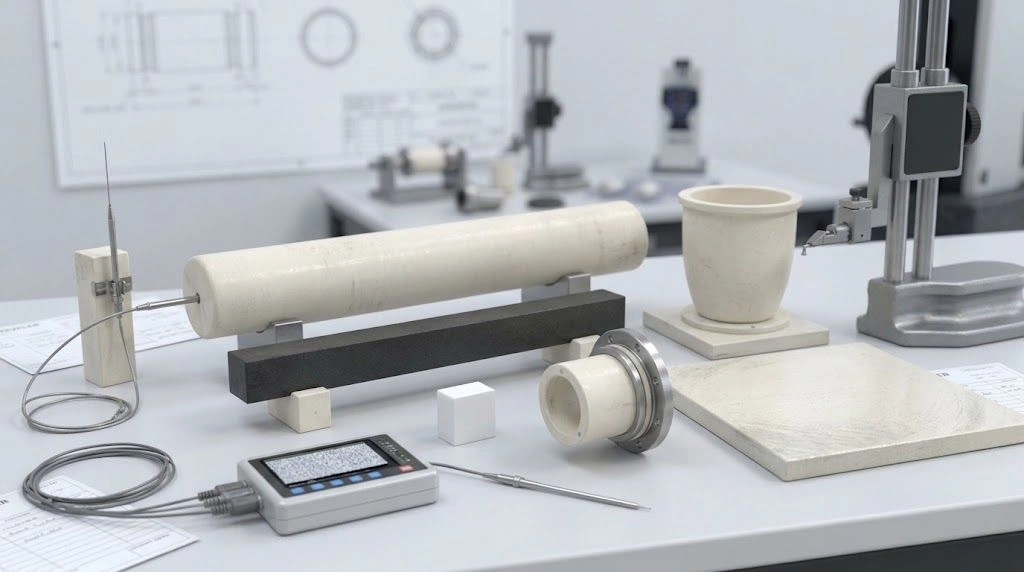
The review bench connects temperature, atmosphere, load, gradients, geometry, joints, and validation requirements in one component-level RFQ.
Frequently Asked Questions
Is ceramic melting point the same as service temperature?
No. Melting point describes phase behavior under defined conditions. Service temperature is an application limit based on retained strength, creep, dimensions, chemistry, electrical behavior, thermal cycling, and assembly integrity. The component may become unacceptable while the ceramic remains completely solid and far below its phase-change temperature.
Can alumina be used continuously at 1,800°C?
Do not approve that condition from alumina’s melting point. Continuous suitability depends on purity, grade, load, dwell, atmosphere, creep allowance, geometry, gradients, chemistry, and supplier evidence. Some published no-load maximum-use values are lower. A representative component test may be necessary near the proposed limit.
Why can zirconia’s use temperature be far below its melting point?
Zirconia service depends on stabilizer chemistry, phase stability, transformation behavior, creep, thermal expansion, time, and load. A high intrinsic melting point does not preserve the room-temperature properties of every stabilized grade. Review elevated-temperature data for the exact composition and required retained function.
Does silicon carbide melt or decompose?
At ordinary pressure, decomposition or sublimation is often more useful than a simple atmospheric melting point for SiC. Practical service is normally limited earlier by SiC processing route, oxidation, free silicon, porosity, atmosphere, load, joints, and chemistry. Use grade-specific data rather than one universal phase-change number.
Which ceramic is best for rapid thermal cycling?
Si₃N₄ and SiC are common starting candidates because suitable grades combine relatively low thermal expansion with useful strength and thermal-shock behavior. The decision still depends on geometry, wall thickness, surface condition, heat-transfer rate, atmosphere, load, and cycle profile. Verify the finished component under representative conditions.
What temperature data should be sent with a ceramic RFQ?
Provide normal, continuous maximum, peak, dwell, ramp, cooling rate, cycle count, atmosphere, pressure, chemistry, load, orientation, supports, gradients, and abnormal excursions. Add the component drawing, joints, seals, required retained properties, contamination limits, test duration, inspection method, and acceptance criteria.