Hexagonal boron nitride is a layered ceramic made of hexagonal sheets of boron and nitrogen atoms. That structure gives h-BN two important traits for non-wetting behavior: its basal planes are chemically quiet and easy to shear, so many molten metals have difficulty spreading and sticking on them. But the structure creates a tendency, not a universal law. Once temperature, alloy chemistry, active elements, or interfacial reactions become strong enough, h-BN can still be wetted or reacted.
Understanding why that tendency exists — and where it breaks down — is more useful than simply repeating that h-BN is non-wetting to molten metals.
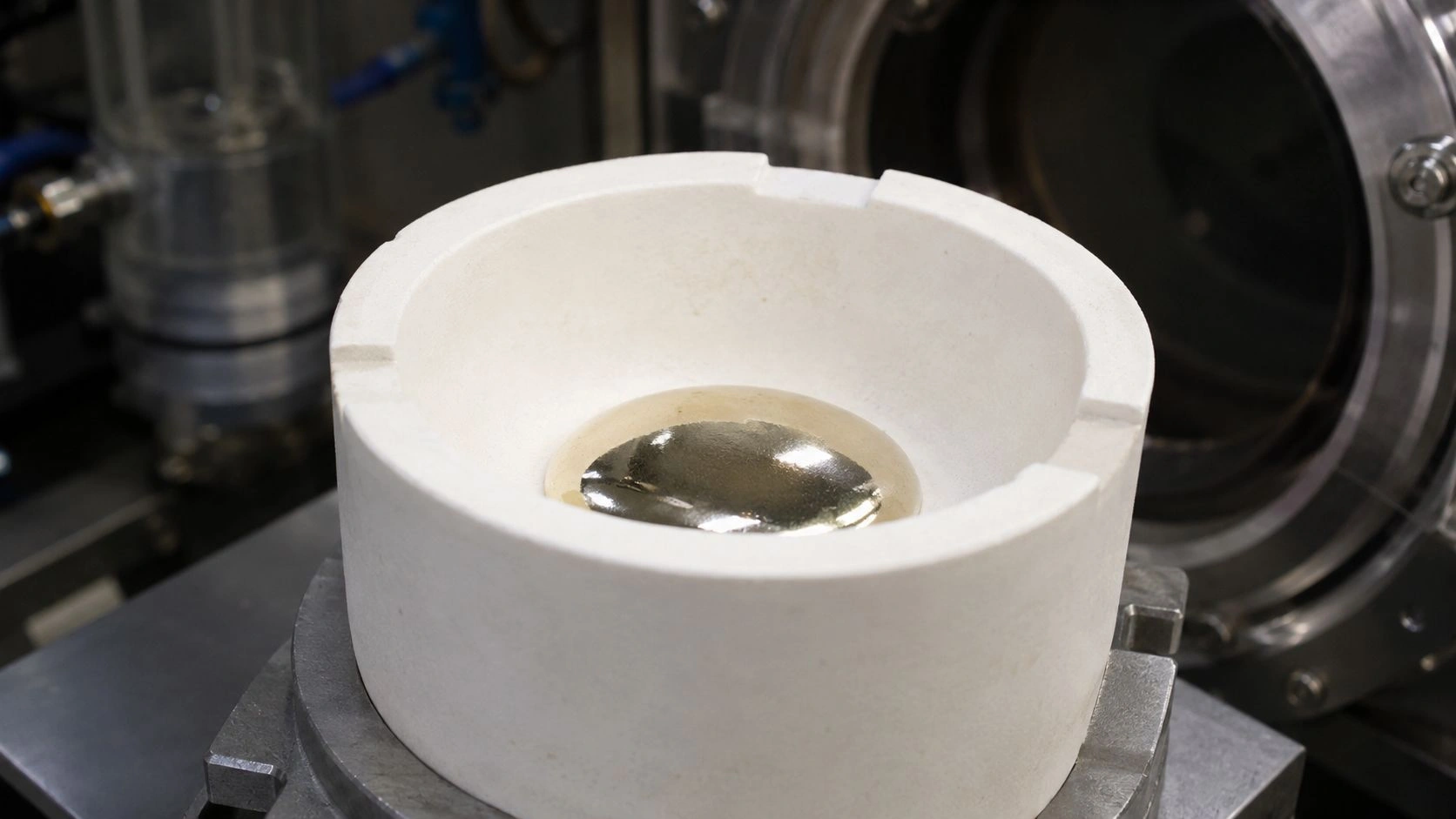
The non-wetting behavior of h-BN in molten-metal contact applications is rooted in its layered hexagonal structure — but that structural advantage has boundaries that matter for real application design.
The boron nitride ceramic grades built on the h-BN structure described in this article — hot-pressed HPBN, binder-free grades, and PBN — each realize this structural non-wetting tendency to different degrees depending on purity, density, and orientation.
What the hexagonal structure of h-BN actually is
Hexagonal boron nitride is the layered form of boron nitride, sometimes called "white graphite" because its atomic architecture closely resembles graphite while its electronic behavior is fundamentally different. The structural description that matters for engineering is simple: h-BN is made of flat hexagonal sheets, each a network of alternating boron and nitrogen atoms arranged in six-membered (BN)₃ rings, stacked on top of one another.
Within each sheet, the bonding between boron and nitrogen is strong and directional. Between adjacent sheets, however, the interaction is much weaker — governed by van der Waals-type forces rather than strong chemical bonds. That contrast between strong in-plane bonding and weak interlayer interaction is the structural fact that underlies most of h-BN's distinctive properties, including non-wetting behavior.
The surface that h-BN presents to an approaching melt is typically a basal plane — the flat face of one of those hexagonal sheets. Modern interface literature describes the h-BN basal plane as atomically smooth and essentially free of dangling bonds, which means it offers very little chemical reactivity to an incoming liquid. This is fundamentally different from the behavior at h-BN edges, grain boundaries, and defects, where unsatisfied bonding gives the surface much more chemical availability.
h-BN is built from sheets, not a three-dimensional framework
The sheet-based architecture distinguishes h-BN from three-dimensionally bonded ceramics like alumina or silicon carbide. A three-dimensional framework ceramic presents a surface with many atomic sites that can interact with a melt. An h-BN basal plane, by contrast, presents a relatively complete, inert surface where there is little local reactivity to drive wetting.
The basal plane is chemically quiet; edges and defects are not
This distinction within h-BN itself is the most important detail for understanding where non-wetting is reliable and where it is not. A well-oriented, dense HPBN surface presenting predominantly basal planes will behave differently from a surface with many exposed edges, grain boundaries, or processing-induced defects. Real industrial ceramics are not perfect single crystals, so the degree of non-wetting seen in practice reflects a mix of both.
How the structure creates non-wetting behavior
The structural link to non-wetting behavior operates through two connected mechanisms.
The first is chemical inertness on the basal plane. Because the basal plane has no dangling bonds and presents a chemically complete surface, many molten metals find little to bond with when they contact it. The interactions that drive wetting — adhesion between liquid atoms and surface atoms — are weaker at an inert basal plane than at a reactive oxide or carbide surface. A melt placed on an ideal h-BN basal plane often forms a high contact angle, the measurable signature of poor wetting.
The second mechanism is easy shear between layers. The weak interlayer forces mean that h-BN layers slide relatively easily against one another, which is why h-BN is also a dry lubricant. In a molten-metal contact situation, this translates to easier release: even when some adhesion does develop, the surface tends to cleave rather than bond permanently to the metal.
Published high-temperature h-BN reviews link these two effects directly to h-BN's practical use as a solid lubricant and release agent in industrial applications including aluminum extrusion tooling and titanium shaping. Industrial suppliers also describe h-BN as non-wettable by molten glass, molten salts, and reactive molten metals in metal-production hardware — a consistent industrial endorsement of the structural logic described above.
The Structure-to-Behavior Matrix below maps the structural features to their engineering consequences:
| Structural feature of h-BN | What it means physically | Why it matters for non-wetting |
|---|---|---|
| Hexagonal layered network of (BN)₃ rings | h-BN is built from sheet-like basal planes rather than a 3D bonding framework | The surface presented to a melt is often a stable, chemically complete basal plane rather than a reactive open network |
| Strong in-plane bonding + weak interlayer forces | Layers are strongly bonded internally but slide relatively easily against one another | Supports dry lubricity and release behavior, which reduces sticking and adhesion |
| Chemically inert, dangling-bond-poor basal plane | The basal plane is atomically smooth and chemically inert | Many melts experience weaker adhesion-driving interactions on the basal plane |
| Defects, edges, and active alloying elements | Edges and defects are more reactive than ideal basal planes; some alloying elements promote interfacial reaction | This is why non-wetting can break down in real systems |
Structure-to-behavior logic synthesized from high-temperature h-BN reviews, wetting papers, and industrial h-BN application references.
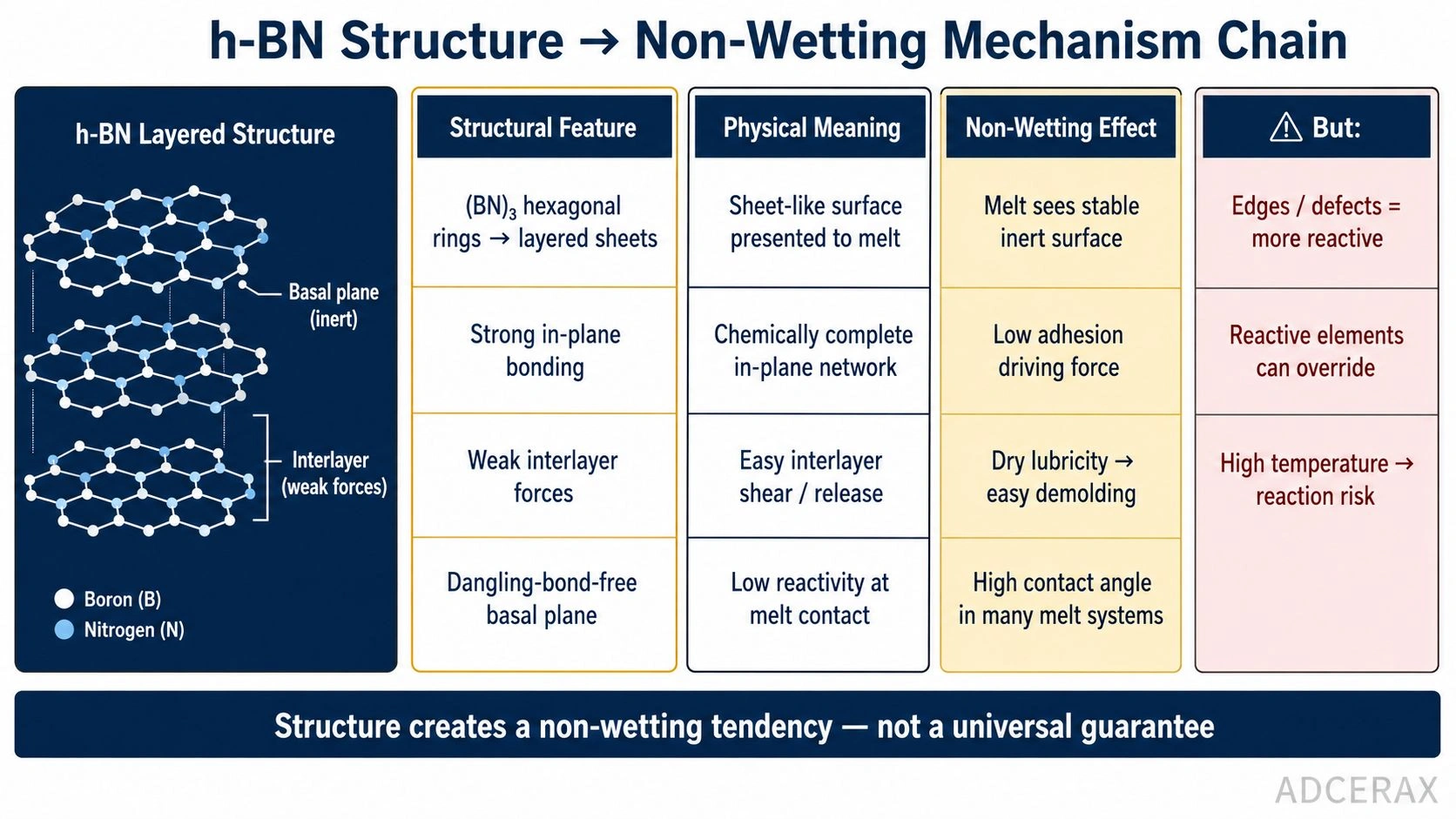
h-BN's layered hexagonal structure creates two linked non-wetting mechanisms: chemical inertness at the basal plane and easy interlayer shear — both of which reduce adhesion at the melt-ceramic interface.
h-BN often gives a molten metal less to grab onto
A plain-English summary of the structural mechanism is that h-BN's basal plane surface often gives a molten metal less chemical opportunity to spread and bond. It is not that the surface is repelling the melt with force — it is that the thermodynamic driving force for adhesion is lower at the basal plane than at more reactive surfaces. That lower driving force is why many molten metals form high contact angles on h-BN rather than spreading to fill the available surface.
Dry lubricity and non-wetting share the same structural root
The same weak interlayer forces that make h-BN a dry lubricant also contribute to its non-wetting behavior by reducing the energy penalty for the metal-ceramic interface to cleave. These are not independent properties — they are two expressions of the same structural fact.
Where this mechanism matters in real applications
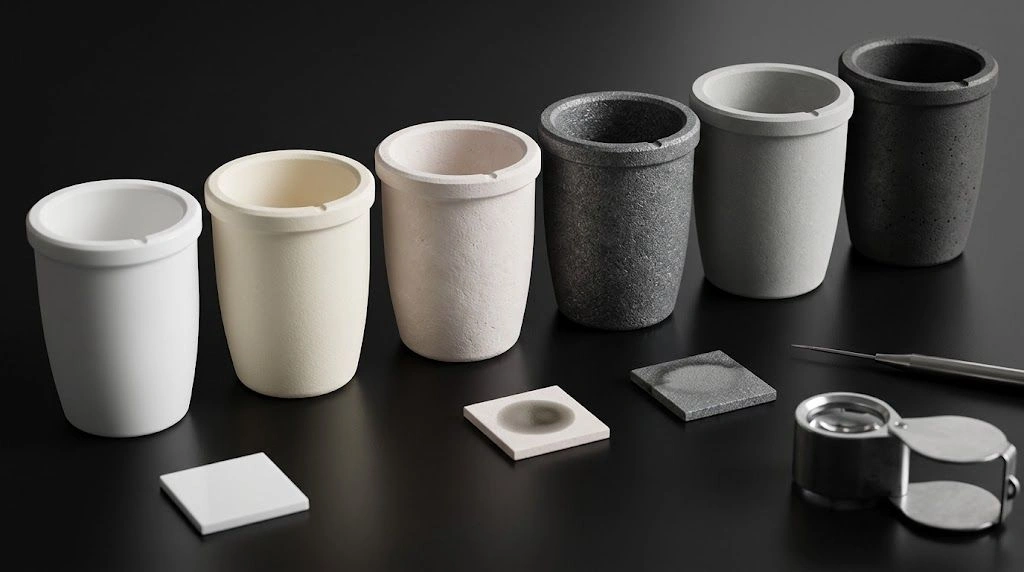
The non-wetting tendency described above is most valuable in applications where the engineering problem is sticking, release difficulty, unwanted adhesion, or metallic contamination from vessel walls. That is why h-BN is specified for crucibles for precious metals and high-purity melt handling, molten-metal release coatings, casting tooling and break rings, and high-temperature contact surfaces where easy demolding matters.
The boron nitride crucibles used in these applications draw directly on the structural non-wetting logic: the combination of low adhesion, easy release, and electrical insulation that h-BN provides at the melt interface is difficult to replicate with oxide ceramics, which lack the same dangling-bond-free basal plane character.
The mechanism also matters in applications where h-BN must simultaneously be non-wetting, electrically insulating, and thermally stable — a combination that other non-wetting materials like graphite cannot achieve because graphite is electrically conductive. This multi-property combination is what makes h-BN useful in applications like induction-melting insulator liners and clean-melting contacts where neither graphite nor oxide ceramics can cover all requirements.
What this is most often confused with
The most important misconception is treating non-wetting as if it meant non-reactive in every condition. Non-wetting describes the spreading behavior of a liquid on a surface. Non-reactive describes whether chemistry occurs at the interface. These two can be independent: a surface can resist initial spreading but still react over time, or conversely can allow spreading while remaining chemically stable.
The clearest example from the wetting literature is the molten aluminum / h-BN system. Published wetting studies report that the initial Al/BN contact angle is high — consistent with non-wetting — but at and above approximately 1273 K under reactive conditions, the equilibrium contact angle can reach zero because interfacial reaction forms AlN and other products, overriding the initial non-wetting tendency. The material that started non-wetting became reactive-wetting not because its structure changed, but because the chemistry became energetically favorable enough to drive interfacial reaction.
A second confusion is treating the ideal basal plane as representative of every h-BN surface. Modern interface literature emphasizes the chemical inertness of the basal plane specifically — not of h-BN surfaces in general. Real hot-pressed or sintered h-BN ceramics have grain boundaries, polishing-induced surface layers, machined edges, and porosity-related features where the surface chemistry differs from the ideal basal plane. The non-wetting benefit is strongest where basal-plane character is preserved.
What the main boundaries and exception conditions are
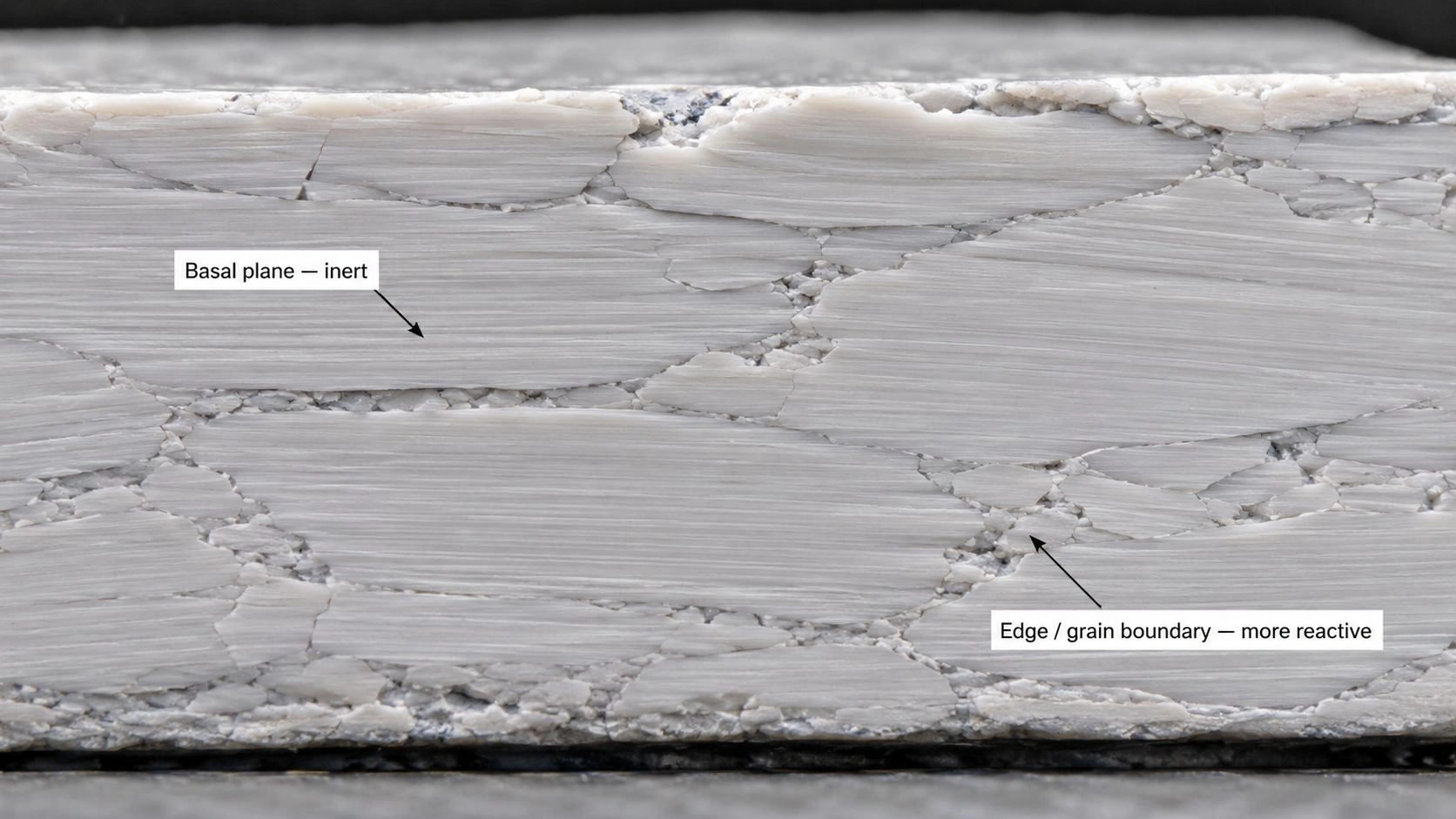
The basal plane is the least reactive part of h-BN; edges, grain boundaries, and defect sites are where chemistry can start — understanding this distinction is essential for predicting where non-wetting behavior will hold and where it can break down.
The Boundary Matrix below maps the four most important exception conditions:
| If the system looks like… | Likely wetting outcome | Why |
|---|---|---|
| Many non-ferrous melts in practical industrial use | Often poor wetting / good release | Review and industrial sources repeatedly describe h-BN as poorly wetted by many metal and glass melts |
| Molten aluminum at moderate casting temperatures | Can remain strongly non-wetting | Published h-BN reviews report liquid aluminum does not wet h-BN up to approximately 900°C, with contact angle around 160° |
| Molten aluminum at higher temperature in purified reactive conditions | Wetting can progress strongly, even to equilibrium 0° contact angle above 1273 K | Interfacial reaction and AlN formation can override the initial non-wetting tendency |
| Alloy systems with active element additions such as Ti | Contact angle can drop sharply | Even a small Ti addition to a Cu–Zr system that does not wet h-BN can substantially increase wetting — demonstrating active-element sensitivity |
Boundary logic synthesized from sampled wetting studies and h-BN review literature; verify against specific melt chemistry and temperature for any critical application.
Alloy chemistry is the first boundary. The addition of small amounts of reactive or active elements to a metal can substantially change the wetting outcome on h-BN. This is demonstrated in wetting studies where Cu–Zr alloys without reactive additions remain non-wetting on h-BN, but small Ti additions lower the contact angle significantly. The basal-plane inertness does not protect against sufficiently reactive interfacial chemistry.
Temperature and dwell time are the second boundary. The same material that gives good release at moderate temperature can become more reactive at higher temperatures where thermodynamic driving forces for interfacial reaction are larger. The Al/BN system is the most documented example: the reaction becomes progressively more favorable above approximately 1000 K under certain conditions.
Surface quality is the third boundary. Edges and defect sites on real h-BN ceramics are more reactive than ideal basal planes. A well-oriented, dense, polished HPBN surface has different wetting behavior from one with exposed grain edges, machining damage, or porosity. Microstructural quality matters for maintaining the structural non-wetting advantage in service.
The safest engineering sentence about h-BN non-wetting is: h-BN has a strong structural tendency toward non-wetting, especially on intact basal planes, but that tendency can be weakened or overridden by interfacial reaction chemistry, active alloying elements, elevated temperature, and surface defects.
Conclusion
h-BN's non-wetting behavior is not a coincidence — it follows directly from the layered hexagonal structure, the chemical inertness of the basal plane, and the weak interlayer forces that enable easy shear and low adhesion. Those structural facts explain why h-BN is specified for crucibles, coatings, and release surfaces in molten-metal processing, and why it often outperforms both graphite and oxide ceramics in those roles. Understanding where the structural advantage breaks down — alloy reactivity, high temperature, active elements, and surface defects — is equally important for anyone specifying h-BN in demanding applications.
Selecting h-BN grades for molten-metal contact applications? The structural non-wetting mechanism described here informs which grade, geometry, and atmosphere specification will preserve that behavior in service. ADCERAX engineers can review application temperature, metal chemistry, and surface requirements before a grade is committed; no RFQ commitment required at this stage.
Frequently Asked Questions
What is the simplest structural description of h-BN?
It is a layered ceramic made of hexagonal sheets of boron and nitrogen atoms, often described as "white graphite." The structure consists of hexagonal (BN)₃ rings arranged into flat atomic sheets with strong in-plane bonding and weak forces between the layers. That sheet-based architecture gives h-BN its characteristic combination of properties — including its tendency toward non-wetting behavior at the basal plane surface.
Why does the layered structure help non-wetting?
Because the basal plane is chemically inert and essentially free of dangling bonds, many molten metals find less to adhere to on that surface. At the same time, the weak interlayer forces support easy shear and release behavior. Together these two structural effects reduce the adhesion-driving interactions between a melt and the ceramic surface, which typically produces a high contact angle — the measurable indicator of poor wetting.
Is h-BN non-wetting to all molten metals?
No. h-BN is non-wetting to many molten metals and slags under typical processing conditions, but the non-wetting behavior is a structural tendency rather than a universal property. Specific melt systems — particularly those involving reactive elements or high temperatures where interfacial reaction becomes thermodynamically favorable — can still wet h-BN by forming reaction products at the interface.
What is the clearest example of a boundary condition?
Molten aluminum is the clearest example documented in the sampled wetting literature. The Al/BN system can begin with a high contact angle consistent with non-wetting, but at elevated temperatures above approximately 1273 K under reactive conditions, interfacial reaction including AlN formation can drive the equilibrium contact angle to zero — full reaction wetting. The material that started as non-wetting became reaction-wetted as the interfacial chemistry changed.
What is the biggest misconception about h-BN non-wetting?
Confusing non-wetting with universally inert. Non-wetting describes the spreading behavior of a liquid on a surface at a given condition; non-reactive describes whether chemistry occurs at the interface. h-BN's basal plane is chemically inert in many melt systems, but real applications with active alloying elements, high temperatures, or damaged surfaces can force interfacial reactions that override the initial non-wetting tendency. The structural advantage exists but has real boundaries.