Silicon carbide furnaceware can serve selected roles in semiconductor vertical diffusion tools: liners, boats, paddles, supports, and, only after full requalification, a process tube, but it is not a universal quartz drop-in. The decision turns on component role, wafer-facing exposure, surface route (CVD-SiC or CVD-coated versus dense bulk), cleaning chemistry, and a documented particle / metal / thermal requalification plan.
3-Minute Decision: SiC in This Vertical Diffusion Position?
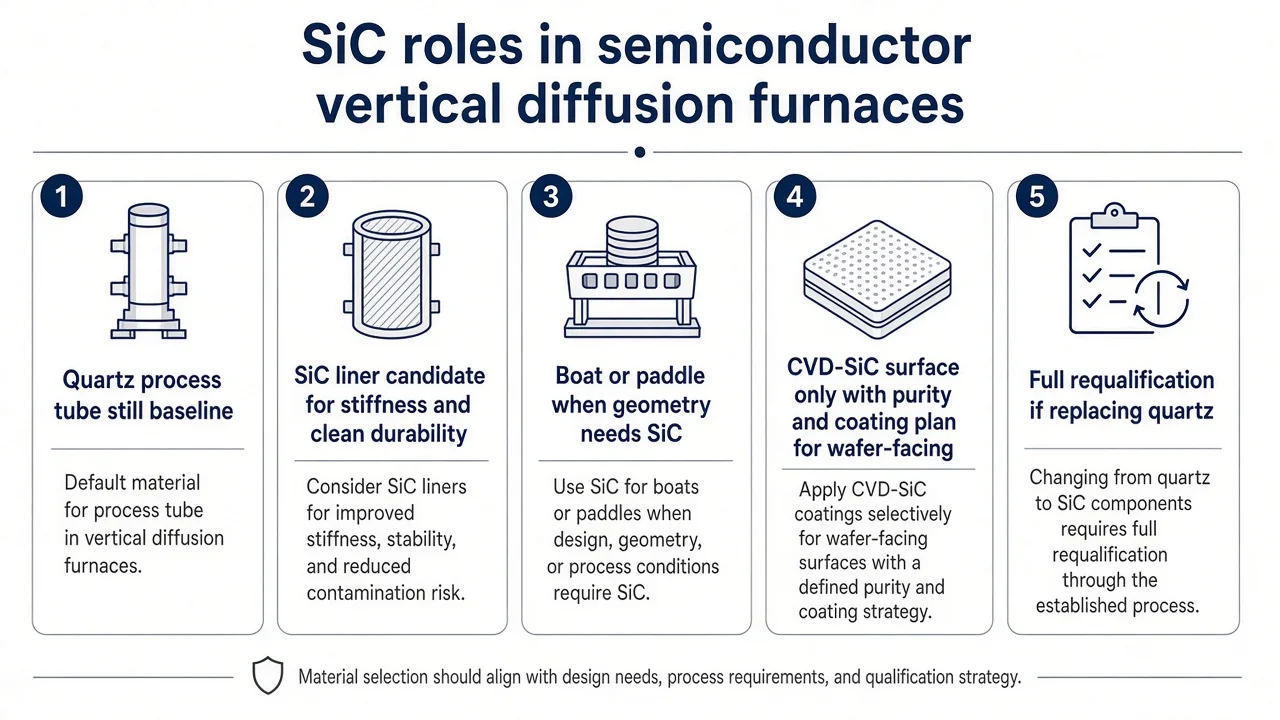
- Quartz process tube or boat still meets geometry and cleaning duty -> keep quartz as baseline. Move to SiC only when durability, stiffness, or cleaning life is proven limiting, not because SiC sounds more advanced.
- Inner liner, support paddle, or boat slots needing stiffness and cleaning durability -> SiC is a fair candidate. Validate coating integrity (if coated), lot purity evidence, and cleaning compatibility before release.
- Wafer-facing surface -> prefer CVD-SiC or a CVD-coated structure only when coating integrity and a lot purity plan exist. Do not treat bulk dense SiC as automatically wafer-facing safe.
- Process gas chemistry unknown and residual free silicon is a concern -> do not assume a reaction-bonded route is wafer-facing OK. Review free-Si chemistry limits against the actual gas set; when a residual silicon phase is unwanted, review dense SSiC instead.
- Replacing a quartz process tube with SiC -> plan full thermal-profile, particle, and metal requalification. Treat it as a process change, not a spare-parts swap.
Risks That End RFQs
Most failed SiC furnaceware inquiries stall for the same reasons: missing role definition, no purity evidence path, and no requalification plan. Address these before quoting wall thickness or route name.
- Particles from coating or cleaning damage. A breached CVD surface or aggressive clean can shed particles into the process volume. State coating inspection method and cleaning chemistry on the RFQ.
- Bulk metal impurity without a lot COA. Trace-metal evidence must be lot-tied and agreed on the order or drawing. Specify required elements and limits per purchase agreement.
- Thermal-profile shift after quartz -> SiC. SiC has higher stiffness and different thermal mass and emissivity than quartz. Expect setpoint and ramp review; do not assume the quartz recipe transfers unchanged.
- Cleaning chemistry attack. Compatibility with HF, HCl, SC-1, and SC-2 style cleans, along with cleaning cycle life, depends on the tool and chemistry. Include cleaning chemistry and frequency in the RFQ.
- Wrong role for the route. A structural paddle and a wafer-facing liner are different purity and surface problems. Naming only "SiC process tube" without role and wafer-facing Y/N usually stops engineering review.
Quartz remains the baseline for most vertical diffusion process tubes and many boats because it is optically and chemically familiar to tool recipes. At high process temperatures quartz can soften or creep under self-weight and long cantilevers; that is a qualitative reason teams review SiC for stiffness-critical hardware, not a hard temperature certificate for either material. Stiffness and geometry control favor SiC when the drawing and duty demand it; purity and surface integrity still decide whether that SiC may face wafers.
Geometry and Role Boundaries
Use role first. The same SiC family behaves differently as a process tube, liner, injector sleeve, boat, paddle, dummy, or support. Fit, advantage, main risk, and what to verify differ by position.
| Role | Fit (qualitative) | Advantage vs quartz baseline | Main risk | Verify |
|---|---|---|---|---|
| Process tube | Conditional only | Stiffness / geometry hold at high T | Recipe and purity requalification load | Full thermal / particle / metal plan |
| Inner liner | Common SiC candidate | Protects outer hardware; cleaning durability | Coating breach -> particles / metals path | Coating integrity + clean chemistry |
| Injector / sleeve | Tool-specific | Dimensional stability under local heat | Gas attack at high surface area | Gas list + surface route |
| Boat / slots | Strong candidate when stiffness needed | Slot geometry control; cleaning durability | Wafer contact if surface not qualified | Wafer-facing Y/N + finish |
| Paddle / cantilever support | Strong mechanical candidate | Stiffness vs long quartz cantilevers | Wrong purity route if wafer-near | Load path + chemistry |
| Dummy / support hardware | Often dense bulk OK | Cost and toughness balance | Misuse as wafer-facing barrier | Keep non-facing unless qualified |
Boats, paddles, and related wafer-near mechanical parts are often reviewed with the same purity discipline as liners when contact or near-wafer exposure exists. For these component forms, see SiC wafer-handling furnace components.
Material Routes by Component Role
For a detailed comparison of material routes and properties, see the SSiC vs RBSC tube grade selection guide.
- CVD-SiC or CVD-coated structures. Preferred review path for wafer-facing surfaces when coating integrity and lot purity evidence are available. Coating isolates bulk impurities only while the coating remains intact; pinholes, chips, or aggressive cleans reopen a contamination path. Coating thickness and trace-metal limits require documented specifications and verification.
- Dense SSiC. High SiC content, no intentional free-silicon infiltrate. Useful when residual silicon phase is unwanted and the duty needs dense, low-open-porosity hardware. Material selection ceiling on the TDS is commonly cited near 1600 °C as an initial selection ceiling, not a process certification for a named diffusion recipe.
- RBSC / SiSiC. Reaction-bonded / siliconized route with a residual free-silicon phase (TDS nominal free Si about 15 wt%). Density and stiffness help structural liners, paddles, and supports when gas chemistry and temperature stay inside free-Si compatibility. That residual silicon phase constrains chemical and temperature fit; it is a route property, not a wafer-facing pass. When free-Si chemistry is unacceptable for the gas set, review dense SSiC instead. Suitability for diffusion or LPCVD service depends on the actual process gases. TDS material selection ceiling for this route is commonly cited near 1380 °C, again selection ceiling, not continuous loaded service or process certification. Atmosphere, load, dwell, and cycling must be defined on the RFQ.
- Porous NBSiC / recrystallized routes. Generally not wafer-facing process barriers in semiconductor vertical diffusion. Keep them out of purity-critical process envelopes unless a specific non-facing duty is proven.
Temperature ceilings above are initial material selection figures from the dense/bonded SiC TDS family. They are not continuous service ratings under a named FEOL recipe, and they do not replace tool requalification.
Do Not Misdiagnose Furnace Yield or Particle Events as "Bad SiC"
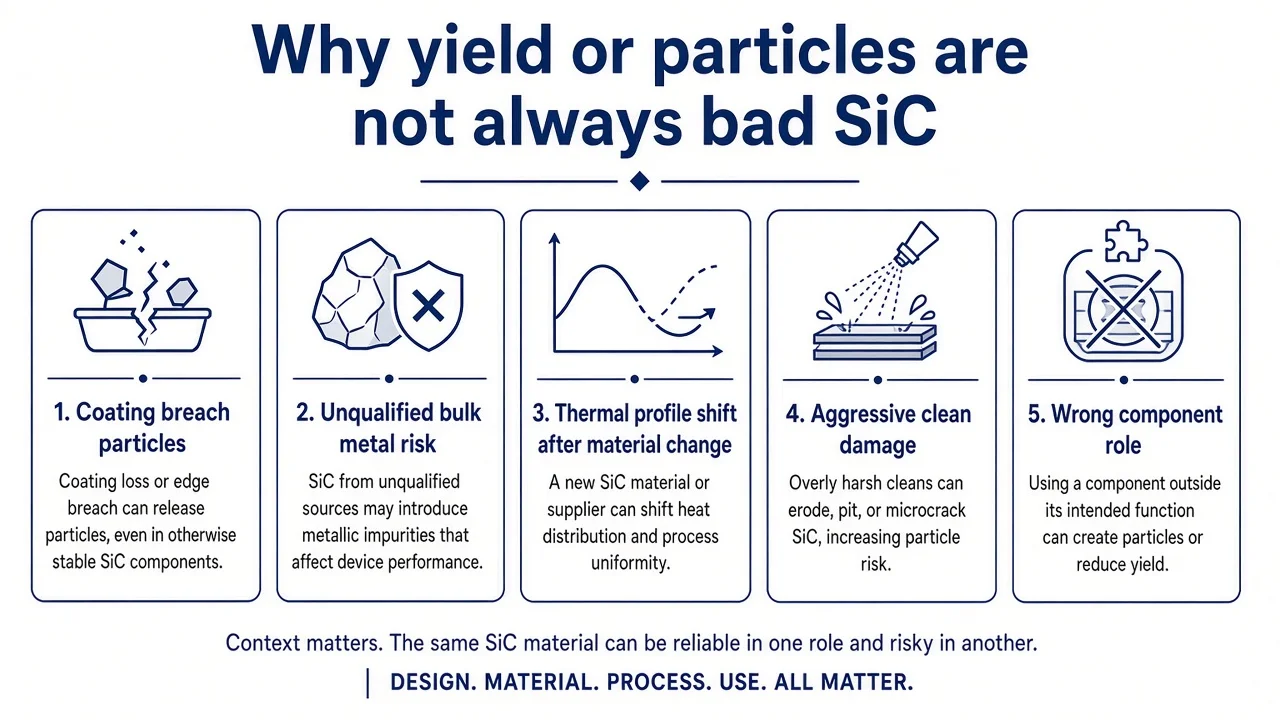
Particle spikes, metal excursions, and profile drift after a SiC install are often system problems, not proof that "SiC failed."
- Coating breach or handling damage. Chips at edges, slots, or clamp points open a particle and metal path even when the bulk ceramic is sound.
- Unqualified bulk metals or missing lot ID. Installing hardware without agreed COA scope and lot traceability invites false "material" blame later.
- Thermal profile not re-qualified. SiC changes heat-up dynamics versus quartz; old setpoints can create new particle or film signatures.
- Aggressive clean damage. Over-etch or mechanical scrub can roughen or undercut a CVD surface; change clean practice before another material swap.
- Wrong role. A structural-grade part placed in a wafer-facing liner seat will look like a purity failure when the real error was role assignment.
For background on high-temperature oxidation behavior in other atmospheres, see active vs passive oxidation SiC failure modes. Vertical-diffusion purity qualification still requires a separate, tool-specific review.
RFQ Checklist for SiC in Semiconductor Vertical Diffusion
Send a role-complete RFQ. "SiC process tube" alone is not enough for engineering review.
Once role and wafer-facing status are fixed, lock OD/ID/wall/length and end finish against manufacturable silicon carbide tube geometry before issuing the drawing package.
- Furnace brand / model and wafer size
- Component role + wafer-facing Y/N
- Process type and gas list (including cleans)
- Temperature profile, ramp, and dwell, with an initial operating envelope if detailed data are not yet available
- SiC route: CVD-SiC / CVD-coated / dense SSiC / RBSC·SiSiC (state free-Si acceptability)
- Trace-metal COA scope + lot ID: elements and limits per order or drawing agreement
- If coated: coating inspection method and acceptance criteria (thickness only if the drawing specifies it)
- Cleaning chemistry and expected cycles, with qualification criteria agreed for the intended duty
- Drawing: OD / ID / wall / length / slots / edge radius / surface finish
- Qualification plan: particles, metals, thermal profile, cleaning trial
Leak-tight assemblies need a finished-part leak specification. Electrical resistivity and hardness values should be reviewed with the grade-specific TDS and stated test methods. They rarely decide a vertical-diffusion liner RFQ by themselves.
Frequently Asked Questions
Can SiC replace quartz process tubes in every vertical diffusion tool?
No. Quartz remains the baseline for most process tubes. SiC is conditional: use it when stiffness, geometry, or cleaning durability justify the change, and only with full thermal, particle, and metal requalification. It is not a spare-parts swap.
When is CVD-SiC preferred over dense bulk SiC?
When the surface is wafer-facing or purity-critical and you can support coating integrity plus lot purity evidence. Dense SSiC or RBSC/SiSiC may still suit non-facing structural roles after chemistry review. Do not treat bulk dense SiC as automatically equivalent to a qualified CVD surface.
Is RBSC / SiSiC acceptable near wafers?
Only after free-Si chemistry review against the actual gases and temperatures. The residual free-silicon phase (about 15 wt% nominal on the TDS) constrains chemical and temperature fit. If that phase is unwanted, review dense SSiC. Do not assume a blanket ban across all diffusion or LPCVD chemistries without checking the process gases.
What purity evidence should the RFQ require?
Lot-tied COA scope agreed on the order or drawing, plus a particle and metal qualification plan. Specify the required elements and acceptance limits for the intended process. Coated parts also need coating integrity evidence.
Why did particles rise after we installed SiC?
Check coating damage, unclean handling, aggressive cleans, and whether the thermal profile was re-qualified after the quartz-to-SiC change. Wrong role assignment (structural part in a wafer-facing seat) is another common root cause. Do not jump to "bad SiC grade" first.