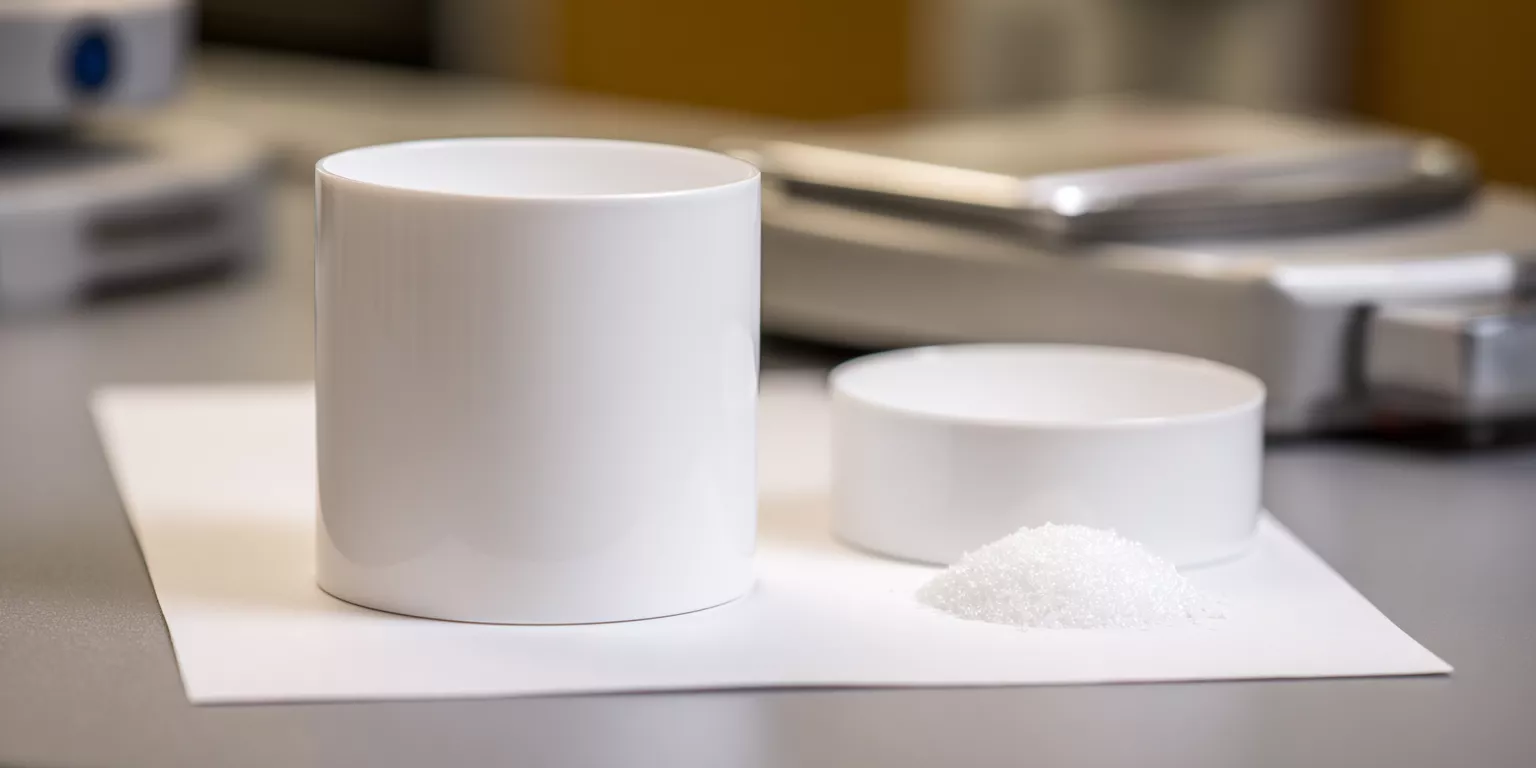
DSC alumina pans (lidded crucibles) are introduced only after aluminum pans begin to distort pharmaceutical DSC results. Consequently, unresolved variability, misleading transitions, and weakened method credibility increasingly delay analytical decisions.
In pharmaceutical thermal analysis, unreliable DSC data creates immediate risk. However, container-related errors are frequently overlooked. Therefore, identifying when aluminum pans fail becomes essential before interpreting solid-state behavior.
DSC alumina pans provide a chemically inert and thermally stable reference for pharmaceutical testing when aluminum pans introduce interaction, deformation, or residue-driven artifacts. This article defines the conditions under which alumina becomes necessary from a user-side engineering perspective.
Before examining specific failure mechanisms, it is necessary to establish why pan material selection directly influences pharmaceutical DSC data integrity. Consequently, the following section reframes container choice as a primary methodological decision rather than a secondary consumable detail.
Why Pan Material Choice Matters in Pharmaceutical DSC Analysis
In pharmaceutical DSC1 workflows, container material defines the thermal and chemical boundary of every measurement. Therefore, pan selection directly influences heat-flow accuracy, baseline stability, and data interpretability. Moreover, container-induced artifacts are often misattributed to sample behavior, which undermines method credibility.
Heat Flow Boundary Conditions in Drug Substance Analysis
In DSC measurements, heat flow is governed by the boundary conditions formed between the sample, the pan, and the sensor. Consequently, differences in thermal conductivity between aluminum and alumina directly affect how rapidly heat is absorbed and dissipated during a scan.
In routine pharmaceutical laboratories, switching pan materials without method adjustment can shift onset temperatures and inflate baseline curvature variability when thermal contact conditions are inconsistent. As a result, pan material becomes a first-order variable rather than a neutral container choice. Site method data should confirm the magnitude under your heating program.
Ultimately, DSC alumina pans stabilize thermal boundary conditions when aluminum pans introduce uncontrolled heat-flow variation.
Key Thermal Parameters Affecting DSC Boundary Conditions
| Parameter | Aluminum Pan | Alumina Pan |
|---|---|---|
| Thermal conductivity (W/m·K) | ~205 (room-temp metal typical) | ~18–42 @25 °C, grade-dependent (material screening; not a DSC heat-flow guarantee) |
| High-temperature material selection ceiling (°C) | Al softens / drifts under sustained high-T DSC holds well below melt | Alumina long-term material selection ceilings ~1400–1750 °C by grade — selection ceiling ≠ DSC pan / instrument rating |
| Heat-flow equilibration speed | Very fast | Moderate |
| Boundary condition predictability | Moderate | High |
Chemical Neutrality as a Data Integrity Requirement
Beyond thermal effects2, pharmaceutical samples often undergo chemical changes during heating. Consequently, pan material reactivity can introduce secondary thermal events unrelated to intrinsic sample transitions.
In practice, reactive or halogenated decomposition can create pan-interaction artifacts in aluminum pans — for example unexpected exothermic shoulders or surface discoloration and residue adhesion after a single run. Therefore, chemical neutrality becomes essential once decomposition pathways are involved.
DSC alumina pans provide a chemically inert interface, thereby reducing the risk of container-induced reactions that compromise pharmaceutical data integrity.
Reproducibility and Method Validation Implications
Reproducibility is central to pharmaceutical method validation. However, even minor pan deformation or surface interaction can accumulate into statistically significant variability across repeated runs.
In validation exercises involving repeated DSC scans, aluminum pans often show larger run-to-run enthalpy scatter at elevated temperatures, while alumina pans typically remain tighter under the same method — confirm in your IQ/OQ/PQ / method validation. Consequently, pan material selection directly affects whether a method meets internal acceptance criteria.
Accordingly, pan material choice should be treated as a foundational method decision rather than an interchangeable consumable option.
Aluminum Pans as the Baseline in DSC: Why They Became the Default Choice
Aluminum pans are widely treated as the baseline container in DSC workflows. Therefore, understanding why they became standard is necessary before identifying where this assumption no longer holds.
-
High thermal conductivity and rapid signal response
Aluminum exhibits high thermal conductivity (room-temp metal typical ~205 W/m·K — not an ADCERAX TDS row), which enables fast heat transfer between the sample and the DSC sensor. Consequently, thermal equilibrium is reached quickly, and transitions such as glass transition temperatures and low-enthalpy melting events appear sharp and well defined. In routine pharmaceutical screening below 300 °C (illustrative method-decision screening — not a universal pharmacopeia rule), aluminum pans often remain adequate when chemistry is benign. -
Reliable performance in conventional pharmaceutical DSC applications
In early-stage polymorph screening and excipient compatibility studies, aluminum pans perform consistently when chemical reactivity is absent. Specifically, sample masses between 2–8 mg under inert atmospheres remain thermally stable without inducing pan deformation. As a result, aluminum pans enable high-throughput comparative analysis during formulation development. -
Practical thermal limits that precede melting behavior
Although aluminum melts near 660 °C, pan rating, geometry, and hold time still govern practical limits — structural softening begins much earlier during sustained heating. Laboratory observations indicate elevated baseline drift during extended high-temperature holds, even without visible melting. Consequently, aluminum reliability declines before its nominal melting point is reached.
Taken together, aluminum pans remain effective only within defined thermal and chemical boundaries; beyond these limits, the default assumption becomes a source of systematic error.
Before selecting alternative materials, it is critical to identify the precise conditions under which aluminum pans compromise pharmaceutical DSC data. Consequently, this section isolates failure mechanisms that originate from aluminum rather than the sample itself.
When Aluminum Pans Become a Source of Error in Pharmaceutical Testing
Aluminum pans stop behaving as neutral containers once specific chemical, thermal, or residue-related thresholds are exceeded. Consequently, DSC results may reflect container-driven artifacts rather than intrinsic pharmaceutical behavior.
-
Chemical interaction with decomposing pharmaceutical samples
During heating, certain APIs and excipients release acidic or oxidative species that can react with aluminum surfaces. In laboratory practice, this interaction can produce unexpected exothermic features and apparent enthalpy contributions that do not belong to the API itself. As a result, analysts may incorrectly attribute these signals to polymorphic transitions or stability events.
Once chemical interaction occurs, aluminum no longer provides a chemically neutral measurement environment. -
Loss of mechanical stability at elevated temperatures
Although aluminum melts near 660 °C, structural softening and micro-deformation often begin well below melt during sustained DSC heating. In pharmaceutical stress-testing scenarios, elevated baseline drift has been observed under these conditions, even without visible melting. Consequently, altered pan geometry changes sensor contact and introduces variability unrelated to sample properties.
This mechanical instability marks a practical limit well below aluminum’s theoretical melting point. -
Residue accumulation and volatilization-driven artifacts
Pharmaceutical samples frequently undergo partial decomposition or volatilization, leaving residues on aluminum pan surfaces. After a single high-temperature run, residue buildup can raise effective thermal mass and broaden peaks in subsequent scans. Therefore, aluminum pans can introduce memory effects that compromise repeatability across runs.
Such residue-induced artifacts accumulate progressively, rather than appearing as isolated anomalies.
Taken together, chemical reactivity, mechanical softening, and residue accumulation define the conditions under which aluminum pans become a systematic source of error in pharmaceutical DSC testing.
Before transitioning away from aluminum, it is necessary to clarify what alumina actually improves in pharmaceutical DSC testing. Therefore, this section explains why alumina pans function as a more stable reference rather than a higher-sensitivity container.
Why Alumina Pans Offer a More Reliable Reference Frame
In pharmaceutical DSC analysis, reliability depends on minimizing non-sample variables. Consequently, alumina pans are valued not for enhancing signal intensity, but for stabilizing thermal and chemical boundary conditions. Moreover, this stability becomes increasingly important as temperature, decomposition, and method duration increase.
Chemical Inertness Toward APIs and Excipients
Alumina exhibits high chemical inertness across acidic, basic, and oxidative environments commonly encountered during pharmaceutical thermal analysis. Therefore, pan–sample reactions are effectively suppressed even when APIs undergo complex decomposition pathways.
In practice, alumina typically remains chemically inert across common pharmaceutical DSC windows — confirm on your API/excipient matrix. Surface condition after reuse cycles is likewise lab- and matrix-specific rather than a factory inertness guarantee. As a result, observed DSC signals can be attributed with higher confidence to intrinsic sample behavior.
This chemical neutrality establishes alumina as a stable reference frame rather than an active participant in the thermal process.
Structural Stability at Elevated Temperatures
Alumina maintains dimensional and mechanical stability far beyond the practical limits of aluminum. Consequently, pan geometry remains consistent throughout extended high-temperature DSC programs.
From an engineering perspective, alumina’s moderate CTE (TDS screening typically ~7.2–7.6×10⁻⁶/K over 25–800 °C for common alumina grades — not a pan rating) supports predictable expansion without warping. In sustained high-temperature holds, alumina drift is typically lower than aluminum under the same program, helping keep sensor contact conditions stable.
This structural reliability directly reduces uncertainty in long-duration pharmaceutical stress testing.
Mechanical Stability Comparison in DSC Conditions
| Parameter | Aluminum Pan | Alumina Pan |
|---|---|---|
| Onset of deformation | Al often shows progressive softening well below melt (~660 °C) | Alumina deformation onset typically far above pharma DSC windows — geometry/hold-time dependent |
| Baseline drift at high temperature | Often larger under sustained high-T holds | Typically lower under the same hold — lab-/method-specific |
| Dimensional stability over repeated runs | Moderate | High |
| Suitability for extended heating | Limited | Excellent |
Reduced Risk of Container-Induced Thermal Artifacts
By combining chemical inertness with structural stability, alumina pans significantly reduce container-driven artifacts. Consequently, anomalous shoulders, peak splitting, and baseline curvature unrelated to sample transitions occur less frequently.
In comparative pharmaceutical DSC studies, alumina pans often reduce artifact-driven repeat tests and clarify separation between overlapping thermal events, particularly in complex formulations. As a result, data interpretation becomes more straightforward and less reliant on corrective assumptions — confirm on your method.
Ultimately, DSC alumina pans function as a controlled thermal reference, allowing pharmaceutical analysts to focus on the sample rather than the container.
As container-related uncertainty is reduced, the remaining question becomes when alumina is technically justified in real pharmaceutical workflows. Therefore, this section translates material principles into concrete user-side decision scenarios.
Typical Pharmaceutical Scenarios Where DSC Alumina Pans Are Justified
In pharmaceutical DSC testing, alumina pans are not selected arbitrarily. Instead, they become necessary when experimental objectives, temperature exposure, or sample chemistry exceed the reliable operating envelope of aluminum. Consequently, the following scenarios represent points where alumina materially improves data trustworthiness rather than marginally altering signal appearance.
Polymorphism and Solid-State Stability Studies
Polymorphic transitions and solid-state transformations often occur close to decomposition or recrystallization thresholds. Therefore, any container-induced interaction risks misclassifying phase behavior as intrinsic material change.
In solid-state stability investigations, aluminum pans often show larger onset scatter between repeat scans near degradation limits, while alumina pans typically stay tighter under the same heating program. Confirm onset/enthalpy repeatability in your IQ/OQ/PQ rather than treating any published band as a factory method guarantee.
Under these conditions, DSC alumina pans reduce ambiguity in solid-state interpretation rather than simply tolerating higher temperatures.
Stability Metrics Observed in Polymorphism Studies
| Metric | Aluminum Pan | Alumina Pan |
|---|---|---|
| Onset temperature repeatability | Scatter often larger near stress limits | Typically tighter under the same method — confirm in IQ/OQ/PQ |
| Enthalpy variation | Often larger run-to-run scatter | Typically tighter under the same method — not a factory contract band |
| Risk of container interaction | Moderate | Low |
| Confidence in phase assignment | Limited | High |
Compatibility and Stress Testing at Elevated Temperatures
Compatibility testing between APIs and excipients frequently involves stress conditions beyond routine formulation screening. Consequently, prolonged exposure to elevated temperatures amplifies both chemical and mechanical pan-related effects.
In pharmaceutical stress protocols above about 500–600 °C (illustrative screening switch window — validate on your method), aluminum pans have demonstrated progressive baseline drift and geometric instability across multi-hour runs. Conversely, alumina pans typically preserve lower drift and consistent geometry after repeated stress cycles, keeping thermal contact conditions more stable between runs.
Accordingly, alumina pans support stress-testing conclusions that would otherwise be confounded by container degradation.
Samples with Corrosive or Reactive Decomposition Products
Certain pharmaceutical compounds release reactive intermediates during thermal decomposition. As a result, aluminum surfaces may participate in secondary reactions that distort DSC signals.
Empirical observations show that aluminum pans are more prone to residue/adhesion artifacts that raise effective thermal mass after a single decomposition event. In contrast, alumina surfaces typically show cleaner carryover under comparable cleans — application-specific — reducing memory effects in subsequent scans. Therefore, alumina becomes essential when decomposition pathways are chemically aggressive.
In such cases, DSC alumina pans protect the integrity of both single-run data and longitudinal study results.
Residue and Memory Effects by Pan Material
| Parameter | Aluminum Pan | Alumina Pan |
|---|---|---|
| Residue adhesion after decomposition | More prone to adhesion artifacts | Typically cleaner carryover under comparable cleans — application-specific |
| Peak distortion in subsequent runs | Higher risk of memory-driven distortion | Typically lower carryover risk — confirm with your clean-out practice |
| Memory effect risk | High | Low |
| Suitability for reuse | Limited | High |
Collectively, these scenarios define practical thresholds at which alumina pans shift from optional to technically necessary in pharmaceutical DSC testing.
Although alumina improves chemical and thermal stability, it does not eliminate all sources of DSC uncertainty. Therefore, clarifying its limitations prevents misapplication and preserves methodological rigor in pharmaceutical testing.
What Alumina Pans Do Not Solve in Pharmaceutical DSC
Although alumina pans improve chemical and thermal stability, they do not eliminate all sources of DSC uncertainty. Therefore, understanding their limitations is essential to avoid misinterpretation in pharmaceutical testing.
-
Reduced sensitivity for low-enthalpy thermal events
Alumina has significantly lower thermal conductivity than aluminum, which slows heat equilibration between the sample and the sensor. In practical DSC work, very low-enthalpy events may appear broadened, particularly at higher heating rates. Consequently, subtle glass transition steps or weak solid–solid transitions can become less distinct.
This limitation means alumina should not be selected solely for sensitivity-critical measurements. -
Inability to compensate for poor method design
Even with chemically inert containers, improper sample mass, uneven distribution, or unsuitable heating rates dominate data quality. Mass-loading mistakes inflate enthalpy scatter regardless of pan material. Therefore, alumina pans cannot correct fundamental methodological errors.
Method discipline remains more influential than container choice. -
Continued need for strict cleaning and handling control
Alumina pans are often assumed to be indefinitely reusable; however, contamination control remains critical. Insufficient cleaning can still shift baselines due to residue embedded in surface microstructures. As a result, alumina pans still require defined cleaning, inspection, and reuse criteria.
Chemical inertness reduces interaction risk but does not eliminate operational responsibility.
Taken together, alumina pans stabilize boundary conditions but cannot replace careful method design, sensitivity matching, or disciplined laboratory practice.
Before concluding, it is necessary to consolidate the preceding analysis into a practical engineering perspective. Therefore, this section reframes pan selection as a methodological decision point rather than a consumable preference.
Engineering Takeaway: Material Selection as the First Method Decision
In pharmaceutical DSC testing, container material defines the experimental boundary conditions before any thermal program is applied. Consequently, pan selection should be treated as an upstream method decision rather than a downstream consumable choice. Moreover, failure to evaluate this decision early often leads to misinterpreted data and repeated method revisions.
-
Pan material establishes the thermal and chemical reference frame
The DSC signal is always measured relative to the pan–sample–sensor system rather than the sample alone. When aluminum interacts chemically, deforms mechanically, or accumulates residue, it alters this reference frame and shifts apparent transitions. Therefore, selecting DSC alumina pans becomes necessary once container neutrality can no longer be assumed.
This decision precedes heating rate, atmosphere, and sample mass optimization. -
Aluminum is conditionally reliable, not universally valid
Aluminum pans perform well in low-temperature, chemically benign pharmaceutical applications. However, once temperature exposure exceeds approximately 500–600 °C or decomposition pathways become reactive, aluminum transitions from baseline to error source. Consequently, continued use under these conditions introduces systematic rather than random error.
Recognizing this boundary prevents false confidence in default methods. -
Alumina supports data credibility rather than signal enhancement
DSC alumina pans do not amplify thermal signals or improve sensitivity for weak events. Instead, they reduce non-sample variability by stabilizing geometry, chemistry, and residue behavior across repeated runs. As a result, analysts gain higher confidence in attributing observed transitions to true pharmaceutical phenomena.
This shift from sensitivity-driven to reliability-driven selection reflects mature method design.
Ultimately, treating pan material selection as the first method decision strengthens pharmaceutical DSC data integrity and reduces downstream interpretation risk.
RFQ / switch routing (after the pan-material decision): If aluminum pans are already distorting your pharmaceutical DSC window, specify the switch with temperature window, decomposition corrosivity, whether repeat scans are required, pan geometry / lid, and whether aluminum remains allowed for low-T legs. Start from DSC alumina crucibles (pans) for the pan SKU, use alumina crucibles when you need broader crucible geometry options, and route non-standard dimensions, lids, or inspection needs through custom services.
Conclusion
In pharmaceutical DSC testing, container behavior determines whether thermal data reflects the sample or the measurement system. Therefore, recognizing when aluminum pans fail and when DSC alumina pans (lidded crucibles) become necessary is essential for reliable interpretation.
If unexplained variability, baseline drift, or inconsistent transitions persist in your pharmaceutical DSC results, reassess pan material selection before modifying method parameters. For an RFQ-ready switch, send temperature window, corrosive decomposition risk, repeat-scan requirement, pan/lid geometry, and whether aluminum remains allowed on low-temperature legs.
FAQ
When should aluminum pans be replaced with alumina in pharmaceutical DSC testing?
Aluminum pans should be replaced when testing involves temperatures above 500–600 °C, reactive decomposition products, or repeated scans showing baseline instability.
Do DSC alumina pans improve sensitivity for pharmaceutical samples?
No. Alumina improves chemical and mechanical stability rather than signal sensitivity, which may decrease for very low-enthalpy events.
Can alumina pans be reused in pharmaceutical DSC workflows?
Yes, provided strict cleaning and inspection protocols are followed to prevent residue-driven baseline shifts.
Are DSC alumina pans necessary for all pharmaceutical DSC methods?
No. For low-temperature, chemically inert samples, aluminum pans remain suitable and efficient.
Related reading
- DSC alumina sample pans with high-temperature stability — Where DSC alumina pan choice is driven by high-temperature stability windows — a different axis than the aluminum-fail switch decision.
- High-purity DSC alumina crucibles reduce measurement uncertainty — How high-purity DSC alumina crucibles target measurement uncertainty — not the first-pass aluminum-to-alumina material switch.
- DSC alumina pans in pharmaceutical DSC execution — Pharmaceutical DSC execution practices that assume the pan material decision is already settled.
References: