In automotive lambda sensors, zirconia is the core ceramic because it acts as the solid electrolyte that allows oxygen ions to pass when the element is hot, generating the sensor signal from the oxygen difference between exhaust gas and reference air. The "zirconia tube" wording mainly fits the older thimble-style sensor architecture; many modern sensors still use zirconia, but in planar laminated form rather than a true tube or thimble geometry.
That distinction — ceramic material stayed the same, geometry changed — is the central fact that this guide unpacks. Understanding it prevents the most common wording and specification errors in lambda-sensor technical documentation, RFQs, and replacement-part selection.
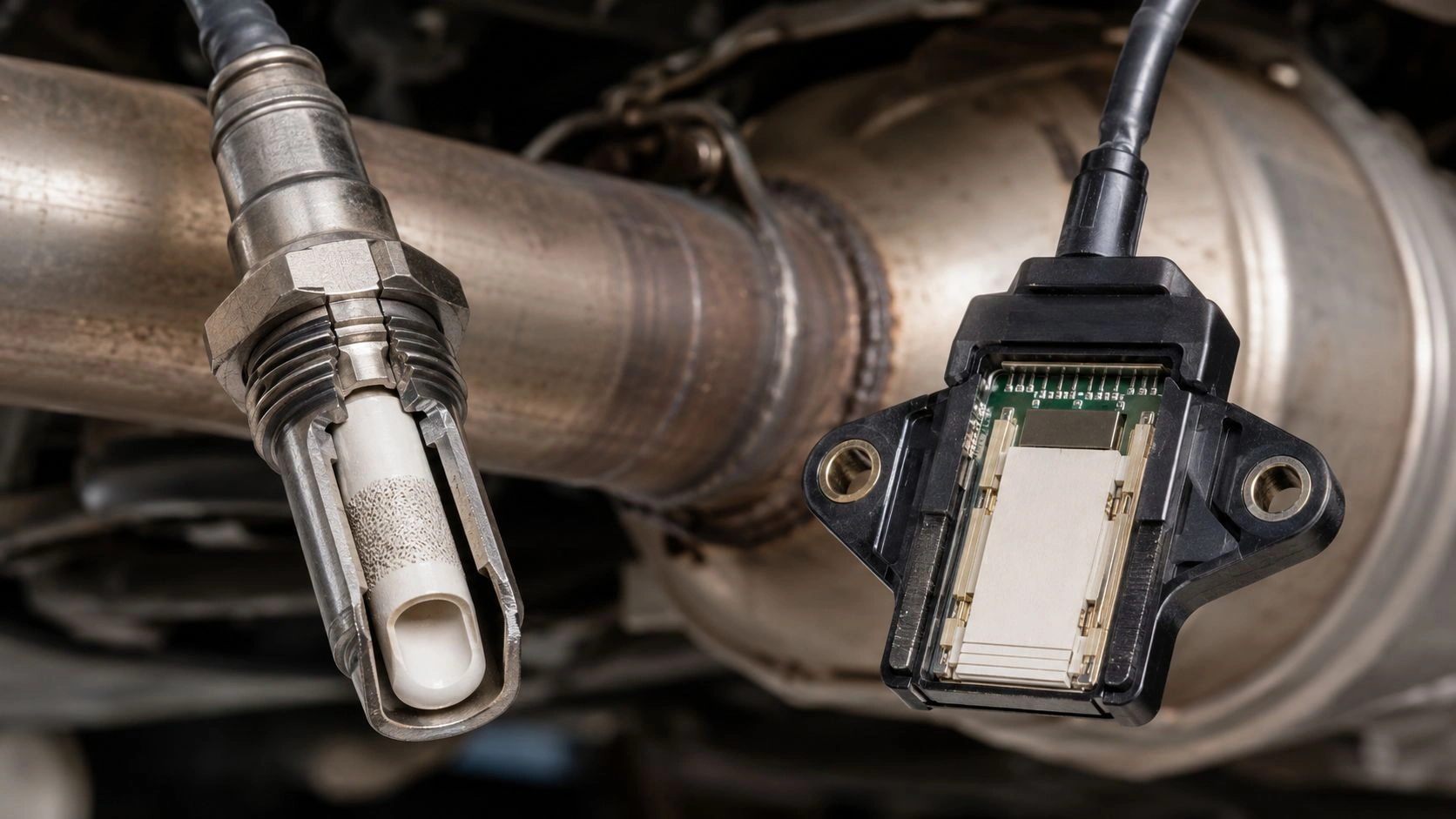
A thimble-style zirconia sensor element (left) and a planar zirconia sensor element (right) both use yttria-stabilized zirconia as the active solid electrolyte — the geometry changed, the ceramic chemistry did not.
The zirconia ceramic components used in precision sensing and high-temperature electrochemical service draw on the same ionic-conduction properties that make YSZ the defining ceramic in automotive lambda sensor design.
What role the zirconia tube or element actually plays in a lambda sensor
The zirconia element in a lambda sensor is not a passive structural or insulating component. It is the active sensing ceramic — the part whose material properties make the measurement possible. Without that understanding, any explanation of "what the tube does" will be incomplete.
The operating principle is straightforward: one face of the zirconia element is exposed to reference air, and the other face is exposed to exhaust gas. Because the two sides have different oxygen concentrations, oxygen ions migrate through the hot zirconia body from the high-concentration side to the low-concentration side. Porous platinum electrodes on both faces convert that ion movement into a measurable voltage. When the exhaust is rich (low oxygen), the voltage output is high — approximately 0.9 V. When the exhaust is lean (high oxygen), the output is low — approximately 0.1 V. That binary-style switching output around stoichiometric combustion is what the engine control unit uses to regulate fuel injection in closed-loop mode.
The critical operating condition is temperature. The zirconia element must reach a minimum temperature — approximately 350°C in automotive technical literature — before it becomes an effective ionic conductor. This is why nearly all modern heated sensors include an internal ceramic heater element: faster light-off means closed-loop control begins earlier in the cold-start phase, which matters for emissions performance.
The zirconia tube is the active electrochemical element, not just a protective sleeve
An alumina tube in a similar geometry would insulate but would not conduct oxygen ions. The reason zirconia was chosen — and has remained the dominant lambda-sensor ceramic — is that stabilized zirconia uniquely combines gas-impermeability, adequate mechanical stability at exhaust temperatures, and oxygen-ion conductivity at the relevant operating temperature. Those three properties together define the solid electrolyte function.
Temperature activation is built into the sensor architecture
The heater element in modern sensors exists specifically because zirconia's ionic conductivity is temperature-dependent. The ceramic is not always "on" — it activates as it heats. A specification for a replacement sensor that ignores heater performance is therefore incomplete, because the heater and the zirconia element are functionally coupled.
Why zirconia is used instead of a generic insulating ceramic
The reason zirconia is the core material rather than alumina, mullite, or another structural ceramic is that yttria-stabilized zirconia can serve as a gas-proof separating layer between two atmospheres with different oxygen concentrations, conducting oxygen ions across that barrier when heated. Kyocera's published materials explanation of this sensor type states the principle directly: the YSZ layer is both a physical gas barrier and an ionic conductor, and the voltage across the platinum-coated faces depends on the oxygen concentration ratio between the two sides.
Alumina does not perform this function. A lambda sensor built on an alumina tube would function as a temperature-resistant enclosure but would not generate the electrochemical oxygen signal. That is the deeper materials reason zirconia cannot simply be replaced by a "more robust" structural ceramic in this application.
The table below summarizes the three functional roles zirconia performs in a lambda sensor:
| Function | Why zirconia is used | What that means for specification |
|---|---|---|
| Solid electrolyte | YSZ conducts oxygen ions when hot (above approximately 350°C in automotive service), enabling a measurable electrochemical signal | The material must be YSZ — not alumina or generic oxide ceramic |
| Signal generation | Different oxygen concentrations on the air side and exhaust side produce a voltage across porous platinum electrodes | Both the ceramic body and the electrode coating are specification variables |
| Closed-loop AFR control | The sensor output (0–1 V for narrowband sensors) is used to regulate fueling near stoichiometric combustion, with upstream and downstream sensors serving different functions | Application position (upstream vs downstream) affects sensor spec requirements |
Functional summary based on current manufacturer technical documentation from Niterra, NGK, and Kyocera.
Ionic conductivity — not hardness or thermal resistance — is the defining material property
For most structural ceramic applications, the selection criteria are strength, toughness, thermal conductivity, and chemical resistance. For lambda sensors, the governing criterion is oxygen-ion conductivity at the operating temperature alongside gas-impermeability. This is why the material-selection logic for lambda sensors is fundamentally different from the logic for process tubes or wear components, even though the ceramic element looks superficially similar to other tube-form ceramics.
Platinum electrode coating is a co-specified variable
The zirconia body alone does not generate the sensor signal — it requires porous platinum electrode coatings on both faces to collect the ion current and produce the voltage output. A specification that names only the ceramic without confirming electrode design and adhesion is leaving the electrochemical core of the sensor underspecified.
Which sensor architectures are being confused when people say "zirconia tube"
Four distinct confusions appear most frequently in lambda-sensor technical documentation, RFQ language, and replacement-part descriptions:
Saying "zirconia tube" when the sensor is actually a planar element. NTK's product documentation explicitly states that planar sensors use the same zirconia ceramic sensing technology as the earlier thimble predecessor, but in a more compact laminated form. This means the ceramic chemistry stayed the same but the geometry changed substantially. In modern technical writing, "zirconia tube" accurately describes thimble-style sensors but becomes misleading when applied to planar sensors, which are now the dominant architecture in most passenger-vehicle OE applications.
Treating zirconia as just another insulating ceramic. The word "ceramic" in a lambda-sensor description is sometimes read by non-specialist readers as "the durable enclosure material." That reading is incorrect. Zirconia is in the sensor because it is an oxygen-ion conductor at operating temperature, not because it is merely temperature-resistant. Any explanation that reduces the zirconia element to "ceramic housing material" misses the electrochemical principle and leaves the reader without the information needed to evaluate replacements or equivalents.
Mixing zirconia and titania sensor logic. NGK's technical documentation lists titania as a separate oxygen-sensor type with a different operating principle — titania sensors change electrical resistance rather than generating a voltage, and they do not require reference air on one side in the same way. Writing "zirconia lambda sensor" and "titania lambda sensor" as interchangeable descriptions is a specification error, not just a terminology choice.
Assuming all zirconia lambda sensors are the same specification problem. Niterra's product literature distinguishes upstream regulating sensors and downstream diagnostic sensors, and notes that modern vehicles often use one sensor on each side of the catalytic converter on each exhaust bank. These sensors may share zirconia chemistry but have different performance requirements for response time, light-off speed, and output characteristics. Treating them as a single product category without position distinction oversimplifies the application.
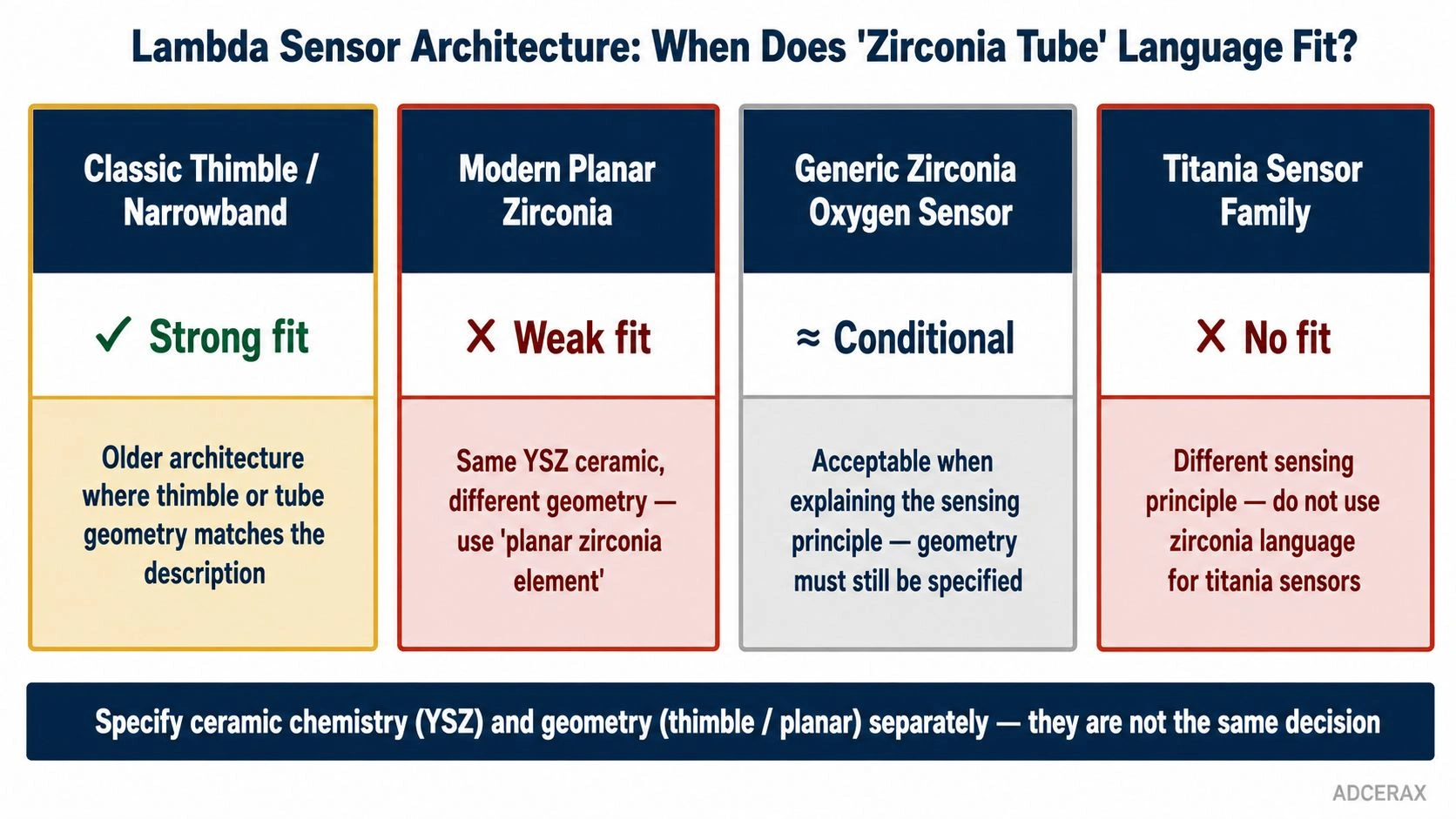
"Zirconia tube" language fits some sensor architectures and not others — the geometry and the ceramic chemistry must be specified separately.
When the description should stay with tube or thimble language, and when it should switch
The Geometry-Fit Matrix below maps the four sensor architecture families to the "zirconia tube" wording:
| Sensor architecture | Where "zirconia tube" language fits | Why | Main boundary |
|---|---|---|---|
| Classic thimble / narrowband zirconia sensor | Strong fit | This is the older zirconia sensor family most closely associated with tube or thimble geometry | Not the best wording for many modern sensors |
| Modern planar zirconia sensor | Weak fit | NTK states planar sensors use the same zirconia ceramic sensing technology as the thimble predecessor, but in a more compact form | Better to describe the part as a planar zirconia element, not a tube |
| Generic zirconia oxygen sensor family | Conditional fit | Zirconia is the core sensing ceramic across automotive oxygen-sensor families (Niterra, NGK) | Geometry must still be specified separately from the ceramic material |
| Titania oxygen sensor family | No fit | NGK lists titania as a separate oxygen-sensor type with a different operating principle | Do not substitute zirconia route language into titania sensor descriptions |
Guidance based on current technical documentation from Niterra, NGK/NTK, and Kyocera.
The plain-English rule: use zirconia tube or thimble language for the older narrowband architecture; switch to planar zirconia element language for modern compact sensors; use generic zirconia oxygen sensor language when explaining the sensing principle without specifying geometry.
The ceramic tube material options used for thermal, sensing, and process protection applications — including zirconia-family components — require the same architecture-specific specification discipline described above: the ceramic chemistry and the geometric form factor must be named separately.
Zirconia remained the core ceramic even as lambda-sensor geometry evolved. That is why the title is both useful and slightly incomplete. It is useful because zirconia really is the key material — the solid electrolyte that allows oxygen ions to move when hot and makes the electrochemical signal possible. It is incomplete because many modern automotive sensors are no longer best described as "zirconia tubes." They are better described as planar zirconia elements using the same underlying ceramic principle.
Use tube or thimble language for classic architecture discussions
The thimble-style zirconia sensor is the architecture that gave lambda-sensor ceramic elements the "tube" association. In service training, historical comparisons, or replacement discussions for older vehicle platforms, thimble or tube language remains accurate and appropriate. The geometry matches the description.
Switch to planar zirconia element language for modern OE sensor documentation
When the product being described is a planar laminated oxygen sensor — which represents the majority of new OE fitments — the tube description is inaccurate. Using it creates a mismatch between the product description and what the engineer or technician will actually see when the sensor is examined. The zirconia chemistry is the same; the geometry is not.
What should go into the RFQ or technical description
Before writing "zirconia tube lambda sensor" in a procurement document or technical specification, the description must resolve four variables: the sensor family, the geometry, the application position, and the ceramic route wording. A specification that names only the material and the application ("zirconia, automotive exhaust") leaves geometry, position, and electrode design unspecified.
The specification and technical documentation checklist for industrial ceramic components in lambda-sensor applications:
- Sensor family — specify zirconia narrowband, zirconia planar, or wideband AFR route; do not use "zirconia oxygen sensor" as a catch-all across architecturally different product families.
- Geometry — specify thimble-style or planar; these are not interchangeable packaging options for the same sensing element.
- Application position — specify upstream regulating sensor or downstream diagnostic sensor; performance requirements including response speed and light-off behavior differ between the two positions.
- Activation requirement — specify heated or unheated; almost all modern sensors are heated, and the heater performance specification is functionally coupled to the zirconia element's activation temperature.
- Ceramic route wording — describe the sensing element as "yttria-stabilized zirconia solid-electrolyte element" rather than "ceramic protection tube" or "ceramic enclosure"; the latter descriptions misrepresent the electrochemical function of the component.
- Electrode design — confirm that porous platinum electrode coatings are specified alongside the ceramic body; the signal generation depends on both the YSZ and the electrode.
- Titania flag — if the application involves a titania sensor type, write that explicitly; do not allow "zirconia" and "oxygen sensor ceramic" to be treated as synonymous across sensor families.
If the technical document uses "zirconia tube" without specifying geometry and sensor family, it is describing the material route but not the product. The specification is incomplete.
Conclusion
Zirconia is the defining ceramic in automotive lambda sensors because of its oxygen-ion conductivity, not because of its structural properties. That electrochemical function has persisted through the geometry transition from thimble-style tubes to planar laminated elements. The practical consequence for specification and documentation is simple: always separate the ceramic material description from the geometric description, confirm whether the product is a thimble or planar architecture, and resist the temptation to use "zirconia tube" as shorthand for all lambda-sensor ceramic elements. The chemistry is consistent; the geometry must be specified explicitly.
Specifying zirconia ceramic components for sensing, electrochemical, or high-temperature process applications? Send the application environment, operating temperature, ceramic geometry, and whether the duty is structural or electrochemical. ADCERAX engineers return a grade recommendation with dimensional guidance and application-compatibility confirmation; no RFQ commitment required at this stage.
Frequently Asked Questions
What does the zirconia tube do in a lambda sensor?
It acts as the solid-electrolyte sensing element. One face is exposed to reference air and the other to exhaust gas. The oxygen concentration difference causes oxygen ions to migrate through the hot zirconia body, and the porous platinum electrodes on both faces convert that ion movement into a voltage signal. The output voltage — approximately 0.9 V in rich exhaust and approximately 0.1 V in lean exhaust — is what the engine control unit uses for closed-loop fuel regulation.
Why is zirconia used instead of a generic ceramic tube?
Because yttria-stabilized zirconia can conduct oxygen ions when heated and act as a gas-proof electrochemical separator between two atmospheres with different oxygen concentrations. A generic ceramic insulator — alumina, for example — would survive the temperature but would not perform the ionic-conduction function that generates the sensor signal. The electrochemical role, not the structural role, is the reason zirconia is specified.
Is the classic lambda sensor a tube or a planar part?
Both architectures exist and both use zirconia as the core sensing ceramic. The older architecture is the thimble-style sensor, where the sensing element is geometrically similar to a closed-end tube. The newer dominant architecture in most OE applications is the planar sensor, where the same zirconia ceramic sensing technology is used in a laminated flat-layer form. NTK's own product documentation draws this continuity explicitly: same ceramic chemistry, different geometry.
At what temperature does the zirconia element start working?
NGK's automotive technical information states that the zirconia element conducts oxygen ions above approximately 350°C. Most modern sensors include an internal ceramic heater to reach operating temperature faster, which allows closed-loop fuel control to begin earlier in the cold-start phase and reduces cold-start emissions.
Are zirconia lambda sensors still used in modern vehicles?
Yes. Current product documentation from Niterra confirms that zirconia oxygen sensors are widely used in automotive applications in both upstream regulating and downstream diagnostic positions. The ceramic has remained the standard solid-electrolyte material through the geometry evolution from thimble to planar designs, and it continues to be specified across new OE and aftermarket lambda-sensor product families.