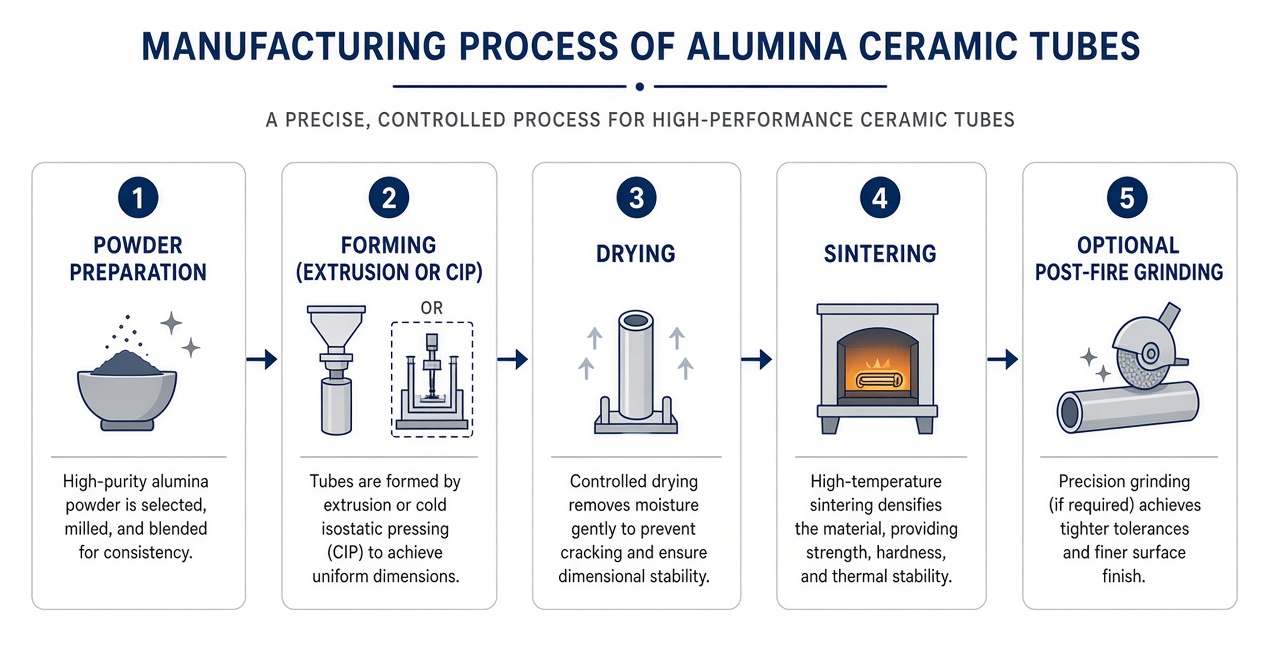
Dense alumina tubes are made through a controlled sequence: powder preparation, forming, drying, sintering, and optional post-fire grinding or machining. Geometry and finish state drive the product and cost far more than purity alone. Two tubes with the same 99.7% alumina composition can follow different forming routes, leave the kiln as-fired or ground, and land at very different tolerances and lead times. For reviewable OD/ID/wall/length ranges and ADCERAX grade options that support process RFQs, start from the alumina tube grade catalog and drawing review.
This page is for process and purchasing engineers who need to decide when a custom manufacturing path matters, and which process fields belong on the RFQ beyond a purity number. It is not a sizes catalog, not a solar-diffusion process-position guide, not a long-tube expansion-joint design guide, and not an electrode-purity deep dive. Keep head terms for the product catalog; this article owns the powder-to-final-product manufacturing sequence and finish-state RFQ intent.
3-Minute Decision: When Custom Process Path Matters for RFQ
- Standard small-OD elongated tubes where as-fired tolerance is acceptable → extrusion path is usually enough. Confirm OD/ID/wall/length, open vs closed end, and whether camber limits are drawing-defined.
- Large OD, thick wall, or special blanks → expect CIP or an engineering-confirmed route. Do not assume every geometry is extruded. Route follows geometry class, not the purity label.
- Tight assembly fits, seal lands, or drawing tolerances beyond as-fired practice → mark ground (or state the drawing tolerance). Never default as-fired when the drawing implies precision interfaces.
- Closed-end sheaths or multi-bore capillaries → same powder-to-sinter family plus variant steps. Call geometry class explicitly; closing and multi-channel dies change green handling, not the purity story.
- Default manufacturing narrative: 99.7% dense alumina. Furnace hardware may also screen 99.5% alumina. Cleanliness-sensitive duty → high-purity alumina. Structural or lower contamination-path parts may review lower-purity alumina when duty and load allow.
- Process fields first, SKU second. Changing purity will not fix an undefined finish state or an unspoken forming preference.
Powder to Forming to Sinter to Finish (Qualitative)
Dense alumina tube manufacturing follows one industrial logic with geometry-driven branches. Treat each stage as a specification lever, not as a free-form process encyclopedia.
Powder preparation
High-purity alumina powder is blended with binders and processing aids into a workable body or granulate with controlled particle behavior. Powder consistency influences densification uniformity, wall integrity after forming, and how predictably the green body responds in the kiln. The listed alumina compositions are a composition and property screen; it does not by itself dictate extrusion versus CIP.
Forming: extrusion vs CIP by geometry
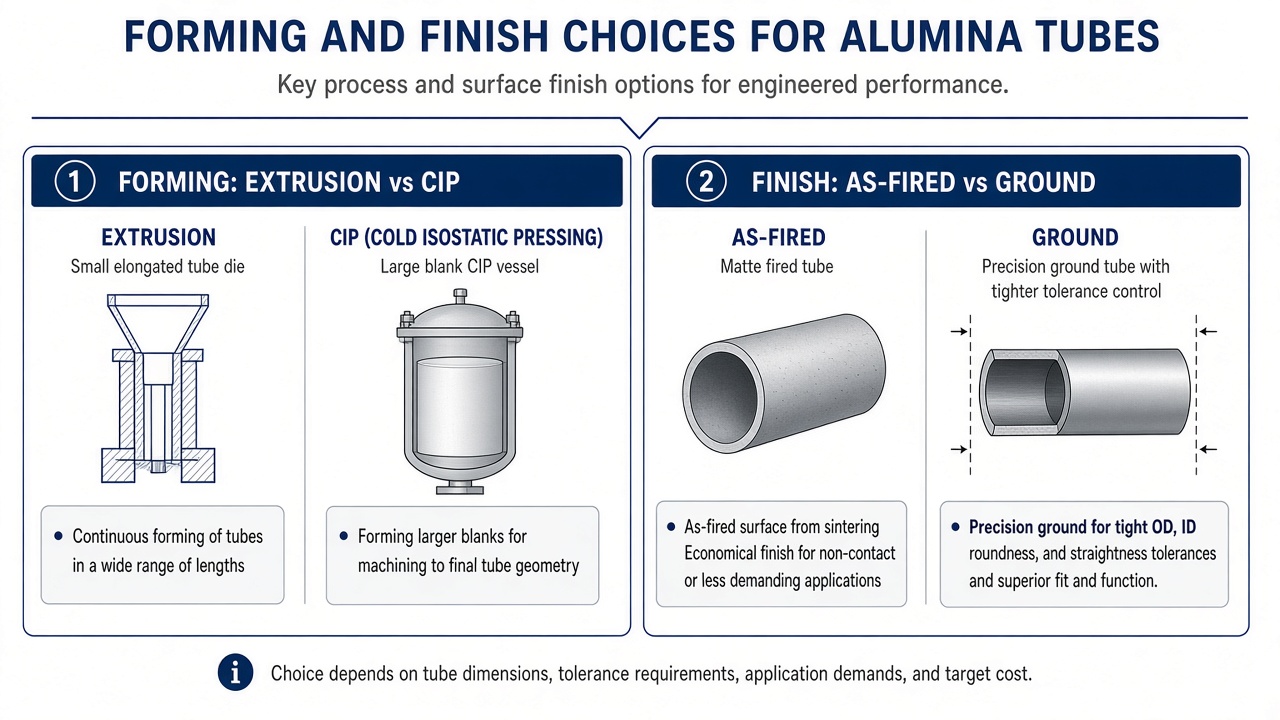
For most commercial alumina tubes, the practical routes are extrusion and cold isostatic pressing (CIP). Smaller elongated open tubes and many multi-bore capillaries are typically extruded through a shaped die that sets the cross-section in one pass. Larger outer diameters, thicker walls, and some complex blanks more often use CIP, which distributes pressure over a larger preform. Geometry class decides the route—not whether the buyer wrote "99.7%" or an internal grade code on the RFQ. Prefer qualitative route language on drawings ("extrusion preferred," "CIP expected," or "supplier to confirm") rather than inventing a hard diameter cutover that is not locked in ADCERAX TDS or tubes KB.
Drying and support before fire
Green tubes must dry and be supported so they do not warp before densification. Long slender parts are especially sensitive to how they rest, rotate, or hang during drying and kiln loading. Support discipline is one reason finished straightness is a drawing acceptance item rather than an afterthought.
Sintering: densification and controlled shrinkage
High-temperature densification converts the fragile green body into a dense technical ceramic. Porosity drops, strength rises, and the body undergoes controlled linear shrinkage. Tooling and green dimensions are therefore set larger than the fired target; final size arrives through sinter contraction plus any later grind, not by forming to finished OD/ID. ADCERAX TDS lists tube straightness for the listed alumina grades as 1 mm/m on a drawing-defined basis. That straightness value is not a sintering shrinkage percentage and must not be reverse-engineered into a shrink number.
Optional post-fire grind and finish state
As-fired tubes leave the kiln at a commercial tolerance band suitable for many furnace and lab uses. When the drawing needs tighter OD/ID, wall uniformity, or sealing surfaces, post-fire diamond grinding (or related finishing) becomes a separate cost and lead-time step. Specify as-fired vs ground explicitly. Do not assume sintering alone delivers precision assembly fits, and do not paste unverified grind-tolerance slogans into the RFQ—use the drawing tolerance callout.
Variant geometries
Closed-end sheaths, glove-finger protection tubes, and multi-bore capillaries follow the same powder → form → dry → sinter → optional grind chain with added green operations (end closing, multi-channel dies, or limited green machining). Protection-tube geometry-before-grade logic lives on a separate spec guide (see Related reading). This page only flags that variant steps exist and must be named on the RFQ.
Four Misunderstandings About Alumina Tube Manufacturing
- Purity is composition. Forming route is manufacturing. Still state geometry class, finish state, and tolerance basis.
- All alumina tubes are extruded. Extrusion is common for smaller elongated shapes; larger OD and many thick blanks more often use CIP. Route is geometry-driven.
- Sintering alone sets precision tolerances. Densification sets microstructure and as-fired size. Drawing-critical fits usually need ground finish and an explicit tolerance callout.
- Open-porosity marketing language equals a pore-free guarantee. Treat density and water-absorption (or open-porosity) results as lot-reported QC against grade TDS selection limits—not as a universal "zero open porosity" certificate detached from test method and grade. Prefer ADCERAX grade typ. density and water-absorption selection limits over invented aggregate bands.
ADCERAX Grade Map for Manufacturing RFQs
Use ADCERAX SKUs on drawings. IEC C795/C799 is a composition grouping aid, not a forming-route certificate and not a part design allowable. Long-term temperature figures below are material selection ceilings, not proof of life under arbitrary load or atmosphere.
| Al2O3 wt% nom. | IEC | Density g/cm3 typ. | Long-term selection ceiling C | CTE 10^-6/K (25-800 C) | Water absorption % selection limit | Manufacturing RFQ note |
|---|---|---|---|---|---|---|
| 99.90 | C799 | 3.94 | 1750 | 7.6 | <=0.01 | Cleanliness-sensitive step-up |
| 99.70 | C799 | 3.94 | 1700 | 7.6 | <=0.05 | Default manufacturing / hot-zone screen |
| 99.50 | C799 | 3.90-3.92 | 1650 | 7.6 | <=0.10 | Also screen for furnace hardware process RFQs |
| 99.00 | C795 | 3.80-3.91 | 1600 | 7.2 | <=0.10 | Structural / lower contamination-path review |
| 95 | C795 | 3.75 | 1400 | 7.6 | <=0.20 | Only when duty and load allow |
Straightness for the listed alumina grades: 1 mm/m (drawing-defined). CTE values above support grade comparison only; do not expand them into a mm growth table on this manufacturing page. For purity-driven electrode or metallization tubes outside this process scope, use alumina purity options for electrode tubes.
RFQ / Manufacturing Specification Fields
Before writing only "99.7% alumina tube," resolve the process fields that actually select the manufacturing product. KB L1 review envelope for alumina tubes (combinations still require drawing review): OD/ID 2-120 mm; length 10-3500 mm; wall 0.5-20 mm; dimensional tolerance review up to +/-0.05 mm where applicable—not a blanket guarantee on every size and length. Thin-wall long tubes and long spans always need section, straightness, firing, and packaging review.
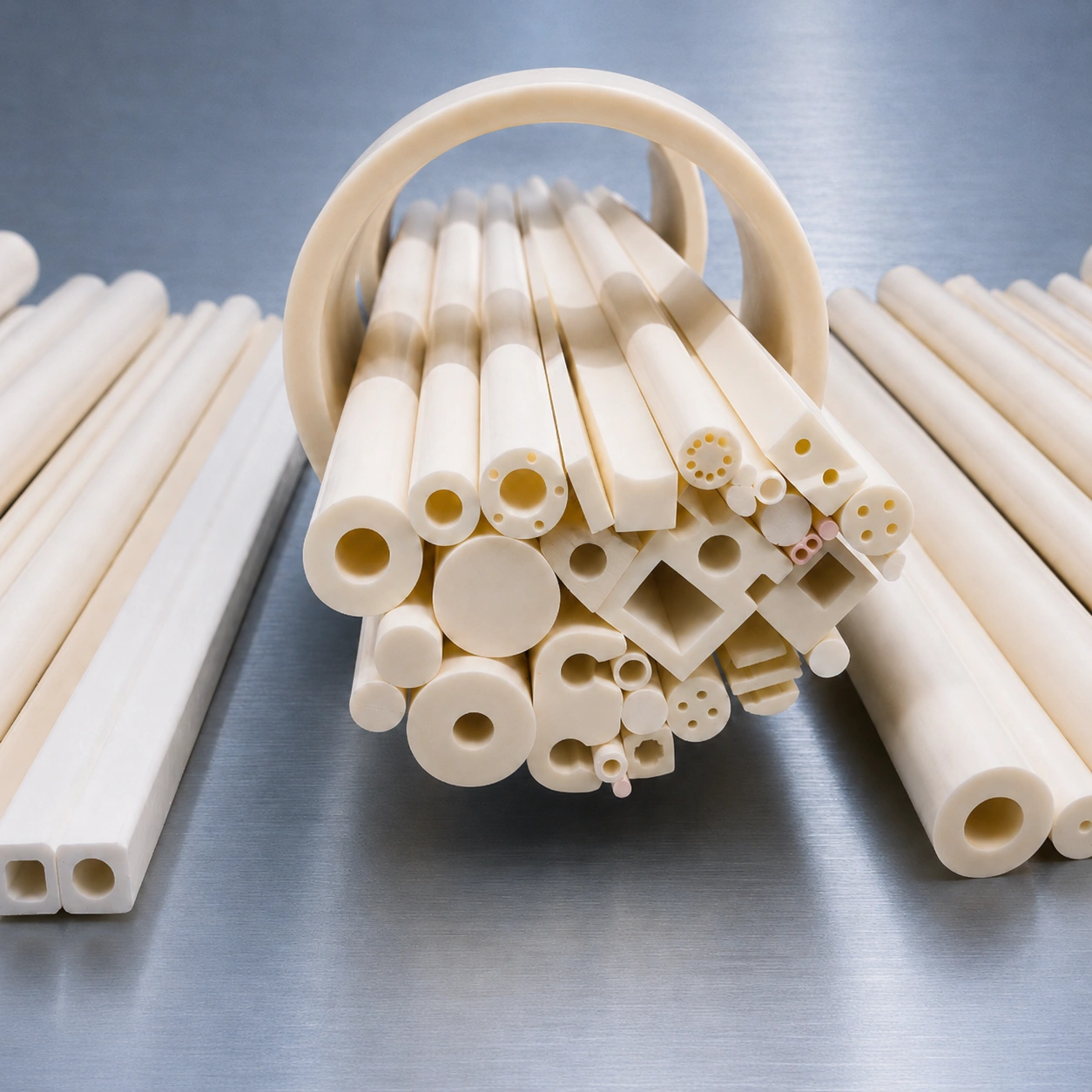
- Geometry class — open tube, closed-end sheath, multi-bore capillary, or other.
- OD / ID / wall / length — with hole count and open/closed ends stated.
- Forming route preference — if you have one (extrusion vs CIP); otherwise ask supplier to confirm for the geometry.
- Finish state — as-fired or ground; largest single lever on tolerance and cost after geometry.
- Tolerance and straightness / camber — drawing basis; recall 1 mm/m straightness semantics where used, and that it is not a shrink %.
- Manufacturing narrative default — 99.7% dense alumina; furnace hardware may use 99.5% alumina; cleaner duty calls for high-purity alumina.
- Temperature and atmosphere — selection ceiling vs actual duty; do not treat ceiling as unlimited service life.
- Quantity / annual need plus photos or drawings of failed parts when replacing hardware.
- Lot QC asks — whether density and water absorption (or open porosity by agreed method) should be reported per lot against grade TDS—not invented aggregate bands.
Where multi-material tube families share a plant line, keep alumina process RFQs separate from broader ceramic tube catalogs. For a compact quoting field list that complements this manufacturing checklist, see key information for quoting alumina tubes.
Evaluating a custom alumina tube manufacturing path? Share the drawing or existing-part photos, preferred alumina composition, OD/ID/wall/length, geometry class, finish state, tolerance/straightness basis, temperature and atmosphere, and quantity. ADCERAX can confirm a forming-route recommendation and finish-state guidance for that geometry—response timing depends on inquiry complexity; this is not a same-day quote commitment.
Frequently Asked Questions
Are alumina tubes usually extruded or CIP-formed?
Both routes are used. Smaller elongated tubes and many multi-bore capillaries are typically extruded; larger OD, thick-wall, or special blanks more often use CIP. Geometry decides—do not lock an unverified diameter cutover into the RFQ.
What happens to the alumina powder before forming?
It is formulated with binders and processing aids, mixed and milled for controlled particle behavior, and prepared as a workable body or granulate so forming and sintering behave consistently. Powder control supports densification uniformity; it does not replace finish-state and tolerance callouts.
Why do drawings plan for sintering shrinkage?
Densification reduces porosity and pulls the body to a smaller fired size, so green tooling is oversized on purpose. ADCERAX publishes straightness (1 mm/m on listed grades) as a drawing metric—not as a shrinkage percentage. Do not invent shrink % from blogs.
Why are some alumina tubes much more expensive than others?
Downstream stages dominate: powder discipline, forming control, kiln support for straighter long parts, and especially post-fire grinding for drawing-critical fits. An as-fired tube and a ground tube can share powder family and route yet remain different manufacturing products.
How are closed-end alumina sheaths made?
They follow the same densification chain with added green closing or CIP blank strategies so the closed end is monolithic after fire—not a bonded metal-style end cap. Name closed-end geometry on the RFQ; do not assume open-tube process notes transfer unchanged.