Furnace thermocouple selection starts with the temperature at the measurement point, its atmosphere, and the required stability. Types K and N are candidates for many base-metal probe designs; Types R, S, and B are platinum-alloy candidates for particular high-temperature measurements. The letter identifies the thermocouple conductor system and temperature–electromotive force (EMF) reference function. It does not specify junction construction, outer protection, or the service life of a complete probe. Check those details and the instrument input separately before finalizing a furnace specification.
A sound shortlist is an engineering question, not a temperature ranking. The same nominal thermocouple type may be assembled with different wire sizes, junction positions, insulators, metal sheaths, or outer ceramic tubes. Furnace atmosphere, contamination, mounting, and cycling then affect what that assembly can actually do.
What Does a Thermocouple Type Specify?
A thermocouple contains two dissimilar conductors joined at a measuring junction. Their temperature-dependent EMF is interpreted with the reference junction and a type-specific conversion. The letter designation identifies the conductor combination and corresponding reference relationship. The NIST ITS-90 Temperature Scale Database provides temperature–EMF tables for Types B, E, J, K, N, R, S, and T. Those tables support signal conversion and reference comparison; they do not certify a particular probe for a given furnace atmosphere or lifetime.
Keep the following specification fields distinct. “Type K” describes the thermoelement pair, while “grounded junction” describes an internal electrical connection between a measuring junction and a metal sheath. “Type S” names a conductor system, while an alumina protection tube describes a separate possible outer component. A probe can be specified with a particular letter and several different mechanical or protective designs.
Type and instrument must agree
The furnace temperature controller or thermocouple input module must be set for the chosen type. Changing a Type K probe to Type N while retaining a Type K conversion setting can produce an incorrect temperature result. Check the allowable input types, connector and extension-wire arrangement, polarity, and reference-junction compensation. Analog Devices’ measurement guidance explains why the reference-junction temperature and signal-conditioning circuit are part of the result. A calibration record should identify the actual sensor and its stated conditions rather than being inferred from a published reference table.
For a new measurement point, state whether the goal is process control, monitoring, or a documented acceptance measurement. This determines what repeatability, calibration evidence, and drift review are needed. It does not by itself choose the alloy or the outer tube.
How Do K, N, R, S, and B Enter a Furnace Shortlist?
Start with the temperature profile at the intended measurement point, including peaks, hold duration, and cycles. Then record the atmosphere, vapors, deposits, contact with process material, required stability, and input-module support. These constraints narrow candidates before a probe supplier reviews wire and protection design. A maximum temperature quoted without wire diameter, exposure duration, atmosphere, and assembly construction should not become an unconditional selection rule.
Type K and Type N: base-metal candidates
Type K is frequently an existing equipment setting or replacement baseline. Type N can be evaluated as another base-metal route when the measurement requirement and input hardware support it. The two have different conductor systems and reference functions. A switch from K to N requires the corresponding input setting and compatible leads, as well as a review of the probe sheath, process atmosphere, and expected stability. It is not a direct substitution based solely on a comparison chart.
Types R, S, and B: platinum-alloy candidates
R, S, and B belong to the platinum-alloy group considered for particular higher-temperature measurement designs. Their use does not eliminate contamination risk. Supplier review should cover the actual thermoelements, insulators, protective layers, atmosphere, calibration plan, and controller configuration. Type B also needs careful review of the measurement span and instrument setup. Selecting the most expensive conductor system does not repair an unsuitable installation or damaged protective assembly.
Type J may appear in an existing furnace or replacement specification and is included in NIST tables. Treat it as a compatibility question for that equipment rather than adding every standardized letter to an indiscriminate high-temperature shortlist.
Initial furnace thermocouple shortlist
| Candidate | Why it enters the shortlist | Verify before specifying |
|---|---|---|
| Type K | Existing input supports K; a base-metal furnace probe is under consideration | Temperature profile, atmosphere, sheath, calibration, and drift requirement |
| Type N | An alternative base-metal design is being evaluated | Input support, lead compatibility, construction, atmosphere, and supplier evidence |
| Type R | A platinum-alloy measurement route is under review | Calibration need, contamination control, insulation, and protection |
| Type S | A platinum-alloy measurement route is under review | Calibration need, contamination control, insulation, and protection |
| Type B | A platinum-alloy design for a particular high-temperature measurement is considered | Useful measurement span, input configuration, insulation, and assembly design |
| Type J | Existing equipment or a replacement specification calls for J | Atmosphere, probe suitability, and instrument setting |
This table makes candidates reviewable; it is not a list of guaranteed continuous-use temperatures. Where furnace exposure requires a separate barrier, ceramic thermocouple protection tubes are evaluated by process duty and geometry after the thermocouple type and probe construction have been defined.
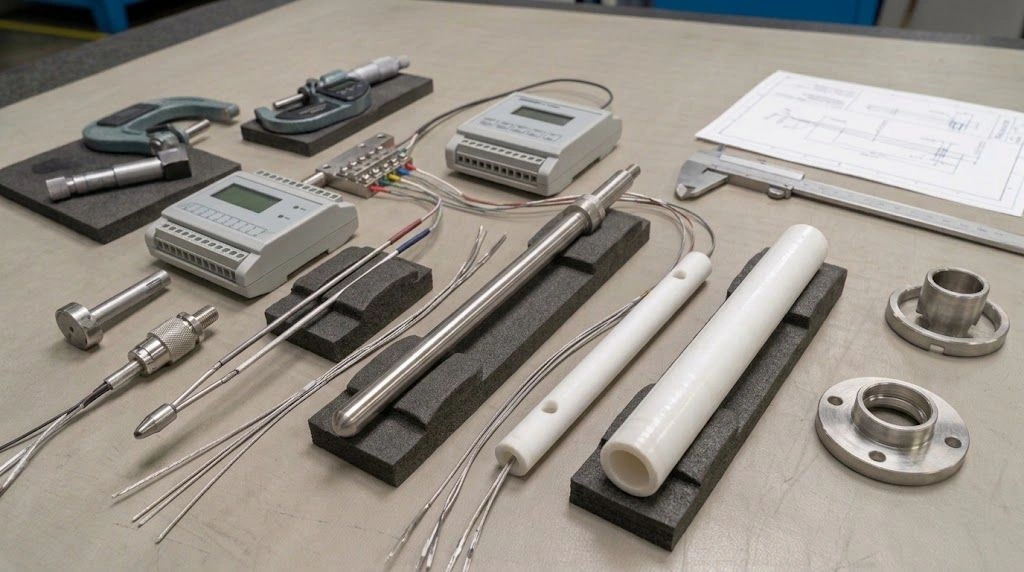
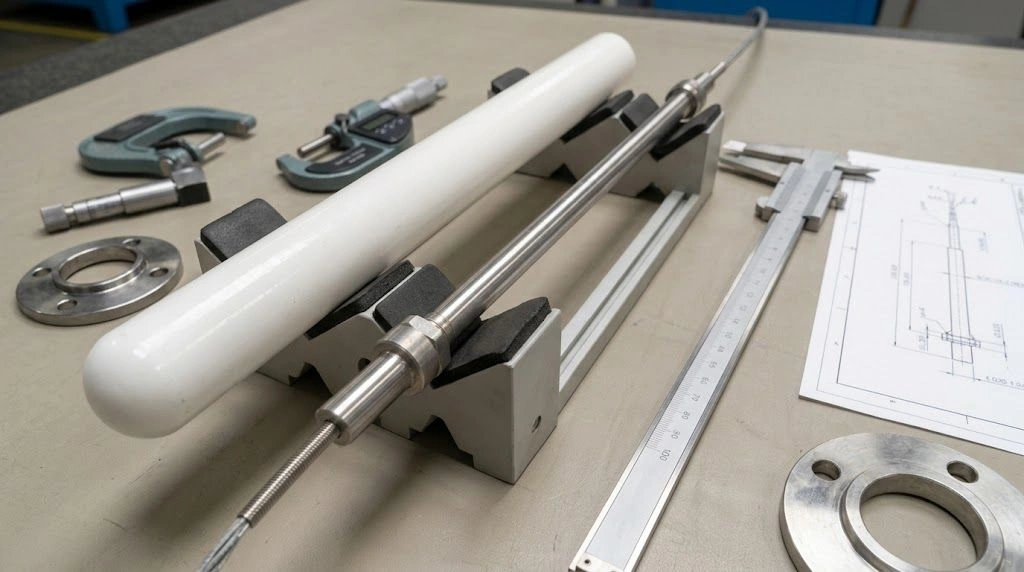
Actual probes and input hardware illustrate why conductor type and instrument configuration must be reviewed together.
When Is the Thermocouple Type the Wrong Diagnosis?
An unstable reading does not automatically call for a change from K to N or from a base-metal type to a platinum-alloy type. Thermocouples produce small signals. Cable routing, shielding, grounded or ungrounded junction construction, input common-mode conditions, filtering, and reference-junction compensation can all affect the reported result. Check the measurement chain before treating noise as an alloy-selection problem.
A slow reading has a different diagnostic path. Probe diameter, junction position, metal sheath, outer protection tube, insertion depth, and controller filtering can influence the observed delay. A newly chosen letter does not move the tip into the correct hot zone or remove the heat-transfer path through a closed-end tube. Compare the installed assembly and the instrument’s raw and displayed data under defined conditions.
Long-term drift or a persistent offset requires more evidence. Check calibration history, contamination, thermoelement condition, polarity, input type, reference-junction arrangement, and the actual temperature at the measurement location. A replacement type may eventually be justified, but the failure mechanism and new assembly must be specified first. Otherwise the same exposure can affect the replacement.
Protection and conductor type solve different problems
An outer ceramic tube may separate a probe from an atmosphere, deposit, or mechanical contact when its material and form are suitable. It does not change the K, N, R, S, or B thermoelement system already inside the probe. Adding it can also change the assembled sensor’s heat path and response. A two-bore ceramic insulator used to separate bare thermoelement wires is another physical component; it should not be confused with the letter designation or automatically substituted for a closed-end outer tube.
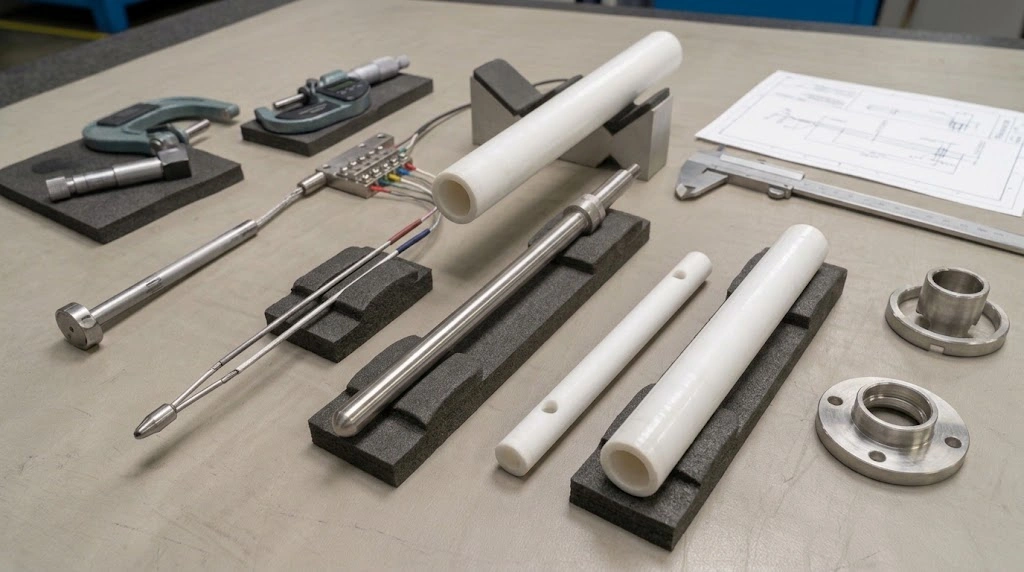
Separate physical components distinguish conductor type, probe construction, insulation, and outer protection.
How Should Furnace Conditions Change the Type and Protection Choices?
Work from the process outward. First, define the temperature curve at the measurement point and confirm that the chosen input module supports each proposed type and range. Second, describe the actual atmosphere: air or oxidizing gas, reducing gas, vacuum, mixed gas, vapors, deposits, or contact with process material as applicable. The probe supplier must evaluate conductor and sheath construction for those conditions. Third, decide whether an additional ceramic barrier is required and have its material and dimensions reviewed separately.
Conditional selection sequence
- Define the measurement: point location, normal and peak temperatures, hold times, cycling, required stability, and calibration evidence.
- Shortlist supported types: confirm the controller’s type options, conversion setting, compatible cable, and reference-junction method.
- Review exposure with the probe supplier: conductors, wire size, junction, sheath or insulator, atmosphere, and contamination mechanisms.
- Review outer protection only if needed: ceramic material, open or closed end, wall and tip, probe clearance, thermal cycling, and mounting.
- Verify the assembly: fit, junction location, response, and measurement performance under conditions relevant to the furnace.
The sequence does not presume that every platinum-alloy probe needs the same ceramic or that every Type K probe can use an existing tube. A closed-end tube may be useful for a specific protective duty yet change response or place the junction farther from the target zone. A high-purity ceramic designation also does not establish compatibility with every vapor or thermal cycle. Drawings and test conditions settle these decisions.
If a legacy installation is being modified, capture the current failure symptom, old sensor type, construction, calibration record, protection tube, and mounting before changing parts. When several fields change together, the effect of the new letter designation cannot be isolated. A controlled trial or staged evaluation can make the result interpretable.
What Goes into a Furnace Thermocouple and Protection-Tube RFQ?
Send a common process description to the probe supplier, ceramic-part supplier, and instrumentation engineer. Then assign each requirement to the party able to verify it. The ceramic tube supplier can review material and geometry for the outer barrier; the probe supplier confirms thermoelement type and probe construction; the system owner validates the installed signal and location.
Probe supplier: type and sensor construction
- Candidate Type K, N, R, S, B, or specified legacy type, with the intended controller setting.
- Measurement range and full temperature cycle, including peaks and long holds.
- Furnace atmosphere, vapors, deposits, and possible contact materials.
- Thermoelement and junction construction, junction position, sheath or insulator design, and probe OD.
- Extension or compensation cable, connector, polarity, and input-module interface.
- Calibration or tolerance documentation, inspection stage, and proposed stability check.
- Required sensor response or installed-assembly verification conditions, if time behavior matters.
Ceramic supplier: outer protection and fit
- Protective duty and candidate ceramic material for the stated atmosphere and thermal cycling.
- Open or closed end, bore count if relevant, wall, closed-tip shape and thickness.
- OD, ID, total length, insertion length, straightness, and critical tolerances.
- Probe clearance, end position, support points, and expansion accommodation.
- Furnace wall port, collar, flange, thread, seal, or other mounting interface.
- Drawing or old-part sample, prototype and production quantities, and agreed inspection evidence.
System owner: complete measurement
Confirm that the temperature controller or acquisition channel is configured for the chosen type and reference-junction arrangement. Identify the actual hot-zone location, mounting datum, and response-test method. If a protected probe is expected to follow a transient, compare the complete proposed assembly with the existing one under the same relevant medium, loading, temperature change, position, sampling, and filtering conditions. An isolated conductor table or bare-probe speed value is not an assembly acceptance test.
Frequently asked questions
Which thermocouple types should I shortlist for a furnace?
Begin with temperature, atmosphere, stability, and instrument support. K and N are base-metal candidates; R, S, and B are platinum-alloy candidates for particular measurement designs. Confirm the complete probe with its supplier.
Is Type N always a direct replacement for Type K?
No. The input must use Type N conversion and compatible wiring. Probe construction, exposure, and calibration evidence also require review.
Does an alumina protection tube turn Type K into Type S?
No. Those letters identify different thermoelement systems. The outer ceramic tube does not change the probe conductors or instrument type setting.
What should be verified before ordering?
Confirm type and probe construction, input compatibility, process exposure, tube material and geometry if needed, junction position, and the installed assembly’s acceptance checks.
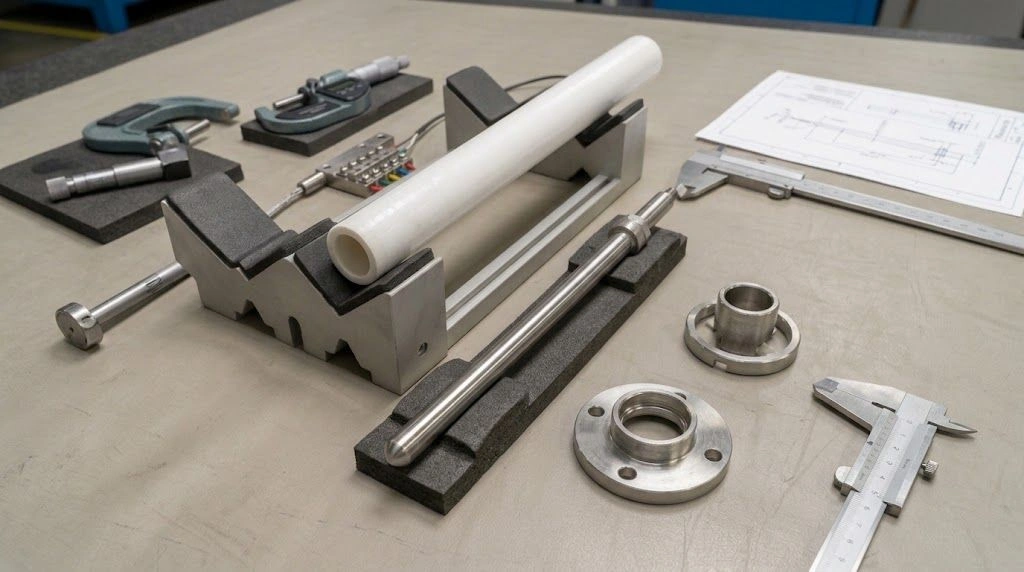
The tube and probe require separate specifications and a shared installation check.