BN crucibles are useful in superalloy sample preparation when the task requires clean handling of small nickel- or cobalt-based alloy samples under vacuum, argon, nitrogen, or other non-oxidizing conditions. Their value comes from low wetting by many molten metals, low carbon contribution compared with graphite containment, and easier sample release after melting or solidification. They are not a universal crucible choice: air exposure above the material's oxidation boundary, aggressive oxide fluxes, long high-temperature holds, and analytical programs where boron contribution must be tightly separated from alloy boron all require a different evaluation. The correct decision depends on the alloy family, the atmosphere, the peak temperature and dwell, and the specific contamination or analytical repeatability concern being managed.
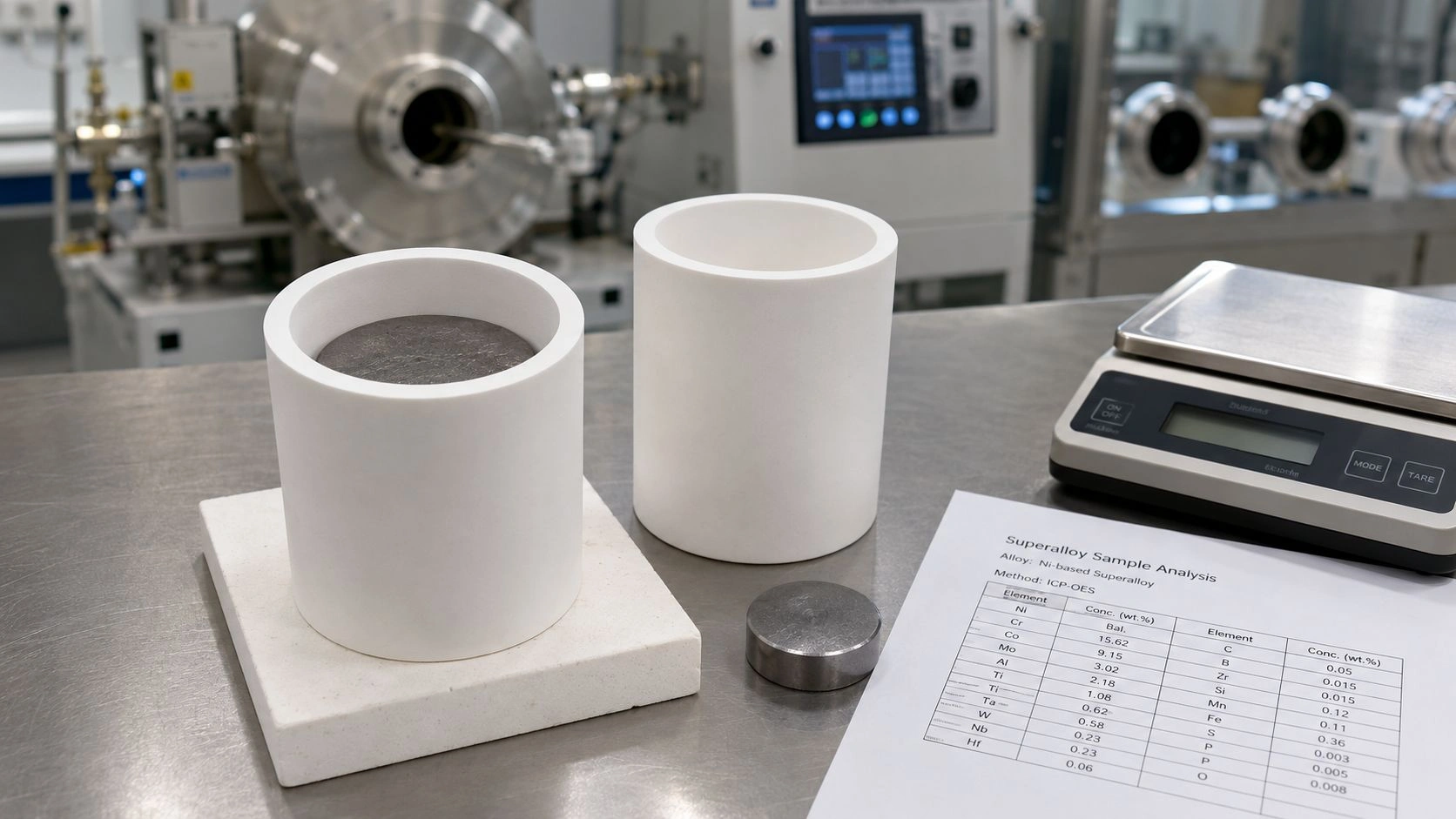
BN crucibles support clean superalloy sample preparation when vacuum or inert melting requires low wetting, controlled carbon contribution, and repeatable sample release before downstream analysis.
The boron nitride crucibles at ADCERAX — including hot-pressed BN crucibles and PBN crucibles for non-wetting metal processing, vacuum and inert-atmosphere applications, and custom geometries for laboratory and analytical preparation — provide the starting point for the crucible selection decisions described in this guide.
When does a BN crucible make sense for superalloy sample preparation?
BN crucibles enter the sample preparation conversation when the engineer is running small melts, re-melts, or button samples of nickel- or cobalt-based alloys under vacuum or inert gas and needs better interface control than graphite or refractory oxide ceramics typically provide.
The practical use window is strongest for short-duration laboratory melting — heating a 5 g to 100 g superalloy sample to melting temperature under argon or vacuum, holding briefly, cooling, and recovering the solidified button for downstream analysis. In this application, BN's low wetting by most molten nickel- and cobalt-based alloy systems means the solidified button typically releases cleanly from the crucible wall, reducing mechanical damage to the sample surface and residue contamination of the crucible bore. Momentive confirms that boron nitride is inert, non-wetted by most molten metals and slags, and suitable for molten-metal interface applications — which is the fundamental property that makes BN relevant here rather than in high-volume furnace charge containers.
Short-duration melts, re-melts, and button samples. Laboratory button samples for composition verification, alloy screening, or microstructure evaluation represent a primary use case. The sample is often small — measured in grams rather than kilograms — and the preparation is a precision analytical step rather than a production casting. The crucible contributes to the measurement result either by contaminating the sample or by failing to release it cleanly.
Why sample release matters for analytical repeatability. A superalloy sample that bonds to the crucible wall, leaves a meniscus ring, or requires mechanical force to extract may arrive at the analytical instrument with altered surface chemistry, mechanical damage, or missing mass. Published guidance on nickel and cobalt superalloy metallographic preparation confirms that these alloys work-harden easily and contain complex phase distributions, making preparation quality directly relevant to measurement reliability. If the crucible introduces variability in sample recovery, the analytical result reflects the preparation geometry as much as the alloy composition. BN's non-wetting behavior can reduce this variability by providing a more consistent release interface across repeated sample preparations from the same alloy family.
Induction heating and resistance furnace compatibility. BN crucibles can be used in both induction-heated vacuum melting chambers and resistance-heated inert-atmosphere furnaces. BN is not electrically conductive, which means it does not couple directly to induction fields — the sample heats inductively and transfers heat to the BN crucible by conduction, rather than the crucible itself being induction-heated. This limits how quickly BN can deliver heat from an induction system compared with a conductive graphite crucible, which is a practical consideration for very short thermal cycles or large thermal mass.
What contamination risks does BN reduce compared with graphite or oxide crucibles?
After establishing the use window, the contamination argument for BN must be made specific. BN reduces or avoids three practical contamination mechanisms that are relevant in superalloy sample preparation: carbon transfer from graphite contact, metal adhesion and incomplete recovery from wall wetting, and oxide-ceramic surface reactions that can alter surface chemistry or recovery efficiency.
Carbon pickup from graphite contact. When a molten nickel- or cobalt-based alloy contacts graphite, dissolved carbon can transfer from the crucible into the melt. The degree of transfer depends on temperature, carbon activity in the alloy, contact time, and whether the graphite surface is fresh or previously wetted. For alloys with controlled low-carbon specifications — many single-crystal and directionally solidified superalloy chemistries specify carbon content in the range of 0.06–0.14 wt% for specific mechanical property targets — carbon pickup during sample preparation can shift the analytical result outside the specification window. BN does not carry dissolved carbon and does not transfer carbon to the melt under inert or vacuum conditions, which is the principal analytical advantage over graphite.
Metal adhesion and wall reaction. Alumina and other oxide ceramics are refractory and clean in many applications, but molten nickel and cobalt alloys containing aluminum, titanium, or reactive additions can form solid oxide reaction products at the melt-crucible interface. These products can bond the solidified sample to the crucible, making clean extraction difficult without surface damage. BN's non-wetting behavior creates a lower-adhesion interface for many nickel alloys, particularly in argon or vacuum atmospheres where oxide formation is suppressed. This improves sample recovery, reduces surface contamination from ceramic spall, and allows the crucible to be reused for repeat preparations without retained surface contamination from the previous run.
Analytical method sensitivity and contamination control. ASTM E2594 covers the ICP-AES and ICP-OES analysis of nickel alloys and frames the method as compliance-oriented, with laboratory-specific work instructions and acceptance criteria. For a lab following this kind of standardized analytical workflow, the crucible contributes to the method blank and the analytical uncertainty budget. Reducing the contamination contribution from the sample preparation step — by using a low-wetting, low-carbon, low-reactivity crucible — reduces the blank correction and improves the confidence interval around the measured composition, particularly for elements present in the alloy at low concentrations.
IntechOpen's review of hexagonal boron nitride properties confirms that hBN exhibits low thermal expansion, good thermal shock resistance, and chemical inertness toward many molten metals, attributing these properties to the layered crystal structure of the material. The review also notes that the properties of hot-pressed BN depend partly on binder additives used during consolidation, which is a practical reminder that the purity and additive content of the specific BN grade must be verified for contamination-sensitive work.
When should BN not be used for superalloy sample preparation?
BN is not a universal superalloy sample preparation material, and the conditions where it should not be used or should be used only after additional validation are as important to specify as the conditions where it works well.
Oxidizing atmosphere and long dwell time. The principal limitation of hot-pressed BN in sample preparation is atmospheric oxidation. NASA research on the high-temperature oxidation behavior of boron nitride establishes that BN is thermodynamically unstable relative to its oxide at elevated temperature — the primary oxidation reaction produces B₂O₃, a low-melting glass that forms on the BN surface, flows under gravity, and can volatilize at higher temperatures. This oxidation mechanism means that BN crucibles used in air at elevated temperature will develop surface degradation, eventually generating oxide particles that can enter the melt or alter the crucible geometry. For laboratory sample preparation, this means standard hot-pressed BN should not be used for repeated air-atmosphere high-temperature holds above the supplier-specified air limit — which is typically substantially lower than the material's vacuum or inert-gas operating limit. If the preparation step must be performed in air, alumina, magnesia, yttria, or a platinum-group crucible is more appropriate depending on the alloy chemistry and temperature.
Boron-sensitive analytical programs. When boron is a critical measured element in the superalloy analysis — for example, in alloys where boron is added in parts-per-million quantities to improve creep resistance and grain boundary cohesion — the boron contribution from a BN crucible must be characterized and controlled. Boron can transfer from the crucible to the melt under conditions of high temperature, surface contact, and reactive alloy chemistry. The amount is typically small, but in a boron-trace analysis at the low-ppm level, even a small crucible contribution changes the measured result. The correct approach is to run method blanks and certified reference material preparations in the same BN crucible and verify that the measured boron from the crucible blank is below the analytical method's quantitation limit for the samples being analyzed. If it is not, PBN, an oxide crucible, or a redesigned preparation method should be evaluated.
Aggressive oxide flux chemistries. Some laboratory superalloy preparation protocols use oxide fluxes — sodium or lithium tetraborate, for example — to prepare samples for XRF fusion bead analysis. These fluxes operate at high temperature and can react chemically with crucible materials. The compatibility of standard hot-pressed BN with specific flux chemistry must be tested, not assumed. The RSC published paper on using BN crucibles to reduce adhesion and contamination in sulfide ore XRF fusion preparation confirms that BN can be useful in fusion contexts — but this was demonstrated for a specific flux and matrix combination, and the result should not be extrapolated to all superalloy flux fusion methods without independent validation.
The Crucible Selection Matrix for Superalloy Sample Preparation summarizes the decision logic:
| Use condition | BN crucible fit | Better alternative if mismatch | Decision note |
|---|---|---|---|
| Short vacuum/inert melt trial | Strong | PBN if ultra-high purity required | Use BN when release and low wetting matter |
| Air-exposed high-temperature hold | Weak to conditional | Alumina, MgO, Y₂O₃, or process redesign | Oxidation boundary must be verified |
| Graphite-contact carbon pickup risk | Strong | BN liner inside graphite crucible | Good fit when carbon must be minimized |
| Boron trace analysis is critical | Conditional | PBN or oxide crucible after validation | Confirm blank contribution |
| Aggressive oxide flux fusion | Conditional | Platinum alloy/oxide crucible depending on method | Verify flux compatibility |
Values are indicative. Verify per ASTM/ISO method and supplier-specific test data.
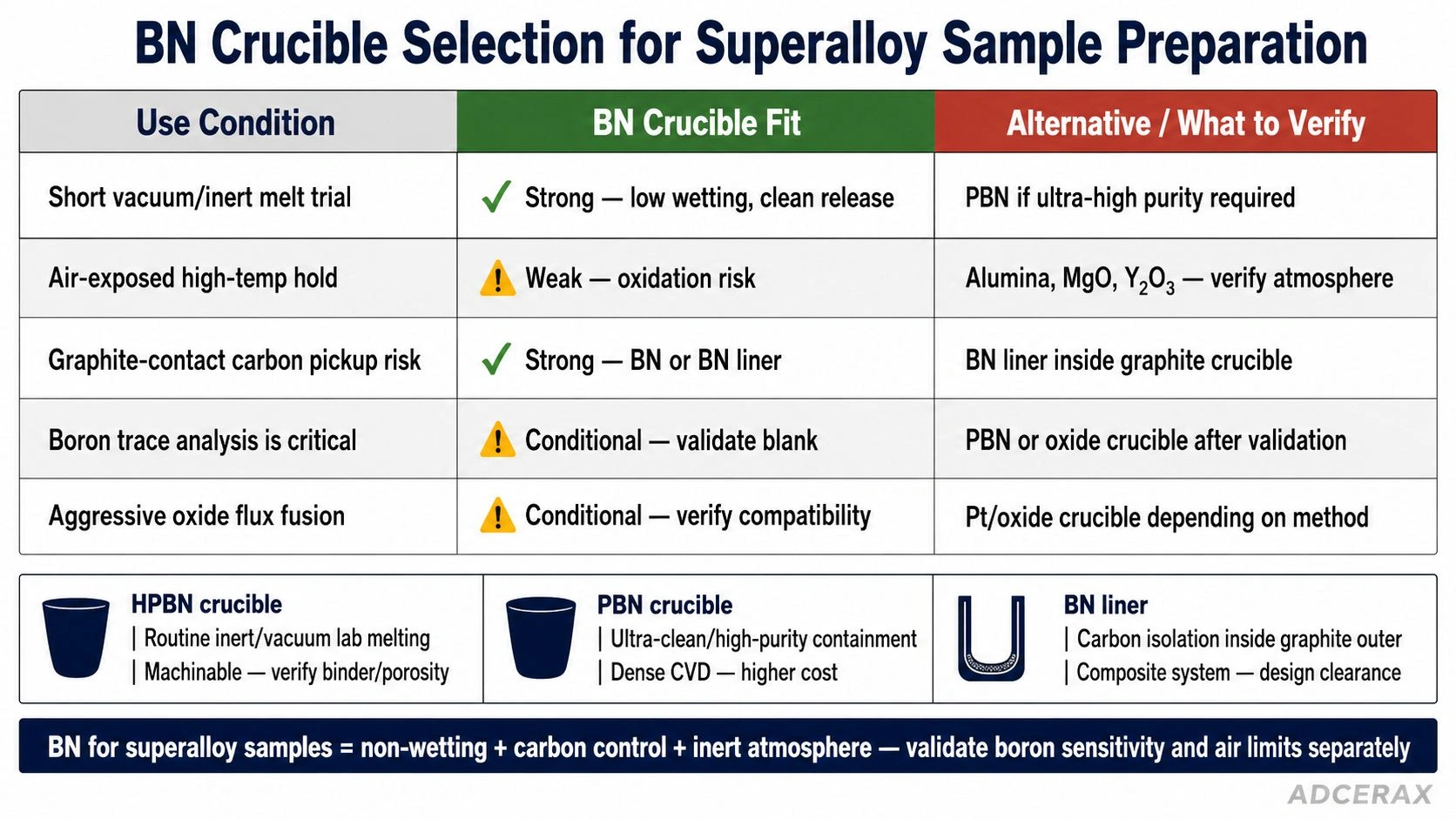
BN crucible selection for superalloy sample preparation depends on use condition — short vacuum or inert melts, graphite-contact carbon risk, boron trace analysis, air exposure, and oxide flux fusion require different crucible routes and validation checks.
What parameters should engineers specify before ordering BN crucibles?
After mapping the use window and the exclusion conditions, the specification must be written in supplier-ready language. A BN crucible RFQ for superalloy sample preparation should not stop at ""BN crucible, 50mm OD, 50mm height."" The supplier must understand the operating conditions to confirm compatibility, and the engineer must document the conditions to support method validation.
The minimum RFQ fields for superalloy sample preparation are: alloy family, sample mass or melt volume, peak temperature, dwell time, atmosphere, heating method, OD/ID/height geometry, wall thickness, lid requirement, surface finish on the inner bore, closed- or open-end configuration, and which elements are contamination-sensitive in the downstream analysis. If the preparation is part of a method qualified to ASTM or internal laboratory standards, this should also be stated so the supplier can confirm relevant material certifications.
When to request HPBN, PBN, or BN liner geometry. The three main BN options differ in purity, structure, and form factor:
The HPBN vs PBN vs BN Liner table summarizes the choice:
| Option | Best fit | Main advantage | Main limitation |
|---|---|---|---|
| Hot-pressed BN crucible | Routine inert/vacuum sample melting | Machinable, non-wetting, practical custom shapes | Binder/additive and porosity must be checked |
| PBN crucible | Ultra-clean evaporation or high-purity containment | Very high purity and dense CVD structure | Higher cost and geometry constraints |
| BN liner | Graphite crucible isolation | Reduces wall reaction and carbon contact | Fit, thermal expansion, and handling matter |
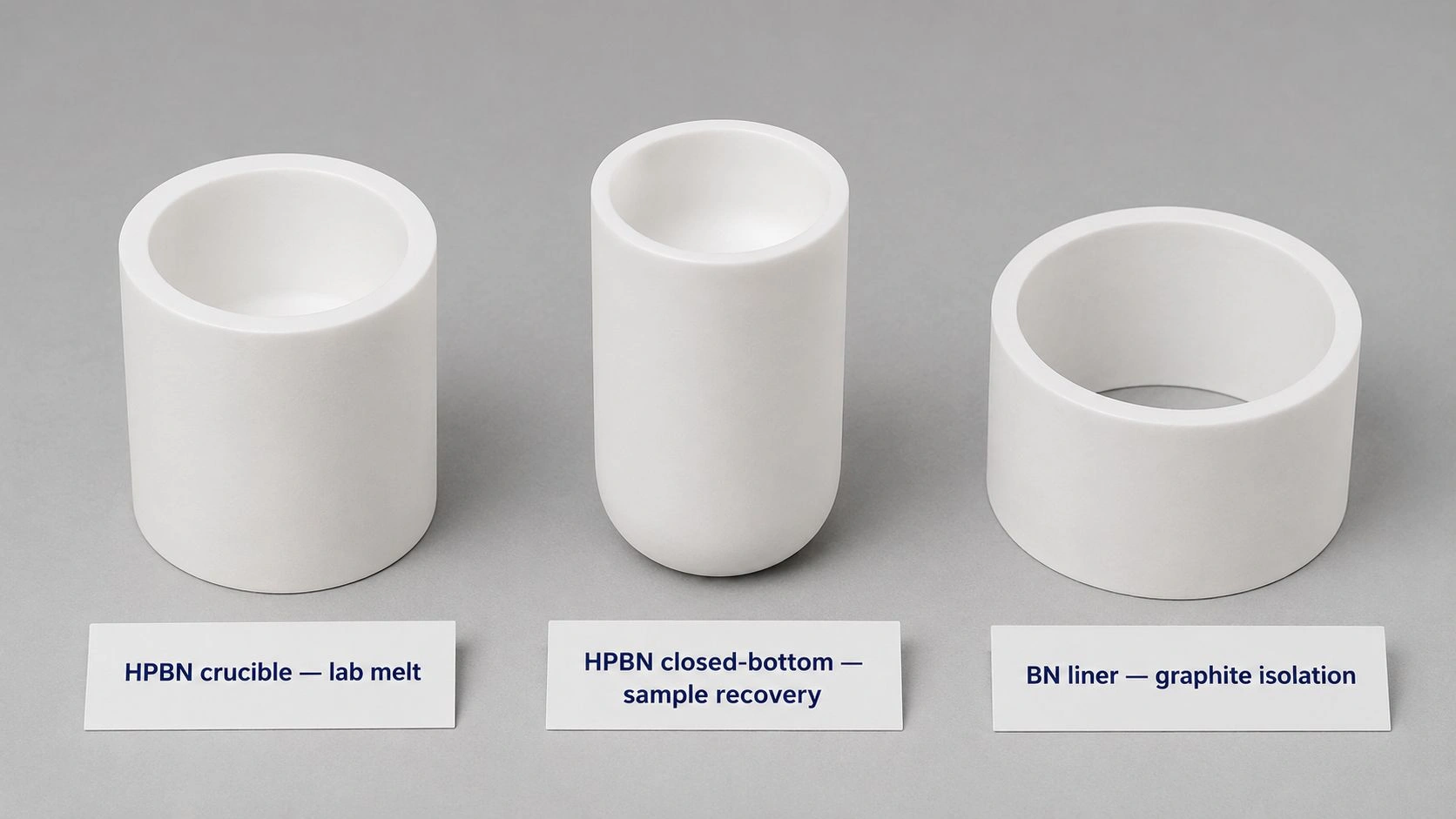
HPBN crucibles, closed-bottom BN crucibles, and BN liners solve different sample-preparation needs — routine inert melting, clean sample recovery, and graphite isolation should be specified separately.
Hot-pressed BN is the practical choice for most laboratory superalloy sample preparation because it is machinable to custom crucible geometry, available in a range of purity grades, and priced appropriately for consumable sample preparation use. The hot-pressed BN vs PBN decision guide at ADCERAX covers the manufacturing route, density, and application differences between these grades.
PBN is preferred when the preparation requires ultra-high purity containment, minimal gas permeability, and the CVD-grown dense structure that provides lower outgassing than hot-pressed grades. PBN is most commonly justified for high-purity evaporation or crystal growth applications rather than routine laboratory superalloy sample preparation, unless the analytical method specifically requires PBN-level purity.
BN liner is the correct choice when the furnace already uses a graphite crucible and the goal is to isolate the sample from carbon pickup or wall reaction without replacing the crucible. The BN crucible liner at ADCERAX is specifically designed for this composite crucible architecture, available in cylindrical, conical, and stepped profiles for standard graphite crucible bore sizes. The tolerance stack-up between the liner and the graphite outer crucible must be designed to allow thermal expansion at operating temperature while maintaining centered positioning.
The BN vs graphite crucibles comparison at ADCERAX provides additional context for the carbon contamination argument when choosing between these two approaches for superalloy laboratory preparation.
What supplier data should be requested before qualifying BN crucibles?
Before approving BN crucibles for routine superalloy sample preparation, five categories of supplier evidence should be requested.
Material grade and purity statement. The BN grade should be specified by alumina or additive content where applicable. Standard hot-pressed BN grades typically use calcium oxide or borate binders for consolidation; these additives can contribute trace elements to the melt at low concentrations. Requesting the supplier's material certificate with major impurity elements and any binder or additive disclosure allows the analytical team to evaluate the crucible's contribution to the method blank.
Maximum-use temperature by atmosphere. Published BN supplier data consistently distinguishes the maximum temperature in air from the maximum in vacuum or inert gas — the air limit is substantially lower due to oxidation. The exact limits vary by supplier, grade, and measurement method, so requesting this information for the specific grade to be used avoids relying on generic BN temperature claims.
Machining tolerance and surface finish capability. A BN crucible for laboratory sample preparation should have a smooth inner bore, a consistent wall thickness, and a flat or appropriate-radius bottom that promotes uniform heat transfer and controlled solidification. Requesting dimensional tolerance confirmation and inner bore surface finish ensures the supplied part matches the preparation geometry required.
Packaging and cleanliness controls. Laboratory sample preparation with BN crucibles requires that the crucible arrives clean, without surface contamination from handling, and protected against chipping during transit. Requesting individually wrapped crucibles with protective packaging is standard practice for ceramic analytical consumables.
Lot traceability. For an ISO-accredited laboratory or a method validated to ASTM standards, lot traceability for the crucible material supports method documentation and enables correlation of analytical performance with specific BN batches if a contamination issue is later suspected.
The Failure/Misdiagnosis Matrix maps common observed problems to better diagnostic questions:
| Observed issue | Possible cause | BN-solvable? | Verification step |
|---|---|---|---|
| Sample sticks to wall | Wetting or oxide reaction | Often yes | Compare post-melt wall residue |
| Carbon elevated in sample | Graphite contact | Yes, with BN liner/crucible | Run blank and reference sample |
| Surface flaking on crucible | Oxidation or thermal cycling | Not always | Check atmosphere and dwell |
| Boron reading unstable | Crucible contribution or alloy heterogeneity | Conditional | Run blank, digest control, certified reference |
| Cracking during handling | Point load or thermal shock | Process-dependent | Check geometry and ramp profile |
Diagnosis should include blank runs with certified reference materials before attributing analytical anomalies to crucible contribution.
The ceramic crucibles range at ADCERAX covers alumina, zirconia, SiC, and BN crucibles for laboratory and industrial applications, providing the cross-material context for cases where an oxide or SiC crucible may be more appropriate for specific superalloy preparation chemistry or atmospheric conditions.
Evaluating BN crucibles for superalloy sample preparation? Share your alloy family, atmosphere, peak temperature, sample volume, dwell time, analytical method, and contamination-sensitive element list. ADCERAX can review whether hot-pressed BN, PBN, a BN liner, or an alternative ceramic crucible fits the preparation requirement and propose a sample supply for method validation.
Frequently Asked Questions
Are BN crucibles suitable for nickel-based superalloys?
Yes, BN crucibles can be suitable for nickel-based superalloy sample preparation when the process runs under vacuum or inert gas and the main concerns are low wetting, clean sample release, or carbon contamination control from graphite alternatives. They should be validated with the specific alloy chemistry, temperature, and analytical method before adoption as a routine preparation material.
Can BN crucibles be used in air for superalloy sample preparation?
Standard hot-pressed BN oxidizes in air at elevated temperature through a mechanism involving B₂O₃ formation on the surface, documented in NASA research on BN high-temperature oxidation behavior. Air use above the supplier-confirmed air temperature limit can cause surface degradation and potential contamination of the sample. For air-atmosphere preparation steps, alumina, magnesia, yttria, or other oxide crucibles are typically more appropriate depending on alloy chemistry.
Does BN contaminate superalloy samples with boron?
BN is generally valued for low reactivity, but when boron is a critical measured trace element in the analytical method, the crucible's boron contribution must be characterized. The correct approach is to run analytical blanks and certified reference material preparations in the same BN crucible type and confirm that the measured blank boron is below the method's quantitation limit for the sample being analyzed.
Is PBN better than hot-pressed BN for superalloy sample preparation?
PBN is preferred when ultra-high purity containment, minimal gas permeability, and the CVD-grown dense wall structure are required — primarily in high-purity evaporation and crystal growth contexts. For routine laboratory superalloy button melting under inert atmosphere, hot-pressed BN is usually more practical because it can be machined to custom geometry at lower cost and is adequate for most contamination control requirements when the grade and condition are verified.
Why use a BN liner instead of a full BN crucible?
A BN liner is appropriate when the furnace system already uses a graphite or metal crucible for its thermal or structural properties, but the sample must be isolated from carbon pickup, wall reaction, or adhesion. Inserting a BN liner into the graphite crucible provides the clean non-wetting interface without replacing the outer structural vessel. The liner dimensions must be specified with clearance for thermal expansion at operating temperature, which is the primary engineering parameter for composite crucible liner systems.
What information should be sent for a BN crucible RFQ?
Send the alloy family and nominal chemistry, sample mass or melt volume, peak temperature and hold time, atmosphere, heating method, crucible geometry including OD/ID/height/wall thickness, lid requirement, surface finish specification for the inner bore, and the target analytical method with any contamination-sensitive elements identified. If replacing a previous crucible material, include the failure mode or contamination issue that is driving the change.
"