BN crucibles are useful in vacuum evaporation for mirror coating when the evaporation source requires a clean, thermally stable, low-wetting ceramic container for coating materials that would react with, wet, or contaminate alternative sources. They are especially relevant for aluminum evaporation — the most common reflective mirror coating material — selected high-purity metal sources, and custom crucible or liner geometries inside thermal evaporation systems. PBN is a screening preference when vacuum cleanliness, gas-tight walls, and high purity are critical — confirm CVD PBN grade and outgassing docs on RFQ; not a sole-specified grade contract. BN is not universal: silver mirror coatings and some optical coating materials may require alumina crucibles, tungsten boats, or tantalum/tungsten basket sources depending on the evaporation method, source heater geometry, and process requirements. The correct BN or PBN crucible selection starts with the evaporated material, not the coating application name.
Product context for the source decisions in this guide: boron nitride crucibles and PBN crucibles (hot-pressed BN and CVD PBN grades for vacuum evaporation, PVD source containment, and custom thermal evaporation geometries), plus drawing·heater·vacuum RFQ.
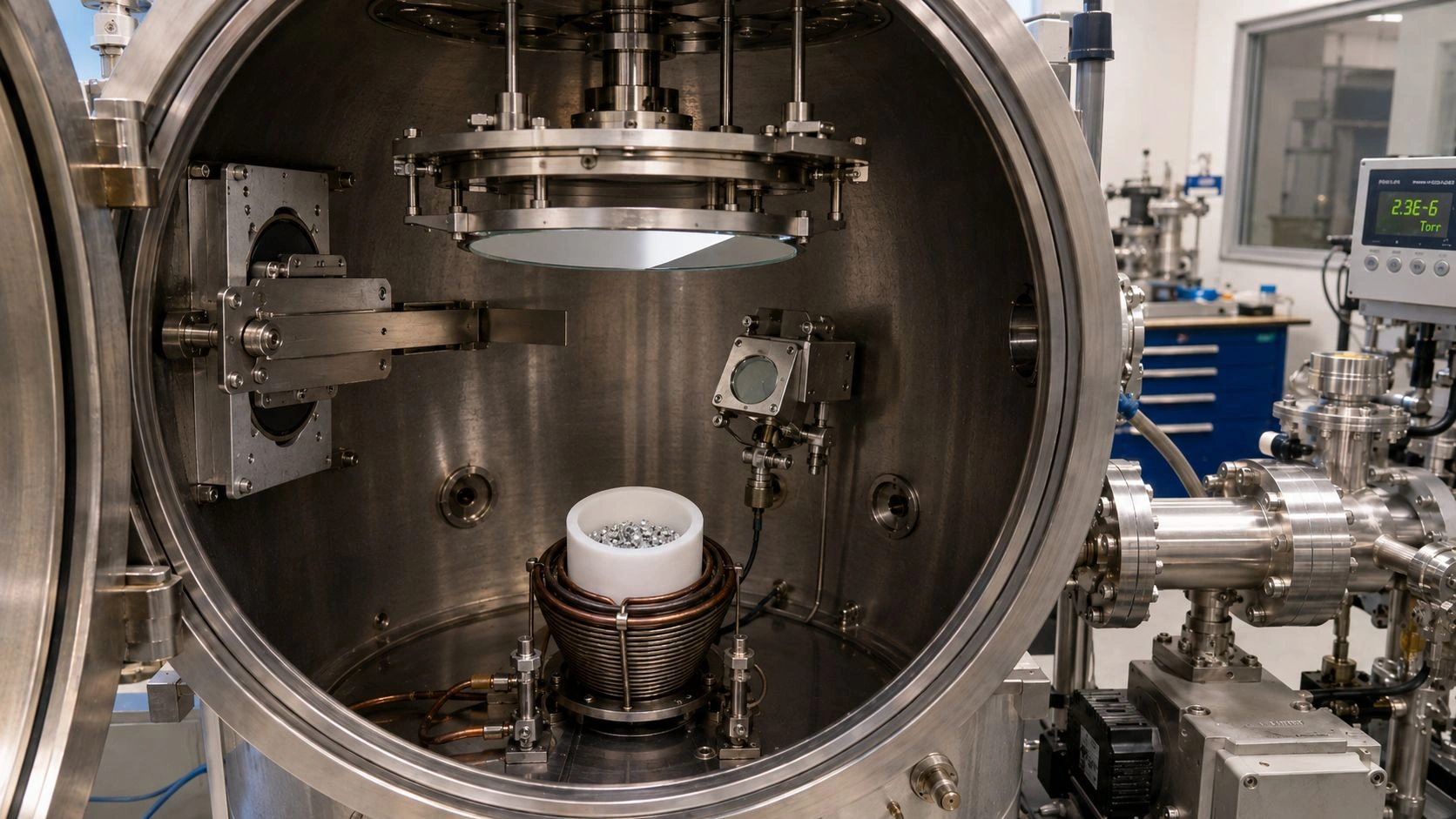
BN and PBN crucibles serve as evaporation source containers in vacuum mirror-coating systems — strongest for aluminum evaporation, conditional for silver, and requiring verification of source heater compatibility, vacuum level, contamination limits, and evaporated material chemistry before selection.
When are BN crucibles suitable for vacuum evaporation mirror coating?
Mirror coating by vacuum evaporation deposits a thin, highly reflective metal or dielectric film onto a glass, metal, or polymer substrate under vacuum conditions. The crucible or boat containing the evaporation material is part of the source hardware — it determines how cleanly the material evaporates, whether the source contaminates the film, how stable the deposition rate is, and how easily the source can be cleaned or recharged between runs.
BN crucibles enter the evaporation source selection when the deposition material requires a clean, low-adhesion, chemically stable container that will not react with the evaporated metal, release carbon or metallic contamination, or disrupt the controlled vacuum environment. KJLC's published process notes for aluminum evaporation confirm that vacuum-evaporated aluminum forms reflective coatings used on telescopes, automotive headlamps, mirrors, packaging, and decorative applications. KJLC's boron nitride crucible page further states that crucible material should be selected based on the material being evaporated, confirming that the source ceramic selection is an evaporation-material decision, not a coating-target decision.
Aluminum mirror coating and BN source compatibility. Aluminum is the most widely used mirror coating material for its high reflectivity across the visible spectrum, ease of deposition, and low cost. BN is commonly used in aluminum evaporation sources because, as industry practice under stated vacuum evaporation conditions, aluminum is typically non-wetting toward BN and does not preferentially react with it — providing clean release, stable melt-pool behavior, and low contamination of the deposited film; confirm grade·vacuum·dwell on RFQ, not as a never-reacts contract claim. For telescope mirror recoating, automotive headlamp reflector production, and decorative mirror metallizing, BN or PBN evaporation crucibles can provide the clean source behavior required for high-quality reflective films.
Why vacuum cleanliness matters more than simple melting temperature. The operating temperature for aluminum thermal evaporation is well within the capability of many ceramic crucible materials — the challenge is contamination and outgassing, not temperature alone. A crucible that outgasses water, organic residues, or metallic impurities during the pumpdown or deposition cycle can introduce background contamination that affects film adhesion, reflectivity, or optical uniformity in ways that are difficult to diagnose without isolating the source material.
How does evaporated material change the BN/PBN crucible decision?
The evaporated material is the controlling variable in evaporation crucible selection — and mirror coating applications use several different materials with different source requirements.
Aluminum evaporation: BN as a screening candidate. For aluminum thermal evaporation, BN is a recognized crucible material. Third-party context (not factory proof for any single supplier): Stanford Advanced Materials' recommended crucible table lists BN for aluminum evaporation as industry-practice alignment. Under typical thermal evaporation vacuum conditions, BN is typically non-wetting toward molten aluminum and does not preferentially react with it, supporting clean release after the melt solidifies — confirm grade·vacuum·dwell on RFQ; ban treating this as a never-reacts contract. Hot-pressed BN in custom crucible geometries can be machined to fit specific source heater dimensions, making it a practical screening choice for a range of thermal evaporation system configurations.
Silver evaporation: why alumina or metal boat sources may be preferred. Silver is used in some high-performance optical mirror coatings for superior reflectivity in the visible and near-infrared range — it can be challenging to protect against tarnishing but offers the highest reflectivity of common mirror metals. For silver thermal evaporation, however, the source recommendation changes. Published-guidance context (verify on buyer source hardware): KJLC's process notes for silver evaporation recommend a tungsten boat or a shielded tantalum/tungsten basket heater with an aluminum oxide crucible, not a BN crucible. This distinction is important: an optical coating engineer who applies the aluminum-evaporation source experience directly to silver evaporation may be choosing the wrong crucible type — confirm on the buyer's heater geometry and process recipe.
The BN/PBN Crucible Suitability Matrix for Mirror-Coating Evaporation maps the main material cases:
| Evaporated material/source context | BN crucible fit | PBN crucible fit | Better alternative if mismatch |
|---|---|---|---|
| Aluminum mirror coating | Strong | Strong when higher purity required | Tungsten boat depending source design |
| Silver optical coating | Conditional | Conditional | Alumina crucible with tungsten/tantalum heater |
| Gold or selected noble metals | Conditional to strong | Strong for cleaner vacuum source | Alumina or vitreous carbon depending system |
| Fluoride/oxide protective layers | Material-specific | Material-specific | Follow deposition-material source recommendation |
| High-purity optical coating lab | Conditional | Strong | PBN or source-specific liner system |
| High-throughput metallizing boat | Conditional | Usually not default | TiB₂-BN evaporator boat designs |
Values indicative. Verify with deposition-material supplier guidance, source-heater compatibility, and supplier-specific BN/PBN data.
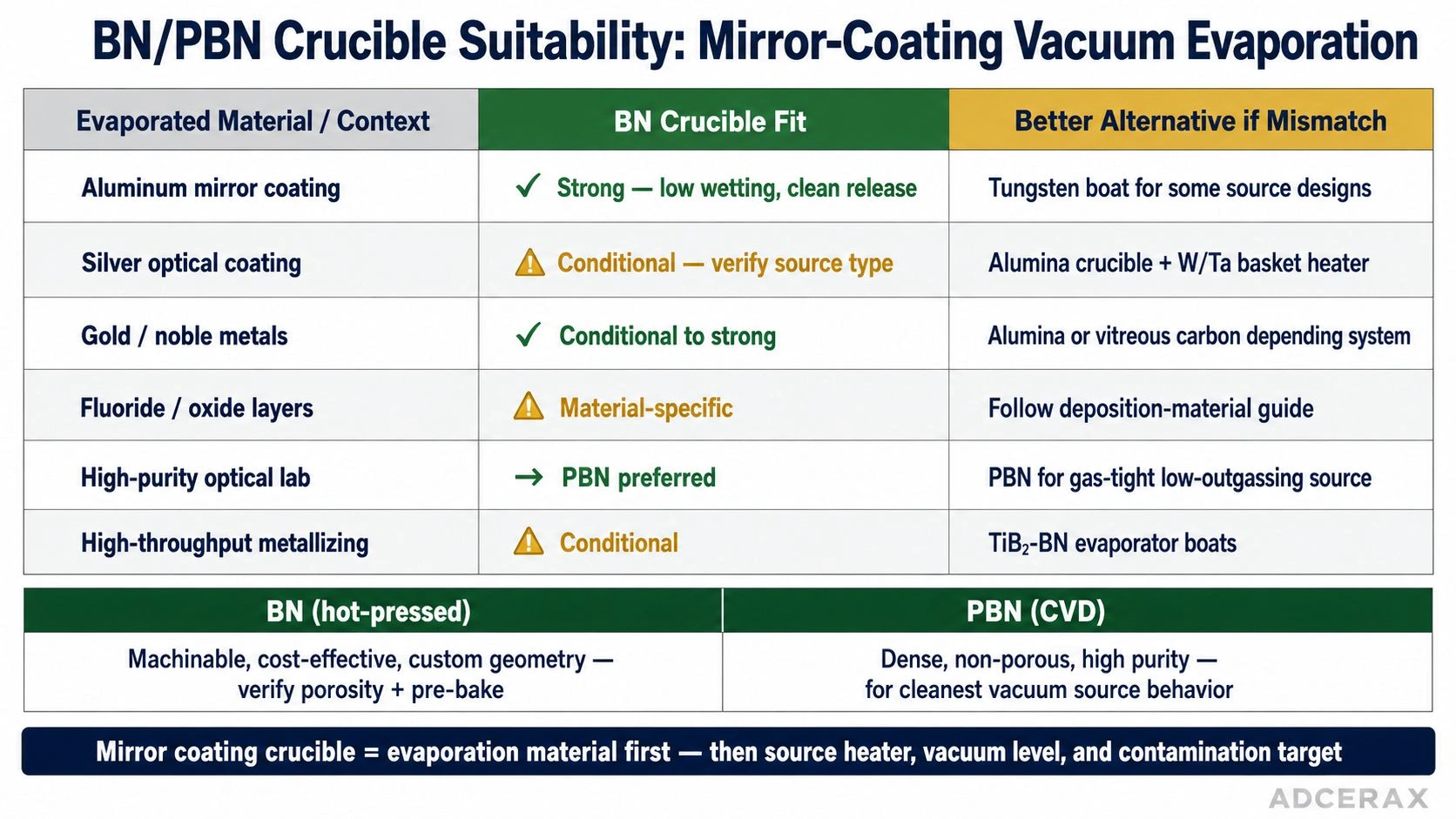
BN/PBN crucible selection for mirror-coating vacuum evaporation should start with the evaporated material — aluminum, silver, noble metals, fluoride/oxide layers, high-purity optical labs, and high-throughput metallizing each require separate source compatibility checks.
When should PBN, alumina, tungsten boats, or tantalum baskets be used instead?
After establishing where BN is a strong candidate, the boundaries where PBN, alumina, or metal sources are more appropriate must be clearly defined — because applying BN to every mirror-coating evaporation source without checking the evaporation material, heater design, and vacuum level leads to avoidable source problems.
Standard BN vs PBN for vacuum cleanliness. Hot-pressed BN is machinable and cost-effective for custom evaporation crucible geometries, but its porous structure can carry adsorbed moisture and trace organics from storage and handling. In a high-vacuum evaporation system, this outgassing load extends pumpdown time and can contribute to background contamination during the early stage of a deposition run. As qualitative screening language, CVD PBN — with a dense, non-porous wall structure — is commonly discussed for lower outgassing, higher purity, and cleaner vacuum behavior relative to hot-pressed BN; confirm CVD PBN grade outgassing documentation on RFQ — not an unverified outgassing-rate SLA or sole-specified grade. Third-party context (not factory proof): Momentive describes its pBN as nonporous and exceptionally pure, available as machined crucibles, boats, plates, and tubes; Shin-Etsu notes PBN suitability for vapor deposition from chemical stability and thermal behavior. Product context: the PBN crucible range covers custom CVD PBN geometries for PVD and vacuum evaporation applications where these cleanness requirements apply.
Why source heater compatibility can override crucible material preference. The crucible must physically fit the source heater assembly — the resistance heater, induction coil, electron-beam hearth, or conical heater basket — and the thermal coupling between the heater and the crucible determines how uniformly the evaporation material heats. A BN or PBN crucible that is correctly specified in material terms but poorly matched in geometry to the heater will provide non-uniform heating, unstable deposition rate, or thermal stress that cracks the crucible. This is why the RFQ must include both the material requirement and the source heater model or geometry.
High-throughput metallizing and evaporator boat design. For high-throughput aluminum, silver, or copper metallizing — where very large charges are processed continuously at high evaporation rates — Kennametal's published evaporator boat application data (literature / process-typical source context) describes boats made from TiB₂ and BN operating around 1500–1600°C to process metals at extreme production rates — confirm heater design·melt·vacuum on RFQ; not a contract continuous temperature rating for laboratory mirror-coating BN crucibles. These composite evaporator boats are a different architecture from laboratory or optical-coating thermal evaporation crucibles, designed specifically for large-scale metallizing line throughput. BN crucibles in the laboratory mirror-coating context operate at much lower throughput and more controlled conditions.
The BN crucible liner covers the liner architecture for cases where a BN typically non-wetting barrier is needed inside a graphite or metal outer crucible rather than as a freestanding ceramic container — confirm grade·vacuum·dwell.
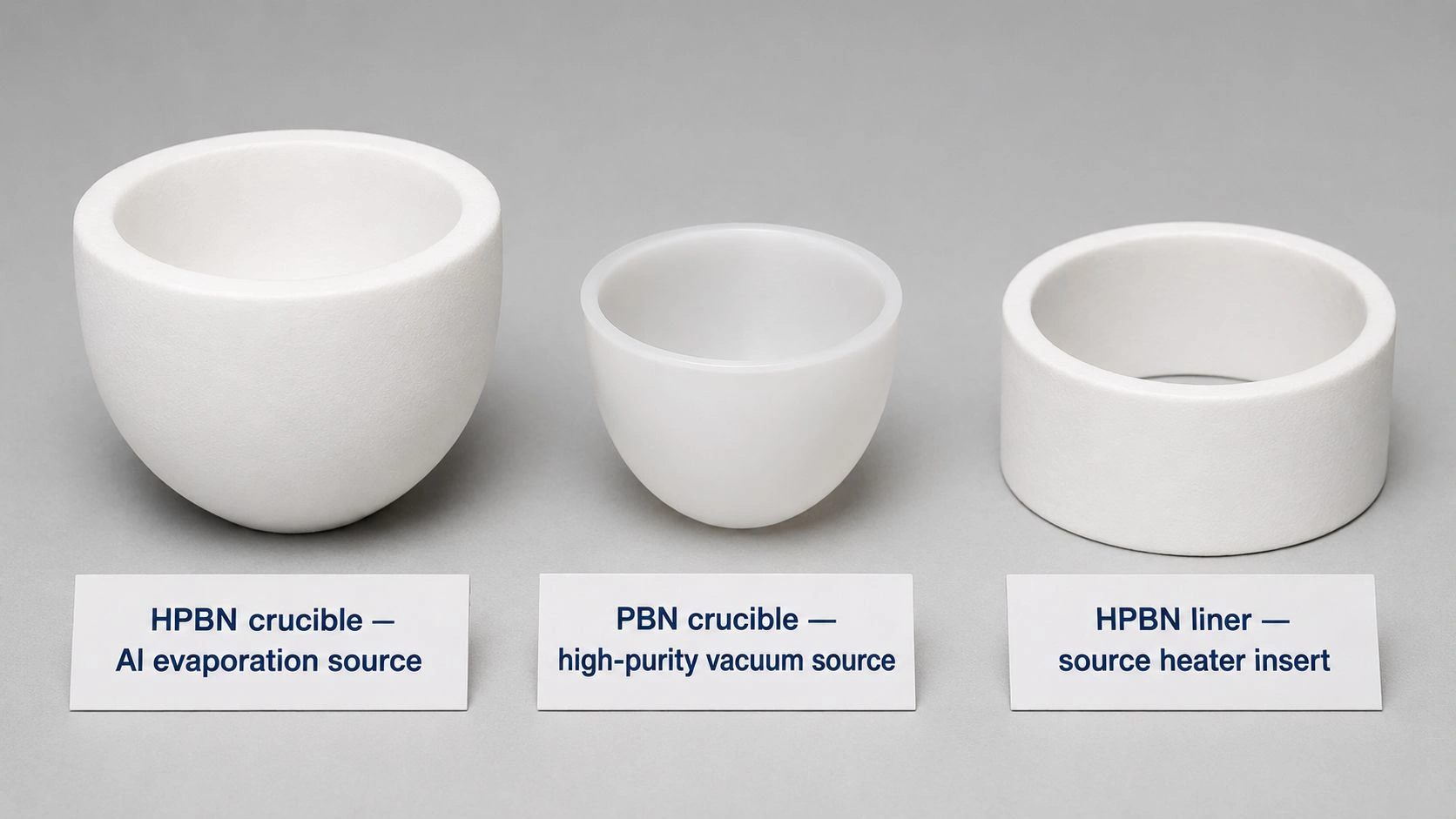
HPBN crucibles, PBN crucibles, and HPBN liners solve different evaporation-source needs — aluminum source containment, high-purity low-outgassing vacuum behavior, and source-heater inserts should be specified separately.
What specifications should be included in a BN/PBN crucible RFQ for mirror coating?
A BN or PBN crucible RFQ for vacuum evaporation mirror coating must begin with the evaporated material and source heater context — without both, the supplier cannot confirm material suitability, geometry compatibility, or vacuum cleanliness requirements.
The RFQ Parameters for BN/PBN Vacuum Evaporation Crucibles table maps the required fields:
| Parameter | Why it matters for mirror coating | Required in RFQ? |
|---|---|---|
| Evaporated material | Main driver of crucible/source compatibility | Yes |
| BN vs PBN grade | Determines purity, porosity, vacuum cleanliness, and cost | Yes |
| Source type | Crucible, liner, boat, or basket insert changes geometry | Yes |
| Heater compatibility | Crucible must fit thermal source hardware | Yes |
| Cavity volume/charge mass | Affects deposition run length and thermal stability | Yes |
| OD/ID/wall thickness | Controls fit, heating behavior, and replacement compatibility | Yes |
| Bottom geometry | Affects melt pool stability and heat transfer | Yes |
| Vacuum level | Determines outgassing and cleanliness requirements | Yes |
| Contamination limits | Critical for optical reflectivity and film consistency | Yes |
| Cleaning/reuse plan | Affects cross-contamination and service life | Recommended |
Purity and outgassing specification language. For optical mirror coating applications where film purity affects reflectivity, the RFQ should specify whether hot-pressed BN or CVD PBN is required, and may include a buyer-specified / optional maximum acceptable outgassing rate or a pre-bake and handling requirement for the specific vacuum level — confirm whether a numeric rate is available from the supplier; do not treat an unverified rate as a mandatory acceptance SLA. Requesting the supplier's recommended pre-bake procedure for the crucible before first use allows the laboratory to include this step in the source preparation protocol.
Heater model and dimension confirmation. Including the source heater model number or the critical heater dimensions — inner diameter, depth, and thermal contact surface — allows the supplier to confirm that the proposed crucible fits the source hardware and that the wall thickness and geometry are compatible with the heating method.
What supplier evidence should be requested before qualification?
Before qualifying BN or PBN crucibles for mirror-coating vacuum evaporation, the following supplier evidence should be collected.
The Misdiagnosis Matrix maps observed source or coating problems to better diagnostic questions:
| Observed problem | Common wrong diagnosis | More useful engineering question |
|---|---|---|
| Dull aluminum coating | ""BN crucible is bad"" | Was the chamber clean, source stable, and aluminum uncontaminated? |
| Unstable deposition rate | ""Wrong coating recipe"" | Is the crucible geometry or heater coupling unstable? |
| Cross-contamination | ""Vacuum pump issue"" | Was the crucible reused with incompatible materials? |
| Source spitting | ""Deposition material quality issue"" | Is the melt pool, charge loading, or source ramp suitable? |
| Poor silver result | ""Need PBN instead of BN"" | Is silver better matched to alumina crucible or metal boat source? |
Before production use, request from the supplier: material grade identification and manufacturing route, purity statement with major impurity elements, density and open porosity data, dimensional inspection report, surface finish, recommended evaporated materials for the specific grade, vacuum-use guidance including pre-bake recommendation, packaging and cleanliness controls, and lot traceability. For PBN crucibles specifically, request CVD formation confirmation, wall thickness range, and any available vacuum outgassing documentation.
For aluminum mirror coating, confirm that the supplier has experience with or can recommend their BN/PBN grade for aluminum evaporation sources. For silver or other optical coating metals, confirm whether BN/PBN is specifically suitable or whether the supplier recommends an alternative crucible material for that metal.
The ceramic crucibles range provides cross-material context for cases where alumina, zirconia, or other crucible materials may be more appropriate for specific evaporation materials.
Evaluating BN or PBN crucibles for vacuum evaporation mirror coating? Share the evaporated material, mirror coating type, source heater model or dimensions, vacuum level, crucible drawing or target dimensions, cavity volume, charge mass, BN or PBN preference, contamination limits, and cleaning or reuse plan via custom RFQ. A supplier can then screen whether hot-pressed BN, CVD PBN, or another ceramic crucible configuration fits the specific evaporation source — confirm melt·vacuum·geometry on RFQ.
Frequently Asked Questions
Are BN crucibles suitable for aluminum mirror coating?
Yes — as screening language, BN crucibles are a strong candidate for aluminum vacuum evaporation when the source design, heater compatibility, charge mass, and contamination requirements match; confirm on duty RFQ. Aluminum is the clearest mirror-coating use case for BN crucible discussion because, under typical thermal evaporation conditions, aluminum is typically non-wetting toward BN, and BN is listed as a recommended crucible material for aluminum evaporation by multiple evaporation equipment suppliers (third-party context, not factory proof).
Is PBN better than hot-pressed BN for vacuum evaporation?
As screening language, PBN is generally preferred when higher purity, lower porosity, gas-tight walls, and cleaner vacuum behavior are required — especially for optical coating systems where background contamination during pumpdown can affect film quality; confirm CVD PBN outgassing docs and duty on RFQ. Hot-pressed BN may be more practical for larger, custom, or less purity-critical evaporation source components where machining flexibility and cost are important factors.
Can BN crucibles be used for silver mirror coating?
BN may be possible in some source configurations, but silver thermal evaporation has a different source recommendation than aluminum. Published-guidance context: KJLC's silver evaporation notes recommend a tungsten boat or a shielded tantalum/tungsten basket heater with an aluminum oxide crucible — not a BN crucible. Any BN application for silver coating should be verified on the buyer's source hardware and process requirements.
Why does crucible material affect mirror coating quality?
The crucible affects film contamination level, source deposition stability, melt-pool uniformity, spitting risk, cross-contamination between runs, cleaning ease, and vacuum pumpdown time. These factors influence the consistency of reflective film deposition before optical measurement begins, making source material selection part of the optical process control chain.
What should be included in a BN/PBN crucible RFQ for mirror coating?
Include the evaporated material, source heater model or critical dimensions, crucible drawing or target geometry, BN or PBN grade preference, purity requirement, vacuum level, cavity volume, charge mass per run, wall thickness, bottom geometry, contamination-sensitive elements, and the planned cleaning or reuse protocol between runs.
Can one PBN crucible be reused for different evaporation metals?
Reuse depends on the metal pair, contamination tolerance, cleaning feasibility, and coating quality requirement. For optical mirror coating where film purity directly affects reflectivity, using dedicated crucibles by evaporation material is generally the safer approach to avoid cross-contamination that could change coating optical performance.
Related reading
- Annealing BN crucibles before first use — When first-use annealing / pre-bake of BN crucibles gates source restart, not only mirror-coating material choice
- BN crucibles for silicon-ingot growth — When the BN crucible duty is silicon-ingot purity/shape rather than evaporation mirror coating
- BN crucible thermal shock vs alumina — When thermal-shock vs alumina changes the BN crucible call before vacuum-evaporation RFQ lock