Choose SSiC when the application needs the highest SiC purity, dense microstructure, strong corrosion resistance, high-temperature stability, tight precision, or severe wear performance. Choose RBSiC or SiSiC when the part is large, complex, cost-sensitive, or benefits from near-net-shape manufacturing, and when residual free silicon will not compromise corrosion resistance, high-temperature behavior, or purity requirements. In many supplier catalogs, RBSiC and SiSiC refer to the same silicon-infiltrated reaction-bonded material family, but engineers should confirm composition, free-silicon content, porosity, maximum use temperature, and chemical compatibility before approving the grade. The most common selection mistake is choosing the grade by name rather than by service environment.
The silicon carbide ceramic material grades at ADCERAX — covering SSiC, RBSiC, and NBSiC across tubes, mechanical seals, nozzles, plates, liner tubes, rods, balls, and custom components — provide the product context for the grade selection decisions described in this guide.

Silicon carbide grade selection — SSiC, RBSiC, SiSiC — is driven by residual silicon risk, service environment, geometry complexity, and cost constraint, not by a universal ranking of which grade is ""best.""
What is the core difference between SSiC, RBSiC, and SiSiC?
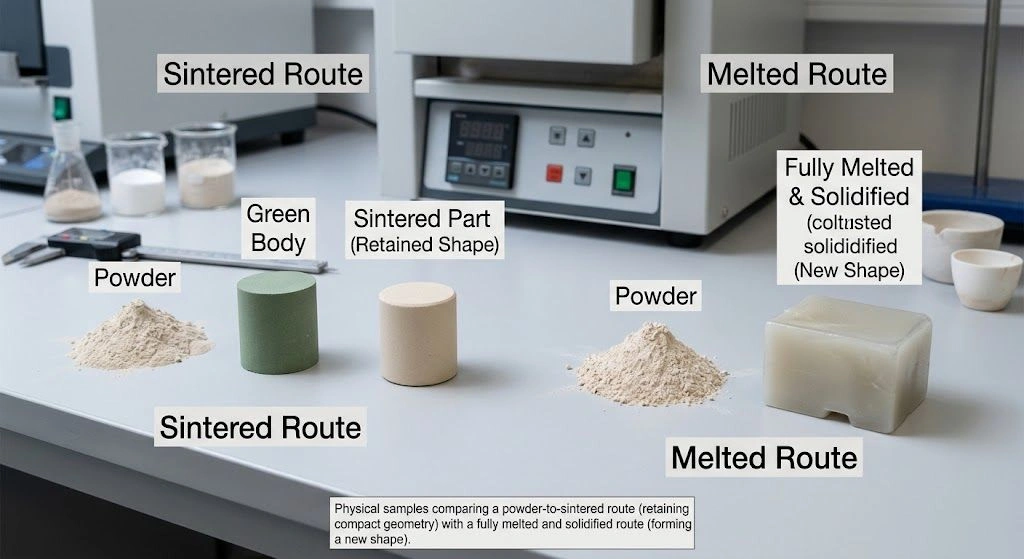
Before the selection rule can be applied, the manufacturing routes that produce these materials must be understood — because the manufacturing route controls the residual phases, microstructure, and performance limits of each grade.
[CITE: CeramTec's published silicon carbide material page confirms that SSiC and SiSiC are both established industrial SiC variants with well-defined application ranges, and describes SiSiC as especially suitable for complex, large-volume components — while published ScienceDirect research on SiC ceramics confirms that traditional reaction-bonded SiC inevitably contains residual silicon in its microstructure, and that this residual silicon can limit performance in higher-temperature and corrosion-intensive applications — establishing that grade selection must account for this microstructural difference as a functional performance variable, not only as a cost or manufacturing consideration.]
SSiC — pressureless sintered silicon carbide. SSiC is produced by mixing fine SiC powder with a small amount of sintering aids — typically boron and carbon compounds — then sintering the pressed body at temperatures above 2000°C under atmospheric pressure or controlled atmosphere. The result is a dense, high-purity SiC body with no infiltrated secondary phase. Density is typically above 3.1 g/cm³, open porosity is very low, and the microstructure is essentially single-phase SiC. This structure provides the strongest chemical resistance, the best high-temperature mechanical stability, the lowest contamination risk, and the most reliable performance in severe wear and sealing applications.
RBSiC — reaction-bonded silicon carbide. RBSiC is produced by forming a shaped preform from SiC powder and carbon, then infiltrating it with molten silicon at elevated temperature. The silicon reacts with the carbon to form additional SiC, binding the structure and providing near-full density — but always leaving residual unreacted silicon in the microstructure, typically in the range of 5–20% by volume depending on the process. This residual silicon phase has a much lower melting point, chemical resistance, and high-temperature strength than SiC itself, which is where the application boundary for RBSiC lies.
SiSiC — silicon-infiltrated silicon carbide. SiSiC is a descriptor that often refers to the same material family as RBSiC, or to a closely related silicon-infiltrated variant. In many industrial and supplier contexts, SiSiC and RBSiC are used interchangeably. SCIEPublish's review of SiC sintering technologies confirms that reaction-bonded sintering uses SiC powder plus carbon and molten silicon infiltration, and is characterized by lower sintering temperature, shorter processing time, and near-final-shape dimensional capability. Buyers should ask suppliers to specify free-silicon content, porosity, and composition when the grade is described as SiSiC to confirm whether it is the same as their RBSiC or a distinct variant.
The SSiC vs RBSiC vs SiSiC Grade Comparison table maps the key decision variables:
| Decision variable | SSiC | RBSiC | SiSiC |
|---|---|---|---|
| Manufacturing route | Pressureless sintered SiC | Reaction-bonded SiC | Silicon-infiltrated SiC, often same family as RBSiC |
| Free silicon | Typically none or very low | Present in traditional RB-SiC | Present as infiltrated silicon phase |
| Best for | Severe corrosion, precision wear, high purity, seal faces | Complex shapes, large parts, thermal-shock and cost-sensitive service | Large complex parts, kiln furniture, structural supports |
| Corrosion boundary | Strongest in many aggressive environments | Limited when residual silicon is attacked | Limited when free silicon is attacked |
| High-temperature boundary | Stronger high-temperature stability | Residual silicon limits upper temperature | Similar residual-silicon limitation |
| Shape complexity | Good, but more machining/sintering constraints | Strong near-net-shape capability | Strong for complex large-volume components |
| Cost tendency | Higher | Lower to medium | Lower to medium |
| Selection rule | Use when performance risk is high | Use when size/shape/cost dominate and chemistry permits | Use when large/complex silicon-infiltrated SiC is acceptable |
Values indicative. Verify with supplier-specific grade data, composition, porosity, free-silicon content, and service-environment testing.

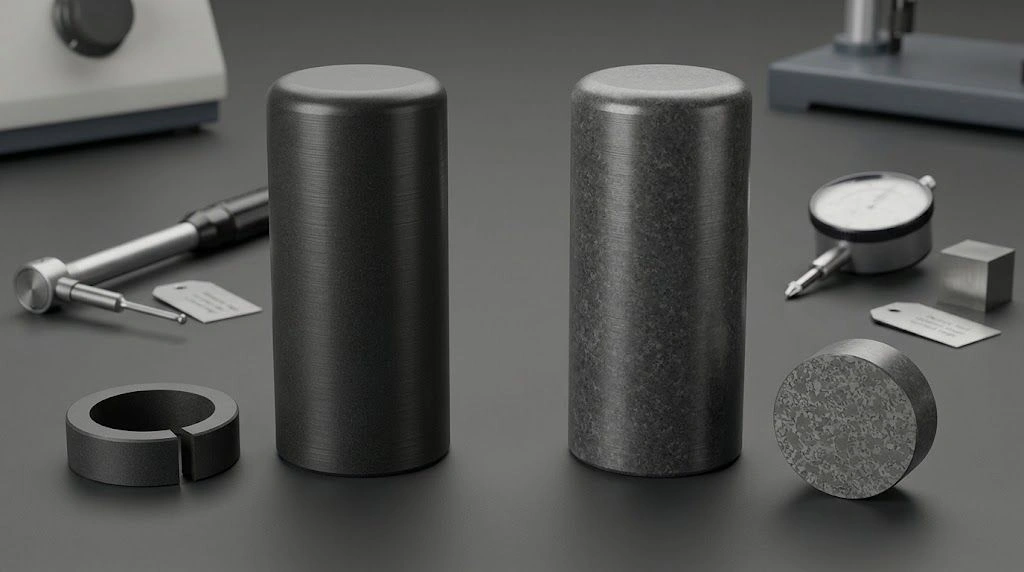
The SiC grade selection matrix shows the practical boundary: SSiC leads when residual silicon is unacceptable, while RBSiC or SiSiC becomes attractive when large complex shape capability and cost dominate the decision.
When should engineers choose SSiC instead of RBSiC or SiSiC?
After establishing the material difference, the upgrade trigger for SSiC must be defined — because the performance advantage of SSiC over RBSiC/SiSiC is real but application-specific, not universal.
[CITE: Schunk's published silicon carbide material characterization describes SSiC as a high-strength, high-performance ceramic with strong chemical-corrosion resistance — and ADCERAX's published SiC grade information identifies SSiC as the grade with the highest purity, highest density, and best mechanical properties in the SiC grade family, with no free silicon in the microstructure — establishing that the engineering argument for SSiC is specifically in applications where density, purity, and freedom from reactive secondary phases are the controlling performance variables.]
Chemical corrosion, high purity, and seal-face reliability. The conditions that most clearly justify SSiC are aggressive corrosive media, high-purity fluid contact, and precision-ground sealing or wear surfaces. When the process fluid is a strong acid, strong alkali, oxidizing agent, concentrated halogen compound, or high-purity process chemical, the residual silicon phase in RBSiC/SiSiC may be selectively attacked — either corroding at a faster rate than the SiC matrix or leaching silicon ions into a purity-sensitive stream. SSiC provides a single-phase SiC surface that does not carry this phase-specific corrosion risk.
For mechanical seal faces, pump bearings, and precision wear components, the same density argument applies: a dense, fully sintered SSiC surface can be ground to tighter flatness and surface finish, maintains its geometry under load more consistently, and provides more uniform hardness and wear behavior across the contact area. Seal face failure from uneven wear, porosity-induced lubricant film breakdown, or phase-specific corrosion at the seal interface is a well-known failure mode that the SSiC upgrade specifically addresses.
Precision wear components and high-temperature mechanical stability. At elevated operating temperatures — above approximately 1400°C in oxidizing atmospheres and higher in inert gas — the residual silicon phase in RBSiC/SiSiC can begin to creep, oxidize, or otherwise limit the mechanical integrity of the component. SSiC, with its fully reacted SiC matrix, maintains mechanical properties to higher temperatures without a secondary phase that could initiate failure. For this reason, SSiC is the more conservative choice in high-temperature furnace components where chemical compatibility with the atmosphere or process species is also important.
When are RBSiC or SiSiC the more practical choice?
After mapping the SSiC upgrade triggers, the equally important engineering case for RBSiC/SiSiC must be made — because these grades are not simply inferior versions of SSiC; they are specifically suited to applications where SSiC's sintering constraints become a limitation.
Large and complex shapes where near-net forming matters. The reaction-bonded infiltration route allows SiC parts to be formed at lower temperatures with less dimensional change during processing. This supports the production of large, complex, asymmetric, or thin-walled geometries that would be difficult or expensive to produce by sintering and then machining SSiC to final dimensions. CeramTec's explicit positioning of SiSiC for complex large-volume components confirms this manufacturing advantage. Kiln furniture beams, long radiant tubes, large setter plates, complex burner blocks, and long roller tubes are common examples where the near-net-shape capability of RBSiC/SiSiC provides a practical and cost-effective path to the required part geometry.
Thermal, structural, and cost-sensitive applications where free silicon is acceptable. In high-temperature furnace applications where the process atmosphere is not chemically aggressive toward silicon — nitrogen, argon, or air atmospheres at moderate temperatures — and where the performance requirement is primarily thermal stability, mechanical strength, and thermal-shock resistance, RBSiC/SiSiC can provide reliable service at lower cost than SSiC. Kiln rollers carry loaded saggers at high temperature, and the principal performance requirements are creep resistance, thermal shock resistance, and mechanical straightness — conditions where RBSiC/SiSiC frequently meets specification without requiring SSiC. Research on reaction-bonded SiC confirms that the process supports complex shapes at lower temperatures, with the limitation being the residual silicon behavior rather than the SiC matrix itself.
Which grade fits seals, tubes, rollers, liners, nozzles, and heat-exchanger parts?
After mapping the grade characteristics, the application-level selection rule converts the engineering logic into a practical routing decision for the most common SiC component types.
The Application Routing Matrix maps component types to preferred grade starting points:
| Application | Preferred first check | Why | When to reconsider |
|---|---|---|---|
| Mechanical seal faces | SSiC | Dense, hard, corrosion-resistant, precision-ground | RBSiC/SiSiC only if medium is compatible and duty is less severe |
| Chemical pump bearings | SSiC | Corrosion and wear dominate | Check RBSiC/SiSiC for cost-sensitive mild media |
| Heat-exchanger tubes | SSiC for severe corrosion | Low porosity and chemical resistance matter | RBSiC/SiSiC may fit thermal service with acceptable chemistry |
| Kiln rollers | RBSiC/SiSiC | Large shape, thermal shock, cost, structural duty | SSiC if precision/corrosion/high-purity requirements dominate |
| Burner nozzles | RBSiC/SiSiC or SSiC | Depends on flame, temperature, erosion, and chemistry | Upgrade to SSiC for severe corrosion/erosion |
| Wear liners | SSiC or RBSiC/SiSiC | Depends on slurry chemistry and impact | SSiC for aggressive acid/alkali slurry |
| Large furnace furniture | RBSiC/SiSiC | Near-net large shape capability | SSiC if contamination or corrosion is critical |
| Precision nozzles | SSiC | Tight geometry, wear, chemical stability | RBSiC/SiSiC only if tolerance and medium allow |

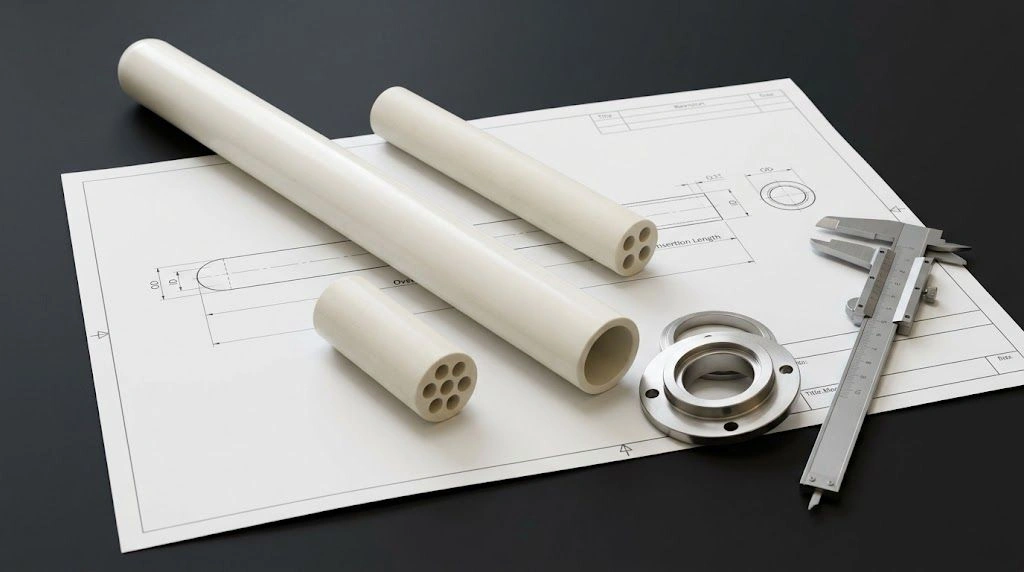
Typical SiC component forms show the grade-selection logic: SSiC is favored for precision-ground sealing and chemical-service parts, while RBSiC or SiSiC often fits larger near-net-shape furnace and kiln components.
SSiC-first applications: seals, bearings, high-purity fluids, severe corrosion. For mechanical seals, pump bearings, heat-exchanger tubes in aggressive acid service, precision nozzles, and any application where the process fluid is chemically aggressive or purity-sensitive, SSiC should be the default starting grade. The silicon carbide mechanical components page at ADCERAX covers seal faces, nozzles, bearings, and custom precision components across SSiC and RBSiC grades, providing the product-level context for these applications.
RBSiC/SiSiC-first applications: large shapes, kiln parts, structural furnace components. For kiln rollers, beams, large radiant tubes, setter plates, and burner nozzles where shape complexity and size dominate the manufacturing challenge — and where the service atmosphere does not aggressively attack the silicon phase — RBSiC/SiSiC is typically the more practical and cost-effective starting point. The silicon carbide tube range at ADCERAX covers both SSiC and RBSiC tube forms, allowing grade-based routing within the same product family. The SiC liner tube covers the RBSiC/SSiC liner application for abrasive and corrosive slurry service, where the trade-off between chemical resistance and cost is a frequent engineering decision.
What RFQ data should be sent for SiC grade selection?
After working through the grade selection logic, the RFQ must communicate enough information for the supplier to confirm the grade, propose dimensions and tolerance, and support qualification testing.
The Misdiagnosis Matrix first maps the most common grade selection errors to better diagnostic questions:
| Observed problem | Common wrong diagnosis | Better engineering question |
|---|---|---|
| Part corrodes in acid service | ""SiC is not corrosion-resistant"" | Was the grade RBSiC/SiSiC with free silicon exposed to aggressive chemistry? |
| Large part quote is expensive in SSiC | ""Supplier is overpriced"" | Does the geometry actually require SSiC, or would RBSiC/SiSiC be valid? |
| Seal face wears unevenly | ""Need thicker component"" | Is the grade dense enough and ground to the right flatness/finish? |
| Furnace beam cracks | ""Need SSiC automatically"" | Is thermal shock, support design, or span the root issue? |
| Heat-exchanger tube fails early | ""Wrong SiC grade only"" | Did flow, seal, thermal shock, fouling, or tube-sheet stress also contribute? |
| Supplier offers SiSiC instead of RBSiC | ""Different material entirely"" | Are they using SiSiC and RBSiC as the same silicon-infiltrated family, and what is the free-silicon content? |
A complete SiC grade-selection RFQ should include: application type, component drawing, target grade if known, operating temperature, atmosphere, process medium or chemical family, pH if relevant, flow velocity and abrasive particle content, mechanical load and sliding or wear condition, thermal cycling profile, dimensional tolerances, surface finish requirements, quantity for prototype and production, required inspection data, and whether residual silicon or free silicon is acceptable in the microstructure. This last point — free-silicon acceptance — is the most important single addition to a SiC RFQ because it forces the grade question to be answered explicitly rather than left to supplier default.
Ask suppliers to confirm the material route — pressureless sintered SSiC, reaction-bonded RBSiC, silicon-infiltrated SiSiC, or NBSiC — and request: density or open porosity data, free-silicon content or composition statement where available, flexural strength, hardness, thermal conductivity reference, maximum-use temperature by atmosphere, chemical-compatibility guidance for the specific process medium, dimensional inspection report, and lot traceability. For applications where corrosion resistance is critical, also request any prior immersion or service data in comparable media before specifying the grade as production-qualified.
Choosing between SSiC, RBSiC, and SiSiC for a custom component or tube? Share your drawing, application type, operating temperature, atmosphere, process medium, wear condition, load, thermal cycling, tolerance, and whether residual silicon is acceptable. ADCERAX can review whether SSiC or RBSiC grade best fits the service envelope and propose a grade confirmation with material data before full RFQ.
Frequently Asked Questions
Is RBSiC the same as SiSiC?
In most industrial supplier catalogs, yes — the two terms often describe the same silicon-infiltrated reaction-bonded SiC material family. However, some suppliers use them for slightly different compositions or infiltration levels, so buyers should confirm free-silicon content, porosity, maximum-use temperature, and composition when the grade is listed as SiSiC rather than RBSiC.
Which grade is best for chemical corrosion?
SSiC is generally the first choice for aggressive chemical corrosion because it is denser, higher purity, and contains no free-silicon phase that could be selectively attacked by acids, alkalis, or oxidizing agents. Schunk's published SiC material characterization confirms SSiC's strong chemical-corrosion resistance as a primary application advantage.
When should RBSiC or SiSiC be selected instead of SSiC?
Choose RBSiC or SiSiC when the part is large, complex in geometry, cost-sensitive, or near-net-shape manufacturing is more practical than sintering and grinding, and when the service atmosphere and temperature do not aggressively attack the residual silicon phase. CeramTec specifically notes SiSiC's suitability for complex large-volume components.
Which grade is better for mechanical seals?
SSiC is the preferred grade for mechanical seals and pump bearings in most chemical service environments because dense structure, zero free silicon, strong chemical stability, and precision-ground seal-face flatness are all required for reliable long-term seal performance.
Which grade is better for kiln rollers and large furnace parts?
RBSiC or SiSiC is typically practical for kiln rollers, beams, radiant tubes, burner nozzles, and large furnace furniture because the near-net-shape forming capability allows large, complex parts at lower cost and shorter lead time. SSiC may be specified instead if the kiln atmosphere is chemically aggressive, if contamination from residual silicon is unacceptable, or if precision grinding requirements dominate.
Why does residual silicon matter in SiC ceramics?
Residual silicon in RBSiC/SiSiC has a much lower melting point, chemical resistance, and high-temperature strength than the SiC matrix itself. Published ScienceDirect research confirms that this residual silicon is inevitable in traditional reaction-bonded SiC and can be the limiting factor in applications involving higher-temperature service or aggressive corrosion.
What should be included in an SiC grade-selection RFQ?
Include application type, component drawing, target grade if known, operating temperature, atmosphere, process medium or chemical family, pH, abrasive content, mechanical load, sliding or wear condition, thermal cycling, tolerances, surface finish, quantity, inspection requirements, and whether residual silicon is acceptable in the microstructure.
"