Silicon carbide liners are used in slurry transport when hard particles, high velocity, corrosive liquid chemistry, and repeated erosion make metal, rubber, or lower-hardness ceramic liners wear too quickly. They are most useful at pump flow paths, elbows, cyclone cones, liner tubes, and high-wear zones where abrasive particles strike or slide against the surface. Selection depends on particle size, particle hardness, solids concentration, velocity, impact angle, fluid chemistry, temperature, liner thickness, backing support, and installation method. SiC is not the automatic choice for all slurry services: the wear mechanism, particle behavior, and liner geometry must be defined before a material is specified.
Product context for the selection decisions in this guide: silicon carbide liner tubes for abrasive and corrosive flow environments (SSiC, RBSiC, and SiSiC grades for slurry transport, corrosive chemical media, and high-wear pipeline and equipment applications), plus drawing·particle·velocity·angle RFQ. Note the diversion: a porous SiC hot-gas candle filter is not a dense slurry wear liner; a liquid SiC membrane for liquid-separation/MBR duty is not a slurry pipe or cyclone liner; a pump seal face is not a replaceable slurry liner tube.

Silicon carbide liners provide high hardness and chemical resistance in hard-particle slurry transport service — performance depends on matching SiC grade, liner thickness, backing support, joint layout, and installation to the specific slurry wear mode and equipment geometry.
When are silicon carbide liners suitable for slurry transport?
SiC liners belong in slurry transport when the combination of particle hardness, fluid corrosion, flow velocity, and localized wear exceeds what metal, rubber, or alumina can provide reliably within an acceptable replacement interval.
Published-research context on wear resistance of materials for slurry transport confirms that slurry-transport systems face severe wear and that different wear modes — including slurry jet erosion, Coriolis slurry scouring erosion, and sliding abrasion — must be simulated and evaluated separately. Liner material selection for slurry transport therefore requires identifying the dominant wear mechanism rather than simply choosing the hardest available material.
High-wear slurry pipelines, elbows, cyclones, and pump flow paths. The clearest use cases for SiC liners in slurry transport are concentrated erosion zones: the outer radius of pipe elbows where particle streams impinge, cyclone cone and apex zones where centrifugal forces concentrate the particle load against the liner surface, pump casing wear plates and throat bushings where high-velocity slurry transitions from impeller to volute, and straight liner tube sections in mineral processing, power-plant slurry systems, or tailings pipelines. Third-party published context (Chemshun and similar industrial application notes) describes SiC cyclone liner use in mining, ore crushing, screening, powder and slurry conveying, mineral processing, and power-plant wear conditions — reflecting a real industrial base for SiC liner deployment; confirm duty on RFQ rather than treating any third-party narrative as a site-specific case study.
SiC liner tubes are positioned for abrasive, corrosive, and high-temperature flow environments including slurry transport, corrosive chemical media, and fiber-laden or particulate-rich flow systems — confirm grade·geometry·backing on RFQ.
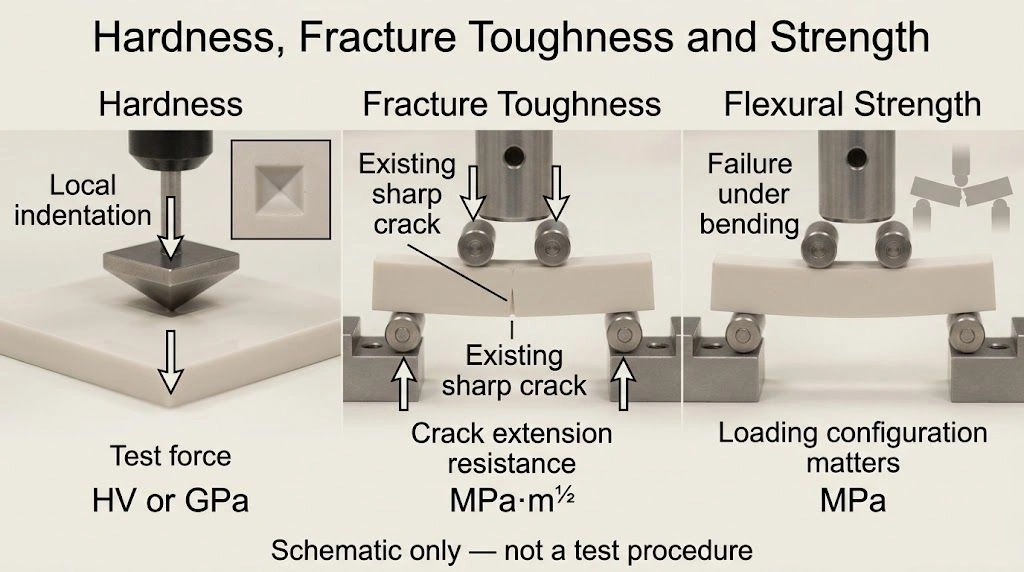
Why SiC liner selection starts with wear mechanism, not material hardness alone. As published-range / grade-typical context (not a contract hardness SLA): SiC Vickers hardness is often cited in the approximate 2000–2500 HV band depending on grade, which is significantly above alumina ranges commonly cited around 1500–1800 HV and far above rubber or metal liners — confirm grade·HV/HK standard on RFQ; do not treat these figures as a factory acceptance limit. Hardness alone does not predict liner life in slurry service because the dominant wear mode — sliding abrasion, jet impingement, or corrosion-assisted erosion — changes which material property matters most. A SiC liner selected for sliding abrasion in a fine mineral slurry will behave differently from the same liner in a coarse rock chip flow with high impact energy. Defining the wear mode before selecting the material is the engineering priority.
What slurry variables control SiC liner performance?
After confirming SiC is a candidate material, the specific slurry and flow variables that determine actual liner service life must be audited systematically.
Particle size, hardness, solids concentration, and velocity. The four most critical variables in slurry liner selection are particle hardness relative to the liner surface, particle size distribution, solids concentration, and flow velocity. Published IRJET slurry pump wear research confirms that wear depends strongly on particle hardness, concentration, impact angle, rotational speed, hydraulic design, and material selection. Particles harder than the liner surface cause cutting wear regardless of the liner's absolute hardness. Larger particles at the same velocity carry more impact energy. Higher solids concentration reduces the distance between particle-surface contacts. Higher velocity exponentially increases erosion energy — as published-model context / screening language, published erosion models show velocity exponents typically between 2 and 4 for ceramics in slurry erosion, meaning doubling the velocity can roughly quadruple the wear rate under the modeled assumptions; confirm slurry RFQ (PSD·velocity·angle·chemistry). Do not treat any unverified life formula as a site guarantee.
Impact angle and corrosion decide where SiC liner needs reinforcement. Impingement angle is the other critical variable. At low angles — below 30° — fine particles erode surfaces through a plowing and cutting mechanism where hardness is the dominant protective property, and SiC performs strongly. At high angles — above 60° to 90° — coarser particles strike the surface with maximum normal force, and toughness and backing support become more important than pure hardness. This is why elbow outer radii often show concentrated wear at high impact angles, and why cyclone cone liners in some applications show different wear patterns at the top versus the apex. The liner design — thickness at the peak impingement zone, backing support thickness, and joint positioning — must account for the local angle map.
Corrosion adds another dimension. When the slurry liquid is acidic, alkaline, or contains oxidizing species, corrosion can accelerate surface degradation by removing the protective surface layer between particle impacts. SiC resists this combined erosion-corrosion mechanism better than most metals and many ceramics in the pH range where both mechanical and chemical attack are active simultaneously.
When should rubber, alumina, metal, polyurethane, or composite liners be used instead?
After mapping where SiC excels, the practical alternatives must be defined — because SiC is not the best engineering choice for every slurry service.
The SiC vs Alternative Slurry Liner Materials comparison table maps the main options:
| Liner option | Best fit | Main advantage | Main limitation |
|---|---|---|---|
| SiC liner | Hard-particle abrasion + corrosion | High hardness and chemical resistance | Brittle under unsupported impact |
| Alumina liner | Moderate to severe abrasion | Proven wear ceramic, broad availability | Lower thermal shock/toughness margin than SiC |
| Rubber liner | Large impact and cushioning | Absorbs impact, reduces noise | Sensitive to heat, cutting particles, some chemistries |
| Polyurethane liner | Flexible wear protection | Good field-friendly wear solution | Temperature and chemical limits |
| High-chrome metal | Impact + structural duty | Tougher, easier to integrate with metal systems | Corrosion and abrasion limits by slurry |
| Composite ceramic-rubber | Abrasion + impact combination | Balances hard surface and backing support | Complex installation and joint design |
Use SiC when hard-particle wear and corrosion dominate. SiC is the most defensible choice when the slurry carries hard mineral particles — quartz, silica, alumina, carbide fines — at high velocity in an environment that also has pH-driven corrosion. The combination punishes both the mechanical and chemical resistance of most alternatives while SiC can address both simultaneously.
Use rubber, metal, or composite liners when impact, flexibility, or site repair dominates. Rubber and polyurethane liners can be better choices when large particles — illustratively greater than about 20–30 mm as an engineering boundary — carry significant kinetic energy at low velocity and moderate angle, because the elastic deformation of rubber absorbs impact energy rather than resisting it with hardness; confirm PSD·velocity·angle on RFQ rather than treating this as an absolute switching table. Published slurry pipeline liner selection guidance confirms that rubber liner sensitivity to particle size in severe applications means coarse slurry at moderate velocity may be better served by rubber's cushioning behavior than by ceramic hardness. High-chrome metal or overlay systems remain practical where structural continuity, field welding, and mechanical strength under bending or impact load are required alongside wear protection. Composite ceramic-rubber liners offer a hybrid option for applications that fall between the clear cases.
Published-research context (WJAETS and related slurry erosion literature) confirms that erosion wear depends on surface properties, solid particle properties, slurry flow characteristics, and geometric impact conditions — reinforcing that liner selection is a system matching problem, not a single-variable hardness decision. Engineering points that matter in practice: dense microstructure and low porosity help reduce material removal under turbulent particulate flow, and liner geometry, backing support, and joint layout must be designed together with material grade.
The SiC Liner Suitability Matrix for Slurry Transport maps the service conditions:
| Service condition | SiC liner fit | Why | Watch-out |
|---|---|---|---|
| Hard mineral slurry | Strong | High hardness resists abrasive particle wear | Check particle impact energy and support |
| Corrosive slurry | Strong to conditional | SiC combines wear and chemical resistance | Confirm pH, temperature, and grade |
| High-velocity elbow | Strong to conditional | SiC can protect concentrated erosion zones | Edge/joint layout must avoid exposed gaps |
| Cyclone cone/apex | Strong | Localized wear and particle impingement dominate | Geometry and thickness uniformity matter |
| Large-particle impact | Conditional | Hard surface resists cutting wear | Rubber/composite backing may be needed |
| Low-impact fine slurry | Conditional | May be more durable than metal | Alumina or polyurethane may be more economical |
| Field-welded pipe repairs | Weak to conditional | Ceramic cannot be welded like metal liners | Use modular or mechanically fixed liner design |
| High thermal shock + slurry | Conditional | SiC has thermal-shock advantages over many ceramics | Support and ramp conditions still matter |
Values indicative. Verify with slurry wear testing, supplier SiC grade data, and project-specific flow conditions.

SiC slurry liner selection should start with the dominant wear mechanism and service condition, then combine grade selection, liner geometry, backing support, and joint design instead of relying on hardness alone.
The silicon carbide mechanical components range frames SiC liner structures as operating in particulate-rich pipelines where dense microstructure and low porosity help reduce material removal under turbulent flow. The silicon carbide sleeve category covers related sleeve and bushing forms for abrasive media protection. For duty-specific particle·velocity·angle confirmation, use a custom RFQ.
What failure modes occur when SiC liners are mis-specified or installed incorrectly?
Many SiC liner failures in slurry service are system-design or installation failures, not material failures. The correct diagnosis determines whether the fix is a material change, a geometry change, a support design change, or an operating condition review.
Published-research context on slurry erosion confirms that wear depends on surface properties, solid particle properties, slurry flow characteristics, and geometric impact conditions. In abrasive slurry pipelines, dense microstructure and low porosity help turbulent-flow wear resistance — so liner geometry, backing support, and joint layout must be designed together with material grade as part of the system wear-protection strategy.
Edge wear, joint exposure, and unsupported impact. The most common SiC liner failure mode is accelerated wear at tile or segment edges and joint lines, not through the center of the liner face. Particle streams in slurry flow are never perfectly uniform: turbulent eddies, flow separation at elbows, and secondary flows concentrate particle impact at geometrically exposed locations. If the liner segment layout places a joint line directly in the peak impingement zone, the exposed edge or adhesive interface becomes the failure point — not the SiC material itself.
Adhesive, backing, and segmented-layout problems. When SiC liner tiles or segments are adhesive-bonded to a metal substrate, the adhesive and backing layer must be chemically compatible with the slurry liquid that inevitably seeps through or around the liner. Acidic or alkaline slurry that contacts a pH-incompatible adhesive will delaminate the liner faster than mechanical wear. Similarly, a stiff metal backing that cannot flex with thermal expansion differences between the liner and the structure can introduce bending stress that fractures the brittle ceramic. The liner system design — not just the SiC grade — determines service life.
The Misdiagnosis Matrix maps observed liner failures to better diagnostic questions:
| Observed problem | Common wrong diagnosis | Better engineering question |
|---|---|---|
| Wear at liner joints | "SiC is wearing too fast" | Are gaps or exposed edges concentrating particle impact? |
| Ceramic tile breaks loose | "SiC adhesion is poor" | Was backing, adhesive, surface prep, or thermal/chemical compatibility correct? |
| Local hole near elbow outer radius | "Need thicker liner everywhere" | Is the impingement zone under-protected or poorly mapped? |
| Cracking after startup | "SiC is too brittle" | Was there unsupported impact, mechanical constraint, or thermal shock? |
| Rapid wear with coarse particles | "Need harder ceramic only" | Does the system need impact-absorbing backing or lower velocity? |
| Corrosion under liner | "Slurry chemistry changed" | Did liquid penetrate joints or backing layers? |
Wear mapping — photographing and measuring the remaining liner thickness at multiple points across the wear surface — provides the diagnostic data needed before any material, thickness, or layout change.
What RFQ data should be sent for SiC slurry liners?
The Slurry Variables Table maps the information required before a SiC liner can be quoted accurately:
| Variable | Why it matters | Required in RFQ? |
|---|---|---|
| Particle size distribution | Determines cutting, impact, and blockage risk | Yes |
| Particle hardness | Controls abrasive severity against liner surface | Yes |
| Particle shape/angularity | Angular particles cut more aggressively | Recommended |
| Solids concentration | Changes wear rate and flow behavior | Yes |
| Flow velocity | Raises erosion energy and local wear | Yes |
| Impact angle/impingement zone | Determines where liner sees peak erosion | Yes |
| Liquid chemistry/pH | Adds corrosion or erosion-corrosion risk | Yes |
| Temperature | Affects chemistry, backing, and adhesive system | Yes |
| Equipment geometry | Elbows, cyclones, pumps, and chutes wear differently | Yes |
| Fixing method | Adhesive, mechanical lock, or segmented support changes reliability | Yes |
| Inspection access | Determines replacement strategy and wear mapping | Recommended |

SiC slurry liner RFQs should define the actual liner form — straight liner tube, elbow liner, cyclone cone liner, or flat wear tile — because geometry, fixing method, backing support, and joint layout directly affect service life.
A complete SiC slurry liner RFQ should include: equipment type and liner location, liner form with drawing, slurry liquid chemistry and pH, temperature, solids concentration, particle size distribution, particle hardness, particle shape, flow velocity, impact angle or impingement zone description, pressure, cycling, cleaning method, liner thickness target, backing material, fixing method, joint layout, wear allowance, and replacement strategy. For SiC grade selection, ask whether SSiC, RBSiC, SiSiC, or NBSiC is recommended for the specific combination of abrasion, corrosion, impact, and geometry.
Ask the supplier to confirm density and porosity for the proposed SiC grade, indentation hardness (HV/HK) with the applicable grade and test standard, dimensional inspection report, surface finish, thickness tolerance, joint detail, packaging, and prior application experience with similar slurry service. If replacing a failed liner, provide photos of the worn surface with measurements of remaining thickness at the peak wear location — this is the most useful single input for confirming whether the failure was a material, design, or installation problem.
Evaluating SiC liners for slurry transport equipment? Share your equipment type, slurry composition, particle size, solids concentration, velocity, pH, temperature, equipment geometry, current liner material and failure mode, and target replacement interval via custom RFQ. A supplier can then screen whether SSiC, RBSiC, or SiSiC liner tubes, cyclone liners, or custom wear components fit the wear environment — confirm particle·velocity·angle·chemistry on RFQ; turnaround depends on inquiry complexity — no commitment required at this stage.
Frequently Asked Questions
Are silicon carbide liners suitable for slurry transport?
Yes, SiC liners are suitable when slurry transport involves hard particles, high velocity, corrosion, and concentrated erosion zones. They are especially useful in elbows, cyclone cones, pump flow paths, liner tubes, and high-wear pipe sections. Published research confirms that slurry transport systems face severe wear and that different erosion modes must be matched to appropriate materials — confirm duty on RFQ.
What causes slurry liner wear?
Slurry liner wear is controlled by particle hardness, particle size, solids concentration, velocity, impact angle, fluid chemistry, equipment geometry, and material selection. Published slurry erosion research identifies different wear modes — sliding abrasion, jet erosion, scouring erosion, and erosion-corrosion — each of which responds differently to liner material properties.
Is SiC better than alumina for slurry liners?
As screening language from published-range / grade-typical hardness context (not a contract hardness SLA): SiC can be better when the slurry combines hard-particle abrasion with corrosion, thermal shock, or high-velocity erosion, because SiC is commonly cited at higher hardness bands than alumina and often offers stronger chemical and thermal-shock margins in demanding combined-loading environments — confirm grade·HV/HK standard on duty RFQ. Alumina may be more practical for many moderate to severe abrasion cases where corrosion and thermal shock are less demanding and where cost or availability favors it.
When should rubber or polyurethane liners be used instead of SiC?
As screening language / illustrative engineering boundary (not an absolute switching table): rubber and polyurethane liners are often better when large particles — typically above about 20–30 mm — carry significant kinetic energy at relatively low velocity, where elastic deformation provides better impact absorption than ceramic hardness; confirm PSD·velocity·angle on duty RFQ. Published liner selection guidance confirms that rubber sensitivity to cutting particles in severe slurry means coarse slurry at moderate velocity may be better served by rubber's cushioning behavior than by SiC hardness alone.
Related reading
- SiC vs metal pump internals — When the duty is rotating SiC vs metal pump internals performance, not replaceable slurry pipe/cyclone liners
- SiC mechanical seal rings — When face-seal life (SiC mechanical seal rings) gates the pump RFQ rather than static slurry liner tubes
- Chemical-pump SiC seal rings — When chemical-pump seal-ring grade/fit is the RFQ bottleneck, not elbow/cyclone liner wear mapping