If you need one simple rule: start with Al₂O₃ for general-purpose ceramic parts, move to ZrO₂ when fracture toughness and low thermal conductivity matter most, move to SiC when heat transfer, wear, low thermal expansion, gas tightness, or very high-temperature process duty dominate, and move to BN when machinability, non-wetting behavior, electrical insulation, and thermal shock matter more than mechanical strength.
For a cross-family overview before you lock a grade, use the ADCERAX ceramic materials hub.
3-minute decision: Default to Al₂O₃ when no single constraint dominates. Escalate to ZrO₂ when fracture toughness / crack resistance (and low thermal conductivity) dominate. Escalate to SiC when heat flow, wear, low CTE, and high-temperature process duty dominate together. Switch to BN only when machinability + non-wetting + high-temperature electrical insulation are the real buying reasons — not when structural load is primary. Use the property table and wrong-choice section below to confirm; then lock the exact ADCERAX grade on the materials hub or the matching product family page.
That rule holds across most standard advanced-ceramic applications, and the four materials in this guide are best understood as four different answers to four different dominant engineering problems — not as a strength ranking or a price tier.
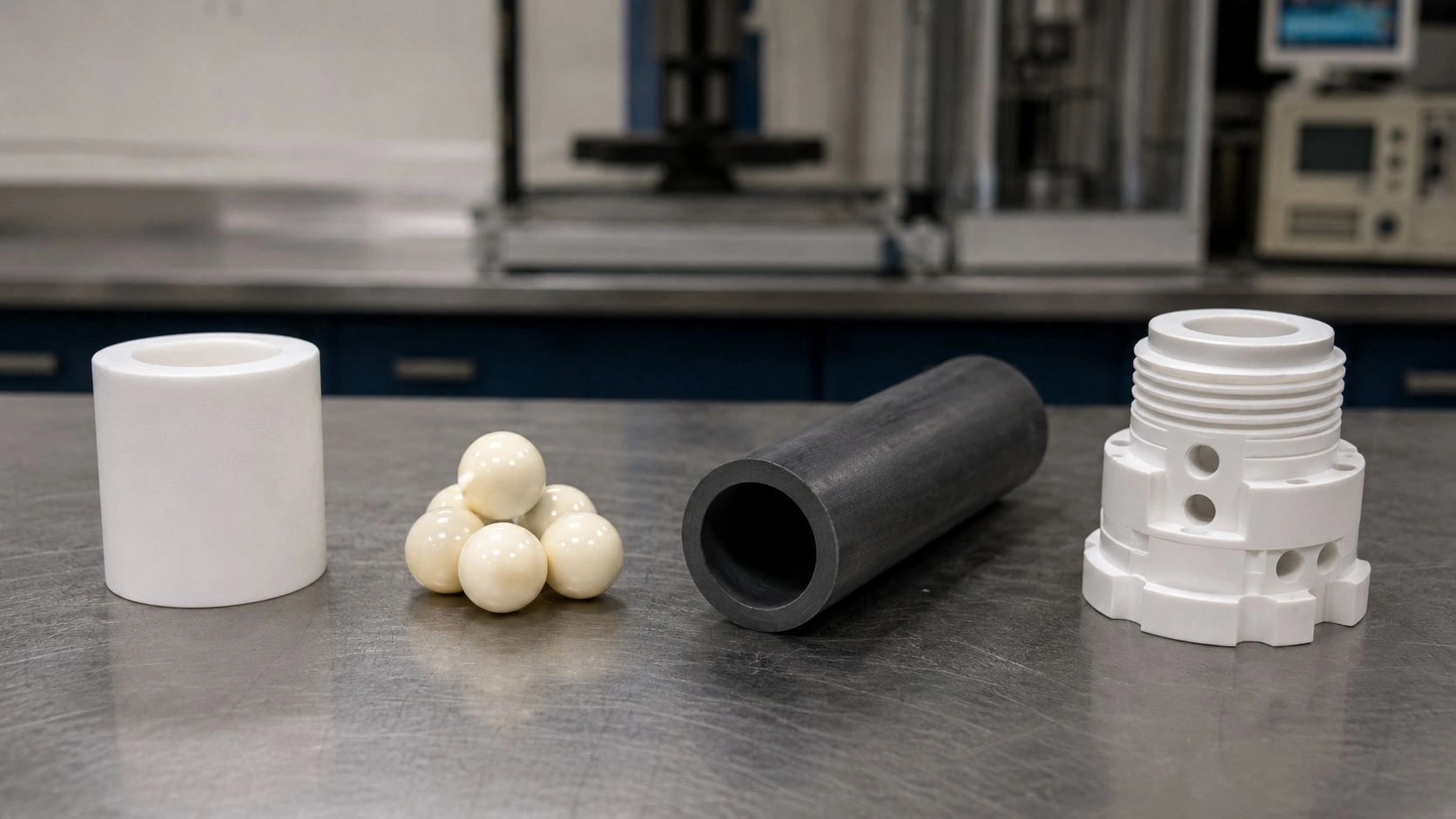
Four advanced ceramic materials, four different dominant design problems: Al₂O₃ for general-purpose baseline, ZrO₂ for toughness, SiC for high-temperature process duty and heat flow, BN for machinable non-wetting insulation.
The alumina crucibles and alumina component family represent the broad-baseline role in this guide, while boron nitride ceramic grades, silicon carbide ceramics, and zirconia crucible options each occupy their specific positions in the selection map below.
What each ceramic is really best at
A selection matrix is only useful if it connects material properties to engineering problems rather than simply listing numbers. The four materials in this comparison are each best understood through the constraint they were designed to solve, not through a single ranked property.
Al₂O₃ — the baseline engineering ceramic. Alumina is the most commonly used technical ceramic because of its generally useful combination of properties and good price/performance ratio. ADCERAX alumina grade tables (AD-ALU C795/C799 family) show a useful combination of wear/corrosion resistance, electrical insulation, and long-term temperature selection ceilings that cover most general industrial ceramic duties — without needing a single “best” hardness number as the selection driver. It is the right starting point for electrical insulators, wear parts, guides, pump seats, simple protection tubes, and general industrial components. It stops being the obvious choice when the design is limited by crack resistance, impact loading, severe thermal shock, or very high heat-flow requirements.
ZrO₂ — the toughness specialist. Zirconia is the choice when a ceramic needs to resist crack initiation and propagation more than any other ceramic in this set. In ADCERAX TDS terms, dense structural 3Y-TZP (AD-ZRO-3Y) is the first-look structural family: typical flexural strength about 800–1000 MPa, fracture toughness about 7.2–9.0 MPa·m½ (method-sensitive), density about 6.00–6.08 g/cm³, and thermal conductivity around 3 W/(m·K) at 20 °C. Mg-PSZ can show higher toughness ranges in the same TDS family, but temperature capability remains stabilizer- and duty-dependent — do not transfer a refractory crucible service temperature onto a dense structural grade. Zirconia is strongest for impact-prone, crack-sensitive, wear-loaded, or thermally insulating precision parts. It is less attractive when low weight, high heat transfer, or the highest continuous structural furnace route are the main priorities.
SiC — the process-route material. Silicon carbide is what you move to when the design problem is dominated by heat, heat flow, wear, low expansion, chemical resistance, and process stability simultaneously. For dense sintered SiC, ADCERAX TDS AD-SIC-SS gives a typical bulk density about 3.10 g/cm³, flexural strength about 380 MPa (selection typical), and thermal conductivity about 100–120 W/(m·K) for preliminary ambient selection — with an application-temperature ceiling around 1600 °C for initial material selection (RBSC/SiSiC about 1380 °C). These ceilings are not continuous loaded-service life ratings; atmosphere, load, dwell, and retained properties must be defined on the RFQ. That combination makes SiC the dominant route in process tubes, thermocouple protection tubes, heat exchanger tubes, seals, nozzles, wear liners, and corrosive high-temperature service. It is not the best choice when easy machining after firing or fracture toughness under impact are the first limiting constraints. Do not reuse dense SSiC/RBSC numbers for porous NBSiC or RSiC.
BN — the specialist's ceramic. Boron nitride should be chosen for its combination of properties rather than for any single mechanical rating. Relative to alumina, zirconia, and SiC, hot-pressed BN is a low-strength specialist: ADCERAX TDS AD-BN-HP lists typical bulk density about 1.98 g/cm³ and flexural strength about 35 MPa (3-point screening); porous high-purity BN (AD-BN-HC) is about 20 MPa, while BN–AlN composite (AD-BN-AN) can reach about 120 MPa when a composite route is justified. Thermal conductivity screening values are orientation- and grade-dependent (about 50 W/(m·K) for AD-BN-HP screening; about 80 for AD-BN-AN) — not isotropic design constants. What BN provides instead is machinability with conventional tooling, non-wetting behavior toward many molten metals and slags, excellent electrical insulation at high temperature, and strong thermal-shock usefulness in the right duty. Do not treat a manufacturing temperature or ceramic material ceiling as a continuous air or inert loaded-life rating — define atmosphere, section, and retained-property endpoints on the RFQ. BN is ideal for hot electrical insulators, molten-metal-contact parts, non-wetting liners, setter plates, and fast-turn custom parts. It is the wrong default for structurally loaded parts, high-contact-stress wear components, or any application selected primarily for strength.
Alumina is the safest default starting point
The engineering case for alumina as the default is not that it is best at any single property — it is that it is adequate across the most properties simultaneously for the widest range of applications. When no single constraint is dominant, alumina is almost always the correct first choice.
BN's specialist combination is its advantage, and also its main selection risk
The risk with BN is not that engineers overlook its properties — it is that its machinability and non-wetting reputation can lead to it being specified for applications where structural loading is the real constraint. The property spread between BN and the other three materials in this set is large enough that mixing up their application roles creates real performance failures.
Representative property data by material
The table below summarizes representative values from sampled current manufacturer datasheets. These are not universal values for every grade of each material — they are a calibrated starting point for shortlisting.
| Material | Representative density | Flexural strength | Fracture toughness | Thermal conductivity | Max-use clue (ADCERAX TDS) | What that usually means |
|---|---|---|---|---|---|---|
| Al₂O₃ (AD-ALU grades) | ≈3.75–3.94 g/cm³ (grade) | ≈280–350 MPa (20 °C typical) | ≈3.0–4.2 MPa·m½ (method-dependent) | ≈18–42 W/(m·K) @25 °C | Long-term temperature selection ≈1400–1750 °C by grade (not a loaded-life rating) | Best baseline for general technical ceramics, wear, insulation, and cost/performance |
| ZrO₂ (3Y-TZP example) | ≈6.00–6.08 g/cm³ | ≈800–1000 MPa | ≈7.2–9.0 MPa·m½ (method-sensitive) | ≈3 W/(m·K) @20 °C | Qualify by stabilizer, atmosphere, load, and cycling — do not transfer refractory service temps onto dense structural grades | Best when toughness, crack resistance, and thermal insulation dominate |
| SiC (SSiC AD-SIC-SS example) | ≈3.10 g/cm³ typical | ≈380 MPa (selection typical) | Specify method on RFQ (not a first-look discriminator vs ZrO₂) | ≈100–120 W/(m·K) (ambient selection) | Application-temperature ceiling ≈1600 °C initial selection (RB ≈1380 °C); not continuous loaded life | Best for high heat flow, wear, low CTE, corrosive high-temp process duty |
| BN (HP AD-BN-HP example) | ≈1.98 g/cm³ typical | ≈35 MPa screening (porous ≈20; BN–AlN ≈120) | Not the primary selection criterion | ≈50 W/(m·K) screening (orientation-dependent; composite ≈80) | Atmosphere-specific; manufacturing/material ceilings ≠ continuous air/inert life | Best for machinable non-wetting insulating parts — not for heavy structural loading |
Values are representative ADCERAX technical-data-sheet selection figures for the named grade families (alumina C795/C799 AD-ALU; zirconia AD-ZRO; SiC AD-SIC; BN AD-BN). They are not component design allowables — verify the exact ordered grade, specimen method, and duty before specifying.
The property spread across these four materials is large enough that specifying the wrong material family — not just the wrong grade — creates real performance and failure risk. The most dangerous confusion is between BN and the structural ceramics, because BN's approachability (machinability, low weight) can make it feel like the obvious choice in situations where alumina, zirconia, or SiC would be structurally necessary.
The numbers point to four genuinely different use cases
A material with roughly 100–120 W/(m·K) ambient thermal conductivity (dense SSiC) and a material with roughly 3 W/(m·K) (3Y-TZP) are not competing for the same application. The same is true for a material with fracture toughness in the ~7–9 MPa·m½ band (3Y-TZP) versus hot-pressed BN with flexural strength around ~35 MPa screening. The property table is not a ranking — it is a map of four different engineering tools.
Thermal conductivity is often the most important single separator in this group
When a design problem requires heat to move through the ceramic (heat exchanger tubes, heating element protection, thermocouple sheaths), SiC is in a different category from the other three. When a design problem requires heat not to move through the ceramic (thermal barrier, insulating precision component), ZrO₂ is in a different category. Alumina and BN both occupy mid-range positions that make them versatile for different reasons.
The most common wrong choices in this material set
Four specification errors appear most often when engineers work through this comparison for the first time. Each one is predictable from the property table above.
Using BN as a general structural ceramic. BN machines easily and handles heat well — those properties attract engineers who need fast, temperature-stable parts. But BN's mechanical screening values in ADCERAX TDS are substantially lower than alumina, zirconia, and dense SiC. If the part carries significant structural load or contact stress, BN is a specialist route, not a default. The correct framing is: if the part needs to be non-wetting, machinable, and electrically insulating at high temperature, BN is often the only answer. If the part needs to be strong, the conversation should start with alumina.
Using ZrO₂ for the hottest process routes just because it is tough. Zirconia is the toughness leader in this comparison, but that does not make it the best high-temperature process material. Usable temperature limits for zirconia vary substantially by stabilization route and grade, and the lowest values in published YSZ datasheets can be well below alumina's practical limits. ZrO₂ is strongest as the toughness-and-insulation specialist. SiC is stronger as the high-temperature process-tube route when heat transfer, gas tightness, and chemical resistance at 1000°C+ are the governing requirements.
Using Al₂O₃ when the design is really limited by thermal shock or heat flow. Alumina is the right default more often than not, but it is not the answer when the design is thermally limited. Moderate thermal conductivity and moderate fracture toughness mean alumina underperforms relative to SiC in heat-flow-dominated duties and relative to ZrO₂ in shock/impact-dominated duties. When a component is failing in alumina because of cracking or insufficient heat transfer, the better question is "should this be SiC or ZrO₂?" rather than "can we find a better alumina grade?"
Using SiC where easy machining or prototype speed matter most. SiC's density and fired hardness make it difficult to machine after firing. In situations where complex geometry needs to be revised quickly or where small production quantities make custom pressing uneconomical, BN's full machinability with conventional tooling is a practical advantage — even though BN is weaker. The use case is hot insulators, melt-contact inserts, and non-wetting precision parts where the geometry matters more than the load-bearing requirement.
The selection rule that prevents all four errors: default to alumina, escalate to zirconia for toughness, escalate to SiC for process heat and wear, and switch to BN only when its special combination of machinability, non-wetting, and insulation is the real reason for buying ceramic at all.
When the decision clearly flips between materials
The Best-Fit Decision Matrix below translates the four material profiles into explicit selection triggers:
| If the dominant requirement is… | Best first-look material | Why | Main watch-out |
|---|---|---|---|
| General-purpose engineering ceramic with good cost/performance | Al₂O₃ | Most commonly used technical ceramic; broadly useful properties and good price/performance ratio | Toughness is only moderate; not the best shock or impact ceramic |
| Highest fracture toughness among common engineering ceramics | ZrO₂ | ≈7.2–9.0 MPa·m½ and ≈800–1000 MPa flexural for AD-ZRO-3Y typical selection; significantly tougher than alumina grade bands | High density; low thermal conductivity; temperature limit is grade-dependent |
| High thermal conductivity + high-temperature structural process duty | SiC | ≈100–120 W/(m·K) ambient selection conductivity; dense/gas-tight grades available; low CTE; AD-SIC-SS application-temperature ceiling ≈1600 °C for initial selection (qualify duty) | Hard to machine after firing; toughness lower than zirconia |
| Machinable, non-wetting, electrically insulating hot part | BN | Machinable with conventional tools; non-wetting to most molten metals and slags; high-temperature insulator | Mechanical properties are relatively poor versus the other three |
| Wear + corrosion + dimensional stability at moderate-to-high temperature | Al₂O₃ or SiC | Alumina: strong wear/corrosion at lower cost; SiC: adds much better heat flow and higher process temperature | Pick SiC when heat flow or thermal shock matter; pick alumina when cost and generality matter more |
| Thermal insulation plus crack resistance | ZrO₂ | Very low thermal conductivity (≈3 W/(m·K) @20 °C for 3Y-TZP) combined with much higher fracture toughness than alumina | Not the obvious choice for the hottest sustained structural furnace route unless the grade supports it |
Representative guidance based on sampled manufacturer data; verify exact grade capabilities with supplier before finalizing specification.
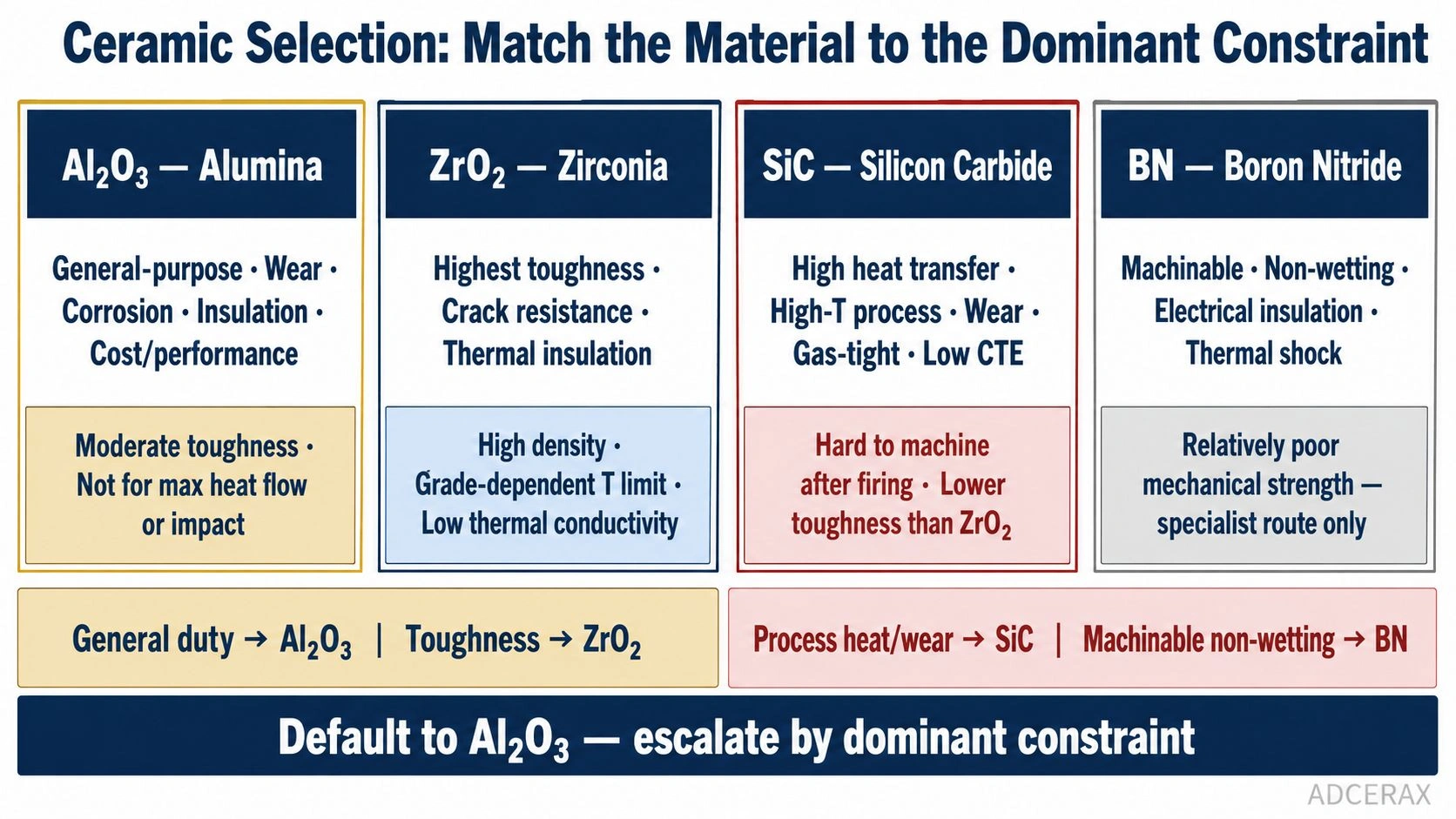
The four dominant engineering requirements that separate Al₂O₃, ZrO₂, SiC, and BN are not a ranking — they are a map of four different design problems with four different answers.
The plain-English summary
Al₂O₃ is the safest default starting point. ZrO₂ is the tough one. SiC is the hot, hard, thermally conductive process material. BN is the machinable specialist for non-wetting hot insulating parts.
Escalate by constraint, not by performance tier
The most useful way to use this matrix is not to ask "which material is the most advanced" but "which constraint am I designing against?" A component that fails because the ceramic is not tough enough needs ZrO₂. A component that fails because the ceramic cannot shed heat fast enough needs SiC. A component that fails because it sticks to the mold or cannot be machined to a complex shape needs BN. A component that does not have a dominant failure constraint needs Al₂O₃.
What should go into the RFQ or design note
Before requesting a ceramic material quote, the specification must name the dominant engineering constraint — not just the part geometry and the material name. A specification that says "ZrO₂ crucible" has not explained why the application needs ZrO₂ rather than Al₂O₃, which is important because the cost difference is significant and the grade-dependent temperature limit of ZrO₂ may matter. A specification that says "BN part for thermal insulation" has not confirmed whether the part will carry structural load, which determines whether BN is adequate or the application actually needs Al₂O₃ or SiC instead.
The specification and RFQ checklist for advanced ceramic component selection:
- Dominant engineering constraint — state whether the limiting factor is toughness/impact, heat transfer, wear, temperature, non-wetting, machinability, electrical insulation, chemical resistance, or cost/availability; this single statement enables the material shortlist.
- Operating temperature — specify peak temperature, continuous operating temperature, and heating/cooling rate; the last item is critical for thermal shock assessment and separates BN from SiC from Al₂O₃ in rapid-cycle applications.
- Atmosphere — specify air, inert, reducing, or process-specific gas; SiC and BN both have atmosphere-dependent temperature ceilings that differ substantially from their vacuum or inert-gas limits.
- Mechanical loading — specify whether the part is structurally loaded, whether it experiences impact or shock, and what the contact stress is; this separates BN (low mechanical properties) from ZrO₂ (highest toughness) from the others.
- Thermal conductivity requirement — state whether heat should flow through the part (heat exchanger, heater protection) or be blocked by it (thermal barrier, insulating component); this separates SiC from ZrO₂ more clearly than any other single criterion.
- Machinability requirement — specify whether the part needs to be machined after firing to final geometry; if yes, BN is the only candidate in this set that supports post-fire machining with conventional tooling.
- Non-wetting or release requirement — specify whether the part must not bond to a melt or casting; BN is the strongest candidate for this requirement in most non-ferrous metal contact applications.
- Grade confirmation — for ZrO₂, specify the stabilization type (yttria, ceria, magnesia) and confirm the temperature rating for the exact grade; ZrO₂ temperature limits are more grade-sensitive than those of the other three materials.
If the purchasing document names only a material and a geometry without specifying the dominant constraint, the supplier cannot confirm whether the material family is correct — only that the geometry is manufacturable.
Conclusion
Al₂O₃, ZrO₂, SiC, and BN are four different answers to four different dominant engineering problems. Alumina covers the largest share of general industrial ceramic applications because it balances cost, wear resistance, chemical resistance, and adequate strength broadly. Zirconia adds toughness and low thermal conductivity where those are the binding constraints. SiC adds high thermal conductivity, high-temperature structural capability, and process reliability where heat, wear, and chemical resistance must coexist. BN adds machinability, non-wetting behavior, and high-temperature electrical insulation where structural loading is not the primary requirement. A selection that matches the material to the dominant constraint will nearly always outperform one that selects by price tier or generic reputation.
Specifying a ceramic component and need to confirm which material fits the application? Send the part geometry, dominant engineering constraint (toughness, heat transfer, wear, non-wetting, machinability), operating temperature, atmosphere, and mechanical loading conditions. ADCERAX engineers return a material-route recommendation with grade guidance, property confirmation, and manufacturability assessment; turnaround depends on inquiry complexity — no RFQ commitment required at this stage.
Frequently Asked Questions
Which ceramic should I default to in an Al₂O₃ vs ZrO₂ vs SiC vs BN selection matrix?
Start with Al₂O₃. Alumina is explicitly positioned by major technical ceramic suppliers as the most commonly used advanced ceramic because of its broadly useful combination of properties and good price/performance ratio. It has adequate strength, excellent wear and corrosion resistance, and good electrical insulation across a wide temperature range. The decision to move away from alumina should be driven by a specific constraint — toughness, heat flow, non-wetting — not by a general sense that a "more advanced" material is better.
Which ceramic in this comparison is the toughest?
ZrO₂ — specifically dense structural 3Y-TZP as the first-look family in ADCERAX TDS. Typical fracture toughness about 7.2–9.0 MPa·m½ and flexural strength about 800–1000 MPa sit well above alumina’s roughly 3.0–4.2 MPa·m½ / 280–350 MPa bands, and above the other two families in this set for toughness-led duties. Zirconia's toughness advantage makes it the standard choice when the ceramic part fails by cracking under impact, thermal shock with crack propagation, or contact stress.
Which ceramic handles the hottest process duty best?
Usually dense SiC among these four, especially where high thermal conductivity, chemical resistance, gas tightness, and high service temperature must coexist. ADCERAX AD-SIC-SS lists about 100–120 W/(m·K) for ambient selection conductivity and an application-temperature ceiling around 1600 °C for initial material selection (RBSC about 1380 °C). Treat those as selection ceilings, not continuous loaded life. That combination makes SiC the dominant route in process tubes, heat exchanger tubes, thermocouple protection, and corrosive high-temperature environments where alumina’s lower conductivity band and zirconia’s stabilizer-dependent service qualification become constraints.
Which ceramic is easiest to machine to complex geometry?
BN. Hot-pressed boron nitride is positioned for machining with conventional tooling — drills, mills, lathes — which allows complex post-fire machining that is not practical for alumina, zirconia, or SiC in their fired dense states. That machinability is one of BN's core value propositions for small-batch, complex-geometry, fast-turn hot insulating or non-wetting parts, even though the tradeoff is significantly lower mechanical strength than the other three ceramics.
Which ceramic is most often chosen for molten-metal non-wetting contact?
BN is the most common first-look choice for non-wetting contact with molten metals, because it is broadly non-wetting to most molten metals and slags and introduces no metallic contamination from the ceramic body. However, non-wetting alone does not make BN the right choice for every metal contact application — for structural foundry duty in molten aluminum, sialon and silicon nitride often carry stronger field-performance evidence. BN's non-wetting advantage is strongest in release, anti-stick, and controlled-atmosphere contact applications where structural loading is secondary.