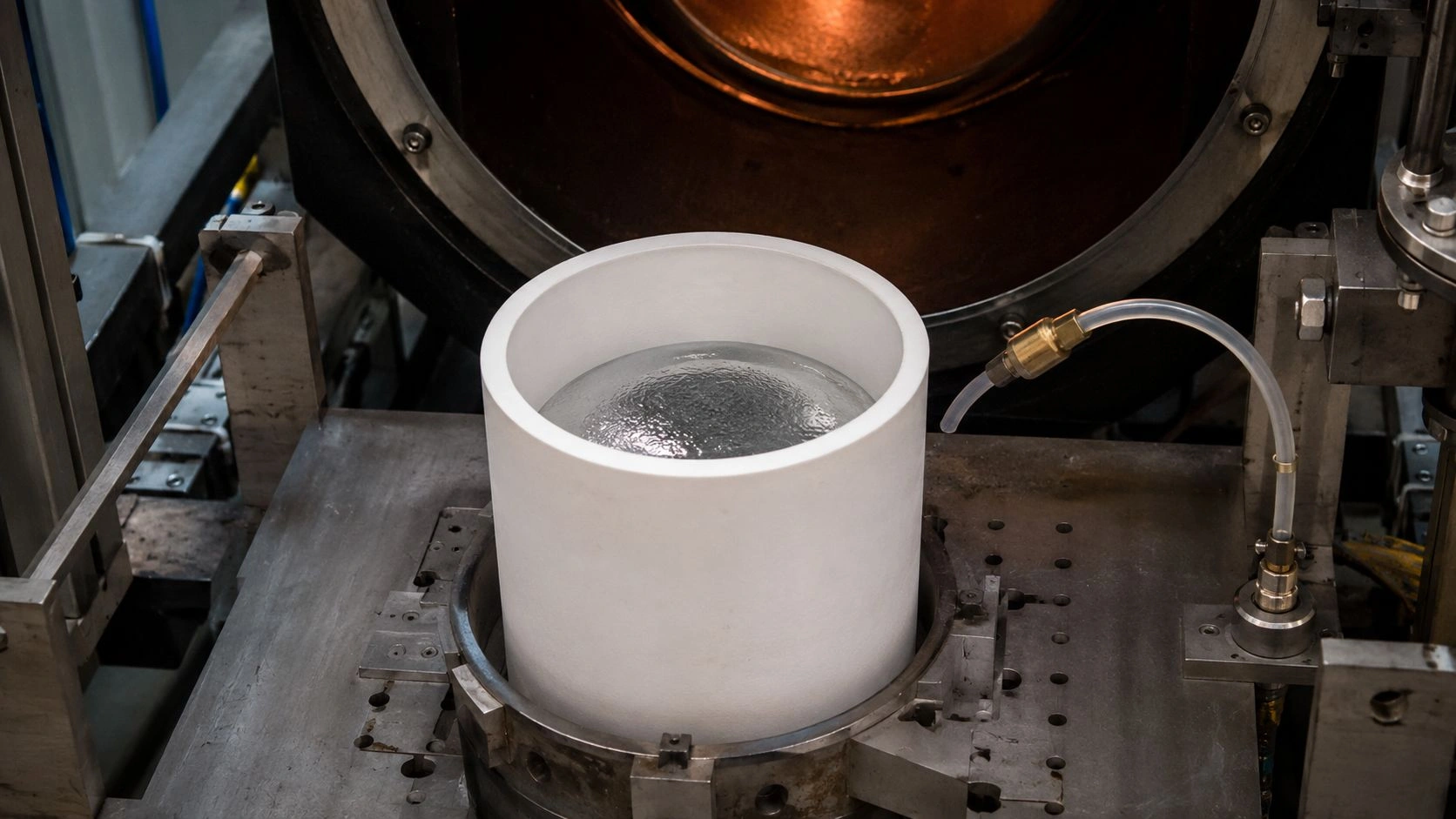
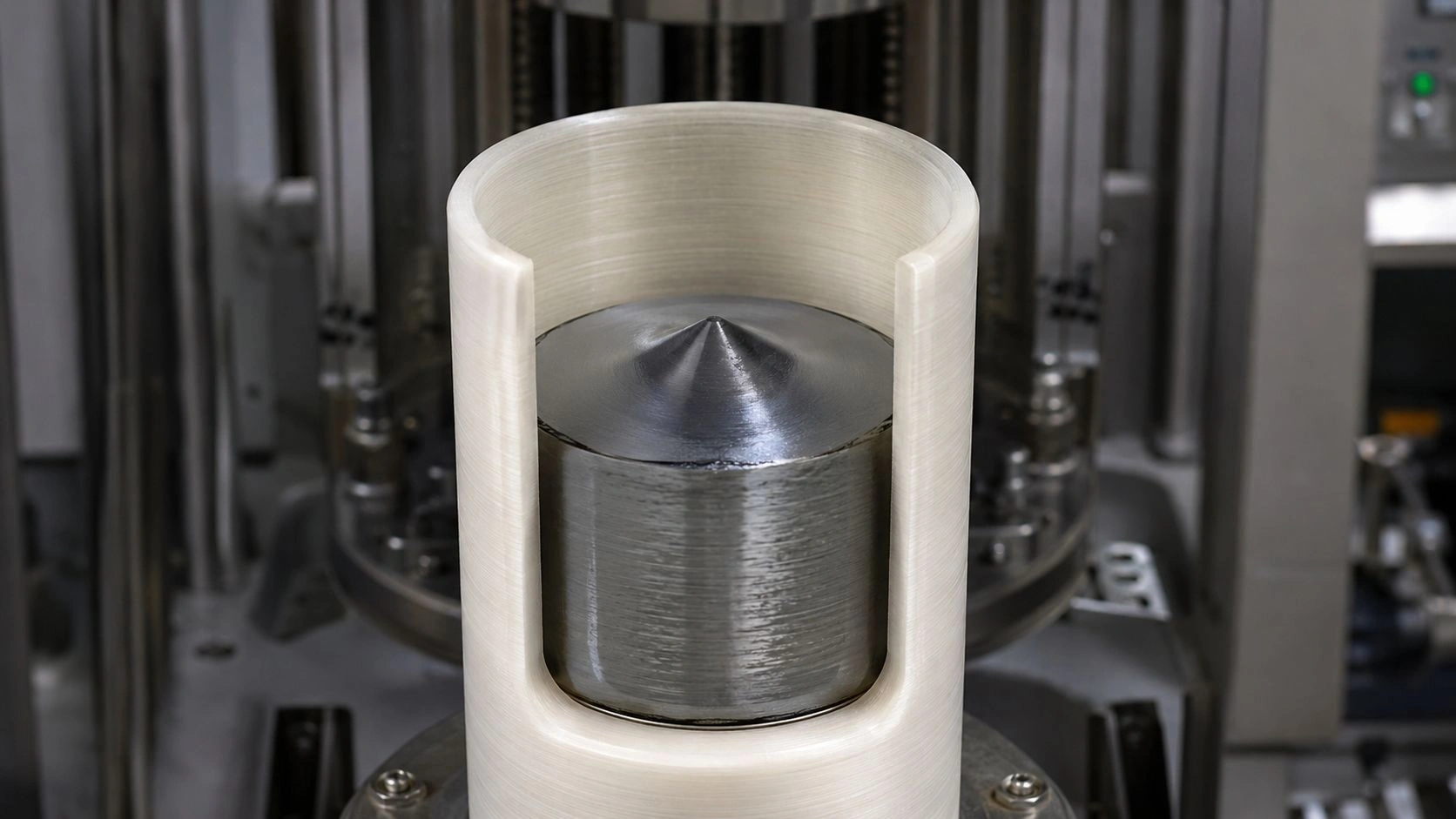
BN crucibles are a strong choice for rare earth metal purification when the step is really a clean melt-handling, remelting, alloying, or metal-collection step and the process benefits from a low-reaction, non-wetting, high-purity contact surface. They are not the universal default for every purification route. In published process literature — and as an application-dependent pattern rather than a universal rule — vacuum distillation and some ultra-high-purity refining routes often lean toward tantalum or other refractory-metal vessel logic, while some zone-refining approaches were developed to reduce W/Ta/Mo crucible-derived impurities. Fit remains process- and alloy-dependent; confirm on RFQ.
The selection decision in rare earth metal purification is driven by which part of the purification workflow the crucible is serving. Melt-handling, collection, and clean-contact steps are where BN's interface-cleanliness advantage is most directly relevant. Vacuum distillation, sublimation, and zone refining are fundamentally different vessel problems that follow different materials logic. This guide maps the boundary between those roles, identifies where BN appears in published rare-earth pyrometallurgy process literature (application-dependent), and closes with the RFQ language that makes the distinction actionable.
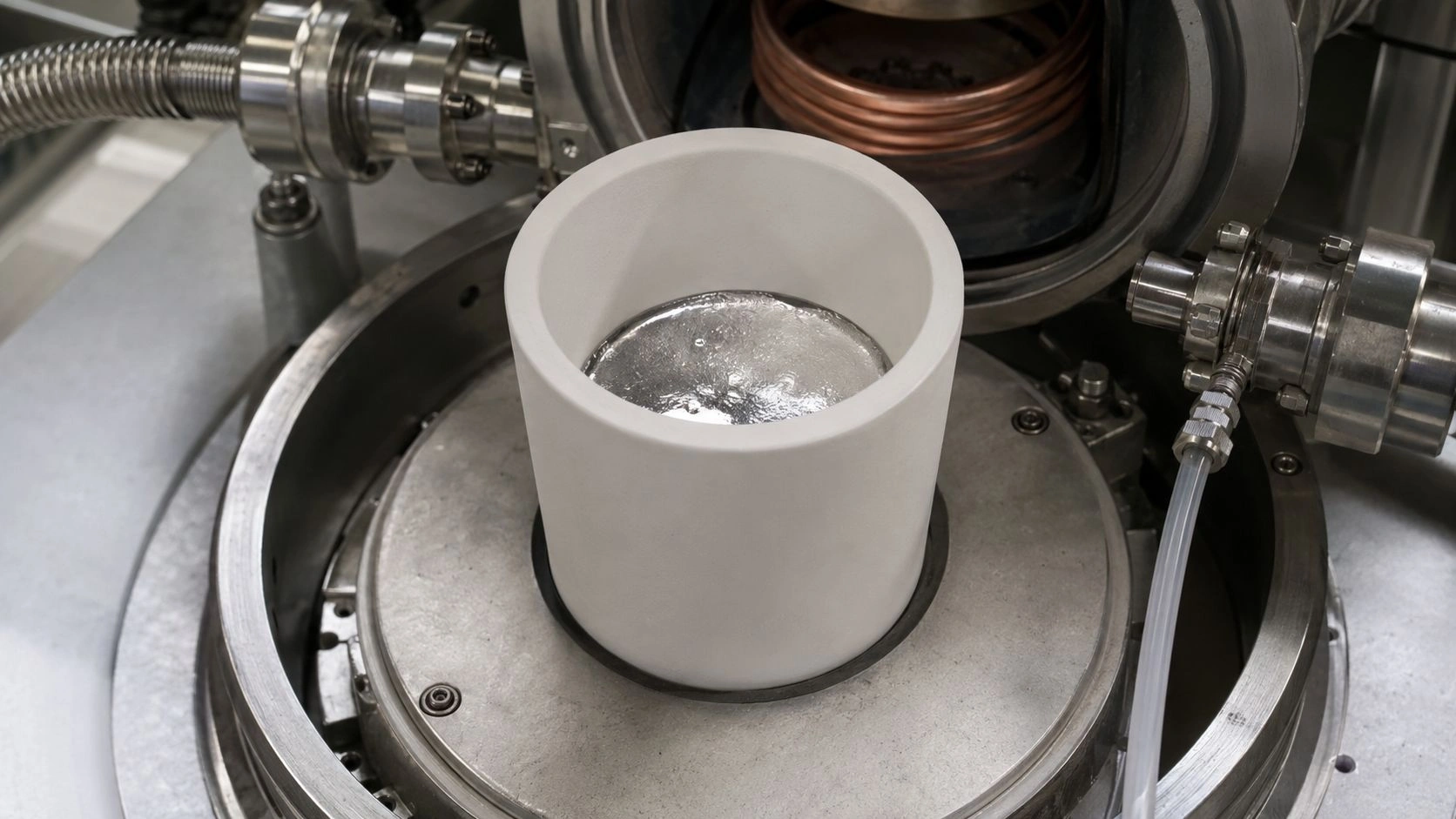
BN crucibles in rare-earth purification workflows are typically evaluated for clean melt-handling and metal-collection steps; vacuum distillation and zone-refining steps often follow different vessel logic (process- and alloy-dependent — confirm on RFQ).
The boron nitride crucibles described in this guide — HPBN and high-purity BN grades as screening candidates — are the BN forms typically evaluated for rare-earth melt-handling service rather than the PBN grades used in semiconductor crystal growth. Confirm grade sheet, lot COA, and RFQ targets before treating any grade as a process SLA.
What BN crucibles actually solve in rare earth purification
BN crucibles solve an interface-cleanliness problem first. Published BN materials documentation from major suppliers describes BN as inorganic, inert, and not wet by most molten metals and slags, with high-purity BN grades explicitly recommended for crucibles used in high-purity metal processing. That combination of non-wetting behavior and purity makes BN highly credible when the engineering goal is to keep molten rare-earth metal away from a reactive or contaminating vessel wall.
The distinction that matters for rare-earth applications is this: BN's advantage is about clean melt contact, not about purification chemistry itself. When the purification step is "hold, handle, or collect the metal cleanly at high temperature," BN's properties are directly relevant. When the purification step is "separate impurities by vapor pressure difference, by crystal migration, or by electrolytic chemistry," the vessel logic changes and BN is no longer automatically the right answer.
BN appears in published rare-earth pyrometallurgy process literature in two specific roles
A published 2025 study on NdPr molten-salt electrolysis explicitly used a BN crucible for metal collection and insulation from the anode. That is a collection/containment role — exactly the type of step where BN's interface properties are the governing advantage. Separately, published experimental work on neodymium extraction using a glass-slag method used a BN crucible with boron trioxide processing under controlled atmosphere — a rare-earth recovery context where BN functioned as a credible high-temperature container with appropriate chemical resistance. Neither example makes BN a universal rare-earth purification answer. Both illustrate BN as a credible tool in rare-earth pyrometallurgy when the step is melt contact and collection rather than dedicated vapor-phase separation — application-dependent; confirm melt chemistry and duty on RFQ.
High-purity rare earth purification involves multiple different process routes, not one vessel problem
Published review material on rare-earth production describes high-purity rare-earth metals as prepared through several distinct routes: vacuum melting, vacuum distillation/sublimation, electrolytic refining, and others. Those are not variants of the same process — they impose different requirements on the vessel, different temperature regimes, different atmospheres, and different contamination mechanisms. A specification that names only the crucible material without identifying the process step is leaving the most important variable undefined.
Where BN is credible in rare earth purification workflows
BN's role in published rare-earth pyrometallurgy process literature concentrates in two process positions that are often evaluated first: clean melt-handling and metal collection (process- and alloy-dependent).
Clean remelting, vacuum alloying, and high-purity melt-handling steps share the requirement that the vessel must not react with or contaminate the rare-earth metal during high-temperature processing. Published BN materials documentation directly supports this function: high-purity BN grades are non-wetting to most molten metals and are explicitly positioned for high-purity processing. Published rare-earth recycling work has also noted that carbon-bearing vessel paths may form carbides in some rare-earth melts. BN is often evaluated when carbon contact is unacceptable; confirm melt chemistry, atmosphere, and contact duration on RFQ rather than treating non-carbide behavior as an absolute guarantee.
Metal-collection duty in molten-salt electrolysis is a second published BN application context in rare-earth metallurgy. In the published NdPr electrolysis work, the BN crucible's role was to collect the cathodically deposited metal while providing electrical insulation from the anode. Both functions — chemical compatibility with rare-earth metal in a melt-collection context and electrical insulation in a chloride molten-salt environment — are properties BN is often evaluated to provide; confirm salt chemistry and duty on RFQ.
BN gains its clearest advantage over graphite in low-carbon-reaction-requirement service
The most important practical comparison for melt-handling steps is often not BN versus tantalum, but BN versus graphite. Graphite is a practical and well-established high-temperature crucible material, but when carbon pickup or carbide formation would compromise the rare-earth metal purity or downstream processing, BN's non-graphitic ceramic interface provides a distinct advantage. Published evidence of rare-earth carbide formation along carbon-bearing vessel paths makes this a concrete screening reason to evaluate BN when carbon contact is unacceptable — confirm melt chemistry on RFQ.
The purity requirement drives grade selection within BN
Not all BN grades provide equivalent screening performance in rare-earth melt-handling service. High-purity BN grades with lower metallic impurity content are often preferred in purity-sensitive work because vessel-derived traces can affect magnetic, optical, or chemical properties. Treat HPBN vs binder-bearing grades as a screening distinction only — confirm grade sheet, lot COA, and RFQ impurity limits; do not treat catalog purity language as a plant SLA.
Where BN's case ends and other vessel routes begin
Three boundaries define where BN remains strong and where the vessel logic in rare-earth purification moves toward different materials:
Vacuum distillation and sublimation follow tantalum-vessel logic, not BN-vessel logic. Published terbium distillation work describes vacuum distillation as a major industrial production method for high-purity rare-earth metals, applicable to essentially all rare earths except lanthanum, cerium, and promethium in the described framework. A published patent on multilevel distillation crucibles for rare-earth metals explicitly selects tantalum as the vessel material because rare-earth metals are highly chemically reactive at the temperatures involved and tantalum minimizes recontamination during the distillation process. In published process literature, tantalum is often the better-supported choice for that duty — not BN — but the call remains process- and alloy-dependent; confirm on RFQ. The vessel logic in vacuum distillation is about sustained chemical stability across the distillation temperature profile, condensation-zone control, and recontamination prevention — a different set of requirements from clean melt-contact containment.
Some rare-earth purification routes are designed to avoid crucible-derived impurities at a fundamental level. A published zone-refining patent for rare-earth purification explicitly states that light rare earths including lanthanum, cerium, praseodymium, and neodymium can pick up tungsten, tantalum, and molybdenum impurities from conventional refractory-metal crucibles during reduction and refining. The patented approach avoids the use of tantalum crucibles by designing a vertical zone-refining process that reduces vessel interaction. This is a meaningful boundary for BN: one branch of rare-earth purification is organized around minimizing crucible influence, not around selecting a better crucible material. BN can reduce one class of interfacial contamination, but where the principle is to eliminate crucible-derived impurities structurally, process redesign may dominate material substitution — process- and alloy-dependent; confirm on RFQ.
BN should not be specified for rare-earth purification steps solely on the basis of temperature capability. BN's inert-atmosphere service temperature is high enough for virtually all rare-earth pyrometallurgical processes. But temperature capability is not the governing selection criterion for rare-earth vessel choice — chemical stability at that temperature, vapor-phase compatibility, and contamination pathway control are. Specifying BN because it survives the temperature without also confirming it addresses the specific contamination mechanism in the process step is under-specified selection.
When BN clearly leads and when other routes are better supported
The Selection Matrix below maps the six most common rare-earth purification vessel scenarios:
| If the purification duty looks like… | Best-fit route | Why |
|---|---|---|
| Clean remelting, vacuum alloying, or high-purity melt handling | BN crucible is a strong first-look route | BN is inert and non-wetting to most molten metals; high-purity grades are explicitly recommended for crucibles in high-purity metal processing |
| Molten-salt electrolysis metal collection | BN crucible is credible | Published NdPr electrolysis research explicitly used a BN crucible for metal collection and electrical insulation from the anode |
| Dry rare-earth recovery / slag-contact extraction experiments | BN crucible remains credible | Published Nd extraction glass-slag work used a BN crucible with boron trioxide in a rare-earth recovery experimental context |
| Vacuum distillation / sublimation of high-purity rare earths | Tantalum-based distillation vessel logic is better supported | Published distillation-crucible patent explicitly selects tantalum because rare-earth metals are highly reactive at distillation temperatures and tantalum minimizes recontamination |
| Zone refining designed to avoid refractory-metal crucible contamination | Zone-refining / crucible-avoidance logic may be stronger | Published purification patent identifies W/Ta/Mo impurities from crucibles as a real problem and proposes a route that avoids expensive tantalum crucibles entirely |
| Graphite vessel where rare-earth carbide formation is unacceptable | BN gains a clear advantage | Carbon-bearing vessel paths may form carbides in some RE melts; BN is often evaluated when carbon contact is unacceptable (confirm melt chemistry) |
Route logic synthesized from published process literature and materials documentation (application-dependent screening — not a contractual SLA). Confirm process step, alloy, and atmosphere on RFQ.
Engineering screening description: BN crucibles are often the stronger first look for melt-handling parts of rare-earth purification workflows, while distillation and zone-refining steps often follow different vessel logic — Ta-based routes for high-temperature chemical stability in distillation, or process redesign to minimize crucible contact. Fit is process- and alloy-dependent; confirm on RFQ.
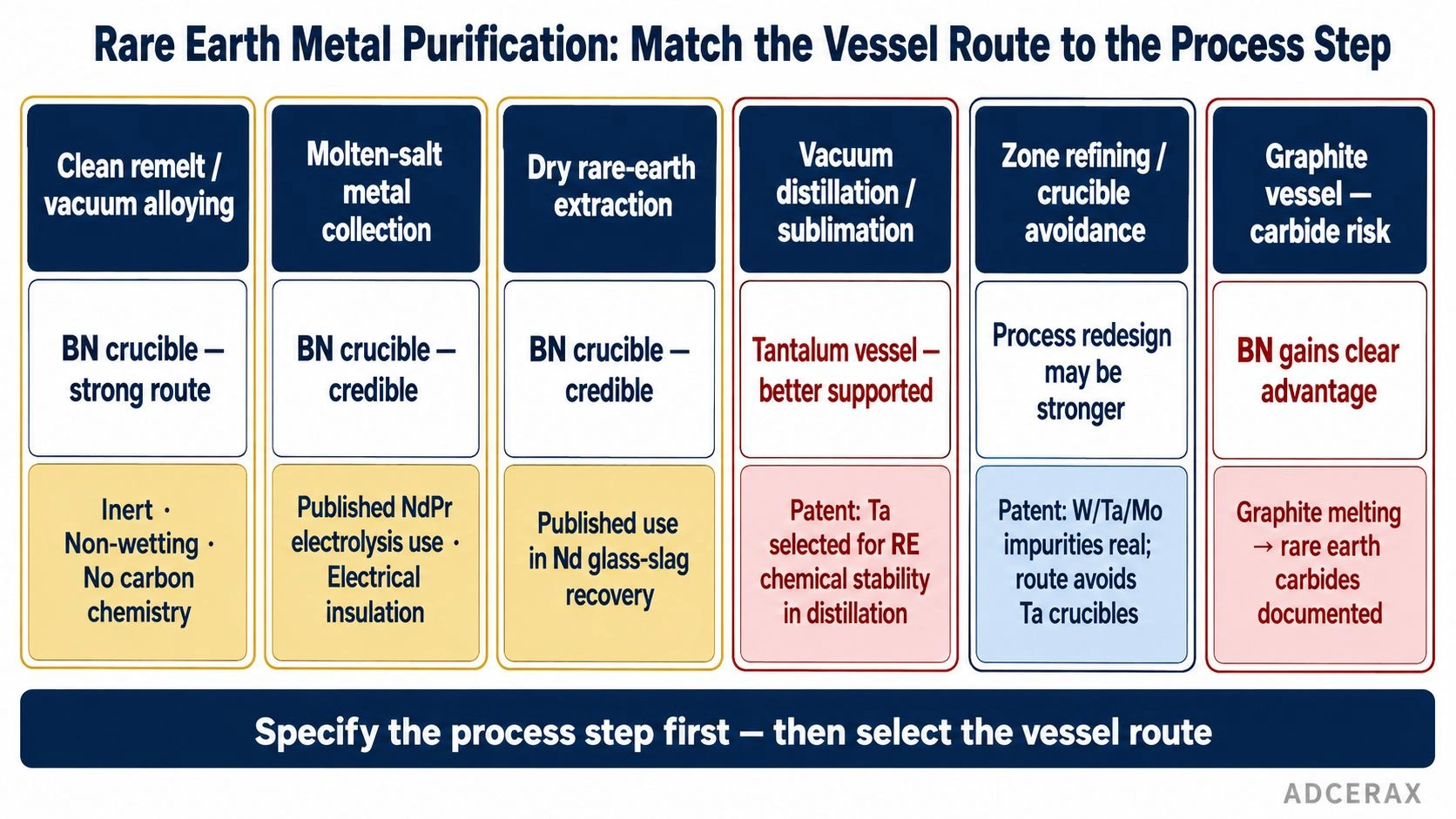
Six rare-earth purification scenarios — and which vessel route fits each one. BN leads in clean melt contact and collection; tantalum leads in vacuum distillation; zone refining may eliminate crucible contact altogether.
The boron nitride ceramic grades — from standard HPBN to high-purity binder-free grades — differ in impurity path and density in ways that matter for rare-earth purity-sensitive screening. Treat that difference as a screening prompt only: confirm grade sheet, lot COA, and RFQ impurity limits. For drawing-controlled geometry and material-family context, see custom services and the materials overview.
The graphite versus BN comparison is often the first practical question in melt handling
For engineers choosing between graphite and BN for rare-earth remelting or alloying, the governing question is whether carbon chemistry is acceptable in the process. Graphite is a practical, lower-cost high-temperature vessel, but carbon-bearing vessel paths may form carbides in some rare-earth melts. BN is often evaluated when carbon contact is unacceptable; confirm melt chemistry and specify a screened high-purity grade sheet / lot COA on RFQ — do not treat non-carbide behavior as an absolute guarantee.
Tantalum's dominance in distillation does not displace BN's role in melt handling
That tantalum is often better supported for distillation-vessel duty in published process literature does not mean BN lacks a role in rare-earth purification. The two materials serve different positions in the process. A workflow may evaluate BN crucibles for remelting and metal collection and tantalum vessels for distillation — matching each material to the contamination mechanism of that step. Routing remains process- and alloy-dependent; confirm on RFQ.
Oxide calcination is not the same vessel problem as metal purification
Alumina crucibles used for rare-earth oxide calcination address a different duty from BN vessels used for rare-earth metal purification / melt-handling. Oxide calcination temperature windows, atmosphere, and contamination pathways are not interchangeable with metal remelt, collection, distillation, or zone-refining vessel routing — keep those RFQs on separate axes.
What should go into the RFQ and process specification
Before writing "BN crucible for rare earth metal purification," the specification must resolve the process step, the atmosphere, and the primary contamination concern. Without those three variables, a supplier cannot confirm whether BN is the right vessel for the duty or whether tantalum, zone refining, or another approach is more appropriate — process- and alloy-dependent.
The specification and RFQ checklist for ceramic crucible or metallurgical ceramic components in rare-earth metal purification:
- Process step — specify remelt, vacuum alloying, molten-salt metal collection, vacuum distillation, or zone refining; this is the most important variable because each step has different vessel requirements.
- Atmosphere — specify vacuum, inert gas (argon, nitrogen), molten-salt environment, or reactive atmosphere; BN compatibility varies by atmosphere and temperature, and the atmosphere defines the contamination pathway.
- Priority — state whether the primary goal is low reaction, low carbon pickup, high purity, low electrical conductivity, or distillation efficiency; these map to different vessel routes and materials.
- Vessel role — specify direct melt container, collector crucible, distillation crucible, or transient handling vessel; each role imposes different geometry, temperature cycling, and contamination control requirements.
- BN grade — specify screening purity targets and maximum metallic impurity concentration, then confirm grade sheet and lot COA on RFQ; for purity-sensitive rare-earth work, vessel impurity path is part of the contamination budget (screening, not SLA).
- Temperature and hold time — specify peak temperature and dwell duration at process temperature; rare-earth reactivity increases with temperature and dwell, which affects whether BN's chemical stability is adequate throughout the process cycle.
Conclusion
BN crucibles are most often evaluated for rare-earth metal purification workflows at the clean melt-handling and metal-collection steps — positions where a non-wetting, low-reaction, high-purity ceramic interface can control a contamination pathway that matters. For vacuum distillation, tantalum is often better supported in published process literature; for zone-refining workflows designed to minimize crucible contact, process redesign may dominate material substitution. Routing is process- and alloy-dependent. The specification that places BN correctly names the process step, atmosphere, and primary contamination mechanism before naming the vessel material — then confirms grade sheet, lot COA, and RFQ fields.
Specifying BN crucibles for rare earth metal purification or melt handling? On the RFQ, specify the metal / alloy, atmosphere, purity target, peak temperature, contact duration, process step (remelt · collection · distillation · zone refining), and geometry. Confirm grade sheet and lot COA against those fields — screening language is not a contractual SLA. Use custom services for drawing-controlled requests and the BN crucible / materials paths for grade-family context.
Frequently Asked Questions
Can BN crucibles be used in rare earth metal purification?
Yes — especially for clean remelting, vacuum alloying, melt handling, and metal-collection steps where low vessel reaction and low wetting are valuable. Published process literature includes BN crucibles in rare-earth metal-collection and extraction experimental contexts — illustrating BN as a credible tool in specific parts of rare-earth purification workflows. Fit remains application-dependent; confirm melt chemistry on RFQ.
Are BN crucibles the default vessel for vacuum distillation of rare earth metals?
Usually not as a default. Published vacuum distillation work and distillation-crucible patents often select tantalum for rare-earth vacuum distillation, citing high chemical reactivity at distillation temperatures and recontamination control. BN is typically not the primary published choice for that specific duty — process- and alloy-dependent; confirm on RFQ.
Why might BN be preferred over graphite for rare earth melt handling?
Because carbon-bearing vessel paths may form carbides in some rare-earth melts. When carbon contact is unacceptable for purity or downstream processing, BN is often evaluated as the non-graphitic ceramic interface — confirm melt chemistry rather than assuming BN never forms carbides under every condition.
Why do some rare-earth purification patents discuss W/Ta/Mo impurities?
Because conventional refractory-metal crucibles — tungsten, tantalum, and molybdenum — can themselves introduce trace metallic impurities into rare-earth metals during high-temperature reduction and refining. A published zone-refining patent for rare-earth purification explicitly identifies this as a problem and describes a purification approach that avoids expensive tantalum crucibles. This boundary is important for BN too: some purification workflows are designed to minimize all crucible influence rather than to select a cleaner crucible material.
What is the biggest specification mistake for BN in rare earth purification?
Writing only "BN crucible for rare earth metal purification" without naming the process step — remelt, melt handling, electrolysis metal collection, vacuum distillation, or zone refining. Each step has different vessel requirements, and BN's published role concentrates in melt-handling and collection positions. Specifying BN for a vacuum distillation step without checking whether tantalum or another vessel route is better supported is a common and consequential specification error.
Related reading
- BN crucibles in precious-metal recovery laboratories — When the duty is precious-metal recovery lab vessel choice, not rare-earth metal purification process-step routing
- BN crucibles for magnesium alloy melting in automotive — When the melt is Mg alloy automotive melting contact, not RE metal purification / collection
- BN crucible failures: delamination vs cracking vs chemical attack — When the bottleneck is BN crucible failure-mode diagnosis, not which purification step gets a BN vessel