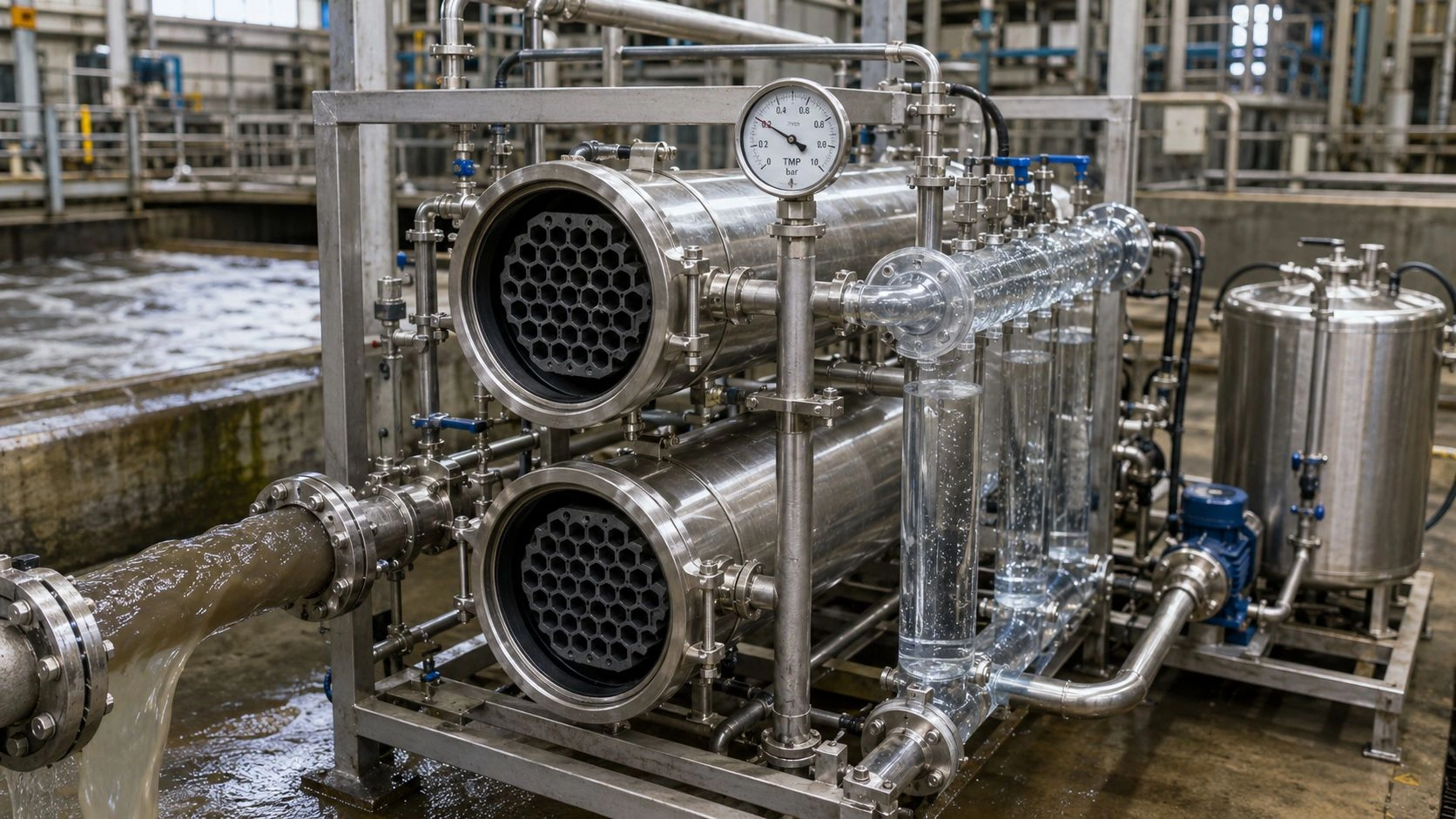
SiC tubes can be used in semiconductor vertical diffusion furnaces when the component must provide high-temperature dimensional stability, chemical durability, repeated-cleaning resistance, low deformation, or structural support in diffusion, oxidation, annealing, or LPCVD environments. They are not a universal drop-in replacement for quartz process tubes. The correct decision depends on the tube's role — process tube, liner, injector, support tube, boat, paddle, or protective sleeve — along with purity, coating integrity, gas impermeability, particle control, metallic impurity limits, thermal cycle, process gas chemistry, and cleaning cycle compatibility.
That role-first, purity-first framing is the engineering basis for this guide.
SiC and CVD-SiC components in semiconductor vertical diffusion furnaces serve as liners, wafer boats, paddles, and support tubes rather than universal quartz replacements — component role, purity, coating integrity, and process qualification together determine suitability.
The silicon carbide wafer handling furnace components at ADCERAX — covering precision-formed SiC carriers, wafer boats, support tubes, and furnace components used in diffusion, oxidation, and LPCVD systems for semiconductor manufacturing — are the starting point for the selection decisions described in this guide.
Where SiC tubes fit in vertical diffusion furnace hardware
The first step in any SiC furnace component decision for a vertical diffusion furnace is mapping the hardware architecture — because ""SiC tube"" can mean very different things depending on which position in the furnace it occupies.
Vertical diffusion furnaces are commonly described as quartz-tube systems. Published furnace supplier descriptions confirm that vertical batch processing furnaces typically use vertically arranged quartz tubes as the process chamber, with silicon wafers loaded from the bottom of the process tube on quartz wafer boats. Quartz is the established baseline for the main process tube and wafer boat in most standard diffusion, oxidation, and LPCVD applications because it is extremely clean, transparent to thermal radiation, dimensionally stable at the process temperatures used for most front-end-of-line steps, and chemically compatible with a wide range of process gases.
SiC becomes relevant when quartz reaches a practical limitation — whether from deformation under repeated high-temperature cycling, cleaning-induced degradation, structural load requirements exceeding quartz strength, or dimensional drift in critical wafer support hardware.
The SiC Tube Use Boundary in Vertical Diffusion Furnaces table below maps hardware positions to SiC fit:
| Component role | SiC fit | Main advantage | Main risk | What to verify |
|---|---|---|---|---|
| Main process tube | Conditional | Thermal stability, cleaning durability | Process change, impurity, coating risk | Process gas, purity, gas impermeability |
| Inner liner | Strong candidate with validation | Protects process zone and extends maintenance interval | Coating/particle risk | Liner fit, cleaning, surface condition |
| Injector/gas tube | Conditional | Thermal stability and corrosion resistance | Flow pattern and deposits | Gas chemistry and particle risk |
| Wafer boat | Strong candidate in selected tools | Stable wafer spacing and low deformation | Contact particles, purity | Slot finish, geometry, cleaning |
| Cantilever paddle/support | Strong candidate | High stiffness and low deformation | Brittle fracture or contact damage | Load, span, support design |
| Dummy wafer/spacer | Conditional | High-temp stability | Surface contamination | Wafer contact and purity |
| Protective sleeve | Conditional | Shields vulnerable hardware | Thermal expansion mismatch | Fit and expansion clearance |
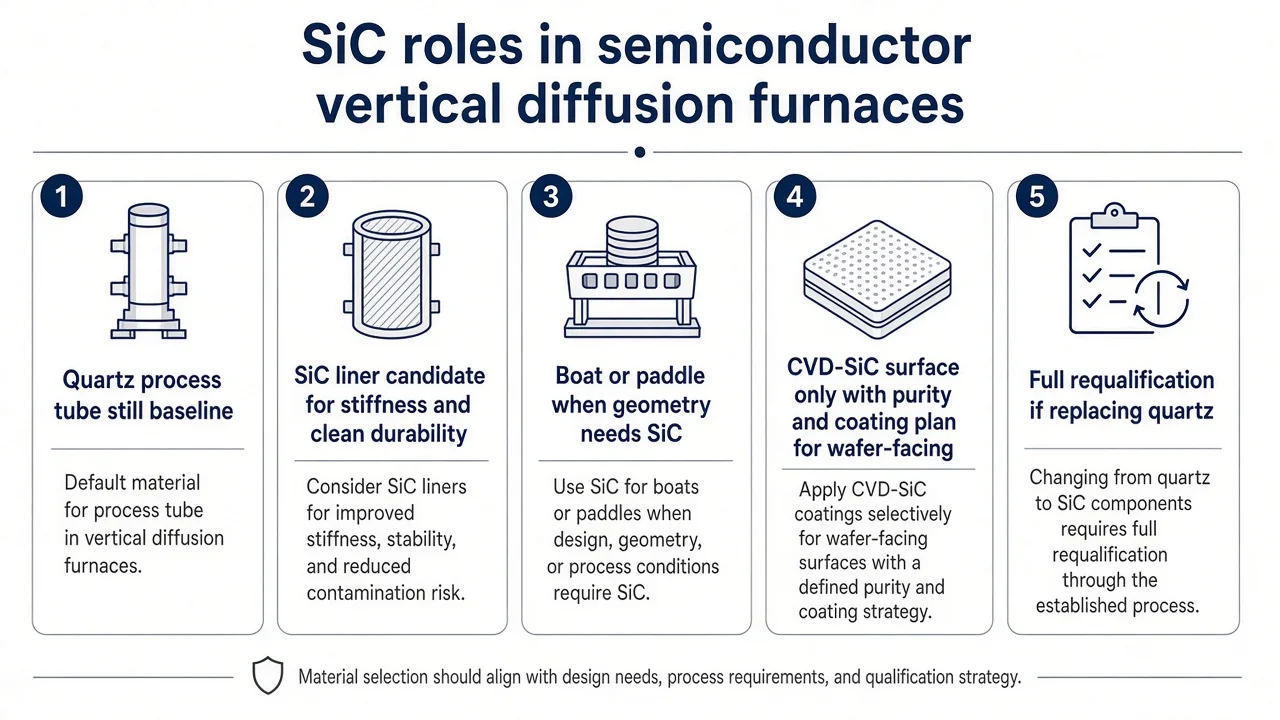
SiC use in vertical diffusion furnaces should be judged by component role first — process tubes, liners, injectors, wafer boats, paddles, dummy wafers, and protective sleeves each carry different purity, coating, particle, gas-impermeability, and requalification risks.
Quartz process tube as the common baseline. For the vast majority of vertical diffusion furnaces in front-end semiconductor manufacturing, quartz remains the process tube and boat material of record. Process qualification, equipment specs, and clean-room protocols are built around quartz. Replacing the quartz process tube with SiC is not an incremental maintenance decision — it requires a process requalification, thermal-profile re-check, emissivity review, particle validation, and potentially metal contamination qualification.
SiC liner or process tube where durability and thermal stability matter. In high-temperature annealing, rapid thermal processing support, and LPCVD systems where temperature and chemical exposure are particularly demanding, SiC liners — inserted inside the quartz process tube to manage deposition, particle load, or thermal gradients — may extend the maintenance interval without requiring a full process tube replacement. Historical diffusion-furnace component patents describe SiC-based systems that include liner tubes, process tubes, paddles, and boats from high-purity sintered SiC, made gas-impervious by silicon impregnation and coated with dense refractory materials for chemical resistance, thermal shock resistance, purity, gas impermeability, and acid-cleaning resistance.
SiC boats, paddles, and support tubes for wafer handling. The positions in a vertical diffusion furnace most often served by SiC are the mechanical support components: wafer boats, cantilever paddles, support rods, and cross-flow injectors. These components must maintain precise wafer spacing and stable geometry through thousands of thermal cycles, and they benefit from SiC's high elastic modulus and lower thermal deformation relative to quartz at elevated temperature.
Typical SiC furnaceware forms — inner liners, wafer boats, and cantilever paddles — solve different mechanical and contamination-control problems, so geometry, surface finish, coating route, and wafer-facing qualification should be specified separately.
Why SiC is considered: thermal stability, cleaning resistance, and geometry control
After mapping the hardware positions, the material argument for SiC in selected vertical diffusion furnace components becomes more specific.
[CITE: ADCERAX's silicon carbide wafer handling furnace components are described as precision-formed carriers that load, support, and stabilize wafers inside high-temperature diffusion, oxidation, and LPCVD furnace systems, helping control wafer spacing and thermal environment during long processing cycles — and published CVD-SiC supplier descriptions characterize CVD-SiC furnace components as ultra-high-purity, corrosion-resistant, oxidation-resistant, heat-resistant, and wear-resistant, used widely in semiconductor manufacturing as wafer boats, tubes, dummy wafers, and high-temperature jigs — confirming that SiC's value in vertical diffusion furnace applications is dimensional stability and surface cleanliness, not just high-temperature capability.]
Dimensional stability during repeated high-temperature cycles. Quartz is a glass — it is amorphous, and above approximately 1050–1100°C it can deform under its own weight during long, high-temperature cycles. SiC is a crystalline ceramic with a significantly higher elastic modulus, which means a SiC wafer boat or cantilever paddle can support more wafers with less deformation under repeated thermal cycling at high temperature. For furnaces pushed to the upper temperature range of diffusion or annealing processes, this difference in creep resistance can translate directly into longer maintenance intervals.
Resistance to aggressive cleaning cycles. Semiconductor furnace components must be cleaned periodically — typically using HF, HCl, SC-1/SC-2 cleaning sequences, or acid strip procedures — to remove deposited films. Quartz can lose material and dimensional precision during repeated acid cleaning, especially in systems that process poly-silicon, silicon nitride, or oxide-containing films that require aggressive removal chemistry. SiC and CVD-SiC surfaces are more resistant to these cleaning agents, potentially extending the cleaning-qualified service life of the component.
CVD-SiC surface purity vs bulk SiC impurity risk. The distinction between the surface seen by the wafer environment and the bulk material forming the structural body is critical in semiconductor furnace components. A CVD-SiC surface layer provides an ultra-high-purity, dense, gas-tight barrier between the bulk material — which may contain trace metals in concentrations higher than the wafer contamination limit — and the process atmosphere. A patent for ultra-pure CVD-SiC semiconductor furnaceware explicitly addresses this architecture, positioning CVD-SiC for wafer boats, process tubes, cantilever paddles, rods, and dummy wafers in high-temperature semiconductor processing.
SiC grade and surface route: SSiC, SiSiC, CVD-SiC, and coated components
After establishing why SiC is evaluated, the grade and surface route decision determines whether the component can actually meet semiconductor purity requirements.
The SiC Route Selection for Semiconductor Furnace Components table maps the main options:
| SiC route | Best-fit use | Main advantage | Main boundary |
|---|---|---|---|
| CVD-SiC | Wafer-facing high-purity components, boats, tubes, jigs | Ultra-high-purity surface, corrosion and heat resistance | Cost, geometry, coating stress |
| CVD-coated SiC/SiSiC | Furnaceware needing clean surface plus structural body | Combines shape capability with clean surface | Coating damage exposes substrate |
| SSiC | Dense structural tubes and supports | Low porosity, strength, chemical resistance | Purity and particles must be verified |
| SiSiC/reaction-bonded SiC | Larger or complex shapes | Near-net forming and dimensional capability | Residual silicon and impurity review |
| ReSiC | High-temperature structural components | Thermal stability and size capability | Porosity/gas-tightness limitations |
| Quartz | Standard process tubes and boats | Established clean process baseline | Deformation, cleaning life, devitrification risk |
CVD-SiC for wafer-facing high-purity components. CVD-SiC is produced by depositing silicon carbide from gas phase onto a mandrel or substrate, creating a dense, pure, grain-boundary-free structure. The resulting material has extremely low metallic impurity content — suited for wafer-facing components in front-end semiconductor manufacturing. The silicon carbide tubes at ADCERAX include CVD-SiC tube and custom component options alongside SSiC and RBSiC grades for high-temperature chemical process applications.
CVD-coated SiC — useful only when coating integrity is maintained. For structural SiC components — SiSiC paddles, support tubes, or process tubes — a thin CVD-SiC surface coating can provide a high-purity surface without requiring the entire body to be CVD-SiC. However, the coating integrity is the controlling variable. If the coating is scratched, chipped, or acid-etched through during cleaning, the underlying substrate material is exposed to the wafer environment, creating a direct metal contamination pathway. Coating thickness, pinhole inspection, and cleaning-cycle compatibility must be confirmed before a CVD-coated component is used in a wafer-facing position.
The silicon carbide ceramic material grades — SSiC, RBSiC, and NBSiC — differ in density, residual phase, and trace metal content in ways that directly affect semiconductor purity requirements. The semiconductor ceramics product range at ADCERAX covers high-purity ceramic components for stable semiconductor process environments, including stiffness, low thermal expansion, and wafer positioning precision requirements.
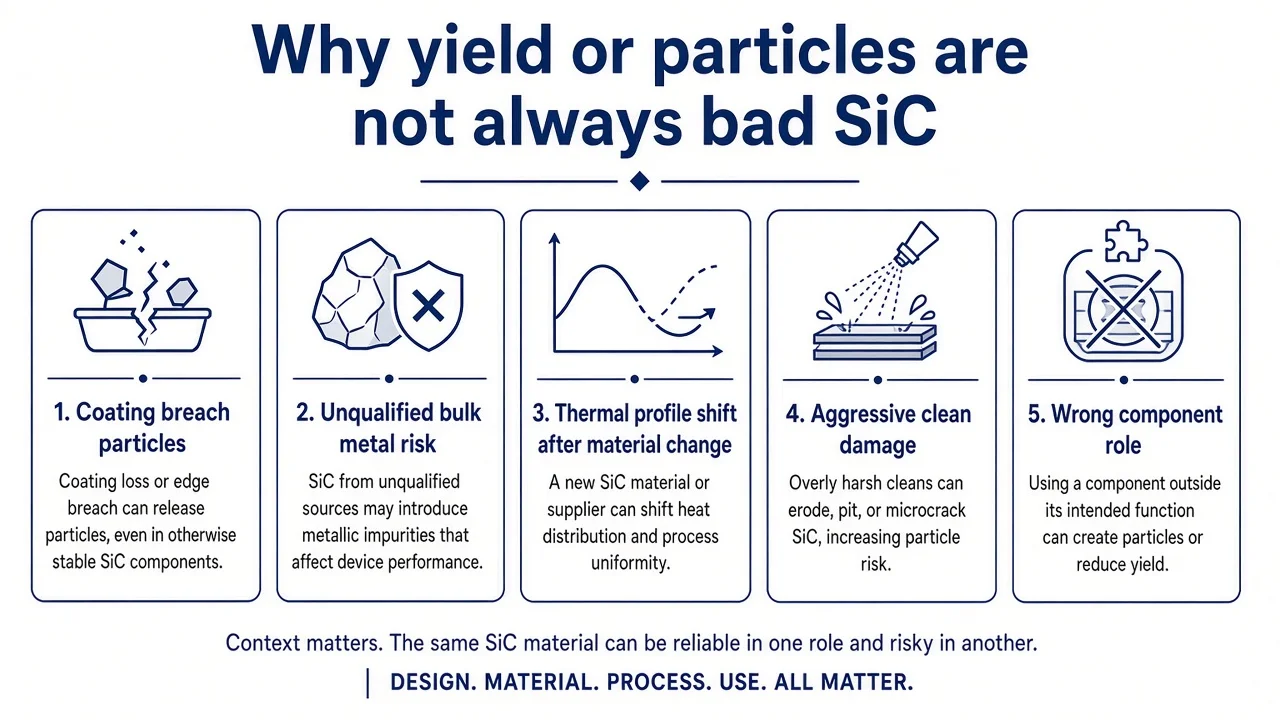
Do not misdiagnose furnace problems as ""SiC tube failure"" alone
When a semiconductor vertical diffusion furnace shows particle count increase, wafer contamination, temperature uniformity shift, yield change, coating discoloration, or mechanical cracking after introducing a SiC tube or liner, the SiC component body is one of several possible sources.
Particle generation from coating damage or cleaning. SiC and CVD-coated components that have been acid-cleaned too aggressively, handled with metal tools, or abraded by wafer boat contact can shed particles from the surface or from coating damage zones. These particles appear in the process atmosphere and on wafer surfaces. The correct diagnostic step is surface inspection of the SiC component before and after each cleaning cycle, not replacement of the SiC material.
Metal impurity risk from unqualified bulk or substrate material. If a SiC component is used in a wafer-facing position without trace metal qualification of the specific lot — either because the procurement did not require COA with trace metal data, or because the cleaning cycle exposed the bulk material through coating damage — the first indication may be elevated metallic contamination on the wafer surface. CoorsTek confirms that diffusion and LPCVD process tubes and liners require high purity and thermal stability in semiconductor reaction zones. Specifying trace metal data by element — Al, Fe, Ni, Cu, Na, K, and others — for every lot used in wafer-facing positions prevents this failure mode.
Temperature-profile change after replacing quartz with SiC. SiC and quartz have different thermal mass, emissivity, and thermal conductivity. A published vertical diffusion furnace temperature ramp patent specifically addresses how temperature and flow-rate management during ramp-up and ramp-down affect wafer uniformity and prevents warp. Replacing a quartz process tube with a SiC tube without re-characterizing the temperature ramp profile and re-validating process uniformity can shift the thermal environment in ways that appear as yield changes rather than particle or contamination events.
The Misdiagnosis Matrix maps observed furnace problems to better diagnostic questions:
| Observed problem | Common assumption | Better diagnostic question |
|---|---|---|
| Particle count increases | SiC material is shedding | Was coating scratched, acid-cleaned too aggressively, or abraded by wafer contact? |
| Wafer contamination appears | SiC is incompatible | Was the bulk substrate, coating, packaging, or cleaning qualified? |
| Temperature uniformity shifts | SiC tube failed | Did thermal mass, emissivity, or gas flow change after replacement? |
| Tube life improves but yield shifts | SiC solved one problem but created another | Was the process re-qualified after hardware change? |
| Coating discoloration | Process corrosion | Is process-film deposition or cleaning residue building up? |
| Cracking at support | Poor SiC quality | Was mounting clearance, support load, or thermal expansion controlled? |
| Cleaning damage | SiC chemical failure | Did cleaning chemistry or handling damage the coating or edges? |
Diagnosis should be based on particle analysis, surface inspection, contamination mapping, and process-record comparison before any component material change is specified.
RFQ checklist for SiC tubes in semiconductor vertical diffusion furnaces
A complete RFQ for SiC or CVD-SiC vertical diffusion furnace components must provide the process and hardware context — without both, the supplier cannot confirm SiC route, purity, coating, or qualification requirements appropriate for the specific component position.
[CITE: Engineering guidance on SiC tube and component specification for semiconductor vertical diffusion furnaces confirms the complete RFQ sequence: furnace brand and model with wafer size, component role with wafer-facing or non-wafer-facing status, process type and process gases, operating temperature profile with ramp and cool rates, SiC route (CVD-SiC/CVD-coated SiC/SSiC/SiSiC/ReSiC), trace metal purity requirements with COA and lot traceability, coating thickness and integrity inspection method, cleaning cycle chemistry and number of cycles, tube drawing with OD/ID/wall/length/slot geometry/edge radius, surface finish requirements, and qualification plan including particle testing, metal impurity monitoring, thermal cycling, and cleaning-cycle validation — because each variable determines whether the SiC component is appropriate for the specific furnace position, and a supplier who receives only ""SiC process tube for semiconductor furnace"" cannot confirm purity, coating route, or qualification requirements without the remaining process context.]
| RFQ field | Why it matters | Recommended wording |
|---|---|---|
| Furnace model | Defines fit and loading | ""Vertical furnace brand/model and wafer size"" |
| Component role | Defines process exposure | ""Process tube/liner/injector/boat/paddle/sleeve"" |
| Wafer-facing status | Defines purity and particle requirement | ""Direct wafer-facing or non-wafer-facing"" |
| Process type | Controls chemistry and deposits | ""Oxidation/diffusion/anneal/LPCVD/poly-Si/SiN"" |
| Process gases | Controls compatibility | ""O₂, N₂, H₂, NH₃, SiH₄, DCS, POCl₃, etc."" |
| Temperature profile | Controls stress and drift | ""Continuous, peak, ramp, cool, cycle count"" |
| SiC route | Core material decision | ""CVD-SiC/CVD-coated SiC/SSiC/SiSiC/ReSiC"" |
| Purity data | Prevents wafer contamination | ""Trace metals, COA, lot traceability, surface purity"" |
| Coating requirement | Protects wafer-facing surface | ""Coating thickness, integrity, pinhole inspection"" |
| Cleaning cycle | Controls service life | ""HF/HCl/SC cleaning, acid strip, number of cycles"" |
| Surface finish | Controls particles and wafer contact | ""Ra, slot finish, edge radius, polishing zone"" |
| Qualification | Confirms process fit | ""Particle, metal impurity, thermal cycle, cleaning validation"" |
RFQ fields are the minimum for a semiconductor diffusion furnace SiC component inquiry; add boat slot count, paddle span, injector hole pattern, and emissivity requirement for complete hardware specification.
For wafer-facing or process-zone components — boat, liner, main process tube, or paddle in direct exposure to the wafer environment — a sample qualification batch with particle count measurement, trace metal surface analysis, thermal cycling, and cleaning-cycle validation before production-scale procurement is the non-negotiable minimum qualification standard for semiconductor use.
Evaluating SiC tubes or liners for semiconductor vertical diffusion furnaces? Share your furnace model, wafer size, process type, process gases, temperature profile, component role, tube drawing, coating requirement, cleaning cycle, purity target, and particle limits. ADCERAX can review whether CVD-SiC, CVD-coated SiC, SSiC, SiSiC, or another furnaceware route fits the application; turnaround depends on inquiry complexity — no commitment required at this stage.
Frequently Asked Questions
Are SiC tubes used in semiconductor vertical diffusion furnaces?
Yes, in specific component roles. SiC may be used as a liner, inner process tube, injector, wafer boat, cantilever paddle, support tube, or protective sleeve in selected furnace systems. However, many vertical diffusion furnaces maintain quartz process tubes and quartz wafer boats as the established baseline. The role determines whether SiC is appropriate, and each role requires separate purity, coating, and qualification validation.
Can SiC replace quartz process tubes in vertical diffusion furnaces?
Sometimes, but not as a universal drop-in replacement. Replacing quartz with SiC changes thermal mass, surface chemistry, emissivity, cleaning response, and potentially metal contamination risk. Replacement requires process requalification, including thermal-profile verification, wafer uniformity validation, particle count measurement, and trace metal contamination qualification appropriate to the specific process.
Why use CVD-SiC or CVD-coated SiC in semiconductor furnaces?
CVD-SiC provides an ultra-high-purity, dense, gas-tight surface for wafer-facing semiconductor furnace components — boat slots, tube inner surfaces, and paddle faces — where the bulk material's trace metals and porosity would create contamination risk. Published CVD-SiC product descriptions confirm its use in wafer boats, tubes, dummy wafers, and high-temperature jigs specifically because of ultra-high purity, corrosion resistance, and heat resistance.
What is the biggest risk with SiC furnace tubes in semiconductor applications?
The biggest risks are particle generation from coating damage or aggressive cleaning, trace metal contamination from unqualified bulk substrate material, temperature uniformity shifts from changed thermal mass and emissivity after replacing quartz, and yield changes from process conditions that were not re-qualified after hardware change.
What is the difference between a SiC process tube and a SiC liner?
A process tube forms part of or the entire main reaction chamber wall. A liner is typically an inner protective sleeve or insert placed inside the process tube to manage deposition load, protect the main tube from reactive gases, or allow selective cleaning of the heavily exposed inner surface without replacing the full process tube. CoorsTek confirms that some diffusion and LPCVD systems use liners in the reaction zone in addition to main process tubes.
What information should I send to a supplier for a semiconductor SiC furnace component?
Send the furnace brand and model, wafer size, process type, process gases, temperature profile with ramp and cool rates, component role with wafer-facing status, tube or component drawing, SiC route preference, trace metal purity requirements, coating requirement with integrity inspection standard, cleaning cycle chemistry and count, surface finish requirements, and the qualification plan — including particle testing, metal impurity monitoring, thermal cycling, and cleaning-cycle validation milestones.
"