Ceramic furnace components usually justify their higher upfront cost when metal parts are failing from oxidation, creep, thermal fatigue, chemical attack, or repeated replacement downtime. Metal remains practical for low-temperature, impact-loaded, or low-cycle applications where fast fabrication and lower purchase price matter more. A TCO comparison should include purchase price, expected service life, replacement frequency, downtime cost, maintenance labor, energy loss, scrap risk, and verification data — not material cost alone. The furnace zone, failure mode, and maintenance record together determine which material delivers lower annualized cost, and that determination should be made with data rather than with the invoice price.
That annualized-cost-first framing — not a material ranking — is the engineering path for the cost stack, payback threshold, and RFQ checks below.
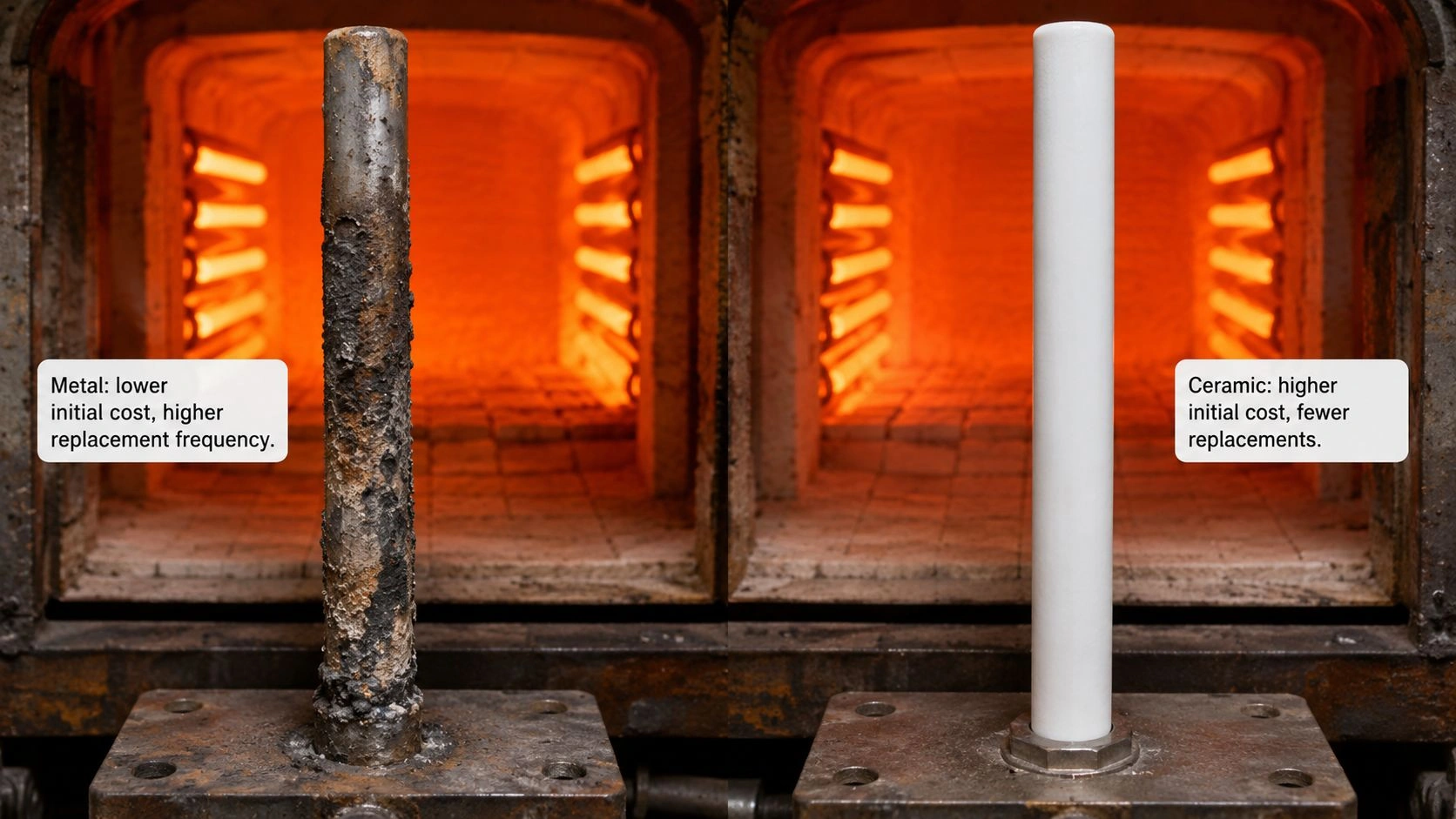
Ceramic and metal furnace components have fundamentally different cost structures — metal wins on initial price, machining speed, and toughness; ceramic wins on oxidation resistance, dimensional stability, and long interval between replacements in demanding thermal and chemical environments.
What costs belong in a ceramic vs metal furnace TCO comparison?
A TCO comparison that starts with the purchase price of a ceramic or metal component will produce a systematically wrong answer — because the initial price is typically the smallest cost driver in a high-temperature furnace that runs continuously or at high cycle frequency.
The minimum cost stack for a valid ceramic vs metal furnace component comparison should include:
| Cost category | What to measure | Metal pattern | Ceramic pattern |
|---|---|---|---|
| Purchase price | Unit cost per part | Lower | Higher |
| Service life | Hours or cycles to replacement | Shorter in aggressive zones | Longer in aggressive zones |
| Replacement labor | Hours per replacement × labor rate | Low to moderate per event | Moderate per event |
| Furnace downtime | Hours × production rate × contribution margin | Accumulates with replacement frequency | Accumulates if lead time is longer |
| Energy loss | Heat lost through degraded insulation or contacts | Increases with oxidation, scale, and deformation | More stable over life |
| Scrap and contamination | Product loss from component-derived contamination | Metal oxidation/scaling can shed | Lower risk for dense ceramics |
| Maintenance inventory | Safety stock value on hand | High if short life | Lower if longer life |
| Qualification cost | First-time engineering, testing, and installation | Low for established metal parts | Higher for ceramic first-time use |
Values are directional; actual costs depend on furnace type, operating temperature, atmosphere, replacement access, and production schedule.
Direct cost: part price, machining, installation, and inventory. Metal components typically win on initial purchase price because they benefit from commodity metal pricing, faster conventional machining, and shorter lead times from standard stock. A Hastelloy support rod, a steel thermocouple holder, or a nickel-alloy heating element bracket can be ordered and installed quickly, often without the drawing review and sintering lead time required for a custom ceramic part. For low-temperature, lightly cycled furnace hardware that is replaced infrequently, this advantage is real and should not be dismissed.
Operating cost: downtime, energy loss, maintenance labor, and scrap. The cost case for ceramics emerges when the operating costs of metal begin to accumulate. Published comparisons of ceramic and metal heating elements confirm that while metal options may have lower upfront cost, ceramic options can reduce replacement, maintenance, and long-term operating costs in demanding environments. In furnace zones where metal oxidizes, creeps, scales, or loses dimensional stability faster than ceramic, the replacement frequency gap creates compounding downtime and labor cost that may exceed the ceramic premium within one to three years under directional maintenance-log framing — site downtime $/h, scrap, labor, and duty cycle decide; this is not an ADCERAX payback guarantee. The maintenance log — not the purchasing record — holds the data that makes this comparison real.
When does higher ceramic upfront cost become economically justified?
After establishing the cost categories, the economic crossover question becomes: at what replacement frequency, downtime rate, or energy-loss level does the ceramic annualized cost fall below the metal annualized cost?
ASTM C1525 evaluates thermal shock resistance of advanced ceramics by water quenching and retained flexural strength — a method reference commonly used when estimating service life under high-cycle furnace shock (loading, cooling, or atmosphere changes). ASTM C1291 addresses creep strain, creep rate, and time to failure at elevated temperature — relevant when a ceramic support or fixture must hold geometry over the service period assumed in the annualized cost model. Together they frame TCO comparison as a shock-plus-creep data problem, not a purchase-price problem. These are method references for RFQ discussion — not a claim that every lot is C1525/C1291 factory-certified.
Annualized cost formula. The simplest valid comparison for a single furnace component position is:
Annualized cost of metal = (Purchase price / Service life in years) + (Replacement labor + Downtime cost) × Replacements per year
Annualized cost of ceramic = (Purchase price / Service life in years) + (Replacement labor + Downtime cost) × Replacements per year + (Qualification cost / Amortization period)
If the annualized cost of the metal option exceeds the annualized cost of the ceramic option after the qualification cost is amortized, ceramic is economically justified.
Furnace zones where the decision usually flips first. The comparison rarely favors ceramic uniformly across the entire furnace. It typically flips first at the specific zone or component position where metal failure is most frequent. The positions that tend to tip earliest toward ceramic include: thermocouple protection tubes in corrosive or reducing atmospheres, heating element supports and spacers in high hot-zone / oxidizing or carburizing duties (often discussed above ~1200°C as a screening cue — exact metal alloy and atmosphere matter; not a universal alloy-failure line), wear surfaces in contact with abrasive kiln feed, electrical insulators under sustained high-temperature voltage, crucibles for reactive materials, and structural support fixtures in controlled-atmosphere furnace zones where metal would oxidize. A furnace zone analysis — reviewing which component position is triggering the most unplanned service events — is the most direct path to identifying where ceramic pays back.
For common metal-to-ceramic replacement positions, review product fit on alumina tubes (thermocouple protection / furnace tubes) and silicon carbide tubes (hot-zone supports and corrosive duties) before locking the annualized model — match geometry and atmosphere to the zone, not the catalog headline.
Which hidden costs make metal look cheaper than it is?
The most persistent error in ceramic vs metal furnace component decisions is evaluating only the invoice price of the candidate parts rather than the full cost of ownership at the component position. Several cost categories are routinely under-counted in the metal-favorable comparison.
Unplanned downtime cost. When a metal heating element holder, thermocouple sleeve, or support bracket fails unexpectedly during a firing cycle, the cost is not only the replacement part. In a continuous industrial furnace, unplanned downtime can include cool-down time, access time, repair or replacement time, heat-up time, atmosphere stabilization time, and any product loss in the kiln at the time of failure. In batch-cycle furnaces, a failed component may abort a complete firing cycle. These costs are rarely visible in the purchasing database but are available in the maintenance and production-loss records.
Energy loss from metal degradation. Metal components in high-temperature oxidizing atmospheres develop scale, lose thermal conductivity at contact surfaces, and may deform away from intended geometry — all of which affect heat transfer and temperature uniformity. Scale on metal thermocouple protection tubes reduces temperature response speed and measurement accuracy. Metal supports that creep away from their design geometry change loading patterns on adjacent heating elements. Ceramic furnace fiber and component suppliers confirm that energy efficiency, durability, maintenance, and lifecycle analysis must be evaluated together rather than separately for industrial furnace components.
Product scrap and contamination from metal shedding. In kilns where the furnace atmosphere or product is sensitive to metal contamination — bright annealing, sintering, chemical vapor processing, high-purity powder calcination — metal scale, oxide particles, or spall from overheated brackets can contaminate the product batch. The resulting scrap cost may significantly exceed the price of the metal component that shed the contamination. Dense, sealed ceramics do not oxidize or shed metallic debris under comparable conditions.
Lead time and inventory cost of short-lived parts. An illustrative inventory pair — a metal component with a shorter (for example six-month) change-out versus a ceramic alternative lasting longer (for example two years) in some hot-zone duties — is not a typical guaranteed life. Use plant history: shorter metal change-outs drive higher replacements per year, more safety stock, and more purchasing/installation overhead than a longer ceramic interval in the same position. The carrying cost of the spare-parts inventory for short-lived metal components in multiple furnace positions can add up to a meaningful hidden cost.
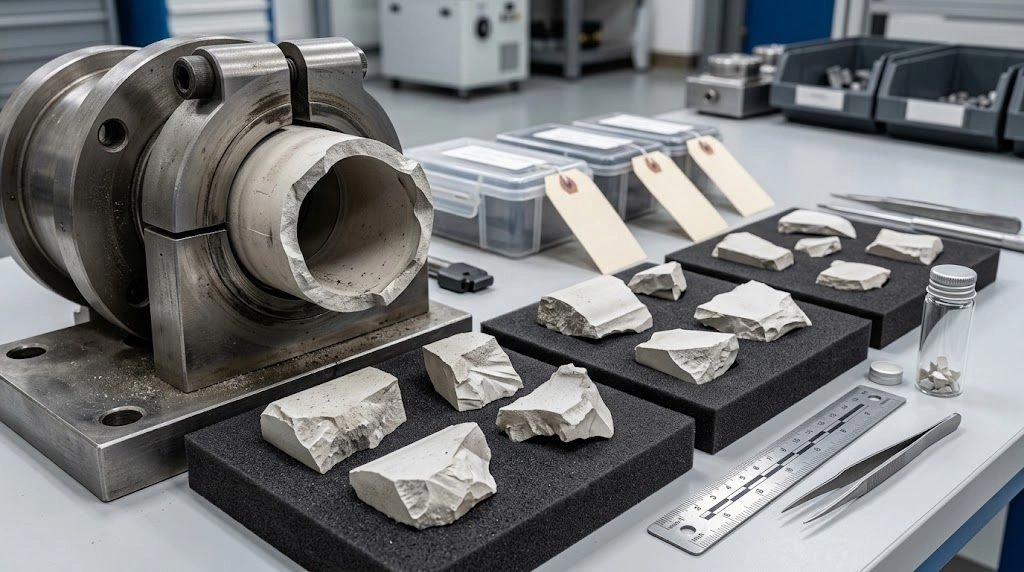
Ceramic risk factors: impact, tolerance, lead time, and thermal shock. A balanced comparison must also account for the hidden costs on the ceramic side. Custom ceramic parts typically have longer lead times than stock metal parts. Ceramic components that are poorly tolerance-matched to their mounting hardware may fail during installation from edge loading or press-fit stress. Ceramic parts that experience unanticipated impact — from kiln charges, tool contact, or vibration — can fracture suddenly in ways that metal would not. First-time ceramic qualification requires engineering review, dimensional verification, and often a trial run period before full production deployment. These costs are real and must be included in the ceramic qualification cost.
What payback threshold should trigger ceramic replacement?
After mapping the costs and understanding the hidden drivers on both sides, the question becomes: what is the decision threshold for moving from metal to ceramic in a given furnace position?
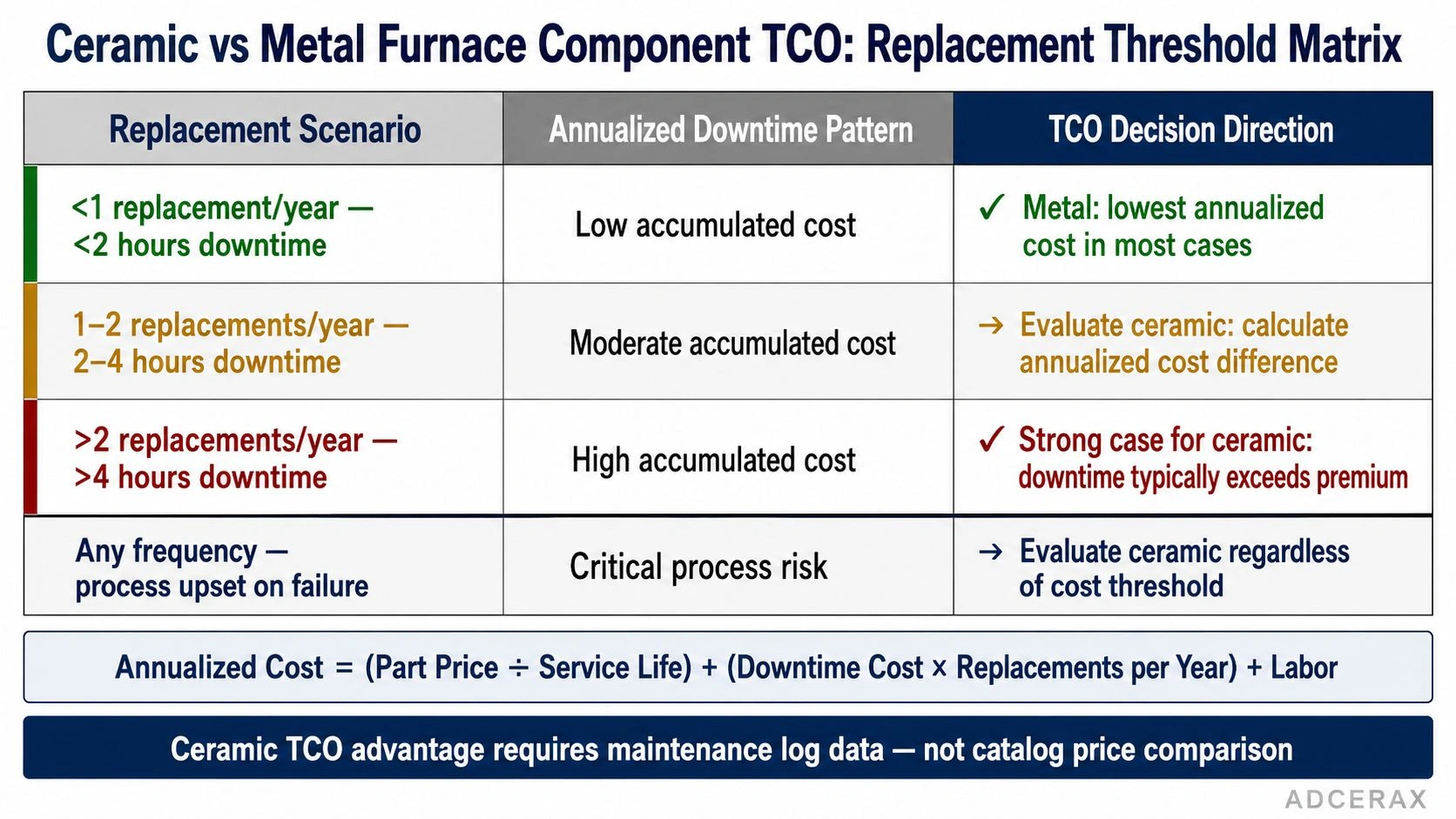
Ceramic replacement is usually justified when metal components require repeated annual replacement or cause high downtime — the decision should be based on annualized cost, maintenance-log data, and process risk rather than catalog price.
A practical ceramic replacement threshold can be organized around three scenarios:
Choose metal when: the furnace zone temperature is below the point where metal oxidizes or creeps significantly, replacement is fast and non-disruptive (less than one hour including furnace cool-down), the part is impact-exposed, no contamination or electrical insulation requirement exists, and the annual replacement cost including downtime is less than the ceramic premium plus qualification cost.
Evaluate ceramic when: screening triggers for a site cost model (frequency × downtime × margin) — not a universal financial crossover — include more than two replacements per year, more than four hours of downtime or production interruption per event, high-temperature oxidizing or reactive atmosphere, electrical insulation or contamination isolation duty, or metal deformation causing secondary damage to adjacent furnace hardware.
Run a trial when: the estimated annualized cost saving from ceramic is material but uncertain because the metal service life record is incomplete, because the furnace zone conditions are variable, or because the ceramic grade has not been tested in the specific atmosphere. A time-limited side-by-side trial sized to one or more planned maintenance intervals (an illustrative planning window such as six to twelve months is not a mandated qualification length) in one furnace position with cost tracking generates the real data needed to justify fleet-wide conversion.
For broader kiln/furnace ceramic component families beyond tubes, see industrial furnace ceramics — use it after the zone cost model, not as a catalog opener.
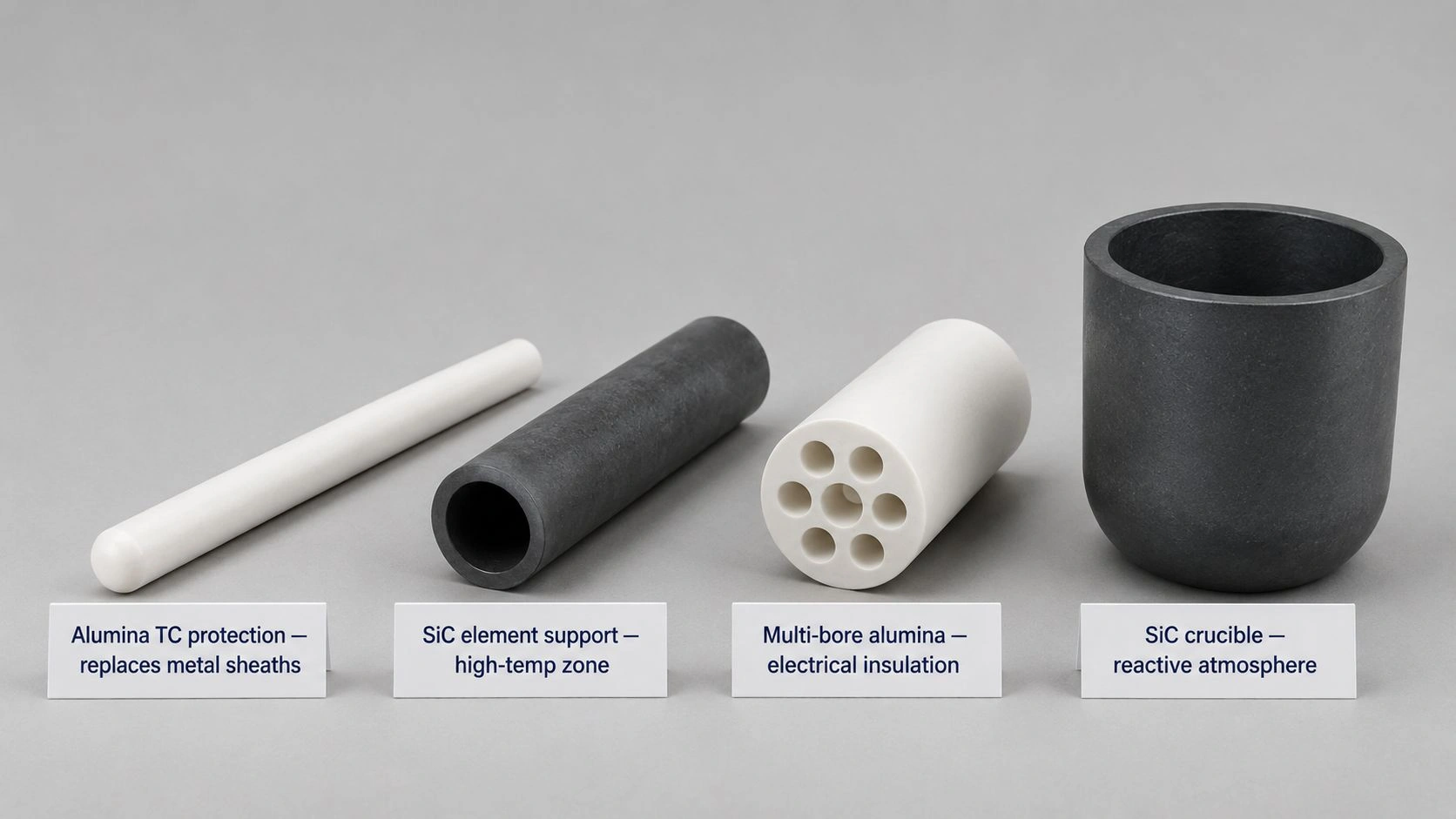
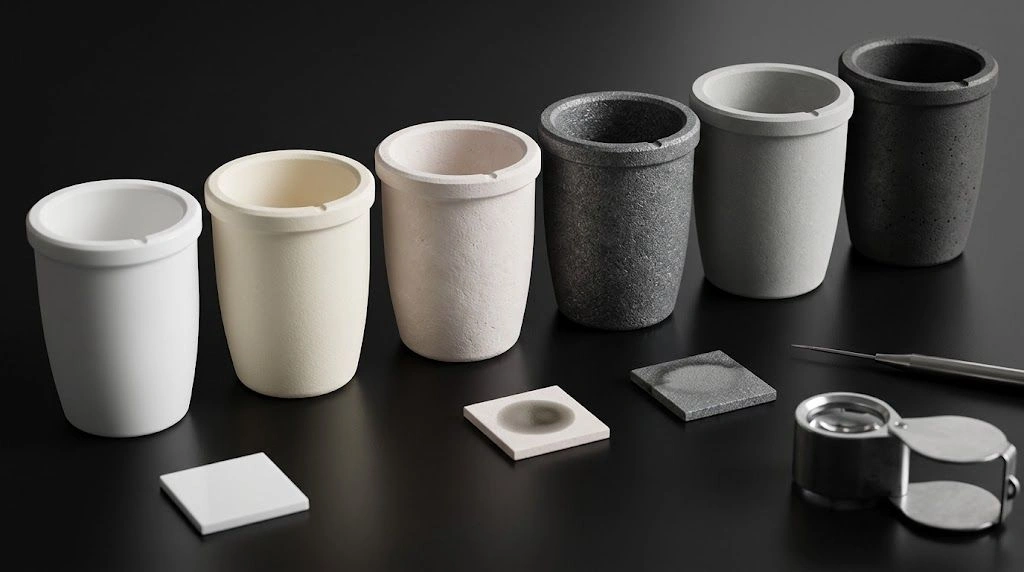
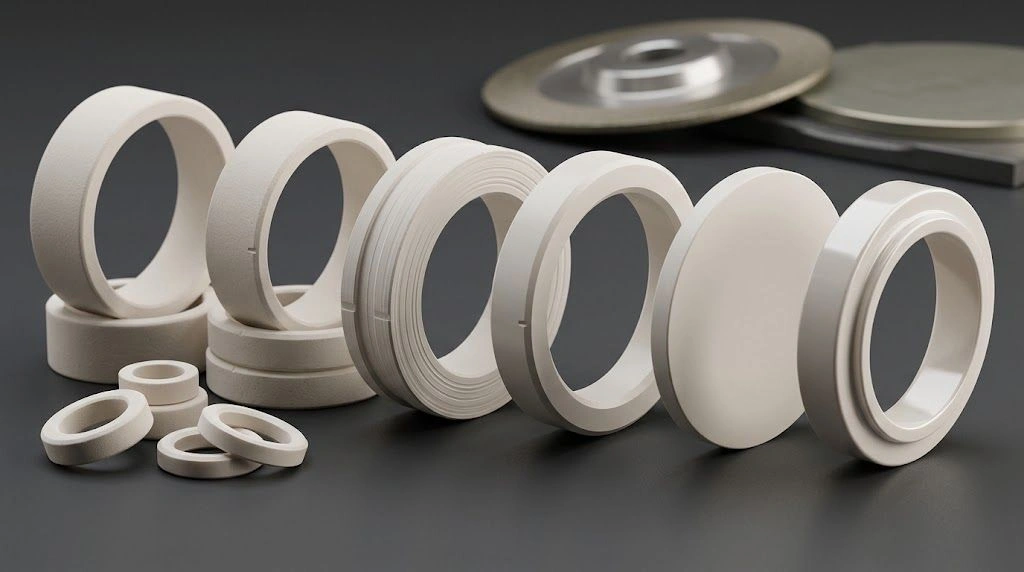
Typical ceramic furnace components — alumina thermocouple protection tubes, SiC element supports, multi-bore alumina insulators, and SiC crucibles — create TCO value only when their longer service life and process stability offset the higher upfront cost.
| Replacement frequency | Downtime per event | Ceramic justified? |
|---|---|---|
| <1 per year | <2 hours | Usually metal: low accumulated cost |
| 1–2 per year | 2–4 hours | Evaluate ceramic: depends on price differential and zone risk |
| >2 per year | >4 hours | Strong case for ceramic: annualized downtime usually exceeds ceramic premium |
| Any frequency | Critical process upset | Evaluate ceramic regardless of cost: process risk justifies qualification |
Directional screening matrix for a site cost model (frequency × downtime × margin) — not a quote and not a universal financial crossover. Verify with actual maintenance logs and contribution margin.
What should a TCO-aware RFQ ask ceramic suppliers to prove?
After the TCO framework justifies a ceramic evaluation, the RFQ must request the specific data that allows an engineering decision rather than a marketing claim.
A complete RFQ verification sequence for TCO-justified furnace ceramic replacements typically covers: operating temperature range and maximum peak temperature; material grade with density and purity where contamination matters; thermal shock test basis (ASTM C1525 or equivalent quench method and retained-strength result); creep or high-temperature strength data (ASTM C1291 or equivalent) for structural parts; dimensional tolerance and surface finish; recommended installation method and mounting clearance; maximum unsupported span; atmosphere compatibility (oxidizing/reducing/vacuum/corrosive species); expected failure modes in the specific furnace duty; and sample inspection documents. A supplier who provides only “suitable for high temperature use” cannot support the cost modeling or failure-mode avoidance that TCO-justified replacement requires.
A TCO-aware RFQ for furnace ceramic replacement should ask for:
Material data: grade, density, open porosity, hardness, flexural strength at operating temperature, thermal conductivity, thermal expansion coefficient, and atmosphere compatibility statement.
Life expectation basis: test standard used (ASTM C1525 for thermal shock, ASTM C1291 for creep — or equivalent), test conditions, and results on relevant coupons/geometry — method references for RFQ discussion, not a claim every lot is factory-certified to those standards. Reject a blanket “suitable for high temperature” claim.
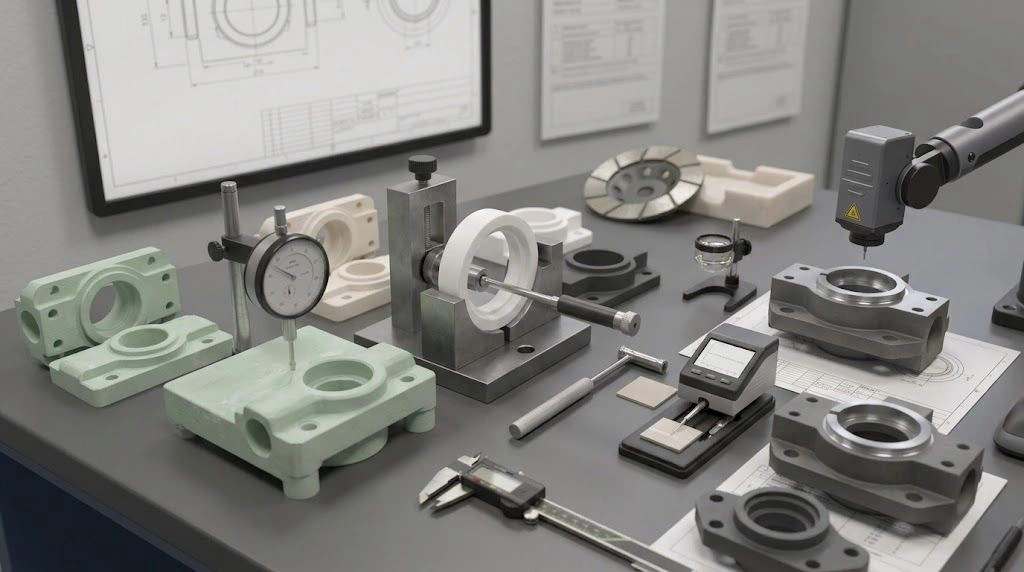
Dimensional and installation data: drawing tolerance, surface finish, maximum unsupported span, recommended mounting hardware, and installation procedure.
Failure mode documentation: what the ceramic is expected to fail from in this duty, and how that failure mode compares to the metal failure mode being replaced.
Application references: confirmation that the ceramic grade has been used in a comparable furnace zone — same atmosphere, similar temperature range, similar load type — stated in neutral terms with available performance data.
For first-time ceramic deployment in a critical furnace position, requesting a qualification sample batch with destructive inspection — density, porosity, microstructure check — and a time-limited trial with measurement of actual service life, energy consumption, and downtime provides the data needed to make the fleet-wide TCO decision on fact rather than estimate. When drawings, mounting clearance, or qualification coupons need a make-to-print path, use custom ceramic services alongside the RFQ fields above.
Comparing ceramic and metal components for a specific furnace zone? Share the furnace type, zone temperature, atmosphere, current metal component and failure mode, replacement frequency, downtime per event, component drawing, and contamination sensitivity. A supplier can review whether alumina, SiC, zirconia, silicon nitride, or another ceramic route fits the specific furnace zone and whether a qualification trial is appropriate.
Frequently Asked Questions
Are ceramic furnace components always cheaper over time than metal?
No. Ceramic reduces total cost of ownership only when the furnace conditions are severe enough that metal fails from oxidation, creep, thermal fatigue, chemical attack, or deformation at a frequency that accumulates downtime, maintenance labor, or contamination cost exceeding the ceramic premium plus qualification cost. In low-temperature, low-cycle, or impact-exposed positions, metal typically remains the lower-cost option on both initial and lifecycle bases.
What are the main maintenance costs in a kiln or furnace?
The main maintenance cost categories include replacement parts, replacement labor, planned downtime for scheduled maintenance, unplanned downtime from component failure, energy cost from degraded insulation or reduced heat transfer efficiency, product scrap from contamination or temperature non-uniformity, and inventory carrying cost for spare parts. Metal components tend to generate more frequent replacement events in demanding high-temperature zones; ceramic components generate higher upfront and qualification costs but can reduce replacement frequency.
How many times does a metal component need to be replaced before ceramic becomes worth it?
An illustrative threshold example: when replacement frequency and downtime hours are high — for example two or more replacements per year with more than four hours of downtime per event — annualized downtime cost can exceed the ceramic price premium within roughly one to two maintenance years. That outcome is contribution-margin / site-specific, not a contract payback period. For critical-process furnace positions where any failure triggers a process upset regardless of frequency, the threshold can be lower. For low-downtime positions where replacement is fast and non-disruptive, the threshold is higher.
What hidden costs make metal look cheaper than it is in furnace applications?
The most commonly missed costs in metal-favorable comparisons are unplanned downtime caused by unexpected failure, energy loss from scale buildup and deformation reducing heat transfer efficiency, product contamination from metal oxide shedding, and spare-parts inventory costs for short-lived components in multiple furnace positions. These costs are typically invisible in purchasing databases but are available in maintenance logs and production-loss records.
What ASTM standards should be referenced in a ceramic furnace component RFQ?
ASTM C1525 covers thermal shock resistance determination for advanced ceramics by water quenching and retained flexural strength — relevant for any ceramic in a thermally cycled furnace environment. ASTM C1291 addresses creep strain, creep rate, and time to failure for advanced ceramics at elevated temperature — often discussed as an engineering cue for structural support and load-bearing ceramics in elevated-temperature creep screening (commonly referenced above ~1000°C), duty- and geometry-dependent rather than a contract creep start temperature.
What should I send to a ceramic supplier to support a TCO comparison?
Send the furnace type and operating zone description, component drawing, current metal grade and failure mode, replacement frequency and downtime per event, atmosphere composition, temperature profile including peak and dwell, contamination sensitivity, and whether the ceramic requirement is for insulation, load support, chemical isolation, thermal transfer, or a combination. This enables the supplier to recommend the appropriate ceramic grade, confirm atmosphere compatibility, and identify what test data supports the assumed service life.
Related reading
- Which ceramic for furnace duty — decision tree — Route alumina vs SiC vs other ceramics by furnace zone and duty — before you run the cost model.
- Alumina tubes in hydrogen reduction furnaces — Hydrogen-reduction furnace tube duty where atmosphere and replacement frequency drive material choice.
- Alumina tube failure modes in tube furnaces — Tube-furnace failure modes that turn into downtime and scrap cost in the TCO stack.