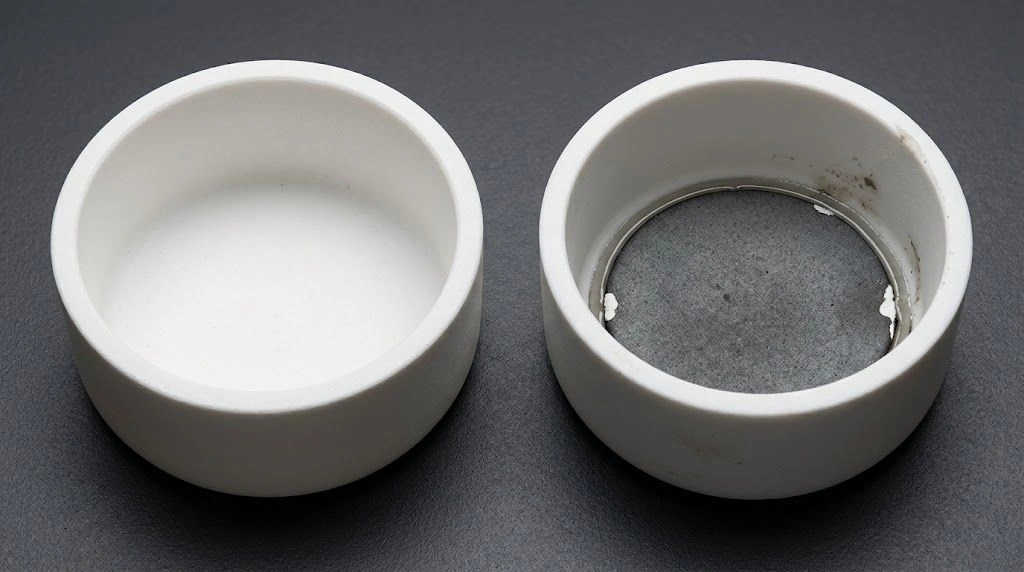
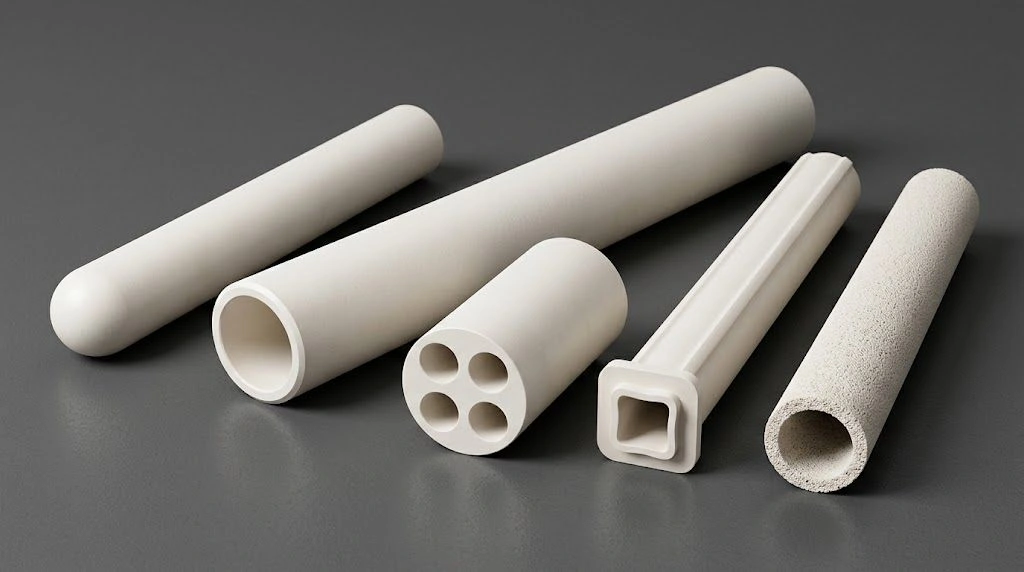
Alumina tube fracture above 1200°C becomes strain-rate sensitive when slow crack growth, creep deformation, grain-boundary phases, and high-temperature stress relaxation begin to influence failure before the final break. A fast flexural test may report a higher apparent strength than a slow load, long dwell, or sustained furnace service condition — and the difference can be large enough to matter for tube specification. For tubes in real furnace service, the effect is strongest when bending stress, wall thickness, unsupported span, thermal gradients, and atmosphere allow flaws to grow over time before final fracture. Test reports must state temperature, loading rate, hold time, atmosphere, and specimen geometry before the strength number can be used responsibly.
That requirement — knowing the test conditions, not just the result — is the engineering principle this guide builds around.
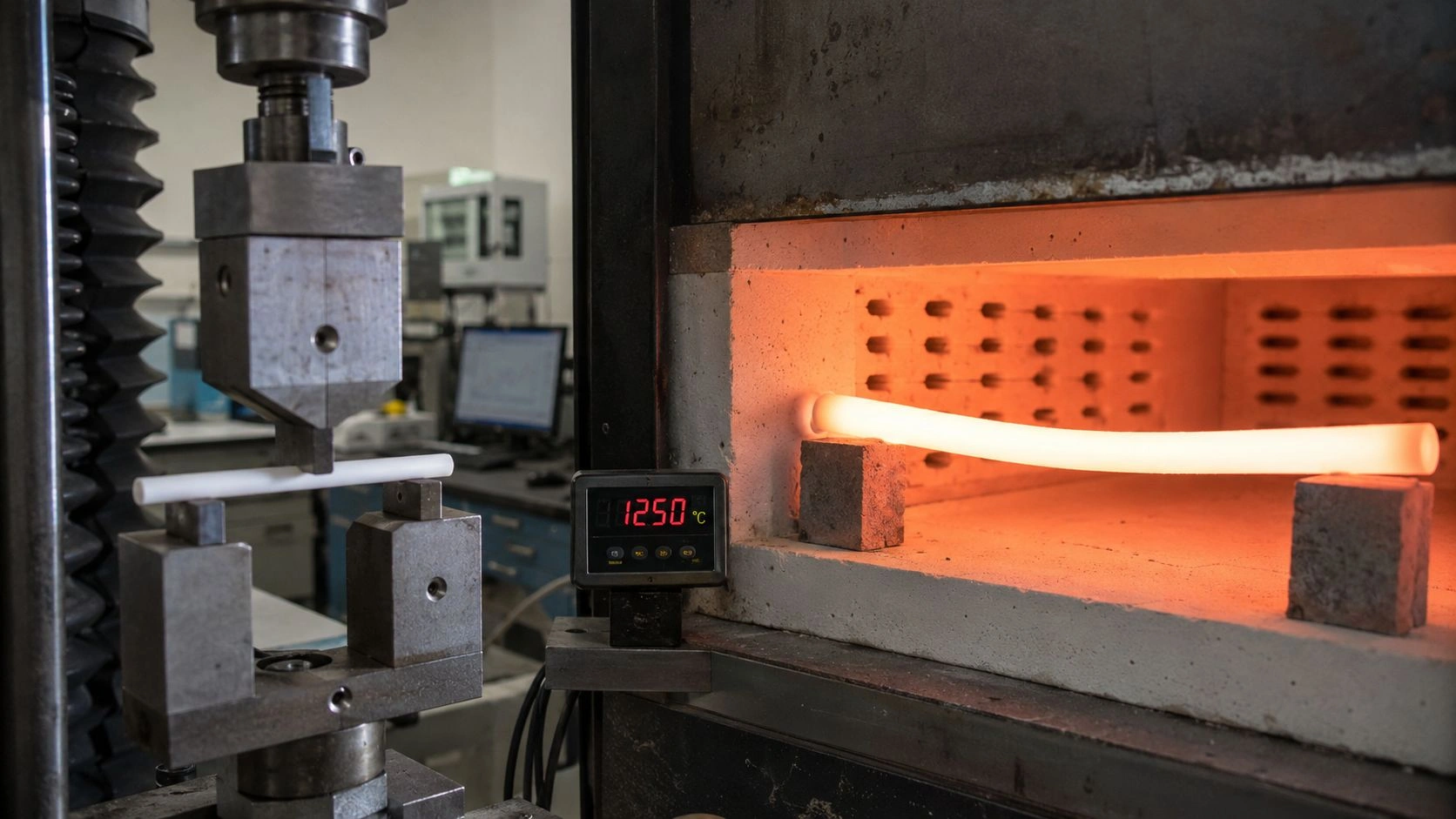
Alumina tube fracture above 1200°C is not controlled by temperature alone — loading rate, dwell time, support span, and grain-boundary phase all shape whether a tube survives long furnace service at a strength that a fast laboratory test would predict.
When screening high-temperature alumina tube grades for furnace, thermocouple protection, or process-tube duty, treat 99%, 99.5%, and 99.7% Al₂O₃ as common industrial purity bands — confirm diameter, wall, length, and grade against the supplier TDS/COA on RFQ. For non-catalog geometry or fixture constraints, use a custom alumina tube RFQ rather than assuming stock sizes cover the bend/span case.
Why strain rate starts to matter above 1200°C
Below the high-temperature regime, alumina fracture is dominated by fast fracture from pre-existing flaws. A fast bend test at room temperature or moderate temperature gives a strength value that is reasonably representative of short-term service conditions. Above approximately 1200°C, this changes. Time-dependent mechanisms become active — cracks can grow subcritically before the final fracture event, grain-boundary phases may soften or facilitate crack advance, and sustained stress introduces creep that can redistribute stress and create new damage.
The consequence for tube specification is direct: a fast-loading laboratory test above 1200°C may measure a strength that the tube cannot sustain if loading is slower, hold time is longer, or the tube carries a sustained bending moment during furnace operation.
ASTM C1211 — the standard test method for elevated-temperature flexural strength of advanced ceramics — explicitly states that the measured strength may be strongly dependent on testing rate because of creep, stress corrosion, or slow crack growth. That warning is embedded in the standard itself, and it means that any elevated-temperature flexural strength value must be accompanied by the testing rate before it can be used as a design input.
Strain rate vs stress rate vs crosshead speed
These three terms describe related but not identical quantities. Crosshead speed is the machine displacement rate. Stress rate is the rate of stress increase at the specimen outer fiber. Strain rate is the rate of strain development. ASTM C1211 discusses outer-fiber stress-rate control for elevated-temperature flexural testing. Rates on the order of 1 MPa/s (moderately fast) versus 0.01 MPa/s (slow) are useful as illustrative screening contrasts in that standard's context — not as a universal plant standard or factory default. A slower rate gives the alumina more time to develop subcritical damage before fracture and will typically return a lower strength value than a faster rate on the same specimen. Always report the actual stress rate or strain rate with the strength number; for tube specification, ask whether service loading is closer to the fast screening condition or a slow/sustained duty.
Fast fracture strength vs long-duration service strength
Fast fracture strength is the strength of the material if it were stressed to failure in a short time. Long-duration service strength is the stress below which the tube will not fail over the intended service life at the operating temperature. These two values can differ substantially when slow crack growth or creep is active. The gap between them — the safety margin that a fast test does not reveal — is the engineering problem this guide addresses.
Why tubes are more sensitive than small coupon bars
Standard flexural strength specimens are short, smooth, uniformly loaded bars. They are designed to sample bulk material properties. A furnace tube is long, may have machined features, carries a distributed or point-loaded bending stress over an unsupported span, and sits at temperature for hours or days per cycle. The probability that a flaw in the tube wall will experience the conditions needed for subcritical crack growth is substantially higher than for a small test coupon. This means tube design should not use coupon-bar strength data without applying geometric and service-condition corrections.
Slow crack growth, creep, or thermal shock: separating the mechanisms
Understanding which mechanism dominates a particular fracture event determines what the corrective action should be. The three most important high-temperature failure mechanisms in alumina tubes are slow crack growth, creep, and thermal shock — and they require different design responses.
Elevated-temperature flexural methods such as ASTM C1211 warn that measured strength may be strongly rate-dependent because of creep, stress corrosion, or slow crack growth. Published slow-crack-growth guidance for advanced ceramics likewise notes that creep and slow crack growth can overlap at lower test rates — so neither mechanism can be excluded from high-temperature tube fracture analysis without rate- and time-specific test data. Ask which elevated-temperature method and environment apply to the duty before treating a single strength number as a design input.
The Strain Rate Effect Matrix below maps key variables to their lower-risk and higher-risk interpretation:
| Variable | Lower-risk interpretation | Higher-risk interpretation | What to request |
|---|---|---|---|
| Loading rate | Fast test used only for comparative screening | Fast test treated as long-term service strength | Stress/strain rate in report |
| Hold time | Short exposure before fracture test | Long dwell under stress | Soak time and time-at-temperature |
| Tube geometry | Short vertical tube with low bending stress | Long horizontal tube with span load | Support spacing and load map |
| Wall thickness | Uniform thermal field | Strong through-wall gradient | Ramp/cooling profile |
| Flaw population | Smooth unmachined tube | Slots, holes, chips, machined transitions | Inspection and edge finish |
| Atmosphere | Clean controlled gas | Wet gas, reactive vapor, thermal cycling | Atmosphere and dew point |
| Data type | Flexural strength clearly labeled | Flexural, creep, and SCG data mixed | Test standard and objective |
Values indicative; verify per ASTM C1211/C1291/C1368 where applicable with supplier-specific test data and application trials.
Slow crack growth: flaw extension before final break. Slow crack growth means that a pre-existing flaw in the alumina — from machining, surface handling, or sintering — extends under sustained stress before reaching the critical size at which fast fracture occurs. ASTM C1368 frames slow crack growth characterization as a way to quantify ceramic susceptibility to this mechanism under defined test environments and stress rates. The flaw does not propagate at a constant rate: the rate depends on stress intensity at the crack tip, temperature, and environment. Water vapor, even at low concentrations, can accelerate crack growth in alumina through stress corrosion mechanisms at the crack tip.
Creep: time-dependent strain under sustained stress. Creep is strain accumulation under sustained temperature and stress. ASTM C1291 addresses elevated-temperature tensile creep strain, creep rate, and time-to-failure for advanced monolithic ceramics. In alumina tubes, creep manifests as gradual dimensional change — sag, ovality, or wall thinning — rather than sudden fracture. The distinction from slow crack growth is that creep is distributed throughout the material, while slow crack growth is localized at a flaw. In practice, both can occur simultaneously: creep can redistribute stress in a way that increases stress intensity at a flaw, accelerating slow crack growth toward final fracture.
Thermal shock: gradient-driven tensile stress. Thermal shock is caused by rapid temperature change creating thermal gradients that produce tensile stress in the cooler region. Unlike slow crack growth and creep, thermal shock failure is fast — it occurs during the thermal event, not during sustained hold at temperature. The crack pattern from thermal shock is typically branched, surface-initiated, and associated with the thermal cycle rather than with accumulated dwell time. Distinguishing thermal shock from slow crack growth requires examining when the failure occurred — during a temperature change or during steady-state soak.
Glassy grain-boundary phases and purity effects. The presence of a glass phase at alumina grain boundaries — even at low volume fraction — substantially affects high-temperature mechanical behavior. Glassy phases soften above their glass transition temperature, allowing grain-boundary sliding, accelerating slow crack growth, and reducing creep resistance. Higher-purity alumina grades (for example 99.7% vs 99%) often have lower impurity content and less glass-phase volume, which can improve high-temperature time-dependent performance under the same load — but the benefit is grade- and process-dependent (grain size, sintering, atmosphere); confirm with TDS/COA rather than treating any purity as inevitably better in creep. NIST research on elevated-temperature alumina fatigue found that subcritical crack growth enhanced by glassy phases controls failure, and that the same pre-existing flaws that control room-temperature strength also control elevated-temperature strength — confirming that flaw management and purity choice are both relevant to service life.
Do not treat fast flexural strength as long-term tube reliability
A supplier data sheet that states "flexural strength at 1300°C: X MPa" is an incomplete specification for a tube in sustained furnace service. The number is useful for comparative screening between materials or grades, but it cannot be used as a service-life design input without knowing the rate, soak time, specimen geometry, atmosphere, and fracture mode.
Why "tested at 1200°C" is not enough. Two suppliers can both state "tested at 1200°C" and produce results that differ by 30–50% if their test rates differ by an order of magnitude. This is not a quality difference — it is a test-condition difference. Without the stress rate or strain rate, the buyer cannot know whether they are comparing equivalent data or fundamentally different test protocols.
Test bar vs actual tube geometry. Standard flexural test specimens are smooth rectangular bars approximately 3mm × 4mm × 45mm. A production alumina tube with OD of 25mm, wall of 2mm, and length of 500mm has a completely different flaw population, stress distribution, and probability of encountering a strength-limiting defect. Strength data from standard coupons provides material characterization; it does not directly predict tube service life without scaling for geometry and surface condition.
Strength data, creep data, and SCG data are not interchangeable. Fast flexural strength tells the buyer about fast-fracture flaw distribution. Creep data tells the buyer about long-duration dimensional stability under sustained stress. Slow crack growth parameters tell the buyer about the rate at which pre-existing flaws will grow under subcritical stress at temperature. For a hypothetical multi-thousand-hour sustained-bend duty (for example, on the order of 10,000 hours at ~1300°C) — not a life guarantee and not a TDS-rated life — creep data and SCG data combined with fast-fracture strength are needed; fast flexural alone is not adequate characterization.
The Failure Mechanism Diagnostic table below maps observed fracture behaviors to likely mechanisms and diagnostic questions:
| Observed behavior | Likely mechanism | Rate sensitivity | Diagnostic question |
|---|---|---|---|
| Lower strength at slower loading | Slow crack growth | High | Was strength measured at multiple stress rates? |
| Permanent bend or sag before fracture | Creep-assisted damage | High | Was the tube under sustained load above 1200°C? |
| Sudden crack during cooling | Thermal shock | Medium to high | Was there a steep thermal gradient or rapid cooling? |
| Crack near support | Point loading/bending stress | Depends on dwell | Is the damage located at a contact point? |
| Crack at machined slot | Flaw-controlled fracture | High | Was edge finish inspected? |
| Different lab vs field results | Test condition mismatch | High | Were rate, atmosphere, geometry, and dwell matched? |
The Test Standards and Data Use table maps the relevant ASTM standards to their specific role and limitations:
| Standard/data type | Best use | Limitation | RFQ wording |
|---|---|---|---|
| ASTM C1211 | Elevated-temperature flexural strength | Rate-dependent strength warning must be considered | "Report test rate, temperature, soak, and span" |
| ASTM C1368 | Slow crack growth parameters | Ambient-temperature version may not represent high-temperature service | "Provide SCG method and environment" |
| ASTM C1291 | Elevated-temperature tensile creep | Tensile specimens may not match tube bending | "Provide creep strain/creep rate if available" |
| Application tube test | Best geometry match | Higher cost and setup complexity | "Test tube section under specified span/load" |
| Supplier data sheet | Screening only | Often lacks rate, dwell, and geometry | "Do not use without test condition details" |
Tube geometry and service conditions that amplify rate effects
Rate effects are not equally important for all alumina tube applications. They become most significant when the tube carries sustained bending stress at temperature over long periods — which is when the gap between fast-test strength and actual service reliability is largest.
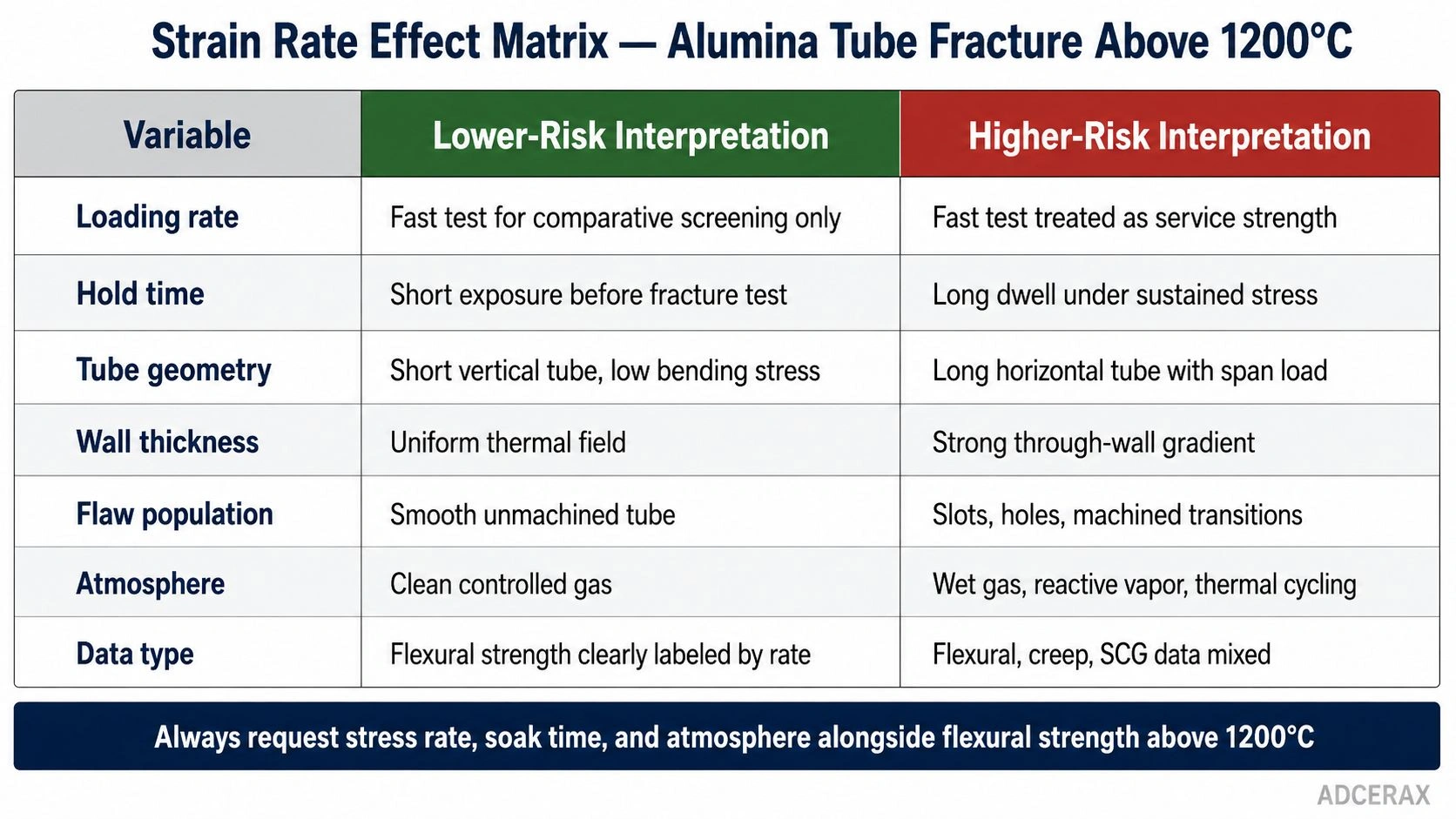
Seven engineering variables control strain-rate sensitivity in alumina tube fracture above 1200°C — loading rate and support span are the highest-leverage variables for specification review.
Long horizontal tubes and bending stress. A long horizontal alumina tube carries its own weight as a distributed load, creating a bending moment that peaks at midspan. The longer the unsupported span, the higher the peak stress, and the more time the highest-stressed region of the wall has to develop subcritical damage during furnace holds. For horizontal tubes above 600mm unsupported length at temperatures above 1200°C, slow crack growth and creep data should be requested alongside flexural strength.
Thick-wall tubes and through-wall thermal gradients. A thick-wall tube heated from the outside — or a tube surrounding a hot process gas — develops a thermal gradient from the outer to inner surface. This gradient creates thermally induced bending stress inside the wall, which adds to any mechanically applied bending stress. The thermal component depends on the ramp rate, the wall thickness, and the thermal conductivity of the alumina grade. At high temperature, this combined stress state creates conditions where slow crack growth can initiate from inner-surface flaws.
Machined holes, slots, and end transitions. Stress concentrations at geometric discontinuities — drilled holes, slots, notches, or sharp wall transitions — are preferential sites for flaw initiation and slow crack growth. Edge finish quality at these features matters more at high temperature than at room temperature because the combination of stress concentration and time-dependent flaw growth above 1200°C can produce fracture at loads that would be safe for an unmachined tube.
End restraint and support-point stress. A tube clamped at both ends cannot accommodate free thermal expansion, which generates additional axial compressive or tensile stress depending on whether the tube is heating or cooling. Point contact at support saddles or end seals concentrates bending stress locally. These stress concentrations are sites where crack growth preferentially initiates under long-duration loading at high temperature.
Alumina tube grades differ in grain size, purity, and sintered density in ways that can change high-temperature slow crack growth and creep behavior. Higher-purity, lower-glass grades often show better creep resistance under the same load — but the outcome is grade- and process-dependent; confirm grain size, sintering route, and TDS/COA rather than assuming any single purity (for example 99.7%) is inevitably better. Select after reviewing service temperature, loading mode, and dwell time — not from catalog maximum temperature alone. Non-standard spans or machined features belong on a custom tube geometry RFQ.
The same tube-geometry and service-condition variables — span, wall, atmosphere, and dwell — govern fracture-rate interpretation for alumina tubes; keep material-family comparisons secondary to the alumina rate/creep/SCG RFQ fields in this guide. When geometry is application-specific, route the inquiry through custom ceramic tube services with the load map attached.
RFQ checklist for alumina tube fracture data above 1200°C
A complete RFQ for high-temperature alumina tubes must provide the service conditions that allow a supplier to confirm whether the available strength data is appropriate for the application — and to identify whether additional creep or slow crack growth testing is needed.
For high-temperature load-bearing alumina tube RFQs, require test reports to state the ASTM C1211 (or equivalent) test rate and soak time alongside the strength value; ask for ASTM C1291 creep data or ASTM C1368 slow crack growth parameters when service involves sustained bending stress above 1200°C; and request test pieces from the same production route as the supplied tubes rather than generic alumina coupon data. Fast-test strength from a standard coupon is not a long-duration service-reliability design input without those additional fields.
| RFQ field | Why it matters | Recommended wording |
|---|---|---|
| Alumina grade | Grain boundary and purity affect high-temp response | "Specify 99%, 99.5%, 99.7%, or 99.9% Al₂O₃" |
| Tube geometry | Controls bending and stress concentration | "OD, ID, wall, length, holes, slots, closed end" |
| Service temperature | Defines mechanism window | "Continuous and peak temperature above 1200°C" |
| Loading condition | Drives fracture/creep risk | "Load mass, support spacing, orientation" |
| Test rate | Controls measured strength | "State stress rate or strain rate" |
| Dwell time | Controls slow growth and creep | "Report soak time before loading" |
| Atmosphere | Affects SCG/grain-boundary behavior | "Air, vacuum, inert, reducing, wet gas" |
| Failure criterion | Defines pass/fail | "Allowable crack, sag, leakage, or fracture" |
| Test standard | Makes data comparable | "Use ASTM C1211/C1291/application test as needed" |
RFQ fields are the minimum for a high-temperature alumina tube fracture data request; add furnace orientation, end-constraint description, and acceptable deflection limit as relevant.
For critical applications — long horizontal tubes, tubes carrying significant sustained load, tubes with machined features, or tubes expected to serve above 1300°C for thousands of hours — application-specific tube load testing using actual tube sections under the intended span and load is the most reliable qualification method. Generic coupon-bar data from the same alumina grade is a necessary starting point, not a final approval.
Specifying alumina tubes for service above 1200°C under load? Share tube geometry, furnace orientation, support spacing, load mass, operating temperature, hold time, atmosphere, and ramp/cooling profile on the RFQ. Ask the supplier which purity band (99% / 99.5% / 99.7% as screening options — confirm TDS), fixture, and fracture/creep test package fits the duty — and whether coupon data or tube-section tests are required. Use the alumina tubes product page for grade/geometry screening and custom services for non-catalog spans or machined features; no RFQ commitment is required at the inquiry stage.
Frequently Asked Questions
Why does strain rate affect alumina tube fracture above 1200°C?
Above 1200°C, time-dependent failure mechanisms become active in alumina. Slow crack growth means pre-existing flaws can extend under stress before reaching the critical size for fast fracture. Creep means sustained stress causes gradual strain accumulation. Grain-boundary glassy phases soften and facilitate crack advance. A slower loading rate or longer hold time gives these mechanisms more time to operate, which is why fast laboratory tests can overstate the strength margin available during long furnace service.
Is fast flexural strength data reliable for long furnace service?
It is useful for comparative material screening but should not be treated as a long-duration service strength without knowing the test rate, soak time, atmosphere, and specimen geometry. ASTM C1211 explicitly warns that elevated-temperature flexural strength may depend strongly on testing rate because of creep, stress corrosion, or slow crack growth. For sustained-load applications above 1200°C, creep data (ASTM C1291) and slow crack growth parameters (ASTM C1368) provide the additional characterization needed.
What is slow crack growth in alumina?
Slow crack growth is subcritical extension of a pre-existing flaw under stress — the flaw grows at a rate below the critical crack velocity, so the tube does not fail immediately but will eventually fracture when the flaw reaches critical size. The rate of growth depends on stress intensity at the crack tip, temperature, and environment. Water vapor can accelerate slow crack growth in alumina through a stress corrosion mechanism at the crack tip.
How is creep different from slow crack growth in alumina?
Creep is distributed time-dependent strain throughout the material under sustained temperature and stress — it shows up as dimensional change, sag, or ovality. Slow crack growth is localized extension of a specific flaw under stress — it shows up as a crack that propagates until fracture. In high-temperature alumina service, both can occur simultaneously: creep can redistribute stress in a way that increases the stress intensity at a flaw, accelerating slow crack growth toward final fracture.
Which tube geometries are most sensitive to strain-rate effects?
Long horizontal tubes with large unsupported spans, thick-wall tubes with significant through-wall thermal gradients, tubes with machined holes or slots that create stress concentrations, and tubes with rigid end constraints that add axial thermal stress are all more sensitive. The combination of elevated sustained bending stress, long dwell time, and stress concentration sites creates the conditions where the gap between fast-test strength and actual service reliability is largest.
What should I ask a supplier for when specifying alumina tubes above 1200°C?
Ask for the alumina grade (99%, 99.5%, 99.7%), tube geometry with OD/ID/wall/length, high-temperature flexural test method and standard, test temperature, soak time, stress or strain rate, atmosphere, specimen geometry, fracture location, and whether the strength data comes from standard coupons or actual tube sections. If the tube will carry sustained bending load above 1200°C, also ask whether ASTM C1291 creep data or ASTM C1368 slow crack growth parameters are available for the specific grade and temperature range.
Related reading
- High-purity alumina tube thermal shock resistance — separates thermal-shock cracking from the strain-rate / slow-crack / creep fracture path covered here.
- Alumina tube grain size and creep — microstructure levers when sustained-load creep, not fast flexural rate, dominates the RFQ.
- Key information for quoting alumina tubes — industrial RFQ field checklist that complements the fracture-test rate and creep fields above.