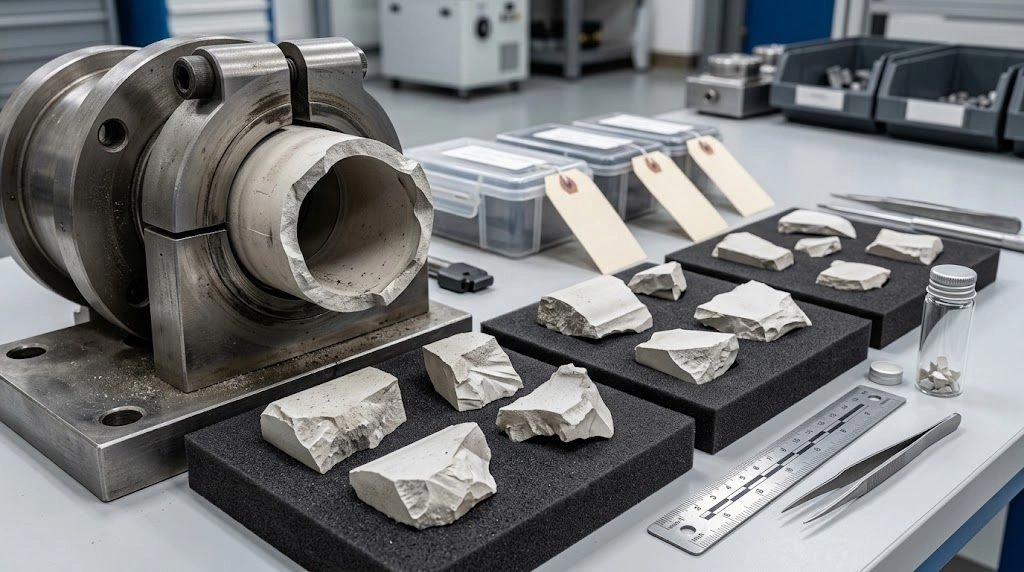
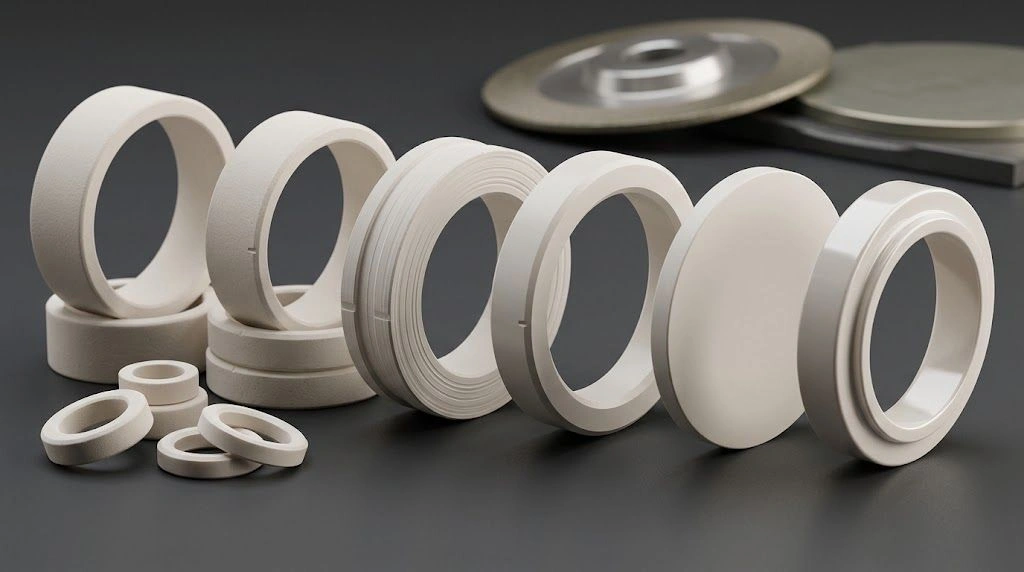
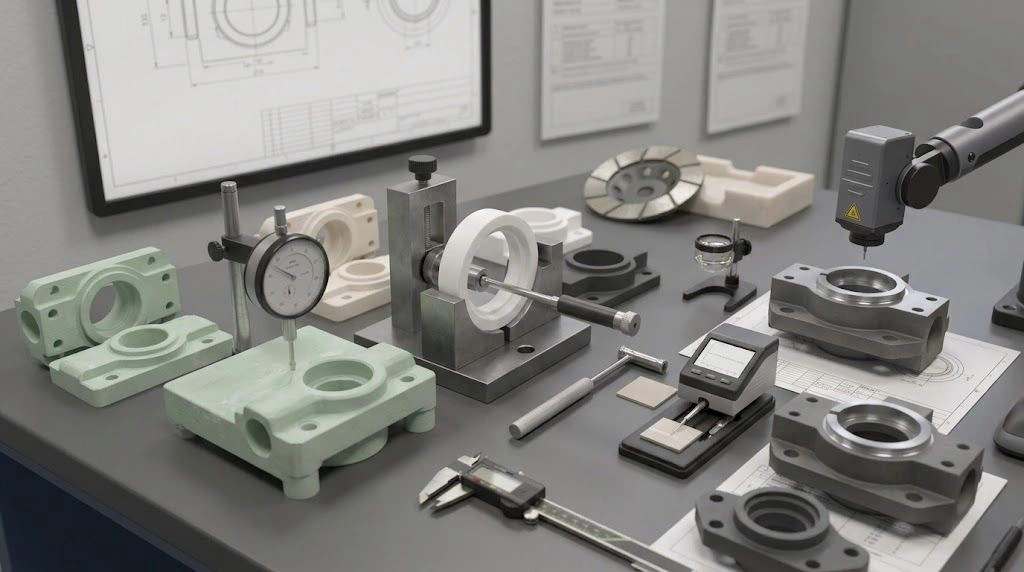
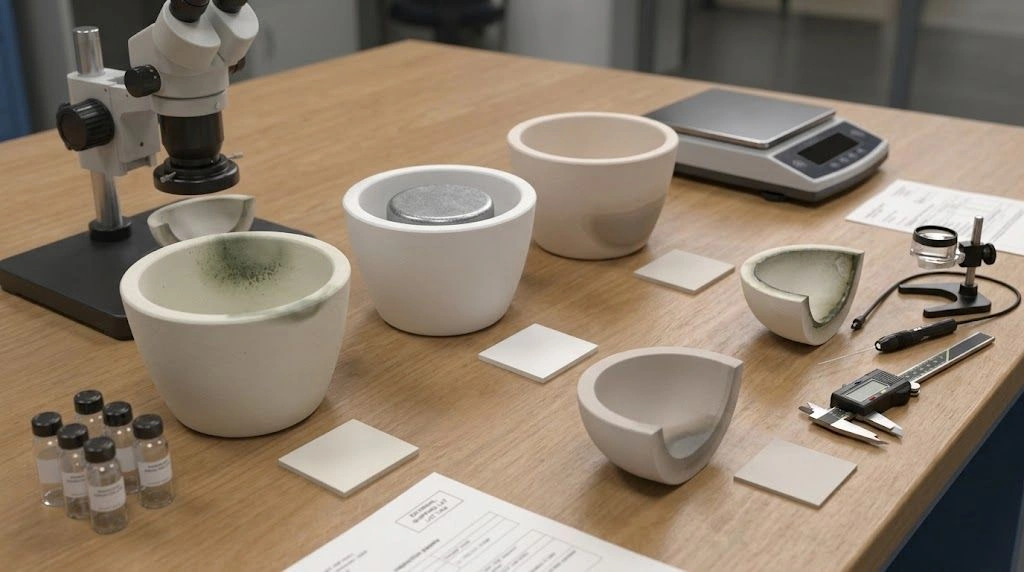
Select a crucible from the complete process, not a maximum-temperature value. Record the sample, flux, binder, impurities and expected reaction products; continuous and peak temperature; ramp and cooling rates; atmosphere, pressure and hold time; working fill; geometry and support; contamination limits; and reuse plan. Eliminate candidates vulnerable to reaction, oxidation, dissolution, wetting, contamination or deformation. Then compare thermal cycling, equipment fit, inspection and cost. A chart can create a shortlist, but only a representative test with the intended charge and operating conditions can qualify a crucible.
1. Define the Process Before Comparing Crucible Materials
Start by classifying what the crucible must do. The same nominal temperature can describe a powder calcination, a corrosive molten-flux exposure, or a milligram-scale thermal-analysis measurement. Those processes impose different chemical, dimensional and measurement requirements on ceramic crucibles for high-temperature processes.
| Process class | Primary crucible duty | Questions that control the shortlist | Typical failure evidence |
|---|---|---|---|
| Calcination or ashing | Contain powder while mass and chemistry change | Will binders burn, salts melt, or ash attack the body? Is complete residue recovery required? | Staining, adhered ash, cracking, mass transfer |
| Ceramic sintering | Support a compact without reaction or distortion | Can the body, setter and crucible exchange species? Is powder bedding needed? | Warping, sticking, color or phase change |
| Metal melting | Contain a liquid alloy and its oxide or slag | What are alloying elements, oxygen potential, fluxes and hold time? | Wetting, penetration, inclusions, wall loss |
| Glass melting | Resist a reactive melt during homogenization | Which oxides, colorants and refining agents are present? What contamination is acceptable? | Dissolution, bubbles, streaks, composition drift |
| TGA, DSC or STA | Hold a small sample without obscuring the signal | Does the instrument approve the material, mass, shape and lid? Are evolved gases expected? | Shifted peaks, baseline change, incomplete gas release |
| Vacuum or e-beam evaporation | Hold or line a source pocket during heating | Is the evaporant compatible with the liner and gun? Does it sublime or become molten? | Spitting, cracking, cross-contamination, poor deposition stability |
For thermal analysis, the crucible is part of the measuring system. NETZSCH notes that its material, mass and geometry can affect DSC/DTA response. METTLER TOLEDO likewise organizes selection by sample, temperature, atmosphere and technique. Do not substitute a custom part without instrument review.
For evaporation, include the evaporant, gun or furnace, pocket geometry, power method and fill behavior. Denton Vacuum and Luxel treat crucibles as source-specific components. Subliming and molten charges can require different fills, while conditioning and spitting must be evaluated in the actual source.
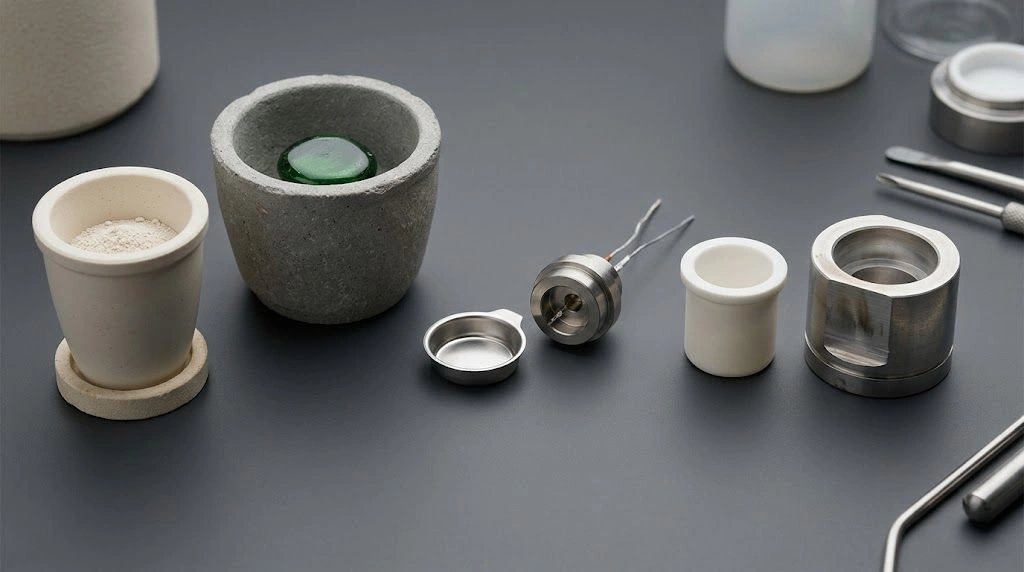
The process class defines the chemical contact, geometry, heat-transfer and equipment-interface questions that precede material selection.
2. Eliminate Materials by Reaction, Atmosphere and Contamination
Use the matrix to reject candidates, not approve one. Published properties describe particular grades and methods; service behavior also depends on purity, porosity, stabilizer, surface, geometry and manufacturing route.
| Material family | Useful first-pass characteristics | Conditions requiring specific review | Procurement evidence to request |
|---|---|---|---|
| Alumina | Broad laboratory use, insulation and many shapes | Charge chemistry, flux attack, wetting, contamination and cycling | Grade, Al₂O₃, density and drawing |
| Stabilized zirconia | Refractory oxide with low thermal conductivity | Stabilizer, phase stability, gradients, reactions and contamination | Stabilizer/type, composition and density |
| Magnesia | High-refractory basic oxide candidate | Hydration, contact chemistry, impurities and storage | MgO grade, density and storage controls |
| Silicon carbide or nitride-bonded SiC | High conductivity and useful shock behavior in suitable systems | Oxidation, bond phase, porosity and electrical behavior | Grade, bonding route and atmosphere limits |
| Boron nitride or PBN | Selected non-wetting, machinable or high-purity options | Oxidation, binder, vacuum chemistry and fragility | BN type, purity, binder and density |
| Yttria | High-purity oxide option for strict contamination limits | Cost, manufacture, porosity, chemistry and cycling | Purity, density and test coupons |
| Quartz or fused silica | Low expansion and transparency in selected uses | Devitrification, time/temperature, chemical attack and softening | Material type, dimensions and surface state |
| Graphite | Conductive, machinable container in controlled environments | Oxidation, carbon pickup, porosity and outgassing | Grade, density, ash and coating |
| Platinum or refractory metal | Specialized conductive or very-high-temperature option | Alloying, catalysis, volatility, cost and contamination | Alloy, purity, thickness and fabrication |
Alumina ceramic crucibles are often practical, but “alumina compatible” is not universal. Zirconia ceramic crucibles must be identified by stabilization system. Magnesium oxide crucibles require hydration and storage controls as well as chemistry review.
For non-oxides, atmosphere is a first-order input. Boron nitride crucibles can suit selected non-wetting or vacuum applications, while a cylindrical silicon carbide crucible may address thermal management. Neither is approved by an “inert” or “high-temperature” label; grade, oxygen potential, pressure and dwell matter.
Apply three elimination tests:
- Reaction: Could the charge dissolve, reduce, oxidize or otherwise react with the crucible, stabilizer, binder, coating or impurities?
- Containment: Could liquid or vapor wet, penetrate, leak through, evaporate from, or mechanically load the body beyond its qualified condition?
- Contamination: Could crucible-derived species alter purity, color, phase formation, electrical behavior, analytical mass or deposition quality?
A melting point or catalogue maximum is only one boundary. It does not prove chemical compatibility, dimensional stability, repeated-cycle durability or safe use in the specified atmosphere.
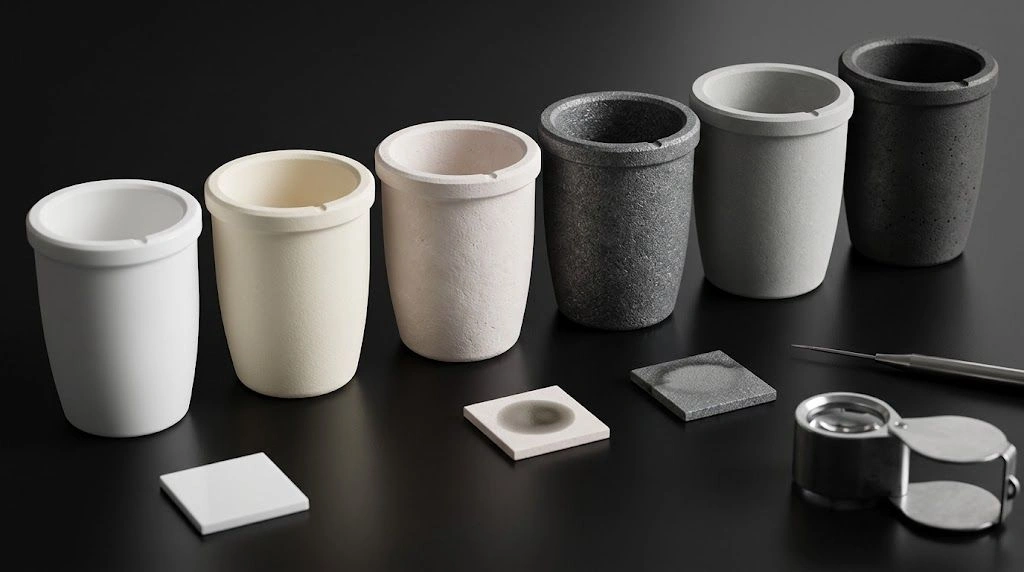
Material-family comparison becomes meaningful only when paired with the intended charge, atmosphere and acceptance evidence.
3. Match Geometry, Working Fill, Lid and Equipment Interface
After chemical screening, close the physical system. State OD, ID, height, wall and base, rim, radius, taper, lip and surface criteria. Show supports, tongs, setters, coils, source pockets, sensors, covers and insertion clearances. Nominal volume does not prove fit.
| Geometry field | What to specify | Why it changes selection |
|---|---|---|
| Working fill | Charge mass/volume and expected expansion, melting, foaming, sublimation or gas evolution | Nominal capacity is not usable capacity; headspace is process-specific |
| Base and wall | Thickness, flatness, radius, taper and permissible variation | Controls support, temperature gradients, stress and equipment contact |
| Rim and handling | Lip, flange, pouring feature, tong zone and prohibited contact areas | Prevents unsafe gripping and unintended point loading |
| Lid system | Open, loose, fitted, vented or instrument-sealed; aperture and clearance | Changes heat transfer, evaporation, gas escape, oxidation and pressure behavior |
| Equipment envelope | Furnace, balance, robot, sensor, holder or source-pocket drawing | Confirms insertion, seating, removal and measurement compatibility |
| Cleanliness | Finish, wash state, packaging and prohibited residues | Limits cross-contamination and variable wetting |
A lid is a process component, not a generic accessory. In NETZSCH’s hydrate example, changing the pierced-lid opening changed the observed release temperature and peak shape. In a furnace, a lid may reduce direct radiant exchange or loss of volatile material, but it may also restrict evolved gas. Never convert a fitted ceramic lid into a pressure closure unless the complete assembly has been engineered and approved as a pressure-rated vessel.
Small thermal-analysis pans require especially strict interface control. A TGA alumina crucible must match the approved instrument holder, balance range, thermocouple or sensor geometry and method. Material, mass, bottom flatness and lid condition can change heat flow or mass-transfer behavior; dimensional fit alone does not establish measurement equivalence.
Working fill must be stated for the actual charge. Dry powder can settle, a binder can foam, glass can wet the wall, and an evaporant may sublime rather than form a pool. Define the expected loaded condition and headspace; do not apply a universal percentage of catalogue capacity.
4. Define the Thermal Cycle, Support, Handling and Retirement Rules
Record continuous and peak temperature, heating and cooling rates, cycle count, dwells, charge state during cooling, furnace loading and transfers between hot and cool zones.
| Operating input | Minimum worksheet entry | Failure mode it helps expose |
|---|---|---|
| Atmosphere | Gas composition, flow, oxygen potential, vacuum range and pressure transitions | Oxidation, reduction, volatilization, outgassing |
| Temperature history | Start, ramps, peaks, dwells, cooling and local gradients | Creep, deformation, phase change, thermal stress |
| Mechanical support | Base ring, setter, powder bed, suspension or source pocket | Rocking, bending, point loading, constrained expansion |
| Handling | Loading temperature, tool/contact zones and removal method | Rim chips, scratches, impact and thermal shock |
| Reuse | Cleaning method, inspection interval, traceability and retirement trigger | Hidden wall loss, contamination memory, crack propagation |
| Batch arrangement | Spacing, stacking, cover and neighboring materials | Uneven radiation, contact reaction, restricted gas flow |
Do not translate a material-level thermal-shock number directly into component life. ASTM C1525-18(2024) measures strength loss after water quenching advanced-ceramic test specimens; its scope says it is not intended for repeated shocks and is not suitable for ceramic components as such. A production crucible’s geometry, wall transitions, surface flaws, support, charge and furnace cycle remain decisive.
Define handling and retirement before purchase: tong zones, loading temperature, cleaning and removal criteria. Check for cracks, rim chips, surface disruption, penetration, thinning, rocking, distortion or unexplained mass change. Reuse depends on inspection and process validation, not a guaranteed cycle count.
5. Validate the Candidate and Issue a Quote-Ready Worksheet
Turn the worksheet into a controlled RFQ and mark unknowns “to be tested.” Custom ceramic manufacturing services can review manufacturability after the application envelope and drawing are defined. Production controls should connect critical features, material records and inspection through documented ceramic quality assurance.
| Crucible selection worksheet field | Required project entry |
|---|---|
| Process | Calcination, ashing, sintering, melting, thermal analysis, evaporation or other |
| Complete contact chemistry | Main sample, flux, binder, additives, impurities, products, slag and vapor species |
| Thermal conditions | Continuous/peak temperature, ramps, dwells, cooling, gradients and cycle count |
| Environment | Air or gas composition, flow, oxygen potential, vacuum/pressure and transitions |
| Load and fill | Initial mass/volume, state changes, expansion, foaming, gas evolution and headspace |
| Contamination limits | Prohibited elements, analytical threshold, color/phase/electrical restrictions |
| Geometry and interface | Drawing, OD/ID/height, wall/base, rim, lid, support, holder and handling access |
| Use plan | Single-use or reuse, cleaning, traceability, inspection and retirement rule |
| Candidate evidence | Grade data, prior compatibility evidence, coupon result and unresolved risks |
| Commercial package | Quantity, drawing revision, CTQs, inspection, material documents and packaging |
Validate at the smallest scale that still reproduces the controlling interfaces. Use the actual material grade, representative charge—including minor additions—and intended atmosphere. Reproduce the relevant temperature, dwell, heating/cooling path, fill depth and support. A chemically correct empty-cycle test can screen thermal fit, but it cannot qualify charge compatibility.
| Representative-test check | Record before test | Possible acceptance evidence |
|---|---|---|
| Crucible condition | Mass, dimensions, photographs and surface state | No prohibited crack, distortion, penetration or mass change |
| Charge outcome | Composition, recovery, residue and appearance | No unacceptable contamination, sticking or product change |
| Interface performance | Support, lid, clearance, handling and equipment response | Stable seating and approved instrument/furnace operation |
| Post-test inspection | Sectioning or microscopy if justified | No unacceptable reaction layer, infiltration or hidden wall loss |
| Repeatability | Number of representative runs and inspection points | Results meet the project’s defined consistency criterion |
Use a gated release: screen literature and supplier data; run a compatibility coupon or small crucible test; inspect crucible and charge; confirm full-size equipment fit; then approve a pilot lot under the laboratory’s risk assessment. If the process changes—especially chemistry, atmosphere, maximum temperature, dwell, fill, lid or cleaning—reopen the selection.
The RFQ should name one proposed material and grade or request alternatives with stated evidence. Include controlled drawings, critical-to-quality dimensions, surface and cleanliness requirements, sampling, material documentation, packing and acceptance criteria. The supplier can confirm what it manufactures and inspects. The process owner remains responsible for chemical qualification, furnace or instrument approval, pressure and atmosphere controls, safe handling and final service release.
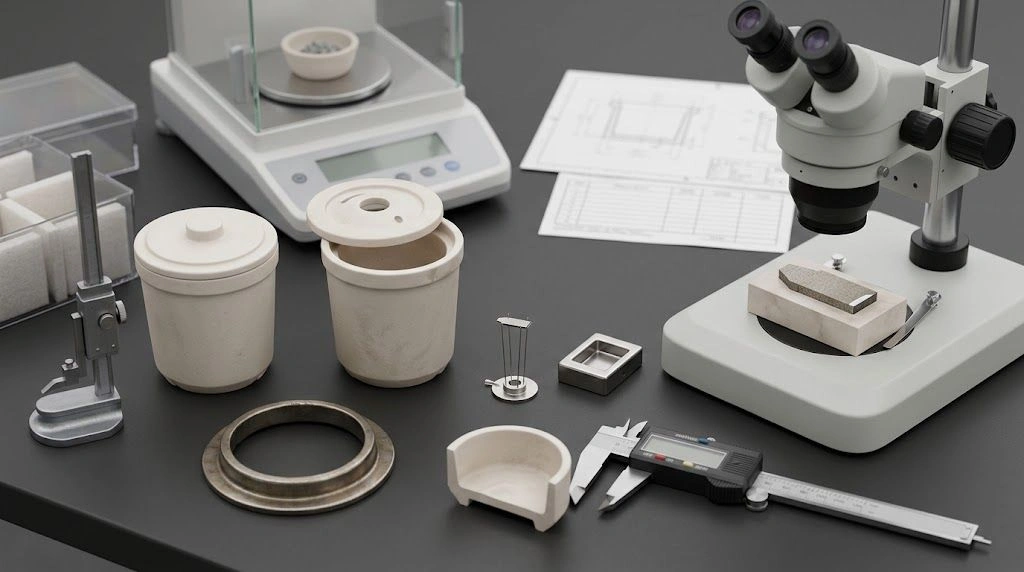
A quote-ready worksheet connects the intended process to material evidence, drawing control, representative testing and acceptance criteria.
Frequently Asked Questions
How do I choose the correct crucible material?
Define the complete charge, reaction products, temperature history, atmosphere, time, fill, contamination limits and equipment interface. Eliminate materials with credible reaction, oxidation, wetting, penetration or measurement risks. Then test the exact grade with a representative charge and inspect both crucible and product before release.
Should I choose alumina or zirconia?
Neither material is universally superior. Compare the actual alumina grade with the specified stabilized-zirconia grade under the intended chemistry, atmosphere, temperature, dwell and thermal gradients. Consider crucible-derived contamination, phase stability, manufacturable geometry and cost, then validate the better candidate experimentally.
Can graphite crucibles be used in air?
Do not assume they can. Graphite oxidation depends on temperature, time, gas flow, oxygen potential, grade, porosity, geometry and any coating. Use supplier data only as a screening input, and have the process owner qualify the complete atmosphere and operating cycle.
Should a crucible have a lid, and how full should it be?
Specify the lid and fill from the process. A lid or aperture changes heat and mass transfer, oxidation, volatile loss and gas escape. Working fill depends on whether the charge settles, melts, expands, foams, sublimes or evolves gas; nominal capacity does not define safe headspace.
Does crucible material affect DSC or TGA results?
Yes. Material, mass, geometry, bottom contact, heat capacity, thermal conductivity, lid and chemical interaction can influence the signal or gas release. Use instrument-approved consumables and methods. Any custom substitute requires fit, calibration and sample-compatibility review before analytical results are treated as equivalent.
How should crucible compatibility be validated for an RFQ?
Test the proposed production grade with the representative charge, impurities, atmosphere, temperature path, dwell, fill and support. Record pre- and post-test mass, dimensions and condition; inspect the product for contamination or reaction; then translate accepted evidence into drawings, CTQs, documentation and retirement criteria.