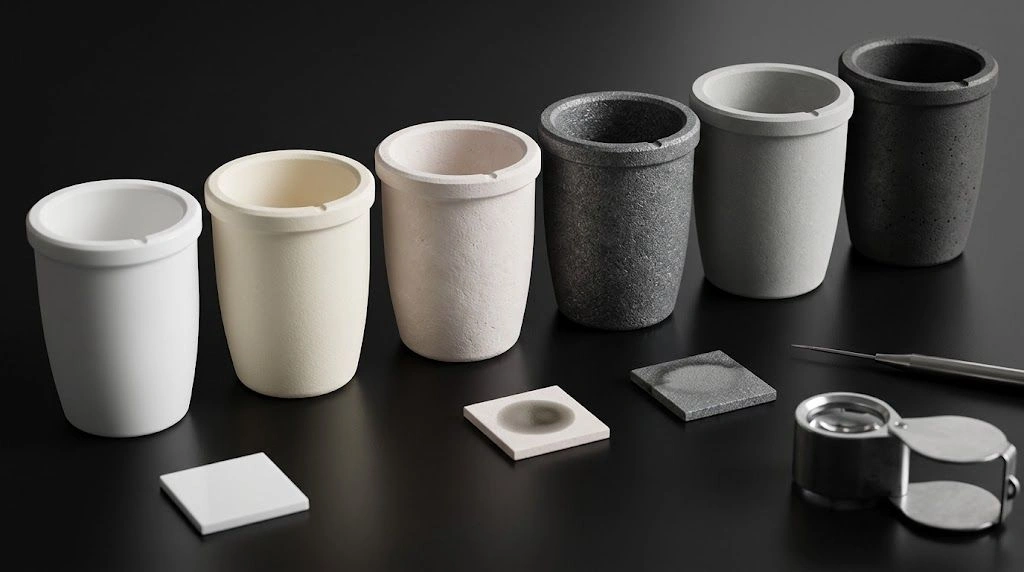
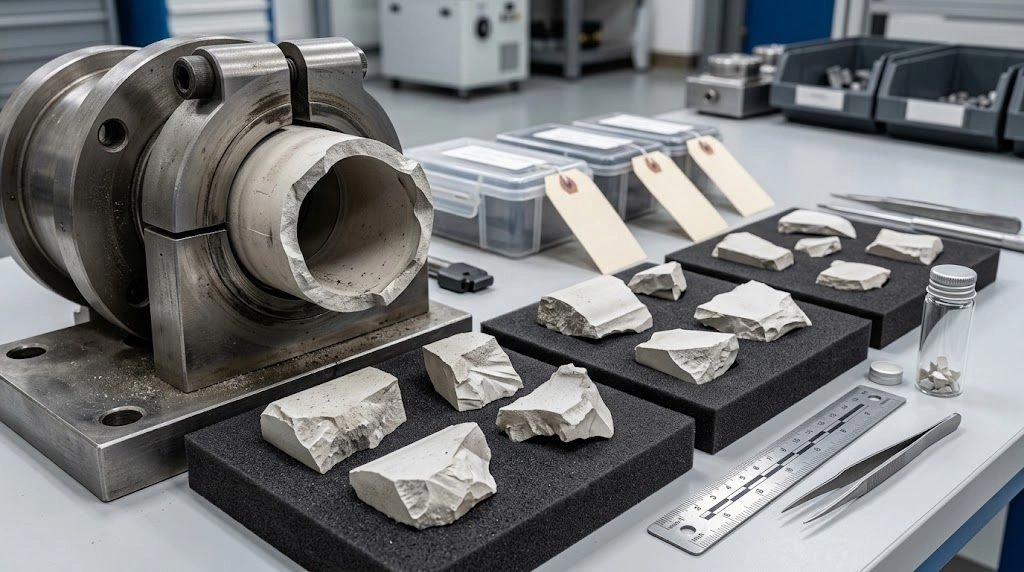
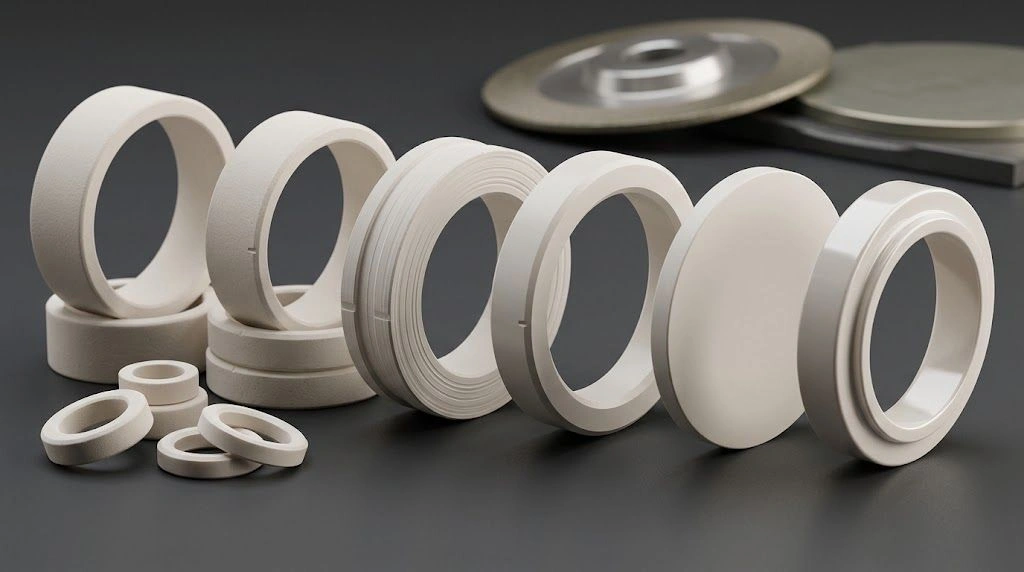
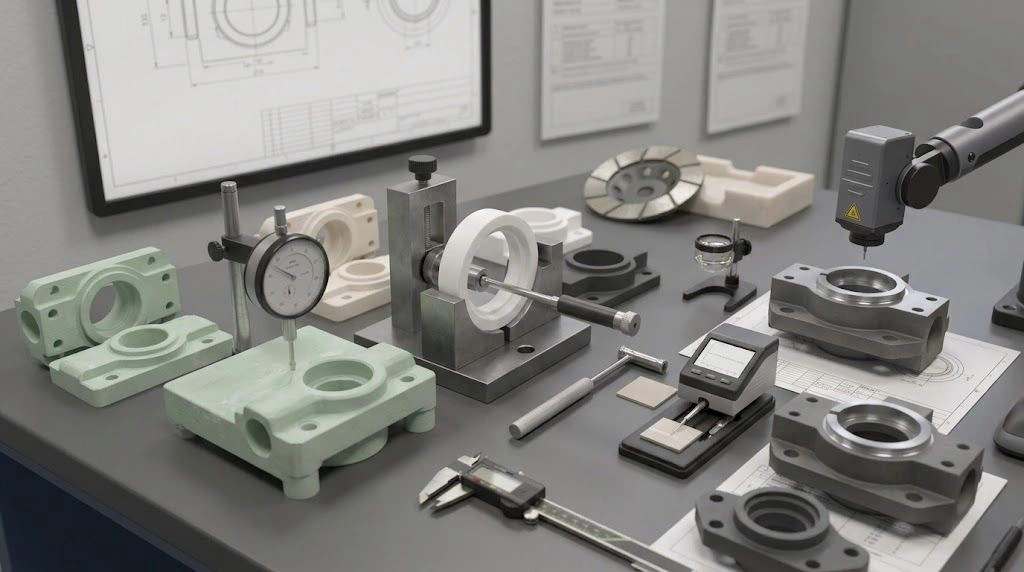
Select a crucible by documenting the complete process—not by choosing the material with the highest published temperature. Record the sample, fluxes, binders, impurities and expected products; continuous and peak temperature; ramp, hold and cooling conditions; atmosphere; pressure; working fill; geometry; support; contamination limit and reuse target. Eliminate materials that may react, oxidize, dissolve, wet, contaminate or deform. Then compare thermal cycling, equipment fit and commercial feasibility. Treat compatibility charts as shortlist tools. Final approval requires a representative charge test using the intended temperature, atmosphere, exposure time and operating cycle.
What Process Must the Crucible Perform?
The word “crucible” covers different duties. Begin the worksheet with the operation and required outcome, then review the available ceramic crucibles for high-temperature processes. A familiar material can still be wrong when the process function changes.
A calcination crucible contains powder while binders, carbonates or organics decompose and gases escape. Ashing requires quantitative residue recovery without unacceptable mass contribution. Sintering may require separation from a setter, powder bed or atmosphere. Metal and glass melting introduce wetting, dissolution, penetration, erosion and pouring. In TGA, DSC or STA, crucible mass, base contact and lid configuration become part of the measuring system. Evaporation liners must also match a heating pocket and source behavior.
| Process | Primary crucible function | First failure question |
|---|---|---|
| Calcination | Contain powder while volatiles leave | Will gases, fluxes or intermediate phases attack the body? |
| Ashing | Preserve quantitative residue | Will the crucible add mass, lose material or retain residue? |
| Sintering | Support parts or a powder bed | Will contact transfer impurities or form a reaction layer? |
| Metal/alloy melting | Contain and sometimes pour liquid | Will the melt wet, dissolve, infiltrate or erode the crucible? |
| Glass melting | Contain a viscous oxide melt | Will dissolution create bubbles, inclusions or composition drift? |
| TGA/DSC/STA | Hold an analytical sample | Will material, mass, lid or geometry change the signal? |
| Vacuum evaporation | Hold and deliver source material | Will it react, spit, sublime poorly or contaminate the chamber? |
Do not write only the primary sample name. List binders, fluxes, mineralizers, sintering aids, coatings, expected impurities, cleaning residues, gases released, molten or vapor intermediates and final products. The controlling chemistry may appear only after heating. “Alumina powder at 1,300°C,” for example, is incomplete if an alkaline flux forms a liquid phase earlier in the cycle.
The first gate is therefore process definition, not catalog temperature. Record whether success means clean residue recovery, melt containment, easy release, low elemental pickup, stable analytical response, controlled evaporation or repeatable reuse.
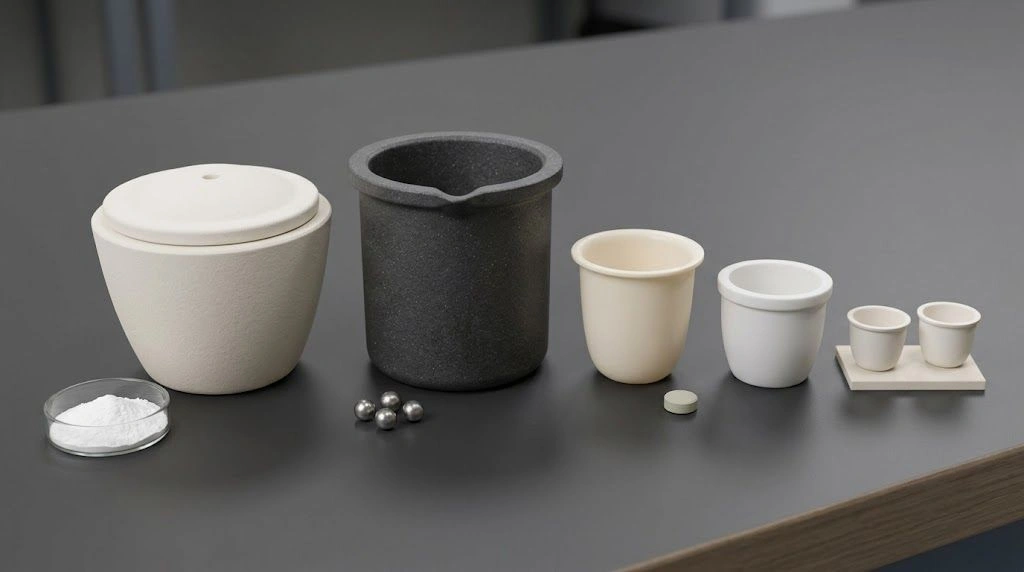
Different process duties turn similar containers into distinct material, geometry and validation problems.
Which Materials Survive the Reaction, Atmosphere and Contamination Limits?
Screen candidates against the complete charge, atmosphere and exposure time. “Chemically inert” is conditional: a dry powder may appear compatible until it melts, forms a flux or changes oxygen potential. Atmosphere can reverse a decision. Graphite and some nitride materials may be candidates in vacuum or inert gas yet unsuitable in oxidizing service. Oxide ceramics avoid carbon pickup but may contribute their constituent elements.
| Material family | Conditional candidate direction | Decision-flip question |
|---|---|---|
| Alumina ceramic crucibles | Calcination, ashing, oxide sintering and compatible laboratory melting | Will a flux, reactive metal or aluminum pickup become unacceptable? |
| Zirconia ceramic crucibles | Selected high-temperature, molten-metal or chemistry-sensitive work | Which grade and stabilizer apply, and can Zr or stabilizer pickup matter? |
| Magnesium oxide crucibles | Selected basic slags, alkaline systems or MgO-compatible melts | Can hydration, thermal cycling or magnesium pickup be tolerated? |
| Cylindrical silicon carbide crucible | Melting and duties needing heat transfer or cycling capability | Can oxidation, free phases, silicon or carbon affect the charge? |
| Boron nitride crucibles | Vacuum/inert processing and selected non-wetting melt or evaporation work | Will oxygen, moisture or the melt degrade the exact BN or PBN grade? |
| Yttria | Specialty reactive-metal or low-contamination processing | Is yttrium pickup acceptable, and is the cost justified? |
| Fused silica | Low-expansion laboratory or selected glass duties | Will temperature, devitrification, alkali or silicon pickup limit use? |
| Graphite | Vacuum, inert, induction-heated or carbon-compatible melting | Is oxygen present, and can carbon pickup or conductivity create risk? |
| Platinum/refractory metal | Defined analytical, fusion or evaporation work | Can the charge alloy with, dissolve or embrittle the metal? |
This matrix creates a shortlist; it does not certify any sample–material pair. Confirm the precise grade, additives or bond phase, temperature, time, atmosphere and impurity level. When evidence is weak, compare two or three candidates under identical representative conditions.
Convert “high purity” and “no contamination” into measurable limits. Identify prohibited elements—such as Al, Zr, Mg, Y, Si, B, C or Fe—the maximum pickup, analytical method, blank correction and whether the crucible is single-use. ICP-OES, ICP-MS, XRF, mass change, phase analysis or another customer-approved method may be appropriate, depending on the decision.
Published maximum temperature is also insufficient. Reaction-assisted corrosion, thermal gradients, wall penetration, load and cycling can control failure below a material headline value. ASTM C1525 evaluates advanced-ceramic thermal shock through water-quenched specimens and retained flexural strength. Its scope excludes steady-state gradients, joined-body mismatch, repeated shocks and direct component testing, so it cannot establish guaranteed crucible life.
What Geometry, Capacity, Lid and Equipment Interface Are Required?
Geometry controls usable capacity, heating, gas escape, pouring and mechanical risk. Record internal dimensions instead of relying on nominal volume. Powders may settle, swell or foam; a solid charge may occupy a different volume after melting. Define maximum working fill separately from geometric capacity.
| Geometry field | Why it matters |
|---|---|
| Top and bottom OD or width | Furnace, holder, pocket and removal clearance |
| ID and usable depth | Charge envelope and validated working fill |
| Overall height | Lid, furnace and handling clearance |
| Wall and base thickness | Heat flow, stiffness, capacity and failure location |
| Taper and corner radii | Release, forming feasibility and local stress |
| Rim, flange or spout | Seating, lifting, pouring and fragile-edge risk |
| Lid type and fit | Contamination, evaporation, gas release and signal response |
| Vent/aperture | Pressure relief, condensation, spitting and mass transfer |
| Support-contact zones | Installed stress and thermal-gradient control |
A lid is a process element, not a generic upgrade. Use an open or loose-lid configuration when gases must escape; consider a controlled lid or aperture when debris, evaporation or spitting must be managed. Never interpret a close-fitting ceramic lid as a pressure-rated seal. NETZSCH reports that changing a pierced lid’s opening altered hydrate-release behavior, demonstrating why identical lid conditions matter for repeatable thermal analysis (NETZSCH).
For analytical equipment, use an instrument-approved form. A TGA alumina crucible must match the instrument, sensor, automation, mass class and lid method; material similarity alone does not prove interchangeability. NETZSCH likewise advises avoiding sample–crucible reaction over the programmed range and notes that crucible properties affect the measurement (selection guidance).
Evaporation hardware is equally equipment-specific. Provide e-beam gun or furnace manufacturer, pocket dimensions, heating method and source material. Denton Vacuum’s guide specifies liners using height, top and bottom diameter, wall thickness and lip features, then matches material to the evaporant (Denton Vacuum PDF).
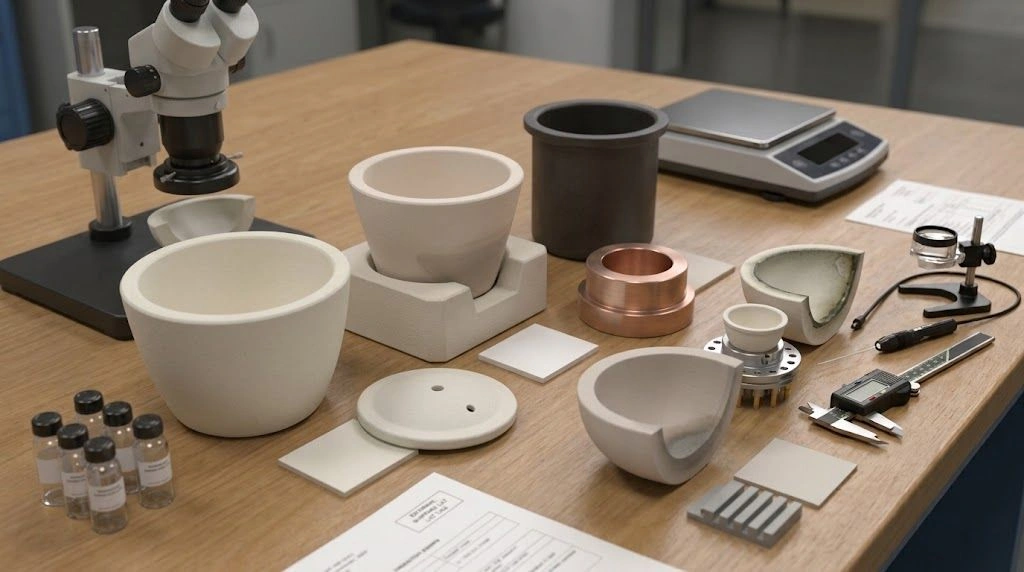
Usable capacity and material choice remain incomplete until the crucible fits its lid, support, heating source and removal path.
How Do Thermal Cycling, Fill, Support and Handling Change the Decision?
A crucible may survive peak temperature yet fail during loading, heating, cooling, pouring or cleaning. Record whether it starts in a cold furnace, enters a preheated zone or receives direct flame, induction or electron-beam heating. Define normal and credible excursion temperatures, ramp and cooling rates, hold time, cycle count and expected gradients across the wall and base.
| Operating variable | Required entry |
|---|---|
| Starting condition | Cold furnace, warm furnace or hot insertion |
| Heating mode | Resistance, radiant, flame, induction, electron beam or other |
| Thermal profile | Normal/peak temperature, ramp, holds and cooling method |
| Atmosphere | Composition, purity, flow, pressure/vacuum and oxygen potential |
| Support | Full base, ring, rails, setter or isolated contacts |
| Handling | Tongs, fork, robot, lift point, pouring or transfer method |
| Cleaning | Chemistry, burn-out, brushing or single-use disposal |
| Reuse target | Cycle target, inspection interval and retirement criteria |
Support and handling belong in material selection. A full base, ring, rails or isolated points create different stress and heat-flow patterns. Tongs and robotic grippers load rims and walls differently. Define contact zones and prohibit point loading where necessary. The supplier can review geometry, but the equipment owner approves the furnace, lifting method and operating procedure.
Working fill depends on state change. Subliming, molten, foaming, expanding and gas-releasing charges require different free volume and lid behavior. Do not publish a universal fill percentage. Validate charge mass and fill in the actual geometry, including credible foaming, splashing, condensation or expansion.
Reuse also needs a retirement rule. Possible rejection conditions include a crack or rim chip; excessive wall loss; penetration or glazing; permanent distortion; unacceptable mass change; cross-contamination; residue that cannot be removed by the approved process; or failure of a defined dimensional, blank-run or leak check. A clean-looking crucible is not automatically qualified for another cycle.
How Should the Candidate Be Tested and Sent for Quotation?
Compatibility charts end at the shortlist. Test a representative charge containing the real fluxes, binders, additives and expected impurities. Use the intended atmosphere, temperature, hold, fill and ramp/cooling conditions. After exposure, inspect the crucible and product for reaction layers, wetting, penetration, erosion, cracking, distortion, mass change and elemental pickup. Reuse approval requires repeated cycles with the approved cleaning method.
| Worksheet block | Required entry |
|---|---|
| Process | Calcination, ashing, sintering, melting, glass, analysis or evaporation |
| Complete charge | Sample, flux, binder, additives, impurities and expected products |
| State changes | Solid, liquid, vapor, subliming, foaming or gas-releasing |
| Thermal profile | Continuous/peak temperature, ramp, hold, cooling and cycles |
| Atmosphere | Composition, flow, pressure/vacuum and oxygen potential |
| Contamination | Prohibited elements, method and acceptance limit |
| Geometry | Internal/external dimensions, wall/base, lid, spout and clearance |
| Working load | Charge mass, fill and expansion/free-volume allowance |
| Support/handling | Setter, ring, rail, tongs, robot or pour mechanism |
| Reuse | Cleaning, target cycles and retirement criteria |
| Validation | Candidates, test charge, inspection and analytical limits |
| Commercial | Prototype/repeat quantity, delivery and documentation |
The acceptance plan must define evidence and limits before testing. Chemical reaction may require a cross-section, microscopy or phase analysis. Contamination needs a stated analytical method and numerical limit. Penetration or erosion may use wall measurement or mass change. Cracking needs agreed visual or nondestructive criteria; distortion must be compared with furnace and handling clearances. Product yield, phase, composition or analytical response should match an approved baseline.
Send the completed worksheet with a revision-controlled drawing or dimensioned sketch, furnace or instrument model, charge composition, thermal and atmosphere program, prohibited materials, quantities and reporting requirements. Use custom ceramic manufacturing services for geometry and prototype review, and define dimensional reporting, traceability and deviations through ceramic quality assurance.
Use a simple release ladder: red when only sample name and peak temperature are known; amber when chemistry, temperature and atmosphere support a shortlist; green when geometry, contamination and equipment data support prototype quotation; validated only after representative testing meets the written acceptance criteria. Production release should freeze the material grade, drawing, process-sensitive features, inspection basis and packaging.
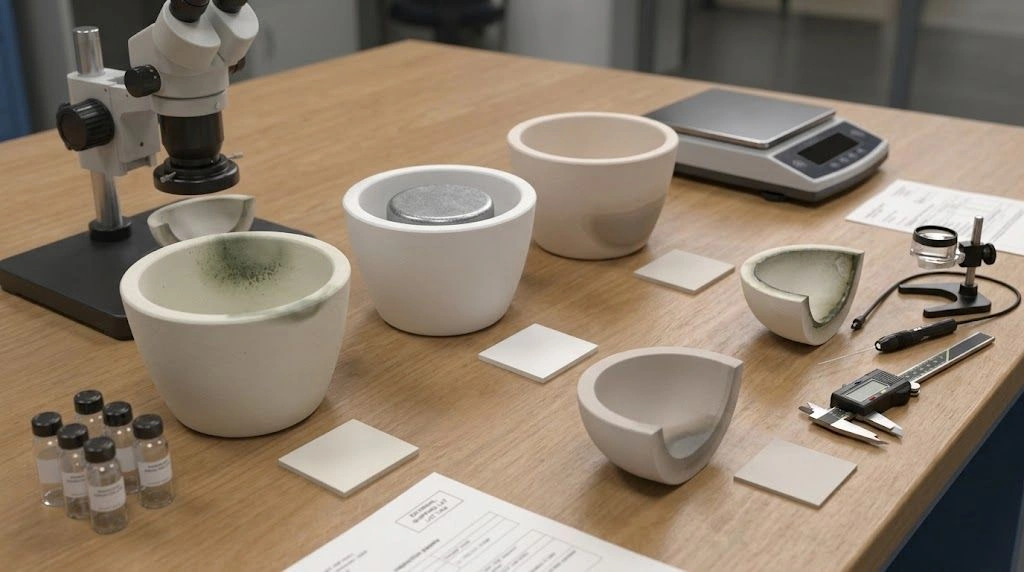
A controlled comparison turns a material shortlist into evidence for prototype approval and a repeatable production specification.
Frequently Asked Questions
How do I choose the correct crucible material?
Classify the process, document the complete charge and state changes, then screen materials by reaction, atmosphere and contamination limits. Compare geometry, heating, support and handling only after eliminating incompatible candidates. Approve the final grade through a representative test rather than a generic temperature chart.
Is the highest published operating temperature the safest choice?
No. A crucible may react, contaminate, wet, penetrate, crack or deform below a catalog maximum. Selection must include the exact grade, sample and flux chemistry, atmosphere, exposure time, temperature gradients, support and cycles. Published temperature is one screening input, not a service-life guarantee.
Can graphite crucibles be used in air?
Graphite is generally screened for vacuum, inert or otherwise carbon-compatible duties because oxidation can become limiting in air or oxygen-bearing atmospheres. The decision also depends on temperature, duration, gas purity and acceptable carbon pickup. Validate the actual graphite grade and complete furnace atmosphere.
Should a crucible have a lid?
Use a lid only for a defined function such as reducing debris, controlling evaporation or managing spitting. A lid may also restrict gas release, change heat transfer or bias thermal-analysis results. Specify fit and vent geometry, and never treat an ordinary ceramic lid as a pressure seal.
How full should a crucible be?
There is no universal fill percentage. Working fill depends on whether the charge settles, melts, foams, expands, sublimes, spits or releases gas, plus lid and pouring requirements. Define charge mass and free volume, then validate the worst credible behavior in the intended crucible and cycle.
Does crucible material affect TGA or DSC results?
Yes. Material, mass, base contact, volume, lid and venting can change heat transfer, reaction-gas release and recorded response. Use instrument-approved consumables and identical configurations for comparative tests. Do not replace a specified pan or crucible solely because another product has similar chemistry or dimensions.