Materials, product forms, and capabilities in one PDF.
SiC tubes are suitable for high-temperature gas filtration when the component is designed as a porous filter tube or candle
CIP does not compete with isostatic pressing — CIP means cold isostatic pressing, one type of isostatic pressing used before
BN crucibles can support optical fiber preform manufacturing when they serve as controlled dopant-source containers, precursor evaporation vessels, or high-temperature
Ash content in recrystallized alumina crucibles usually refers to the sample residue measured after ashing — the inorganic fraction left
Zirconia tubes are usually preferred when acid exposure is combined with mechanical stress, thermal cycling, impact risk, acid/alkali cleaning cycles,
Alumina tube surface roughness affects gas flow mainly when the tube has small ID, long flow length, high velocity, turbulent
Dense SSiC tubes become expensive to machine because fully sintered silicon carbide is already at near-final ceramic hardness after sintering
Ceramics for metal melting should be selected by melt chemistry, operating temperature, wetting behavior, flux or slag exposure, thermal cycling,
SiC tubes are suitable for coal gasification reactor internals when the component must resist high-temperature reducing gas, abrasive solids, thermal
PBN crucibles are useful in OLED organic effusion cells when low outgassing, high purity, chemical inertness, stable heating, and clean
Alumina tube fracture above 1200°C becomes strain-rate sensitive when slow crack growth, creep deformation, grain-boundary phases, and high-temperature stress relaxation
Alumina crucibles can fit quartz glass manufacturing when the work is experimental, small-batch, non-optical, or explicitly tolerant of controlled Al
SiC tubes and liners can be used in solar polysilicon CVD reactors when the component must withstand high temperature, hydrogen-and-chlorosilane
Choose furnace ceramics by function first, not by maximum temperature alone. Use alumina when electrical insulation, oxide stability, and general
BN can be used in oxidizing atmospheres only within a controlled temperature, time, and moisture window. Hot-pressed BN is commonly
Pick the crucible family from the metal first—wetting, dissolve risk, carbon or oxygen pickup, slag attack, and vapor compatibility—then layer
SiC tubes can resist creep well at 1400°C when the applied stress, support span, tube diameter, wall thickness, atmosphere, and
BN crucibles survive thermal shock better than alumina crucibles because boron nitride combines low thermal expansion, useful thermal conductivity, a
BN crucibles can support silicon ingot growth only when purity, melt interaction, temperature window, and crucible geometry are matched to
Alumina tube helium leak testing should be specified by test method, not by the phrase "helium leak tested" alone. ISO
BN crucible shape should be optimized for induction heating when the crucible must isolate the melt, control wetting, improve release,
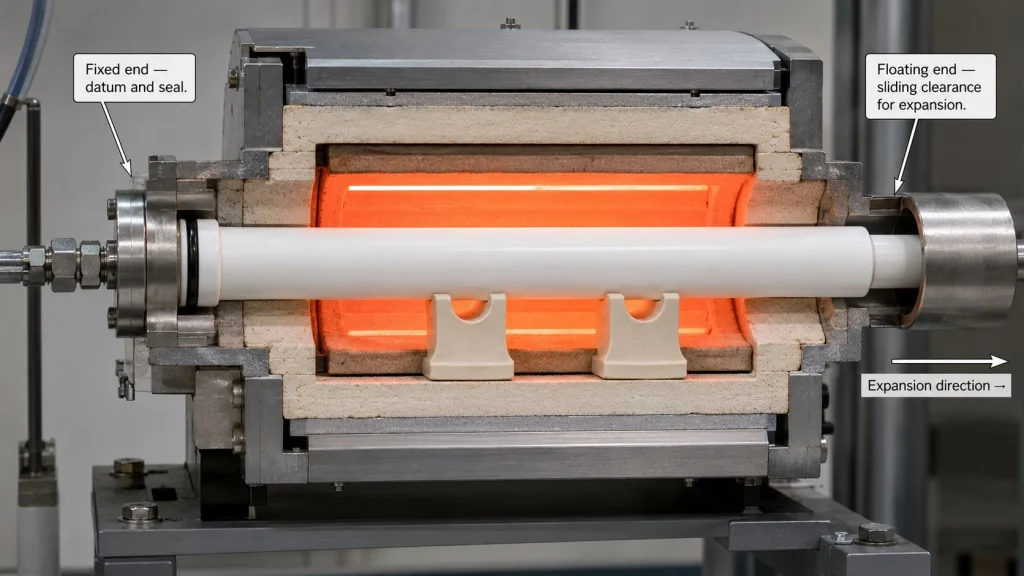
Alumina tubes crack in high-temperature furnaces when thermal gradients, restrained expansion, mechanical loading, or chemical attack create tensile stress above
Alumina crucibles are suitable for semiconductor dopant evaporation when the evaporant is chemically compatible with Al₂O₃, the source temperature stays
A used BN crucible should be reused only when its geometry, surface condition, mass stability, and contamination history still match
Send your drawing, material requirement, dimensions, quantity, and working conditions — our engineering team reviews manufacturability before quotation.

WhatsApp us
The more details you provide, the faster we can quote.
*We respond within 24 hours. All inquiries are confidential.